
Hindu & Vedic Pantheon — Part II
The Vedic Devas
Adityas · Elementals · Vasus · Maruts · Navagrahas
the celestial order of the Rigveda and the Puranas
The 12 Adityas
Solar gods born to Aditi — guardians of Rita, the cosmic principle of truth and order
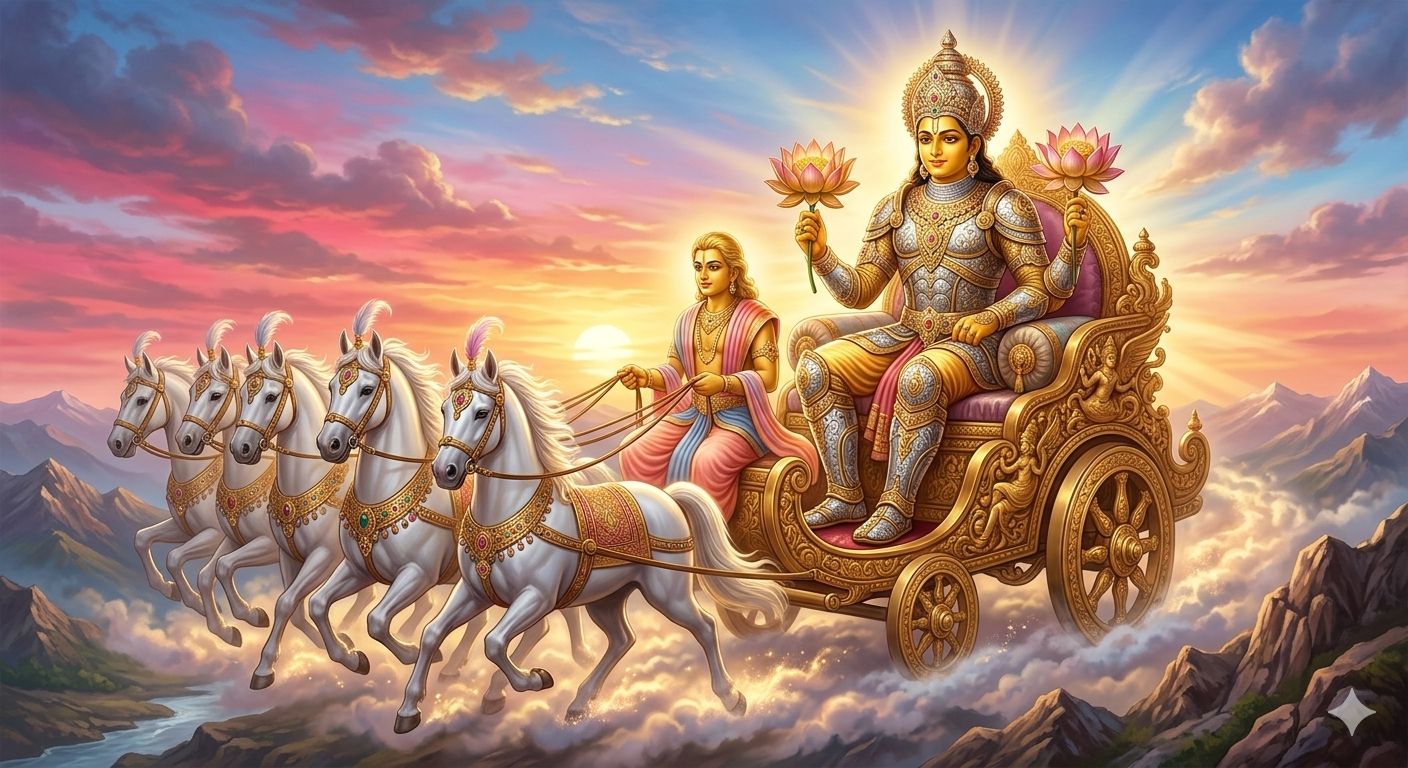
Surya is the god of the sun and the most directly observable divine presence in the Vedic world. He governs light, heat, time, and vision. In the Rigveda he is called the eye of Mitra and Varuna — the cosmic witness who sees all things. He is both one of the twelve Adityas and the presiding deity of the Navagrahas. Also known as Aditya, Ravi, Bhaskara, Vivasvat, Savitr, and Bhanu.
Symbols & Iconography
Birth & Origin
Born to Aditi and Kashyapa. In the Rigveda, Surya is described as rising from the cosmic ocean each morning, crossing the sky, and descending again — a cycle the Vedic poets observed as the fundamental rhythm of existence. Several hymns describe his birth as the kindling of a great light by the gods to dispel the darkness of chaos.
Family
Consort: Sanjna (also called Saranyu), daughter of Vishwakarma. Shadow-double of Sanjna: Chhaya. Children with Sanjna: Vaivasvata Manu, Yama, and Yami (the river Yamuna). Children with Chhaya: Shani and Savarni Manu.
Scriptures
Surya is extensively hymned in the Rigveda. The Gayatri Mantra — addressed to his solar aspect Savitr — is the most recited Vedic verse in history. The Aditya Hridayam from the Ramayana, in which Agastya instructs Rama to worship Surya before fighting Ravana, is among the most recited solar hymns in later Hinduism. He appears prominently in the Mahabharata through the story of Karna.
Worship & Legacy
The Konark Sun Temple in Odisha — built in the 13th century CE — is constructed in the form of a massive stone chariot with 24 wheels and is a UNESCO World Heritage Site. The Modhera Sun Temple in Gujarat, built in 1026 CE, is another major site. Chhath Puja — observed in Bihar, Jharkhand, and eastern Uttar Pradesh — is dedicated entirely to Surya. The Gayatri Mantra continues to be recited daily by millions.
Key Stories
1. The Eye That Sees All — Rigvedic
In the Rigveda, Surya's primary role is as the universal witness. Hymn 1.50 describes him rising and dispersing darkness, watching over all creatures, seeing the good and evil acts of every being. He is invoked alongside Mitra and Varuna as the eye through which the moral order of the cosmos is maintained.
2. Sanjna's Flight and Chhaya
Unable to bear Surya's full radiance, his consort Sanjna fashioned Chhaya — a shadow replica of herself — left her as a substitute, and retreated to the forest in the form of a mare. Surya eventually discovered the deception when Chhaya showed favoritism toward her own children over Sanjna's. He tracked Sanjna to the forest, both living as horses until Vishwakarma brought Surya to his workshop and reduced his radiance. From the shaved-off light, Vishwakarma fashioned Vishnu's discus, Shiva's trident, and other divine weapons. (See also: Shani, Vishwakarma)
3. Karna, Son of Surya
In the Mahabharata, the princess Kunti accidentally invoked Surya using a mantra given by the sage Durvasa. Obligated by the mantra's power, Surya fathered a son with her — Karna, born with natural golden armor (Kavacha) and earrings (Kundala) fused to his body. Kunti, unmarried, set the infant adrift on a river. When Indra later came disguised as a brahmin to strip Karna of his armor, Surya had already warned his son in a dream not to give it up. Karna gave it anyway and his invincibility was lost. (See also: Karna, Kunti, Indra)
4. Hanuman Mistakes Surya for a Fruit
As an infant, Hanuman saw Surya in the sky and mistook him for a ripe fruit. He leapt toward him to eat him. Indra struck Hanuman down with his thunderbolt to stop the assault. Hanuman later studied under Surya and regarded him as his guru. (See also: Hanuman, Indra)
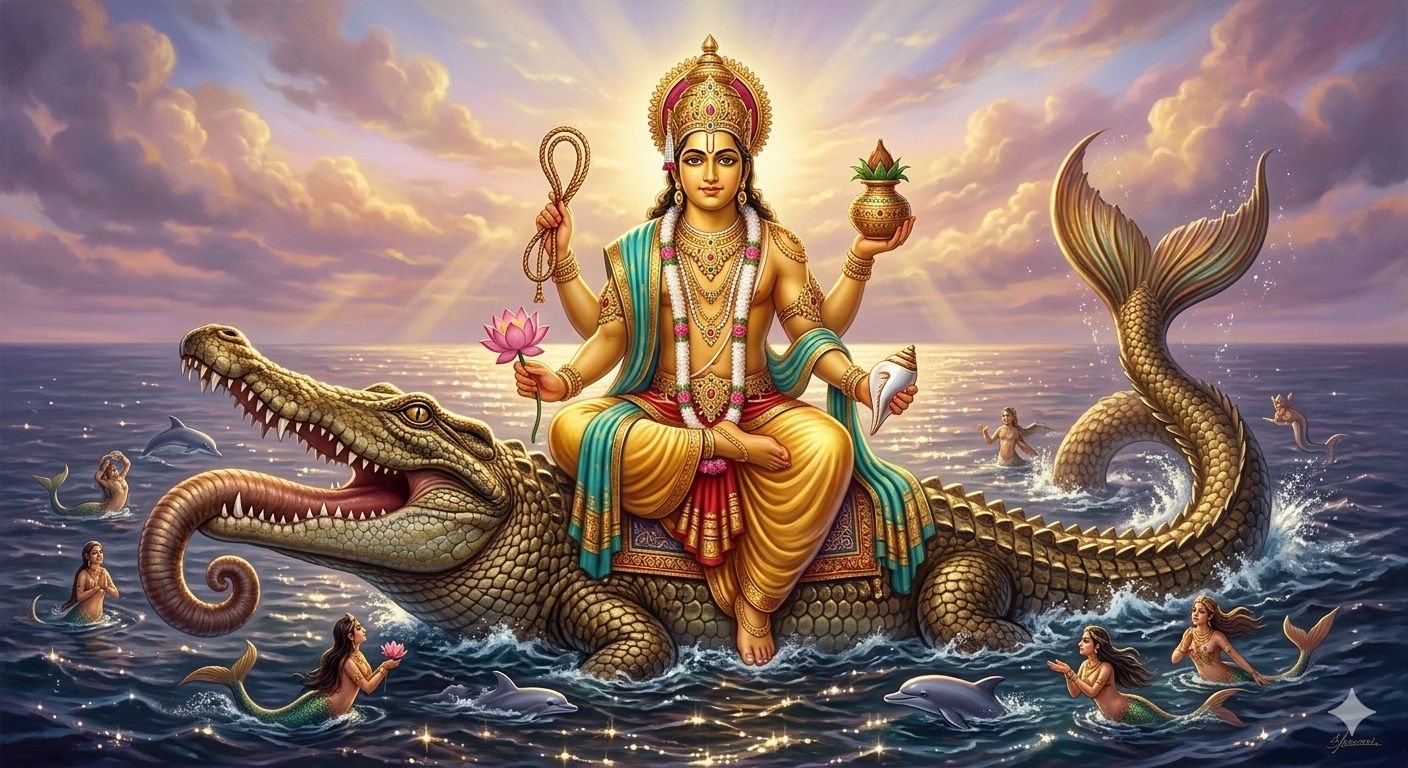
Varuna is one of the most theologically significant deities of the Rigveda. He governs the cosmic ocean, the night sky, Rita (cosmic truth and order), and the keeping of oaths. He sees every hidden act and every broken vow, and binds transgressors with his nooses (pasha). In the early Rigveda he and Mitra form the supreme pair overseeing cosmic and moral law. This prominence diminished substantially in the Puranic period. Also known as Apampati and Jalapati.
Symbols & Iconography
Birth & Origin
Born to Aditi and Kashyapa. In the Rigveda, Varuna and Mitra are treated almost as a single sovereign entity — two aspects of the same function of overseeing Rita. Their pairing likely reflects a shared Indo-Iranian tradition, as Varuna's counterpart appears in Zoroastrianism as Ahura Mazda.
Family
Father: Kashyapa. Mother: Aditi. Associated with the birth of the sages Vasishtha and Agastya in some texts — both said to have been born from the encounter of Mitra-Varuna with the Apsara Urvashi.
Scriptures
One of the most hymned deities of the Rigveda, prominent in Books 1, 5, and 7. Appears in the Atharvaveda and the Shatapatha Brahmana. In the Puranas his role is reduced to lord of the ocean.
Worship & Legacy
Varuna has no major independent temples in modern India. He is worshipped as directional guardian of the west in temple ritual and invoked in Vedic fire ceremonies and water-related rites. Scholars of comparative religion have noted close parallels between Varuna and Ahura Mazda of Zoroastrianism, suggesting a shared Indo-Iranian divine ancestor predating both traditions.
Key Stories
1. The Hymns of Guilt — Rigvedic
In Book 7 of the Rigveda, the sage Vasishtha addresses Varuna in a series of hymns that are among the most personal in the entire text. He confesses sins he cannot name, begs for the loosening of Varuna's nooses, and asks what wrong he has committed to earn the god's displeasure. Varuna is depicted as actively monitoring human moral conduct — noticing, judging, and punishing. The image of divine nooses binding the sinner is Rigvedic, not Puranic.
2. Varuna and Harischandra
In the Aitareya Brahmana, King Harischandra vowed to sacrifice his firstborn son to Varuna in exchange for being granted a son. When the time came, Harischandra repeatedly delayed. Varuna afflicted him with a disease of the swollen abdomen as punishment. This became the seed of the larger Harischandra legend — a king tested to the absolute limit to honor an oath — illustrating Varuna's core function: vows made to him are binding and their violation has physical consequences.
3. The Decline from Supremacy
In the early Rigveda Varuna is among the supreme gods. By the later Vedic period Indra has overtaken him. By the Puranic period he has been reduced to the god of the ocean and directional guardian of the west. No single myth explains this shift — it is visible across centuries of texts as the religious world changed around him.
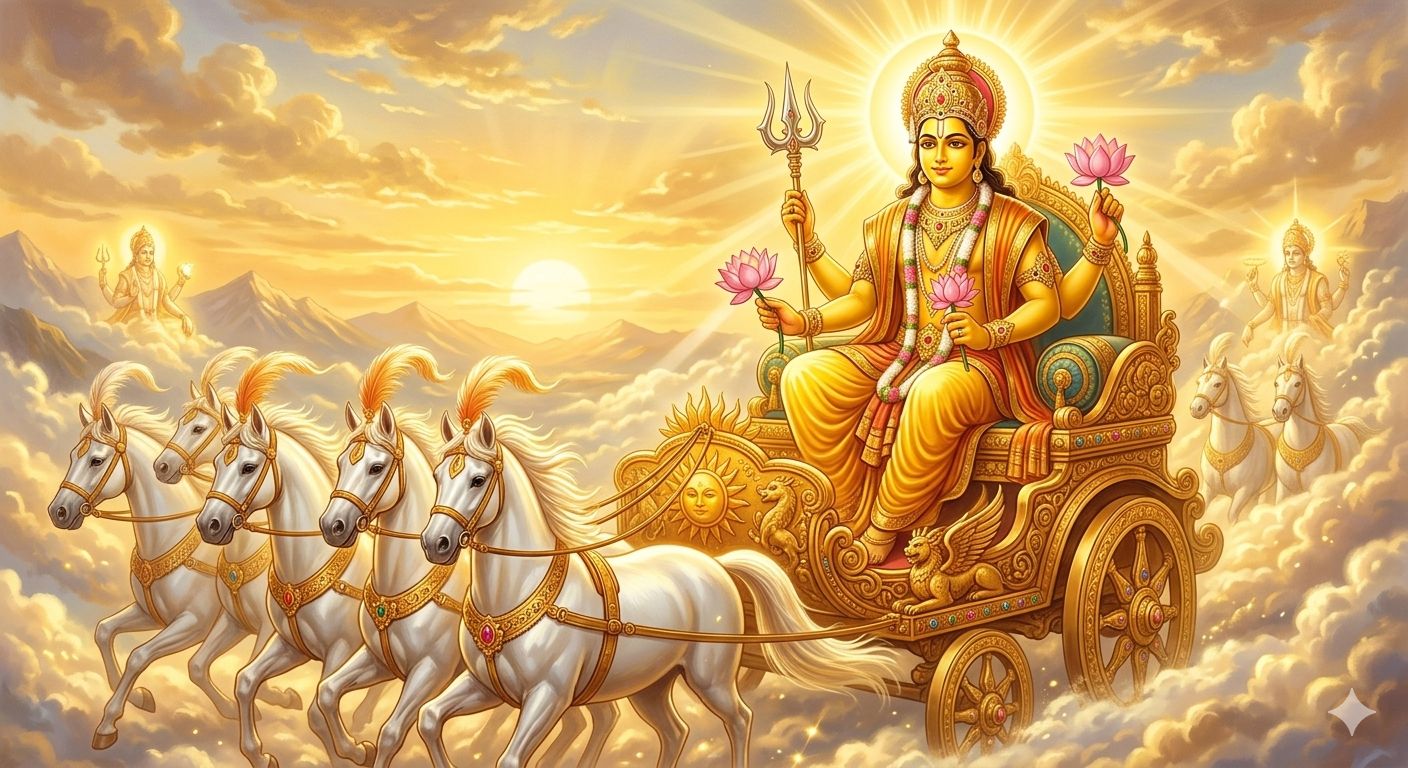
Mitra is one of the twelve Adityas and in the Rigveda is paired almost inseparably with Varuna as a dual guardian of Rita. Where Varuna governs through law and the binding noose, Mitra governs through friendship, alliance, and the keeping of agreements. His name means "friend" or "ally" in Sanskrit. He presides over oaths between people, treaties between kingdoms, and the bonds that hold social order together. His Iranian counterpart Mithra became a major independent deity, eventually forming the center of Roman Mithraism, while Mitra in Hindu tradition remained bound to his pairing with Varuna.
Symbols & Iconography
Birth & Origin
Born to Aditi and Kashyapa.
Family
Father: Kashyapa. Mother: Aditi. The sages Vasishtha and Agastya are associated with his lineage in some texts — born from the encounter of Mitra-Varuna with the Apsara Urvashi.
Scriptures
Appears throughout the Rigveda, almost always alongside Varuna. Less prominent in the Puranas, where his individual identity largely dissolves into the collective group of the twelve Adityas.
Worship & Legacy
No independent temples or festivals in modern Hinduism. His most significant legacy outside India is in the Iranian and Roman traditions — Mithra in Zoroastrianism is a major deity of covenants and the sun, and Mithraism spread across the Roman Empire with considerable following among Roman soldiers.
Key Stories
1. Mitra and Varuna as the Twin Sovereigns — Rigvedic
In the Rigveda, Mitra and Varuna are addressed together in dozens of hymns as joint upholders of Rita. The division of their functions is consistently maintained: Varuna watches the night, Mitra governs the day; Varuna punishes through his nooses, Mitra sustains through friendship and agreement. Together they see all things, bind the dishonest, and release those who confess. Book 5, Hymn 63 addresses them as the two kings who together make rain fall and the sun rise.
2. The Birth of Vasishtha and Agastya
In the Rigveda and the Aitareya Brahmana, the sages Vasishtha and Agastya are said to have been born from the seed of Mitra and Varuna shed when they saw the Apsara Urvashi. Vasishtha was born from a pot into which Mitra's seed fell; Agastya from Varuna's. This makes two of the most important sages of the Vedic tradition the sons of this divine pair.
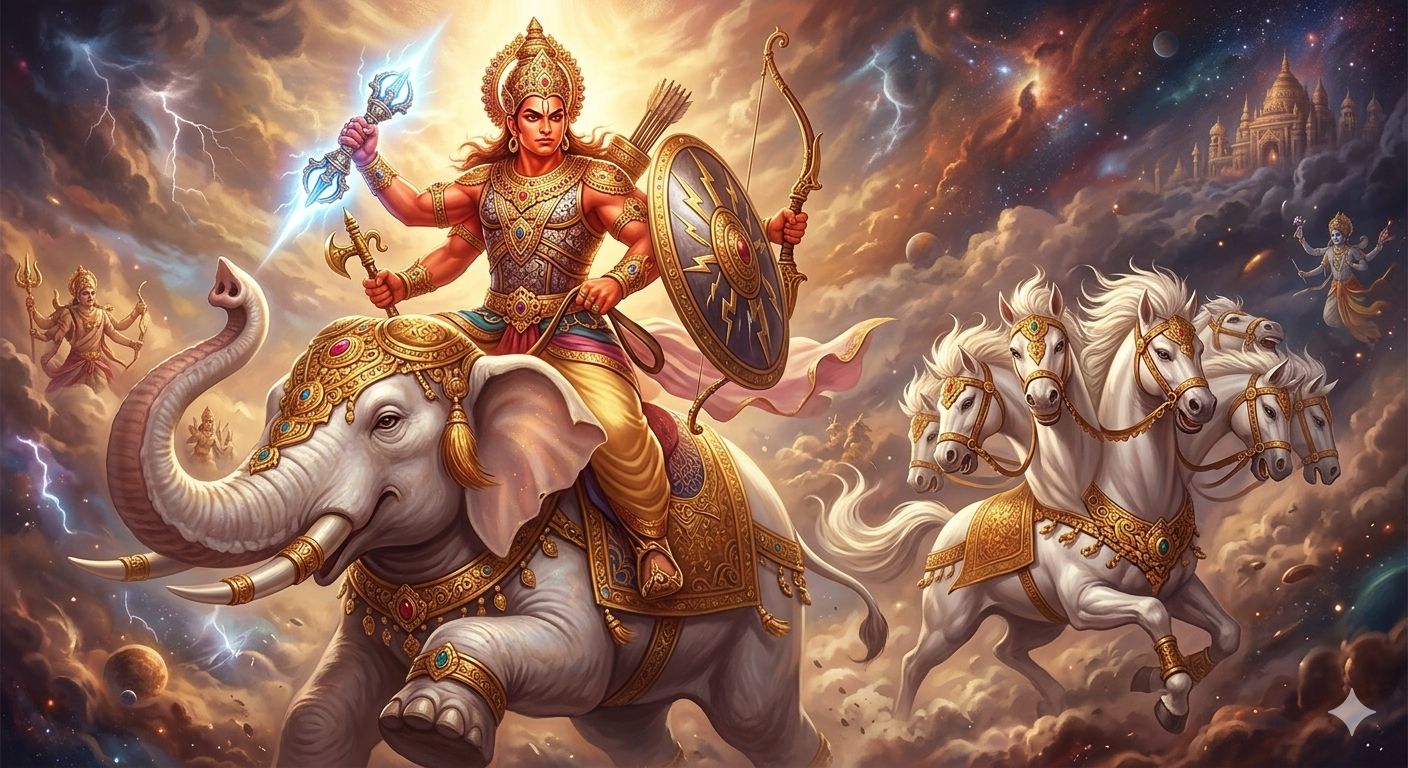
Indra is the king of the gods and the most hymned deity in the entire Rigveda — over 250 of its 1,028 hymns are addressed to him. He is the god of thunder, lightning, storms, and rain. His primary mythological function in the Rigveda is as the great warrior who slew the cosmic serpent Vritra — releasing the waters and allowing monsoon rains and rivers to flow. He governs Svarga from his palace Amaravati. By the Puranic period his dominance had faded dramatically — he became a figure frequently outwitted, humbled, or cursed. Also known as Shakra, Vasava, Purandara, and Maghavan.
Symbols & Iconography
Birth & Origin
Born to Aditi and Kashyapa in the standard Aditya account. In an alternative Rigvedic account, Indra was born from the union of Dyaus (the sky) and Prithvi (the earth). Some hymns describe his birth as so powerful it split his mother's side. From the moment of birth he was already armed and ready for battle.
Family
Consort: Shachi (also called Indrani or Pulomaja), daughter of the demon Puloman. Son: Jayanta. Arjuna of the Mahabharata is Indra's son by the princess Kunti.
Scriptures
The most hymned deity in the Rigveda with over 250 hymns. Prominent in the Atharvaveda, the Shatapatha Brahmana, the Mahabharata, and the Ramayana. In the Puranas he appears frequently but almost always in a diminished role — outwitted, humbled, or rescued by Vishnu or Krishna.
Worship & Legacy
Indra has no major independent temples in modern India. He is worshipped as the directional guardian of the east in temple ritual and invoked in agricultural festivals related to rainfall. In Buddhism he appears as Shakra, a devoted follower of the Buddha. The Vajra remains a symbol of power across Hindu, Buddhist, and Jain traditions.
Key Stories
1. The Slaying of Vritra — Rigvedic
Vritra was a cosmic serpent who had dammed all the waters of the world, causing catastrophic drought. The gods were powerless against him. Indra, fortified by drinking Soma, took up his Vajra and attacked. He split the serpent open and the waters burst free across the earth. This myth is hymned more than any other in the Rigveda. Indra's epithet Vritrahan — slayer of Vritra — is used hundreds of times across the text.
2. The Bones of Dadhichi
When Indra's Vajra proved insufficient against a resurgent demonic force, the gods were told that only a weapon made from the bones of the sage Dadhichi could prevail. Indra approached Dadhichi and asked for his bones. The sage gave up his life through yoga so his skeleton could be used. Vishwakarma fashioned the Vajra from his spine. With it Indra finally defeated the demon.
3. Indra and Ahalya
In the Ramayana, Indra desired Ahalya, wife of the sage Gautama, and approached her disguised as her husband. She acquiesced. When Gautama discovered the deception he cursed Ahalya to become stone and cursed Indra — in some versions losing his testicles, in others being covered with a thousand marks of shame later transformed into eyes, giving him the epithet Sahasraksha (thousand-eyed). Ahalya remained stone until Rama's foot touched her and restored her.
4. Indra and Krishna — The Lifting of Govardhana
In the Bhagavata Purana, the young Krishna persuaded the cowherd community of Vrindavan to stop their annual worship of Indra and instead honor the local Govardhana hill. Enraged, Indra sent catastrophic storms and floods for seven days. Krishna lifted the Govardhana hill on his little finger and held it as a shelter for all the people and animals beneath it. Indra, unable to break through, finally relented and acknowledged Krishna's supremacy. (See also: Krishna)
5. The Parade of Ants
In the Brahmavaivarta Purana, after Vishwakarma rebuilt and expanded Indra's palace, a young brahmin boy appeared before Indra — secretly Vishnu — and told him no previous Indra had ever completed such a palace. He pointed to a column of ants and noted that each ant had once been an Indra. A sage appeared simultaneously who had not grown his hair long because he had watched too many Indras rise and fall. Indra, shaken, renounced his ambitions.
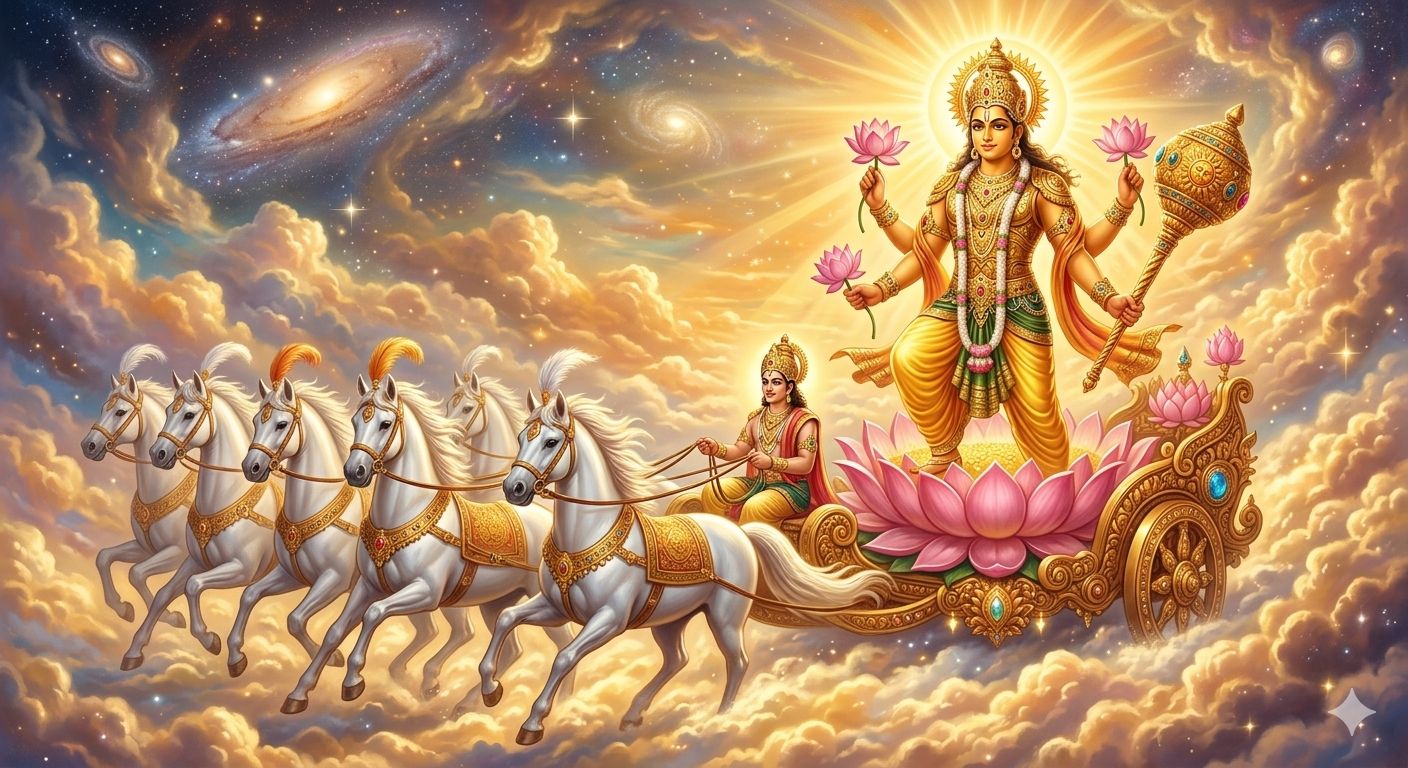
Aryaman is one of the twelve Adityas and is addressed in the Rigveda as the guardian of Arya customs — the social and ritual codes of the Vedic people. He presides over hospitality, marriage, the proper treatment of guests, and the obligations owed to ancestors. He is the lord of the Pitru — the ancestral spirits — and governs the path of the dead. The Milky Way is associated with him in later texts as the road along which ancestral souls travel. Also known as Aryama.
Symbols & Iconography
Birth & Origin
Born to Aditi and Kashyapa.
Family
Father: Kashyapa. Mother: Aditi. Brothers: the other eleven Adityas.
Scriptures
Hymned in the Rigveda, most often in company with Mitra and Varuna. Mentioned in the Atharvaveda and the Mahabharata.
Worship & Legacy
No independent temples or festivals. Invoked in wedding and ancestral rites. Named individually in the Bhagavad Gita (10.29) — where Krishna says "among the Pitru I am Aryaman."
Key Stories
Aryaman has no independent narrative mythology in either the Rigveda or the Puranas. He is invoked collectively with Mitra and Varuna as an upholder of Rita. No story is built around him alone.
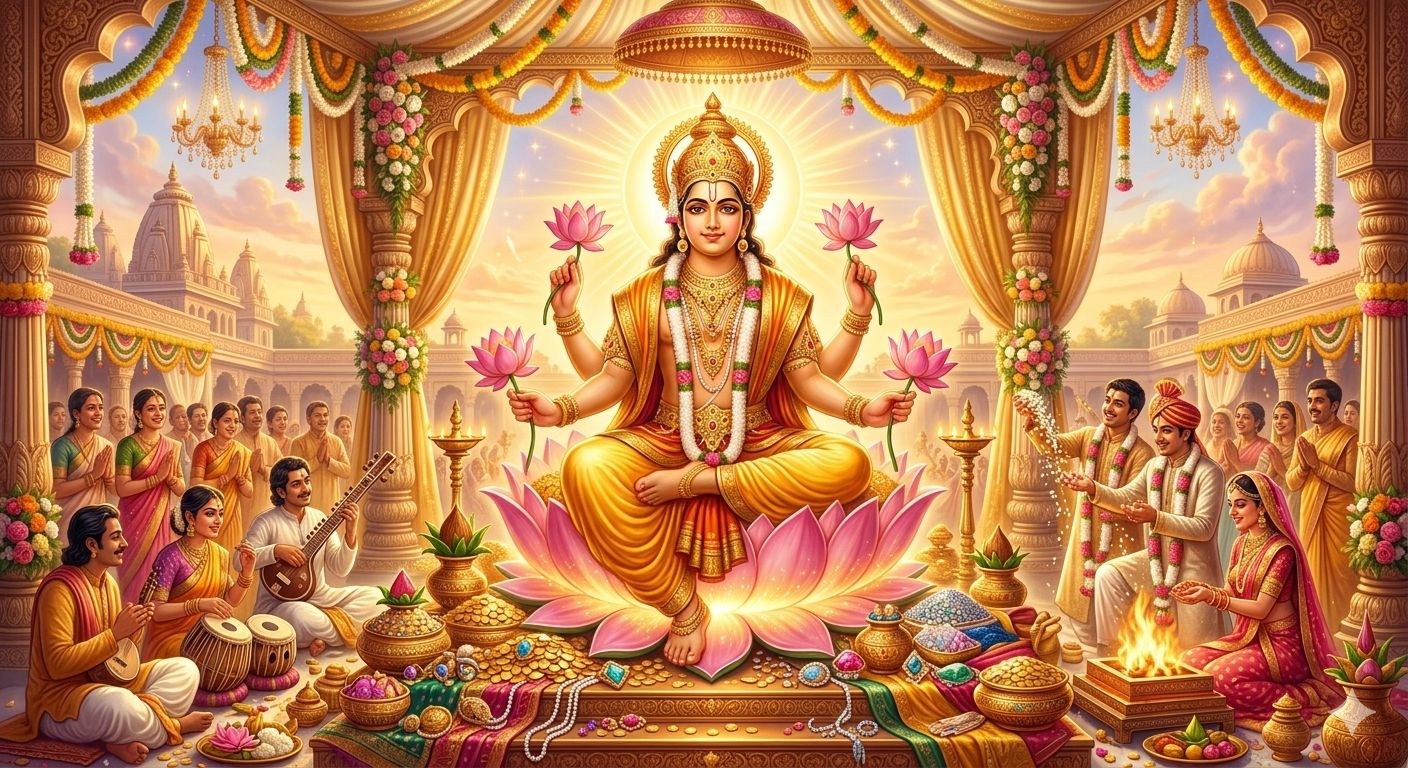
Bhaga is one of the twelve Adityas and presides over wealth, good fortune, marital prosperity, and the fair distribution of abundance. His name means "share" or "allotment." He is the deity of the portion that each person receives in life, and is invoked specifically in the context of marriage to grant the new household its rightful share of fortune. His name is the etymological root of the word Bhagavan — the most universal Sanskrit term for the divine lord.
Symbols & Iconography
Birth & Origin
Born to Aditi and Kashyapa.
Family
Father: Kashyapa. Mother: Aditi. Brothers: the other eleven Adityas.
Scriptures
Hymned in the Rigveda, particularly in Books 7 and 10. Appears in the Atharvaveda, Vishnu Purana, Bhagavata Purana, and the Mahabharata.
Worship & Legacy
No independent temples or festivals. His most enduring legacy is linguistic — the word Bhagavan, derived directly from his name, became the universal Sanskrit term for the divine lord and is used across all traditions of Hinduism.
Key Stories
1. The Blinding at Daksha's Sacrifice
At Daksha's great sacrifice, when Virabhadra stormed the ritual in Shiva's fury, Bhaga was struck in the eyes and blinded. This story appears in the Shiva Purana and the Bhagavata Purana and accounts for his diminished presence in later texts. (See also: Shiva, Daksha, Virabhadra)
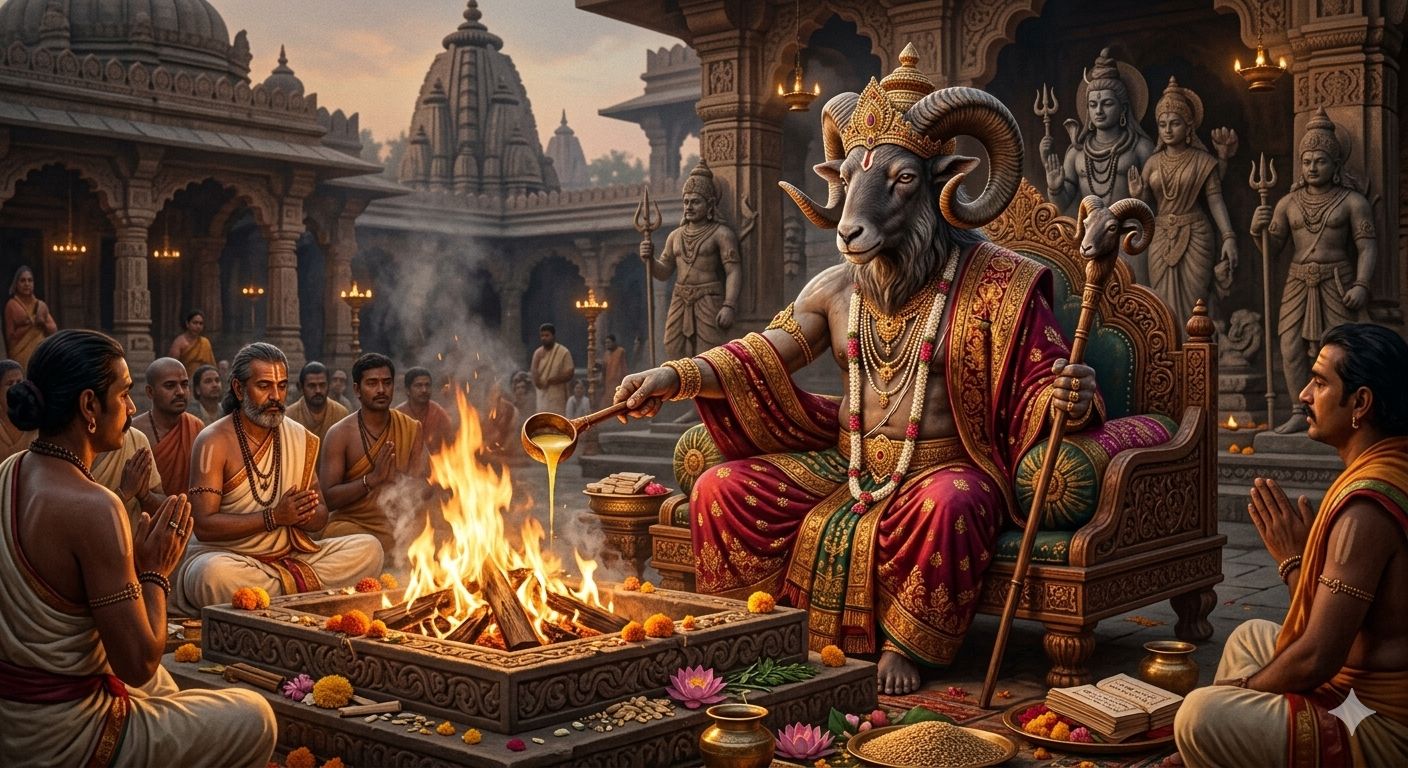
Daksha is one of the twelve Adityas in the Puranic lists, though in older texts he functions primarily as a Prajapati — one of the progenitors of all life. He presides over ritual precision, procreation, and the proper order of sacrifice. His name means "skilled" or "able." He is the father of many important figures in Hindu mythology and his conflict with Shiva is one of the most consequential events in the entire Puranic tradition.
Symbols & Iconography
Birth & Origin
In the Rigveda, Daksha is listed among the Adityas and described in some hymns as both son of Aditi and father of Aditi — a paradoxical co-arising that later commentators read as indicating his primordial status. In the Puranas he is established as a son of Brahma.
Family
Father: Kashyapa (or Brahma in Puranic accounts). Mother: Aditi. Daughters: 60 in the Bhagavata Purana — 27 given to the moon god Chandra (the Nakshatras), 13 to the sage Kashyapa, and others to various sages. Most significant daughter: Sati, consort of Shiva.
Scriptures
Appears in the Rigveda among the Adityas. Elaborated in the Vishnu Purana, Bhagavata Purana, Shiva Purana, Mahabharata, and Ramayana.
Worship & Legacy
No major independent temples. His conflict with Shiva produced the 51 Shakti Peethas — the most important pilgrimage network of the Goddess tradition.
Key Stories
1. The Sacrifice That Destroyed Itself
Daksha held a grand yagna to which all gods and sages were invited except Shiva, whom he despised. His daughter Sati arrived uninvited and was publicly humiliated. She immolated herself in the sacrificial fire. Shiva sent Virabhadra who beheaded Daksha, blinded Bhaga, knocked out Pushan's teeth, and scattered the gods. Brahma interceded and Shiva restored the dead — but Daksha's own head could not be found, so a goat's head was placed on his body instead. This is the foundational event that leads to Sati being reborn as Parvati and to the creation of the 51 Shakti Peethas. (See also: Sati, Shiva, Virabhadra)
2. The Curse on Chandra
Daksha gave 27 of his daughters as wives to the moon god Chandra (representing the 27 Nakshatras). Chandra favored one wife — Rohini — above all others. The other 26 complained to Daksha. After repeated warnings were ignored, Daksha cursed Chandra to wane and lose his light. Chandra appealed to Shiva, who mitigated the curse — the moon would wane but also wax again, in an eternal cycle. (See also: Chandra)
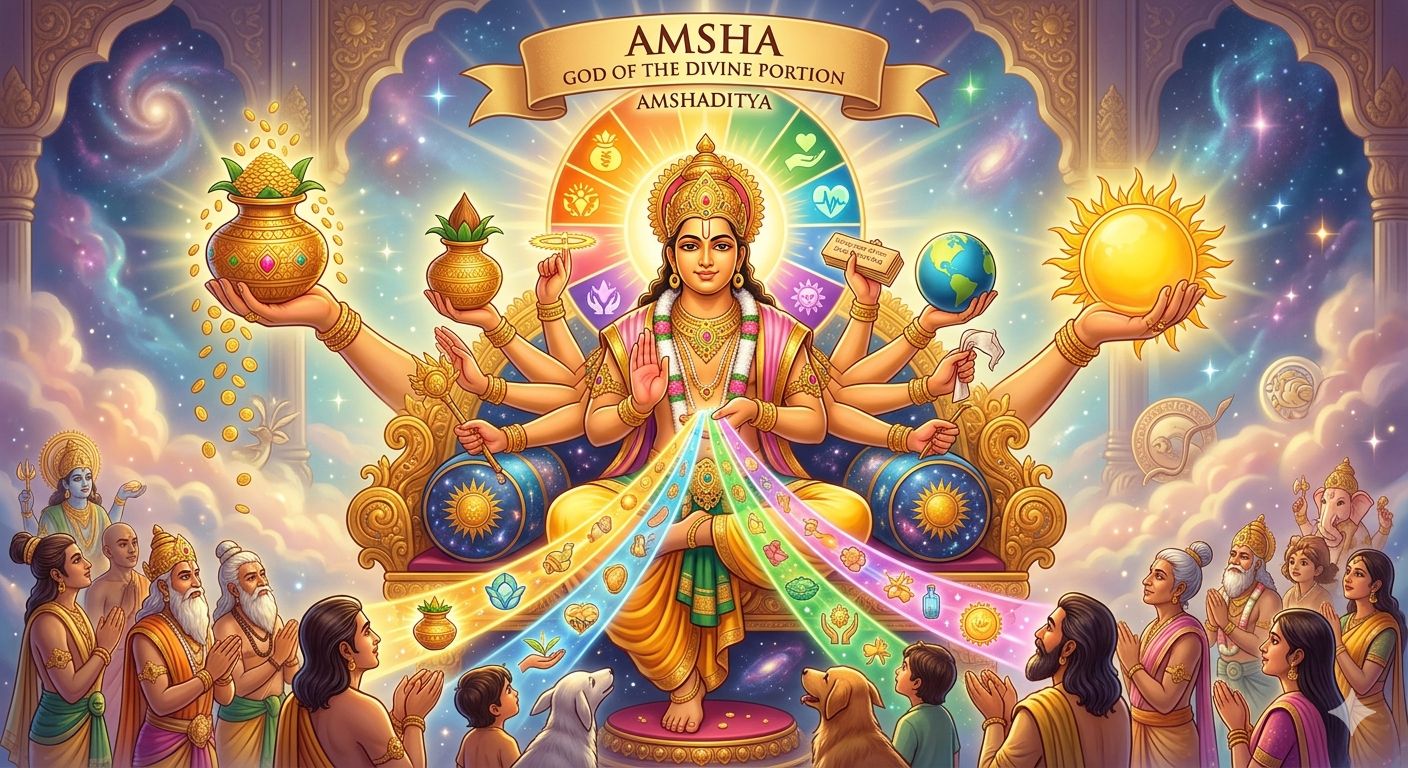
Amsha is one of the twelve Adityas. His name means "portion" or "share" — he presides over the divine allotment, the portion of existence and prosperity each being receives. His role overlaps with Bhaga's and the two are sometimes grouped together in Rigvedic hymns as gods of abundance and fair distribution. Beyond this function, Amsha has almost no independent mythology in either Vedic or Puranic literature.
Symbols & Iconography
Birth & Origin
Born to Aditi and Kashyapa.
Family
Father: Kashyapa. Mother: Aditi. Brothers: the other eleven Adityas.
Scriptures
Named in the Rigveda among the Adityas and in the Vishnu Purana and Bhagavata Purana in lists of the twelve.
Worship & Legacy
No independent temples, festivals, or devotional tradition. Present in collective invocations of the twelve Adityas in Vedic ritual.
Key Stories
Amsha has no significant independent mythology. He is named in lists of the Adityas and invoked collectively with them. No narrative is built around him individually in the Rigveda or the Puranas.
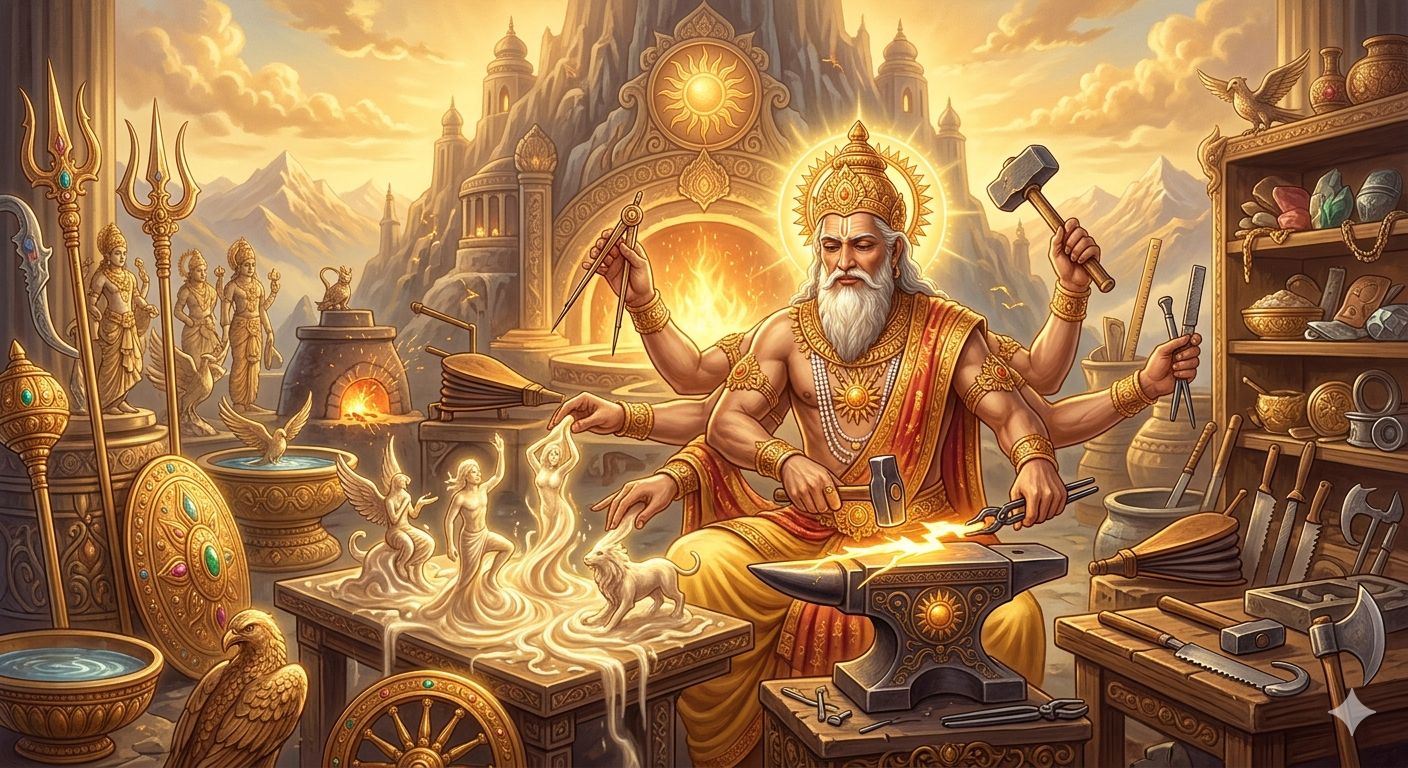
Tvashtr is one of the twelve Adityas and the divine craftsman of the gods — the deity who shapes and gives form to all living beings and fashions the weapons and tools of the divine world. He is described in the Rigveda as the one who gives all creatures their forms in the womb. He shaped divine weapons, crafted Soma cups for the gods, and is the divine sculptor of existence. Also known as Tvastr.
Symbols & Iconography
Birth & Origin
Born to Aditi and Kashyapa. Among the older divine craftsmen of the Rigveda, his function predates the more fully developed figure of Vishwakarma who appears prominently in the Puranas.
Family
Father: Kashyapa. Mother: Aditi. Daughter: Saranyu (Sanjna) — the consort of Surya. Son: Vishvarupa — a three-headed being who served as the gods' priest before being killed by Indra.
Scriptures
Hymned in the Rigveda across multiple books, including Hymn 10.184 which invokes him for the formation of children in the womb. Appears in the Shatapatha Brahmana, Atharvaveda, and is referenced in the Mahabharata and the Puranas.
Worship & Legacy
No independent temples or active worship in modern Hinduism. His craftsmanship role was largely absorbed by Vishwakarma in the Puranic tradition. Vishwakarma Puja — celebrated by artisans, engineers, and craftsmen across India — is the living descendant of what Tvashtr represented.
Key Stories
1. The Creation of Vritra
After Indra killed Tvashtr's son Vishvarupa — a three-headed priest who had secretly offered portions of sacrifice to the demons — Tvashtr performed a great sacrifice to produce a being that could destroy Indra. From the sacrificial fire emerged Vritra, the cosmic serpent who dammed all the world's waters. This makes Vritra not a primordial demon but the deliberately created instrument of a father's grief, and makes Indra's great victory against him morally complicated. (See also: Indra, Vritra)
2. The Fashioning of the Vajra
In Rigvedic hymns, Tvashtr is credited with fashioning Indra's Vajra — the thunderbolt that became his defining weapon. The Puranic version later attributed the Vajra's final form to Vishwakarma using the bones of the sage Dadhichi, but the Rigvedic craftsman who first made divine weapons is Tvashtr.
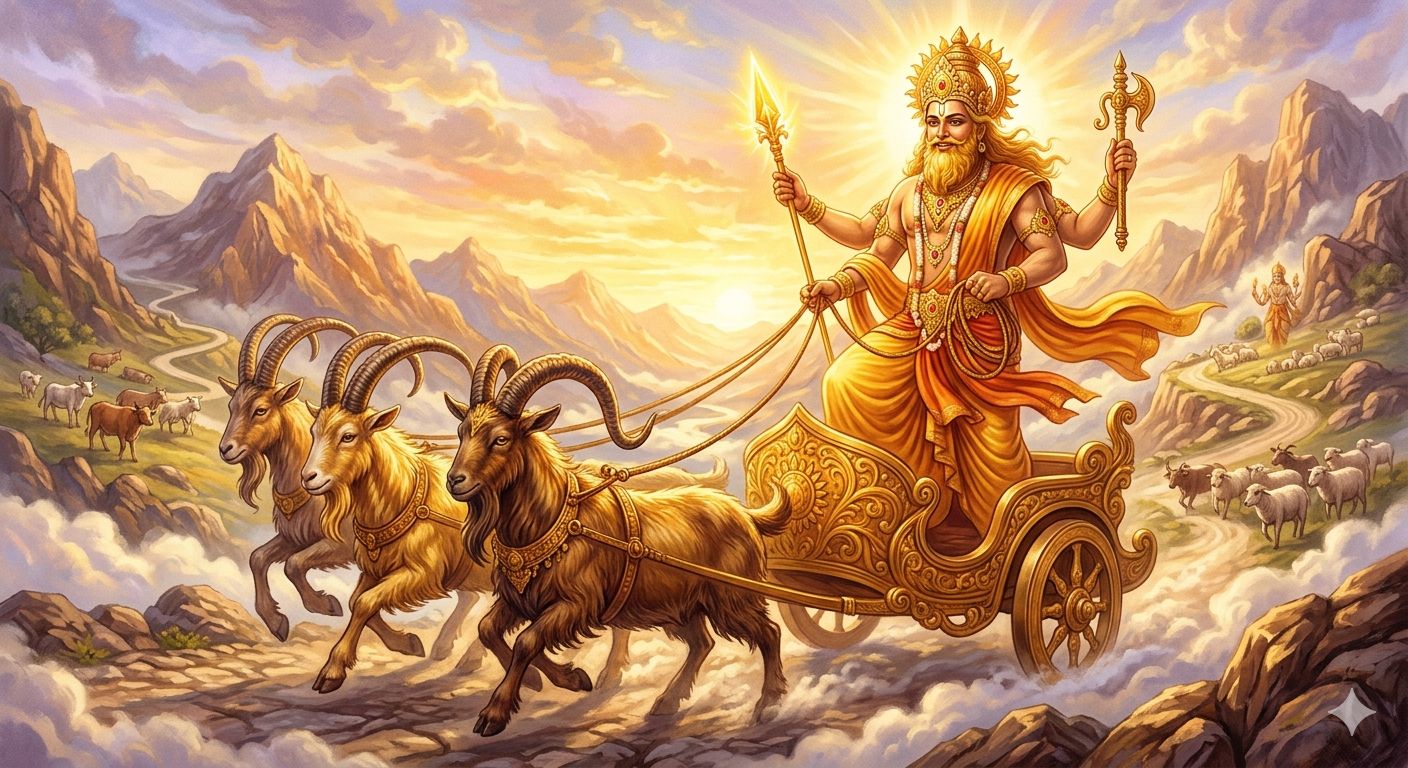
Pushan is one of the twelve Adityas and governs safe travel, roads, the nourishing of cattle, and the finding of lost things. He is the divine shepherd and guide who leads both the living on their journeys and the dead along the path to the afterlife. He is an unusual deity among the Adityas — not a warrior or a sovereign but a caretaker and a nourisher.
Symbols & Iconography
Birth & Origin
Born to Aditi and Kashyapa.
Family
Father: Kashyapa. Mother: Aditi. In some Rigvedic wedding hymns he is described in a ritual context alongside Surya's daughter — a relationship not elaborated as a standard family narrative.
Scriptures
Hymned across multiple books of the Rigveda, particularly Books 1 and 6. Appears in the Atharvaveda and the Shatapatha Brahmana. The Isha Upanishad contains a famous prayer addressed to him asking him to remove his golden covering so the worshipper can see the truth beneath.
Worship & Legacy
No major independent temples in modern India. Invoked in Vedic ritual in contexts of travel, cattle, and funeral rites. The Isha Upanishad prayer addressed to him is still recited in some Vedic traditions at death.
Key Stories
1. The Guide of Travelers and Cattle — Rigvedic
In the Rigveda, Pushan is addressed specifically by those embarking on journeys. Book 6, Hymn 54 asks him to recover lost cattle. Book 1, Hymn 42 asks him to clear the road ahead and keep wild animals away. These hymns give a vivid picture of the practical concerns of Vedic pastoral life and the deity who presided over them.
2. The Loss of Teeth at Daksha's Sacrifice
When Virabhadra stormed Daksha's sacrifice in Shiva's fury, Pushan was struck and lost all his teeth. From that point he could eat only soft food. Vedic ritual offerings to Pushan are always in the form of gruel as a result. (See also: Daksha, Shiva, Virabhadra)
3. Guide of the Dead
In the Rigveda's funeral hymns (Book 10), Pushan is invoked alongside Yama to guide the soul of the dead along the path to the ancestors. He is the one who knows all roads — including the road beyond death.
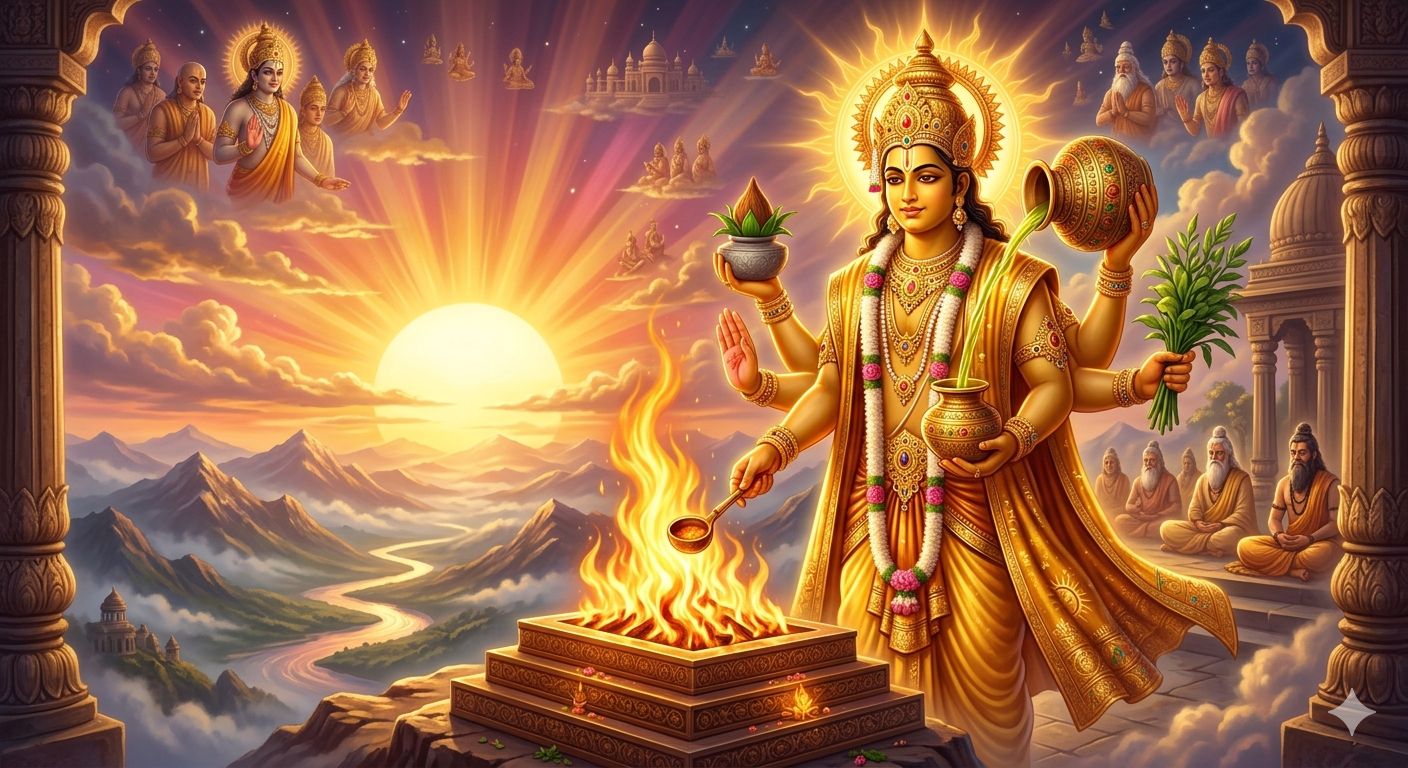
Vivasvat is one of the twelve Adityas and one of the most genealogically significant deities in the Hindu tradition. He presides over the morning sun and is the father — through his son Vaivasvata Manu — of the current race of humanity. He is also the father of Yama and Yami. His name means "the shining one." In the Rigveda he is associated with the first pressing of Soma and with the fire of the sun at dawn. In some contexts he is identified with Surya and in others treated as distinct.
Symbols & Iconography
Birth & Origin
Born to Aditi and Kashyapa. In the Rigveda, Vivasvat is identified with the first dawn — the first moment that the sun appeared and made the world visible.
Family
Consort: Sanjna (Saranyu), daughter of Tvashtr. Children: Vaivasvata Manu, Yama, and Yami (the river Yamuna) with Sanjna; Shani and Savarni Manu with Chhaya.
Scriptures
Appears in the Rigveda, Shatapatha Brahmana, Vishnu Purana, Mahabharata, and the Bhagavad Gita.
Worship & Legacy
No independent temples or festivals. His significance is genealogical — as the father of Manu, Yama, and Shani, he is the ancestor of humanity, the lord of death, and the god of karma.
Key Stories
1. The First Soma Pressing — Rigvedic
In the Rigveda, Vivasvat is associated with the first pressing of Soma — the sacred ritual drink. He is described as the first to have pressed Soma for the gods, establishing the sacrificial ritual that became the center of Vedic religion.
2. Father of Manu and the Flood
Vaivasvata Manu — son of Vivasvat — survived a great flood described in the Shatapatha Brahmana and the Mahabharata. A fish warned Manu of the coming flood and instructed him to build a boat. Manu survived and from him the current human race descends. In the Bhagavad Gita, Krishna tells Arjuna that he taught the yoga of action first to Vivasvat, who taught it to Manu, who taught it to the kings. (See also: Matsya, Manu)
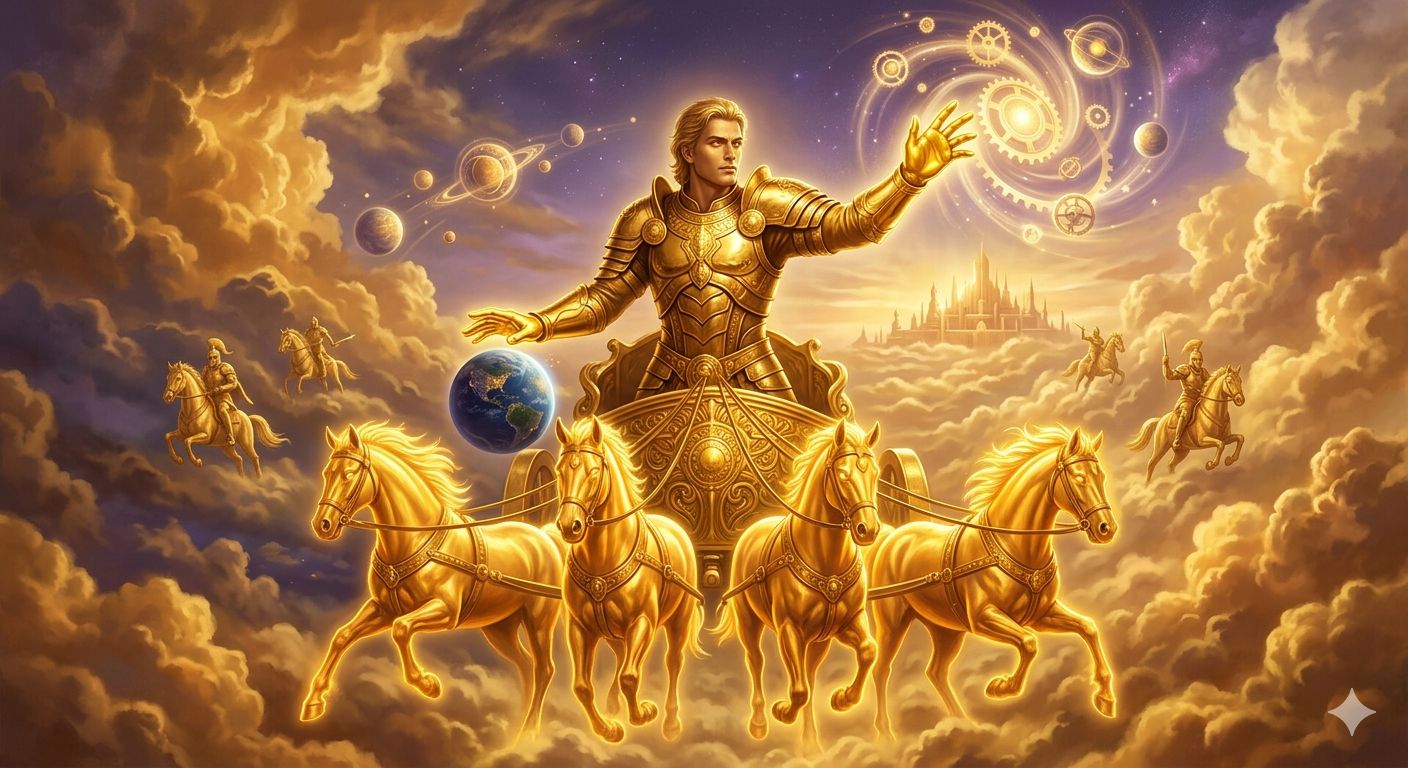
Savitr is one of the twelve Adityas and governs the impelling, activating power of the sun — the force that sets the world in motion each day. His name comes from the root "su" meaning to impel or animate. He is distinct from Surya in the Rigveda — where Surya is the visible sun, Savitr is the animating force behind it. He is most significant as the deity addressed in the Gayatri Mantra — the most recited verse in the history of Hinduism.
Symbols & Iconography
Birth & Origin
Born to Aditi and Kashyapa. In some texts identified fully with Surya; in others treated as a distinct solar aspect.
Family
Father: Kashyapa. Mother: Aditi.
Scriptures
Hymned across the Rigveda, most notably in Book 1 (Hymn 35) and Book 3 (the Gayatri Mantra). Appears in the Atharvaveda, Yajurveda, and throughout Vedic ritual literature.
Worship & Legacy
No independent temples. His entire living legacy is concentrated in the Gayatri Mantra, recited at dawn and dusk by millions of Hindus daily as part of the Sandhyavandanam ritual — a practice continuous from the Vedic period to the present.
Key Stories
1. The Golden Hands — Rigvedic
The Rigveda describes Savitr's golden arms in several hymns — he stretches them out at dawn to set all creatures in motion and at dusk draws them back, bringing all beings to rest. Book 1, Hymn 35 describes his golden chariot, his two white horses, and his arms stretched across the sky. This image of divine hands governing the rhythm of the day is one of the most distinctive solar images in Vedic poetry.
2. The Gayatri Mantra
The Gayatri Mantra — Rigveda 3.62.10 — is addressed to Savitr as the solar deity whose divine radiance illuminates the mind. It asks him to inspire and illuminate the intellect of the one reciting it. It has been recited daily for over three thousand years, is the first mantra taught to initiates in the Vedic tradition, and is the most widely known Sanskrit verse.
Elemental & Nature Devas
Forces of nature personified — fire, wind, storm, moon, death, and the primordial world
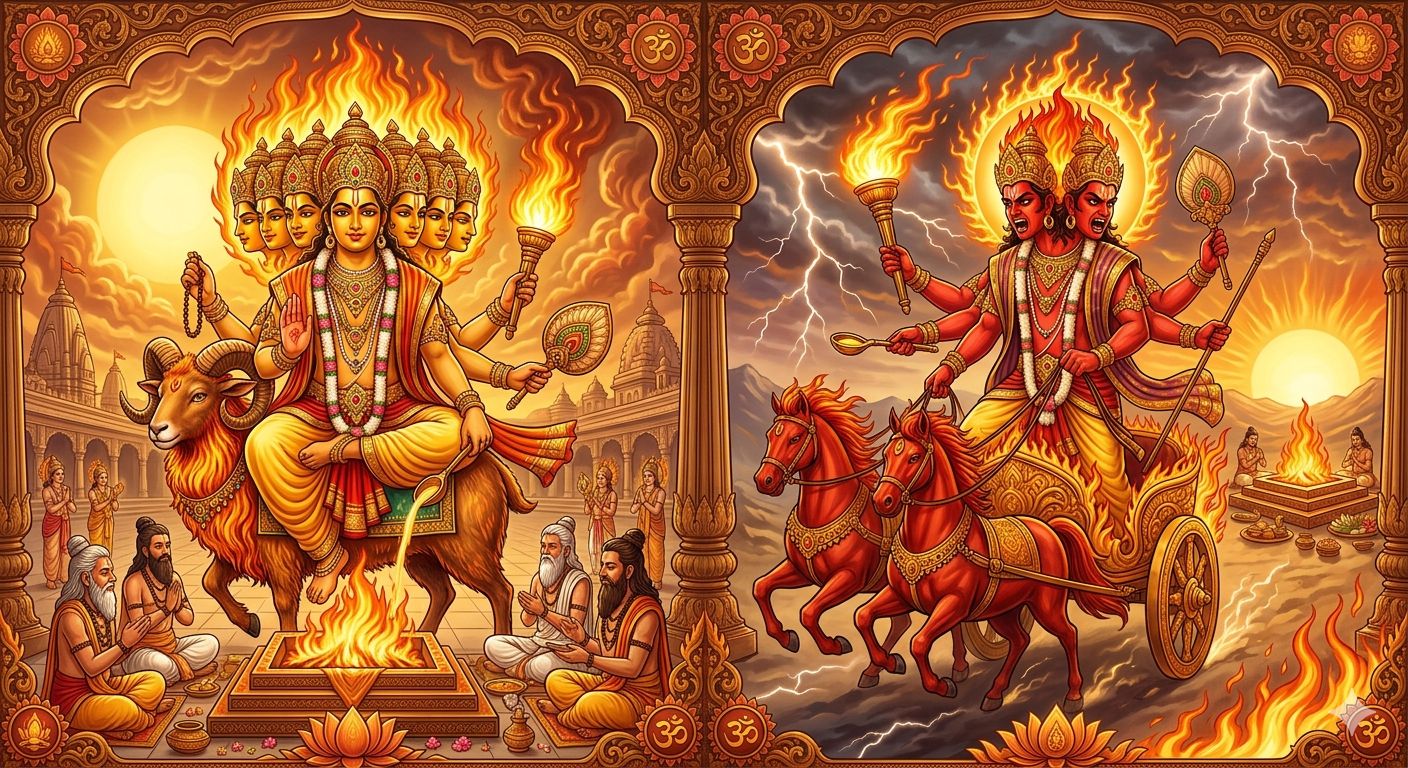
Agni is the god of fire and one of the most important deities of the Rigveda — second only to Indra in the number of hymns addressed to him, with approximately 200. He is the sacred fire of the sacrificial altar, the fire of the domestic hearth, the fire of lightning, and the fire of the funeral pyre. As the god who consumes the sacrifice and carries it to the gods, he is the divine messenger between the human and divine worlds — every Vedic ritual passes through him. Also known as Vahni, Havyavahana (carrier of offerings), Jataveda (knower of all creatures), and Pavaka (the purifier).
Symbols & Iconography
Birth & Origin
In the Rigveda, Agni has multiple simultaneous origins — he is born from the rubbing of two fire sticks (the arani), from the waters (as lightning), and from the sky (as the sun). He is described as the child of Heaven and Earth. In one hymn he is called the newborn who immediately devoured his own parents — the fire sticks that created him. In the Puranas he is one of the eight Vasus or a son of Brahma, depending on the text.
Family
Consort: Svaha — whose name became the ritual exclamation chanted when offerings are poured into the fire. Sons: Pavaka, Pavamana, and Suchi — representing the three forms of fire. His sons are sometimes named as the ancestors of the 45 types of sacred fire described in the Vedic texts.
Scriptures
The most prominently positioned deity in the Rigveda — the first hymn is his. Appears extensively in all four Vedas, the Shatapatha Brahmana, the Mahabharata, and all 18 Mahapuranas. The Agni Purana is among the 18 Mahapuranas, though its content is more encyclopedic than biographical.
Worship & Legacy
Agni is present in every Hindu ritual that involves fire — which is nearly all of them. The sacred fire (homa or havan) is the center of weddings, funerals, daily worship, and major festivals. Every Hindu wedding is concluded by the couple walking around the sacred fire seven times. The eternal flame in every major temple traces its theological lineage to Agni.
Key Stories
1. Agni as the Priest of the Gods — Rigvedic
The first hymn of the entire Rigveda (1.1) is addressed to Agni — not Indra, not Varuna, but Agni. He is called the divine priest, the lord of the house, the giver of treasure, and the god who must be invoked before all others. This positioning establishes him as the indispensable gateway to all divine contact. Without Agni, no sacrifice reaches the gods. Without Agni, no prayer is heard.
2. Agni Hides in the Waters
In the Rigveda and elaborated in the Shatapatha Brahmana, Agni repeatedly hides from the gods to escape the burden of being the eternal carrier of sacrifices. He conceals himself in water, in plants, in trees. The gods search for him and persuade him to return each time, promising him the first share of every offering and honor above all other gods at the ritual. This myth explains why fire can be drawn from wood and water — Agni hides within them.
3. Agni and the Forest of Khandava
In the Mahabharata, Agni was suffering from indigestion — caused by consuming too many offerings of ghee over too long a period. He needed to consume the Khandava forest, which was full of living beings, to restore himself. But Indra, who protected the forest and the serpent Takshaka who lived in it, repeatedly extinguished Agni with rain whenever he tried to burn it. Agni appealed to Krishna and Arjuna, who stood guard against Indra's rain and allowed Agni to consume the entire forest. From this destruction the city of Indraprastha was eventually built.
4. Agni and Svaha
The Bhagavata Purana tells that Agni burned with desire for the wives of the seven great sages but could not act upon it. The Apsara Svaha, who desired Agni, disguised herself as each of the sages' wives in turn and approached him, taking his seed six times. From this union the war god Skanda (Kartikeya) was born. Svaha married Agni and her name became permanently embedded in the ritual as the exclamation of offering. (See also: Kartikeya)
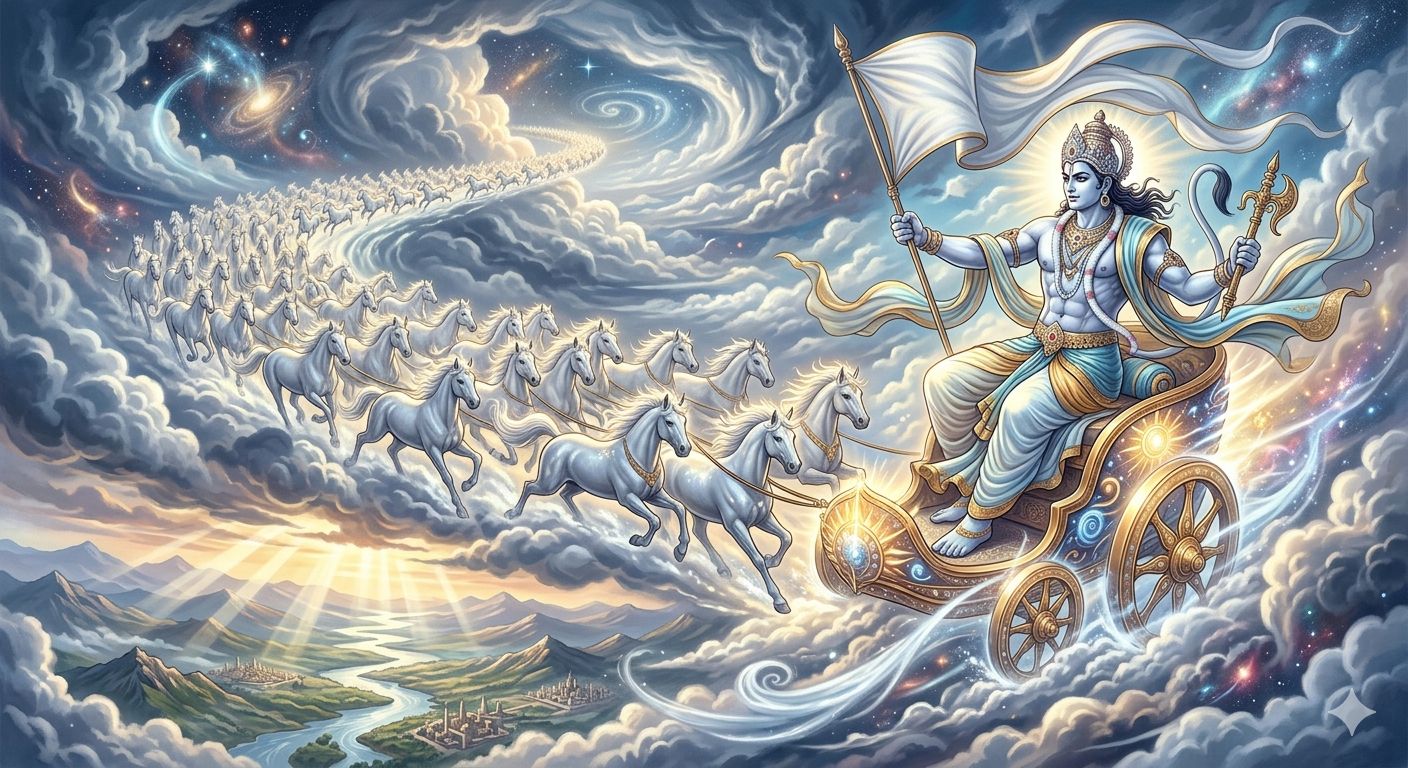
Vayu is the god of wind and the vital breath (prana) that sustains all living things. In the Rigveda he is among the primary elemental gods and is closely paired with Indra. He governs the atmosphere, the breath of life, and the space between heaven and earth. He is also the father of two of the most celebrated heroes in Hindu epic literature — Hanuman and Bhima. Also known as Pavana (the purifier), Anila, and Maruta.
Symbols & Iconography
Birth & Origin
In the Rigveda, Vayu is primordial — he arises from the breath of the Purusha (the cosmic person) in the Purusha Sukta hymn (10.90). He is among the most ancient divine forces, existing before the world took its current form.
Family
Father of Hanuman (by Anjana) and Bhima (by Kunti) in the epic tradition. Associated with the Maruts — the storm gods — who are sometimes described as his sons or companions.
Scriptures
Vayu is hymned in the Rigveda, the Atharvaveda, and the Yajurveda. He appears in the Mahabharata, the Ramayana, and the Puranas. The Vayu Purana is among the 18 Mahapuranas.
Worship & Legacy
Vayu has no major independent temples in modern India. He is invoked in Vedic ritual as one of the five elemental forces (Panchabhutas) and is worshipped as a directional guardian of the northwest in temple ritual. His living presence is strongest through his sons — Hanuman, who has more temples than almost any other deity in India, and Bhima, one of the central heroes of the Mahabharata.
Key Stories
1. Vayu and Indra — Rigvedic
In the Rigveda, Vayu and Indra are frequently invoked together as the first to drink the Soma pressed at the sacrifice — Vayu arriving first, Indra second. Book 4, Hymn 46 addresses them jointly. Vayu's speed makes him the first of the gods to reach the sacrifice; this ritual priority is reflected across many Vedic hymns.
2. The Birth of Hanuman
In the Ramayana and the Puranas, Vayu carried the divine essence that led to Hanuman's birth. The Apsara Punjikasthala had been reborn as the vanara woman Anjana due to a curse. During her austerities, the god Vayu carried his own divine power into her womb. Hanuman was born — inheriting Vayu's speed and strength. (See also: Hanuman)
3. Vayu Cracks the Summit of Meru
In the Mahabharata, the sage Narada once taunted Vayu — claiming that the serpent Shesha who held the earth was more powerful. Vayu accepted the challenge and unleashed all his force against Mount Meru, the cosmic mountain. Shesha wrapped himself around the mountain to protect it. They battled until Vishnu and Brahma intervened. Vayu, unable to topple Meru, instead broke off its peak and cast it into the ocean — which became the island of Lanka.
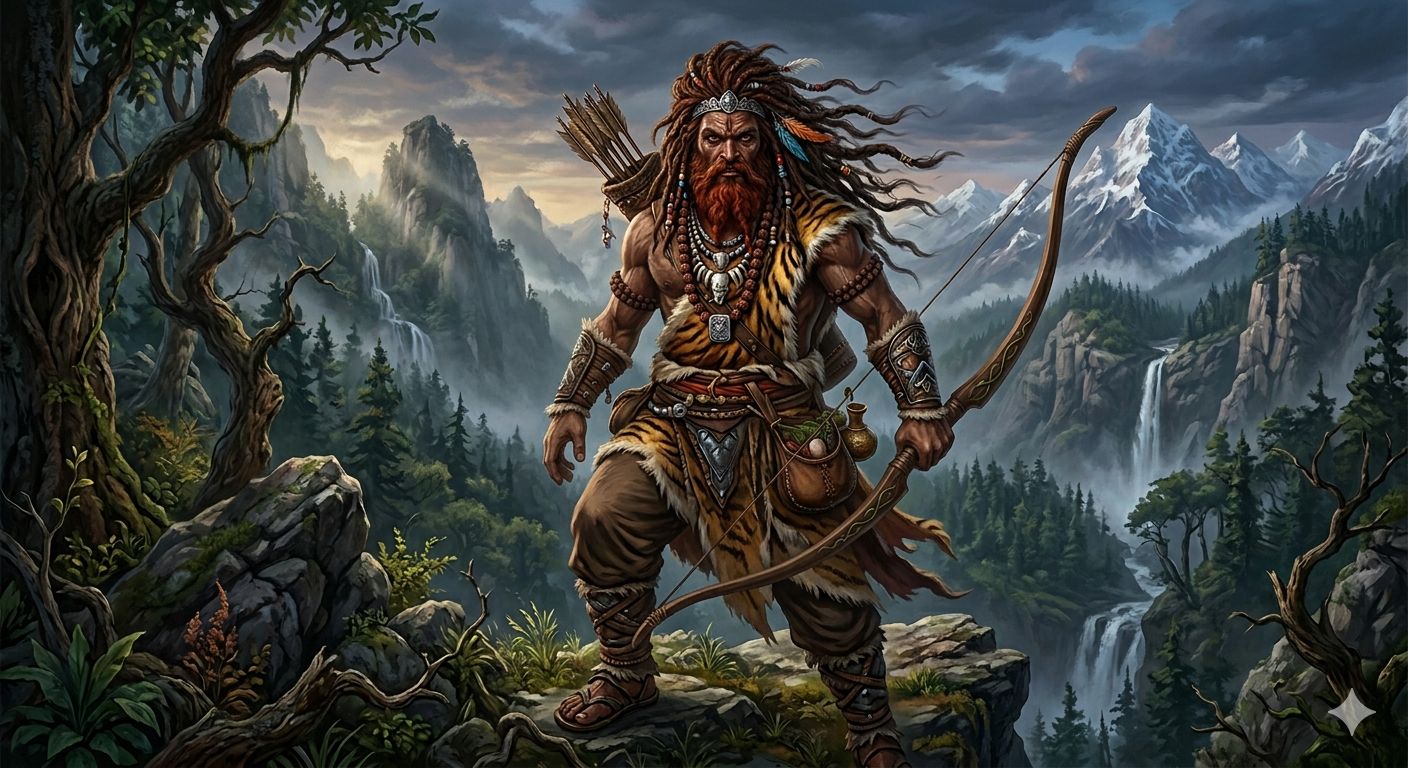
Rudra is the fierce Vedic god of storms, wild animals, forests, disease, and healing — the deity who kills and also cures. He is the most terrifying god of the Rigveda, haunting the wild spaces beyond human settlement, bringing disease with his arrows and removing it when propitiated. He is the direct precursor of Shiva, and the transition from the Vedic Rudra to the Puranic Shiva is one of the most significant developments in the history of Hinduism. He is addressed in the Rigveda as both the destroyer and the most generous healer — his medicines are said to be the best of all the gods. Also known as Shiva (auspicious) — a placatory epithet used in the Rigveda itself to soften his fierce aspect.
Symbols & Iconography
Birth & Origin
In the Rigveda, Rudra's origin is not systematically described — he simply exists as a primal, wild force. In the Shatapatha Brahmana, he is born when Prajapati (Brahma) weeps from the pain of creation — the tears that fell became Rudra, who then wept further, his tears scattering to become his eleven forms (the Ekadasha Rudras). In the Puranas, Rudra emerges from Brahma's forehead in a moment of anger.
Family
Consort: Prishni or Rudrani (in the Rigveda). Sons: the Maruts (storm gods), said to be born from his union with Prishni. In the Puranic tradition, his family merges with that of Shiva — Parvati, Ganesha, and Kartikeya.
Scriptures
Rudra appears in the Rigveda primarily in Book 2. He is extensively addressed in the Yajurveda through the Sri Rudram. He appears in the Atharvaveda, the Shatapatha Brahmana, and the Upanishads — particularly the Shvetashvatara Upanishad, which is the earliest text to equate Rudra fully with the supreme cosmic reality.
Worship & Legacy
Rudra as an independent deity is not worshipped separately from Shiva in modern Hinduism — he has been fully absorbed into the Shiva tradition. The Shvetashvatara Upanishad's identification of Rudra with the supreme reality laid the philosophical foundation for all of Shaivism.
Key Stories
1. The Placation of Rudra — Rigvedic
The Rigveda contains several hymns (particularly in Book 2) that are essentially prayers asking Rudra not to harm the worshipper's family, cattle, or children. He is addressed with extreme care — invoked with the placatory adjective shiva (auspicious, benign) rather than his fierce name, asked to keep his bow unstrung and his arrows unfired, and promised that the worshippers mean no disrespect. This cautious mode of address is unlike any other deity in the Rigveda and reflects genuine fear of his power. The word shiva here is a descriptive term, not yet a proper name — that development belongs to the Puranic period.
2. Rudra the Healer
In the same hymns that fear his arrows, Rudra is addressed as the greatest of healers — his remedies are said to surpass those of all other gods. Hymn 2.33 of the Rigveda asks for his healing hand and praises the medicines in his chariot. This dual nature — bringer of disease and bringer of cure — is the defining theological tension of the Vedic Rudra.
3. The Sri Rudram — Yajuvedic
The Sri Rudram in the Yajurveda (Taittiriya Samhita 4.5 and 4.7) is one of the most important hymns in Hinduism, still chanted daily in Shiva temples across India. It addresses Rudra in all his forms — in the forest, in rivers, in armies, in craftsmen, in thieves, in merchants — acknowledging his presence in every aspect of life and asking for his protection. The Namakam (the naming of Rudra's forms) and the Chamakam (the asking of boons) together form the complete Sri Rudram. This text is the most direct thread connecting the Vedic Rudra to the living worship of Shiva today.
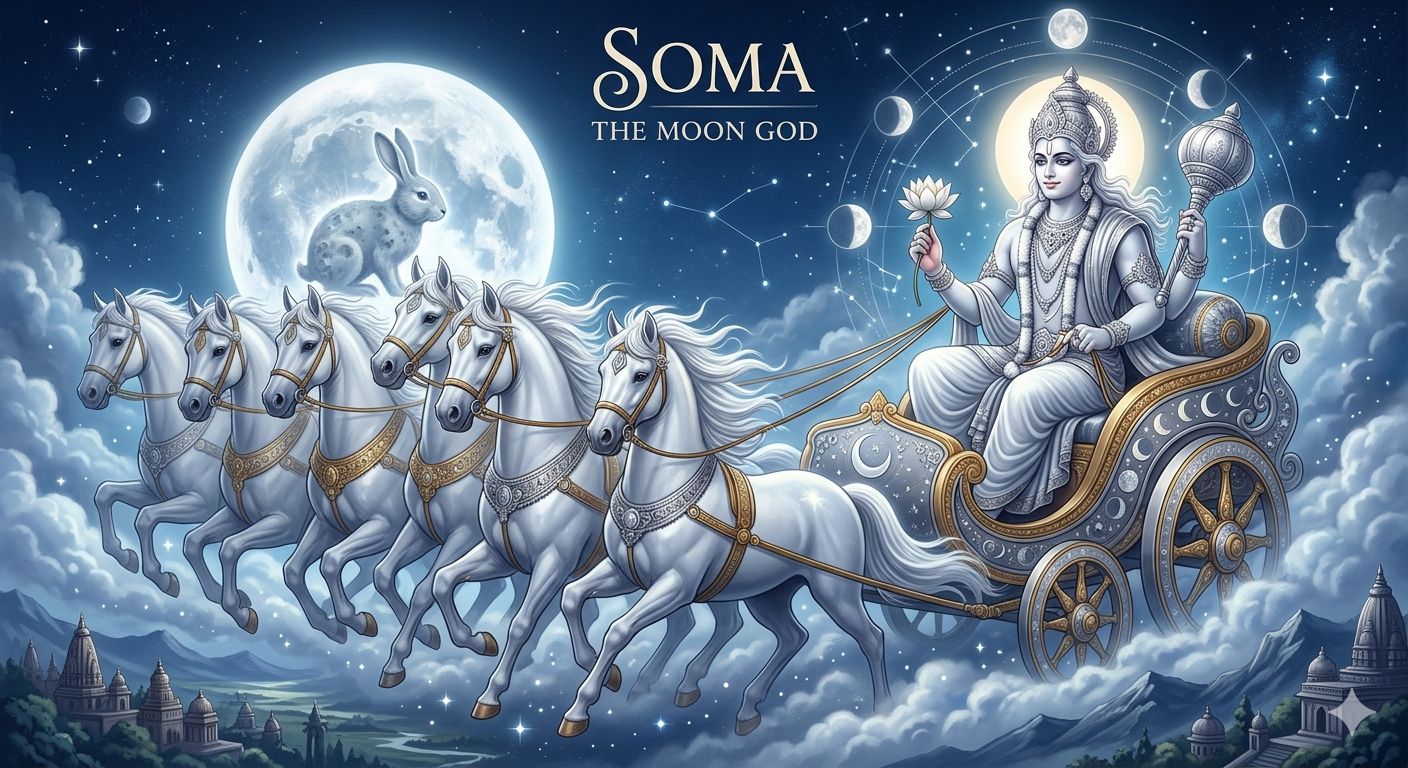
Soma occupies a unique position in the Vedic tradition — he is simultaneously the moon god and the divine ritual drink pressed from the Soma plant that formed the center of Vedic sacrifice. In the Rigveda, Soma the drink is hymned in an entire book (Book 9, the Soma Mandala — 114 hymns) as a deity in himself. Soma the moon god (Chandra) developed more fully in the Puranic tradition. Also known as Chandra, Indu (the drop), Shashin (bearing the rabbit), and Oshadhipati (lord of plants).
Symbols & Iconography
Birth & Origin
In the Rigveda, Soma the drink is born from the pressing of the plant on the sacred stones — his birth is the ritual pressing itself. In the Puranas, Chandra (the moon) was born during the Samudra Manthan — the churning of the cosmic ocean — and emerged as a luminous deity claimed by both gods and demons before being worn by Shiva in his matted hair.
Family
Soma/Chandra's 27 wives are the Nakshatras (lunar mansions) — daughters of Daksha. His favorite wife Rohini led to Daksha's curse and the waxing and waning of the moon. Through his union with the star Tara (wife of Brihaspati, whom he abducted), he fathered Budha — the god of Mercury. Budha fathered Pururavas, the ancestor of the lunar dynasty of kings from which the heroes of the Mahabharata descend.
Scriptures
Soma is the subject of the entire Book 9 of the Rigveda. Chandra appears in the Vishnu Purana, Bhagavata Purana, Mahabharata, and the Puranic accounts of the Samudra Manthan.
Worship & Legacy
Chandra is one of the nine Navagrahas and is worshipped in all Navagraha shrines found in South Indian temples. Monday (Somavara) is his sacred day. The Somnath Jyotirlinga temple in Gujarat — one of the twelve most sacred Shiva temples in India — is named for Soma/Chandra, who built the original temple in gold after being freed from Daksha's curse. His lunar dynasty (Chandravamsha) is one of the two great royal lineages of Hindu epic tradition, from which the Pandavas and Kauravas ultimately descend.
Key Stories
1. The Soma Mandala — Rigvedic
The entire ninth book of the Rigveda — 114 hymns — is addressed to Soma Pavamana (the flowing, purified Soma). These hymns describe the ritual pressing of the Soma plant, the filtering of the juice through wool, its mixing with milk, and its offering to the gods. Soma is called the king of plants, the lord of the mind, the drink that defeats death. No other substance in the Rigveda receives this sustained devotional attention. The identity of the actual Soma plant remains a debated question in Vedic scholarship.
2. The Abduction of Tara
Chandra, the moon, abducted Tara — the wife of Brihaspati, the preceptor of the gods. Brihaspati demanded her return. Chandra refused. The gods and the demons divided over the dispute and a war broke out — the Tarakamaya war. Brahma eventually intervened and forced Chandra to return Tara. She was found to be pregnant. Her son, Budha (Mercury), was fathered by Chandra. This story is told in the Vishnu Purana and the Mahabharata. (See also: Brihaspati, Budha)
3. Daksha's Curse and the Waning of the Moon
Chandra's neglect of 26 of his 27 wives (the daughters of Daksha) in favor of Rohini led Daksha to curse him to wane and lose his light. Chandra appealed to Shiva, who mitigated the curse — decreeing that the moon would wane for half the month but wax again for the other half, in an eternal cycle. This story explains the lunar cycle. (See also: Daksha)
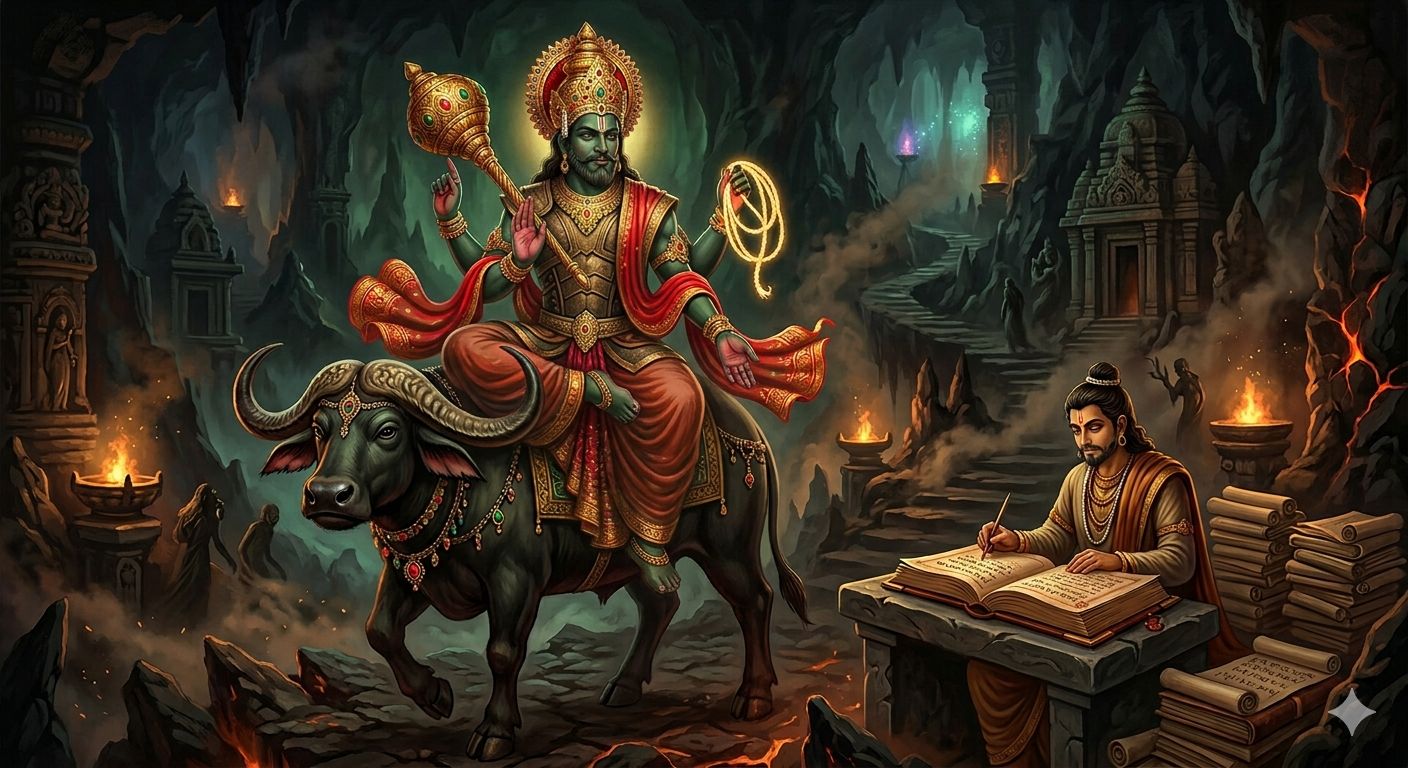
Yama is the god of death and the lord of Naraka (the realm of the dead), where souls are judged and assigned their fate based on their actions in life. He is the first mortal to have died and by that act became the ruler and guide of all who follow. He is also the god of dharma and justice — his court is the place where cosmic moral accounting occurs. Also known as Dharmaraja (king of dharma), Pitrupati (lord of ancestors), Antaka (the ender), and Kala (time/death).
Symbols & Iconography
Birth & Origin
Son of Surya (Vivasvat) and Sanjna. He is the first mortal — the first being to die — and by crossing that threshold became its ruler. In the Rigveda he is depicted as having found the path to the afterlife that no one before him had traveled.
Family
Father: Surya (Vivasvat). Mother: Sanjna. Twin sister: Yami (the river Yamuna). Brother: Vaivasvata Manu. Half-brothers (through Chhaya): Shani. Scribe: Chitragupta, who records all human deeds.
Scriptures
Yama appears in the Rigveda (Book 10), the Atharvavedic funeral hymns, the Katha Upanishad, the Mahabharata, the Ramayana, and extensively in the Puranas — particularly the Garuda Purana, which describes his realm and the fate of souls in great detail.
Worship & Legacy
Yama has no major temples in modern India — he is not a deity of devotional worship but of cosmic function. He is invoked in funeral rites and the Shraddha ceremonies for ancestors. The Garuda Purana, which describes his realm in detail, is traditionally read aloud during the mourning period after a death. Yamadwitiya — the day after Diwali — is dedicated to him, on which sisters pray for their brothers' long lives.
Key Stories
1. Yama and Yami — Rigvedic
One of the most unusual dialogues in the Rigveda (Book 10, Hymn 10) is between Yama and his twin sister Yami. Yami presses Yama to be with her, arguing they are the first pair and should continue their kind. Yama refuses absolutely, saying that this would be a violation of cosmic law (Rita) that he cannot commit regardless of her plea. The dialogue is remarkable for its depiction of moral refusal under pressure and is an early dramatic dialogue in Sanskrit literature.
2. Nachiketa and the Secrets of Death
In the Katha Upanishad, the boy Nachiketa is sent to Yama's realm by his father in a fit of anger. Yama is absent for three days and, on returning, offers Nachiketa three boons as compensation. Nachiketa uses his first boon to ask for his father's peace of mind, his second to learn about the sacred fire, and his third — despite Yama's attempts to dissuade him with offers of wealth, women, and kingdoms — to learn the secret of what happens after death. Yama's answer forms the philosophical core of the Katha Upanishad and an early systematic discussion of the self and its relationship to death in Indian thought.
3. The Judgment of Souls
The Puranas describe Yama's court in detail — the dead arrive before him, Chitragupta reads their record of deeds, and Yama assigns them to various realms of experience. The righteous go to Svarga (heaven), the wicked to one of many Narakas (hells) appropriate to their offenses, and eventually all return to rebirth. The specificity of the Puranic descriptions — with named hells for specific sins — is among the most elaborate moral accounting systems in world religion.
4. Yama and Savitri
In the Mahabharata, Savitri followed Yama as he led away the soul of her husband Satyavan. She argued, debated, and impressed Yama so thoroughly with her devotion and intelligence that he granted her four boons — and she was clever enough to frame the fourth so that Yama was compelled to return her husband's life. The story of Savitri is the most celebrated narrative of wifely devotion in the Hindu tradition.
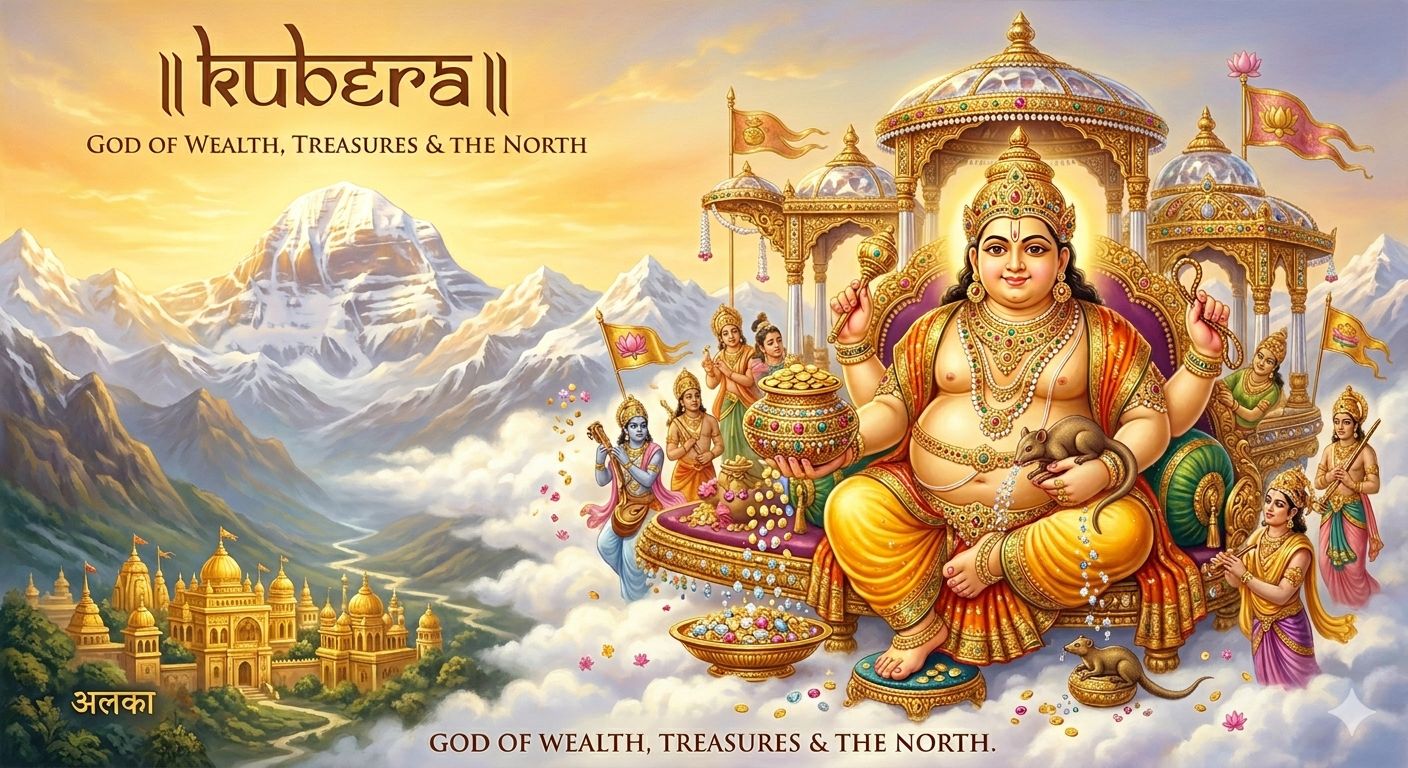
Kubera is the god of wealth and material prosperity, the treasurer of the gods, and the lord of the Yakshas (nature spirits associated with wealth and abundance). He governs the north and resides in the city of Alaka in the Himalayas, near Mount Kailash. He is the half-brother of Ravana. Also known as Dhanapati (lord of wealth), Vitteshvara, and Vaishravana.
Symbols & Iconography
Birth & Origin
Son of the sage Vishrava and the brahmin woman Devavarnini (Ilavida) in the Puranic tradition.
Family
Father: Vishrava. Mother: Devavarnini (Ilavida). Half-brothers: Ravana, Kumbhakarna, and Vibhishana — born to Vishrava's other wife, the demoness Kaikesi. Consort: Kuveri (also called Bhadra). Son: Nalakuvera.
Scriptures
Kubera appears in the Rigveda as a minor figure, elaborated in the Atharvaveda, and features prominently in the Ramayana, Mahabharata, Vishnu Purana, and the Shiva Purana.
Worship & Legacy
Kubera is invoked on Dhanteras — the first day of Diwali — and worshipped alongside Lakshmi on the main night of the festival. In Buddhism he appears as Vaisravana, one of the four heavenly kings. The Kubera Yantra is used in wealth-related ritual practice. No single major temple is dedicated to him independently.
Key Stories
1. Kubera and Ravana — The Loss of Lanka
In the Ramayana, Lanka was originally Kubera's city — built by Vishwakarma and given to him by Brahma. When Ravana performed great austerities and received boons from Brahma, he drove Kubera out of Lanka and seized it along with the Pushpaka Vimana — the flying vehicle that Brahma had given to Kubera. Kubera retreated to Alaka in the Himalayas. (See also: Ravana, Rama)
2. Kubera's Feast and Ganesha's Hunger
In a story from the Shiva Purana, Kubera once invited Shiva and Parvati to a feast at his palace in Alaka, intending to display his wealth. Shiva sent Ganesha instead. Ganesha ate everything — every dish prepared for the feast, then the feast vessels, then the furniture, then began to eat the palace itself and threatened to consume Kubera next. Kubera, in panic, ran to Shiva and Parvati who gave Ganesha a handful of roasted rice — which satisfied him immediately. (See also: Ganesha)
3. Nalakuvera's Curse on Ravana
Nalakuvera cursed Ravana that if he ever touched a woman without her consent, his heads would burst. This is cited in the Ramayana as the reason Ravana could not forcibly touch Sita during her captivity in Lanka.
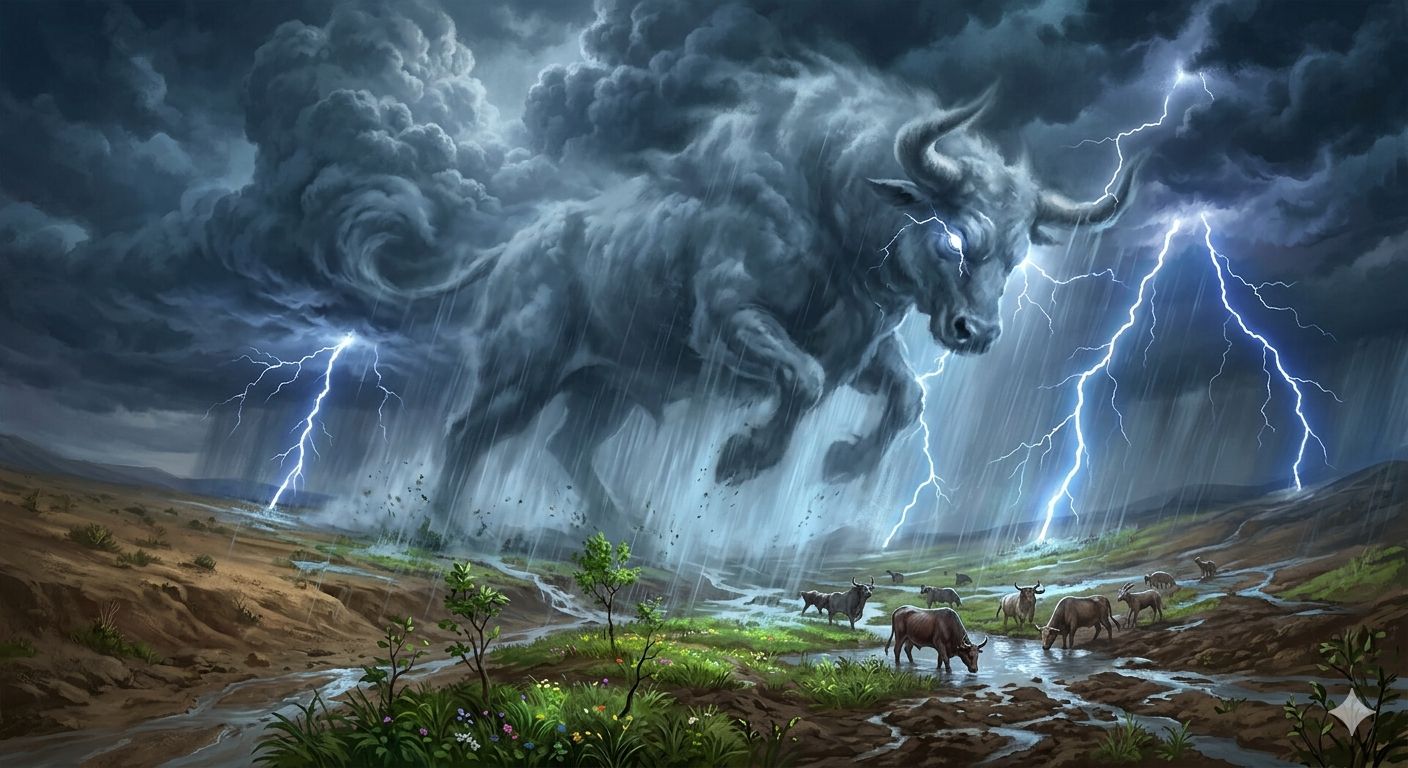
Parjanya is the Vedic god of rain clouds, thunderstorms, and the fertilizing rain that makes crops grow. He is one of the most agriculturally significant deities of the Rigveda — his rain is life for the pastoral and farming communities who composed the Vedic hymns. He is associated with the bull who fertilizes the earth, and the rain cloud is described as his roar. He is distinct from Indra (who is the warrior who releases rain by slaying the cloud-demon Vritra) — Parjanya is the rain cloud itself as a divine force.
Symbols & Iconography
Birth & Origin
In the Rigveda, Parjanya is described as the son of Dyaus (the sky) or as an Aditya in some later lists. His origin is the sky itself — he is the divine presence within the storm cloud.
Family
In some texts Parjanya is the father of Soma plants — the rain that causes Soma to grow. He is associated with Prithvi (the earth goddess) as her fertilizing partner.
Scriptures
Parjanya is hymned in the Rigveda (Books 5 and 7) and the Atharvaveda. He is mentioned in later Vedic texts and the Puranas, where his role is largely absorbed by Indra.
Worship & Legacy
Parjanya has no independent temples or active worship in modern Hinduism. His role as the rain deity was absorbed almost entirely by Indra in the epic and Puranic tradition. He survives in agricultural prayers and in the study of Vedic religion, where his hymns remain among the most direct expressions of the Vedic relationship with the natural world.
Key Stories
1. The Rain Hymns — Rigvedic
Rigveda Book 5, Hymn 83 is addressed entirely to Parjanya and is one of the most vivid nature hymns in the text. It describes him roaring across the sky, lashing the earth with his rain, causing trees to split with lightning, making all creatures flee before him, and then releasing the rain that fills the earth with life. The hymn asks him to bring rain, spare the worshippers from excessive lightning, and bless the crops. It depicts a deity who is both frightening and essential — the storm that terrifies and the rain that feeds.
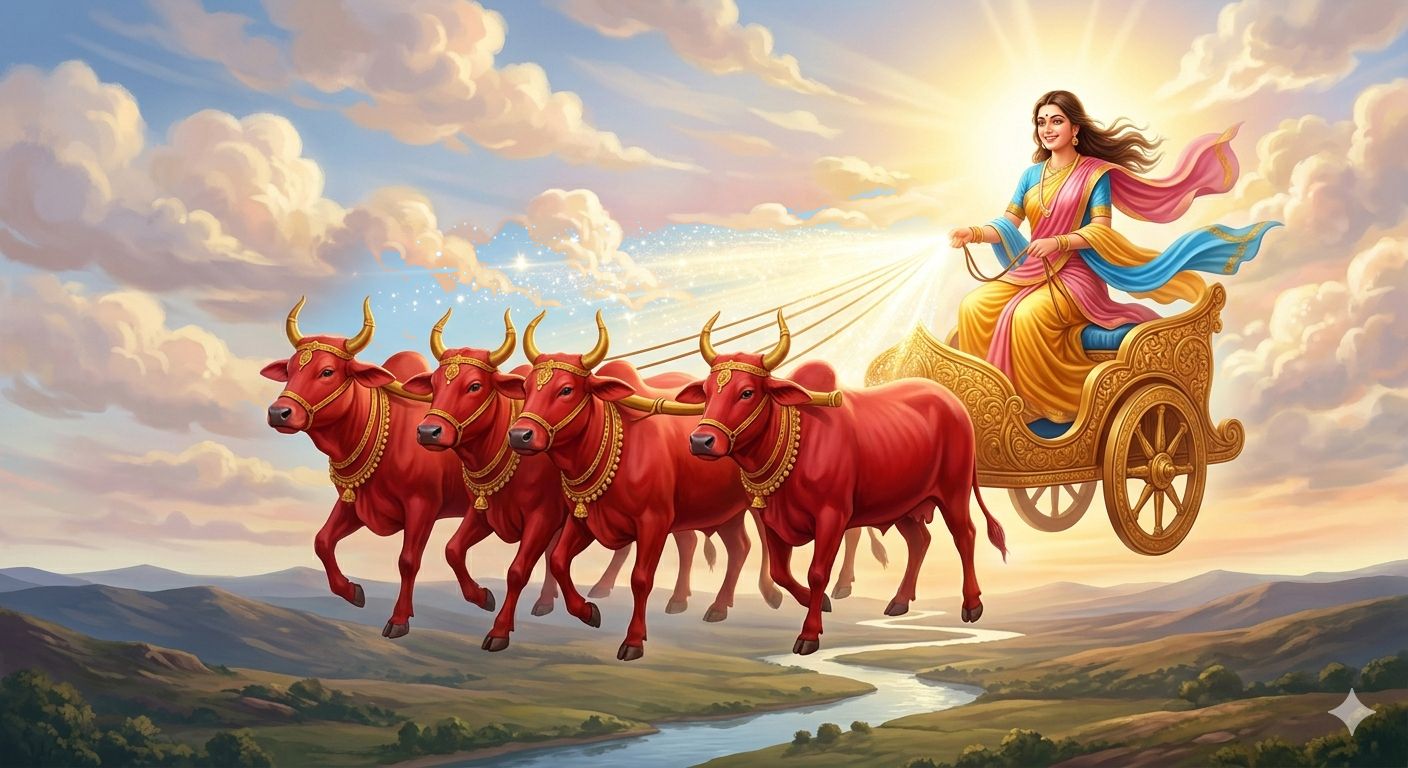
Ushas is the goddess of the dawn and one of the most beautifully hymned deities in the entire Rigveda — over 20 hymns are dedicated to her, and she is described with more poetic elaboration than almost any other deity. She is the light that precedes the sun, the daily renewal of the world, the goddess who drives away darkness and awakens all living beings. She is associated with youth, beauty, abundance, and the new beginning that each dawn represents. Also known as Usha.
Symbols & Iconography
Birth & Origin
In the Rigveda, Ushas is the daughter of Dyaus (the sky) and is described as the sister of Ratri (the night). She and Ratri alternate — one following the other — in an eternal cycle. In some hymns she is also the sister of the Adityas.
Family
Father: Dyaus (the sky). Sister: Ratri (night). She is associated with the Ashvins — the twin horsemen who precede her chariot each morning.
Scriptures
Ushas is hymned across multiple books of the Rigveda. She is mentioned in the Atharvaveda and later texts but receives far less attention in the Puranic tradition, where she has no major independent mythology.
Worship & Legacy
Ushas has no major independent temples in modern India. Her legacy lives in the Rigvedic hymns themselves — among the finest nature poetry in any ancient tradition — and in the daily Sandhyavandanam (dawn prayer) ritual still performed by millions of Hindus, which in its Vedic origins was an invocation of exactly the moment Ushas represents.
Key Stories
1. The Dawn Hymns — Rigvedic
The Rigvedic dawn hymns (particularly Books 1, 3, 4, 5, and 7) are a celebrated poetry in the Sanskrit tradition. Ushas is described awakening the world — stirring birds, rousing sleeping humans, sending them to their tasks, calling the priest to the sacrifice. She is praised for her beauty, her generosity, her consistency. Hymn 1.113 describes her as the mother of cows, the life of all that lives, and the one who makes the riches of the world visible.
2. Ushas and Indra
In one Rigvedic passage, Indra is said to have shattered Ushas's chariot with his thunderbolt — an episode that scholars have interpreted as representing the sun overtaking the dawn. Ushas fled, her chariot broken, the light dissolved into the full day. This brief, violent encounter is unusual in the Vedic treatment of Ushas, who is otherwise entirely benign.
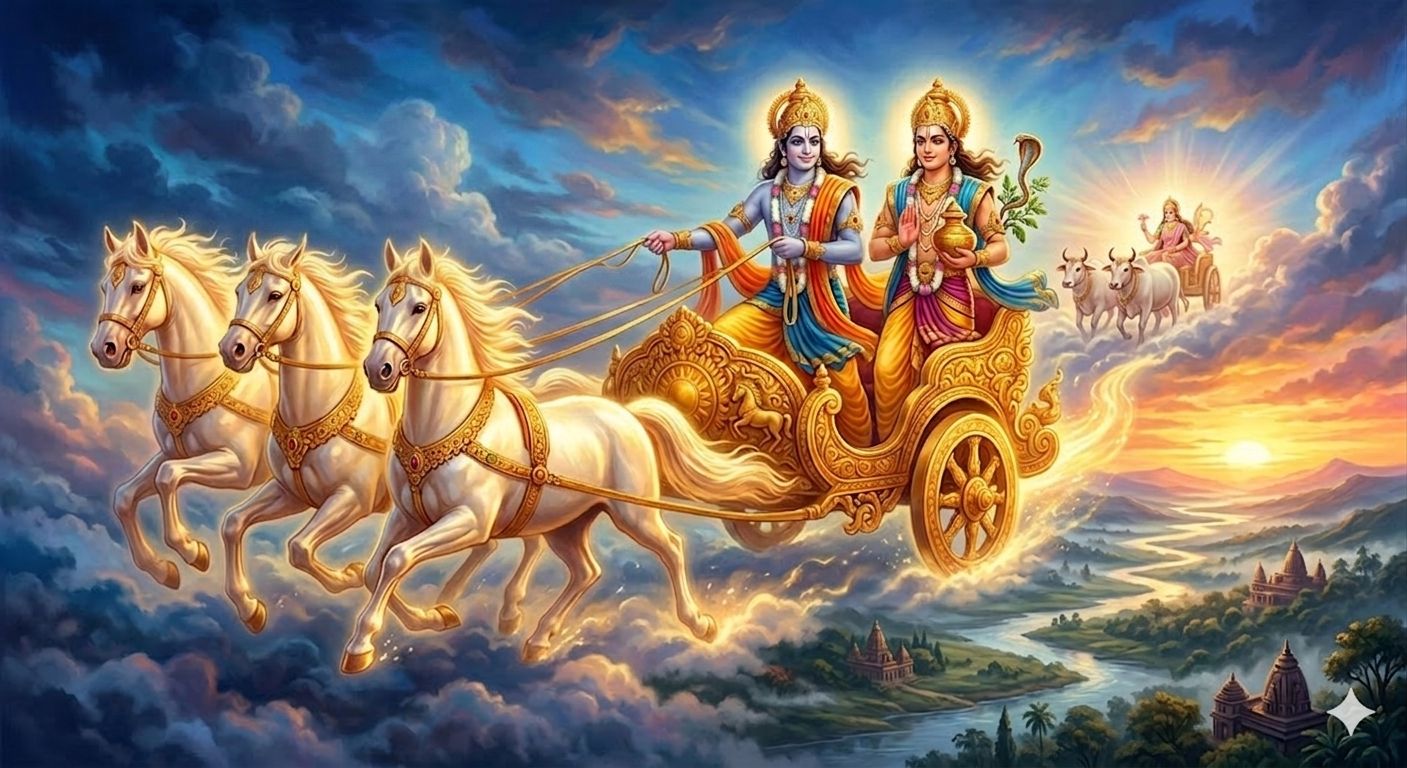
The Ashvins are twin gods — the divine horsemen who appear at dawn before the sun rises, preceding Ushas's chariot. They are the physicians of the gods, the rescuers of those in distress, and the helpers who appear at the moment of greatest need. In the Rigveda they are among the most frequently hymned deities — over 50 hymns are addressed to them — and they are always invoked as a pair, never separately. Also known as Nasatyas, Dasras, and Asvins. Their individual names — rarely used separately — are Nasatya and Dasra.
Symbols & Iconography
Birth & Origin
In the Rigveda their birth is described in multiple ways. In one account they are the sons of Dyaus (the sky) and Saranyu (the daughter of Tvashtr). In the Puranas, they are born from Surya and his consort Sanjna when both were in horse form in the forest — twin sons born from that union.
Family
Father: Surya (Vivasvat) in the Puranic account. Mother: Sanjna (in horse form). They are considered the fathers of Nakula and Sahadeva — two of the five Pandava brothers — through Madri (the second wife of Pandu) in the Mahabharata.
Scriptures
The Ashvins are among the most hymned deities of the Rigveda, with over 50 hymns addressed to them. They appear in the Shatapatha Brahmana, the Mahabharata (as fathers of Nakula and Sahadeva), and the Puranas.
Worship & Legacy
The Ashvins have no major independent temples in modern India. They are invoked in Vedic ritual, particularly in healing contexts. Their legacy in Ayurveda — as the first divine physicians — gives them an indirect presence in the entire tradition of traditional Indian medicine. Nakula and Sahadeva, their epic sons, are among the five Pandava heroes of the Mahabharata.
Key Stories
1. The Rescue of Chyavana — Rigvedic
One of the most celebrated Ashvin stories appears in the Rigveda and is elaborated in the Shatapatha Brahmana. The ancient sage Chyavana had grown extremely old and was buried in an anthill with only his eyes visible. The princess Sukanya accidentally blinded one of his eyes while playing. Her father the king was compelled to offer her in marriage to the ancient sage as restitution. The Ashvins, moved by her devotion, offered to restore Chyavana's youth. All three — Chyavana and the Ashvins — dived into a sacred pond. All three emerged young and equally handsome. Sukanya chose her husband by recognition alone. The Ashvins, in return for this healing, demanded the right to drink Soma at the sacrifice — a right the other gods had denied them because they were too closely associated with mortals. Chyavana compelled the gods to grant this right.
2. The Rescue of Bhujyu
In the Rigveda (hymns in Books 1 and 10), the Ashvins are praised for rescuing Bhujyu, the son of Tugra, who had been abandoned at sea. The Ashvins carried him across the ocean in their ship with a hundred oars and three wheels, flying through the sky and water simultaneously. This rescue is cited as one of their greatest acts and is referenced in multiple Rigvedic hymns as evidence of their compassion and power.
3. The Physicians of the Gods
In the Rigveda and the Mahabharata, the Ashvins are credited with numerous medical miracles — restoring the sight of the blind, the hearing of the deaf, giving a leg to Vishpala (a warrior woman who lost her leg in battle, for whom they fashioned an iron replacement), and restoring youth to the aged. They are the divine doctors and their Rigvedic hymns form part of the basis of Ayurveda — the traditional Indian system of medicine.
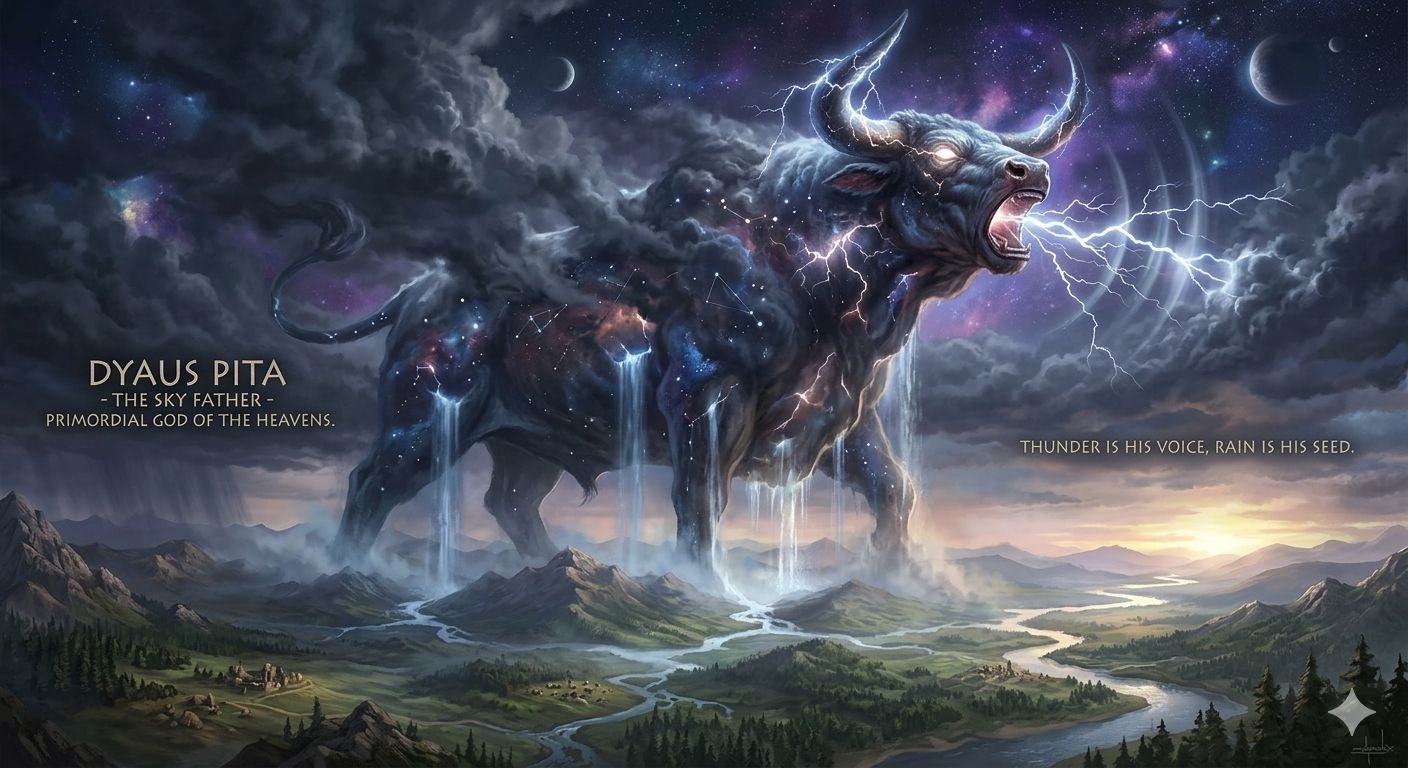
Dyaus Pita is the primordial sky god of the Rigveda — the divine father whose name means literally "sky father." He is the oldest deity in the Indo-European religious tradition that the Vedic religion shares with the Greeks (Zeus Pater), Romans (Jupiter), and other branches — all derived from the same proto-Indo-European root. In the Rigveda he is addressed alongside Prithvi (the earth) as the cosmic parents of all things. By the time the Puranas were composed, Dyaus had largely faded as an active deity, his functions absorbed by Indra and later by Brahma, Vishnu, and Shiva. Also known as Dyavaprithvi (Heaven and Earth) as a paired deity.
Symbols & Iconography
Birth & Origin
In the Rigveda, Dyaus and Prithvi are described as the primordial pair — existing before most other gods. Some hymns describe them as self-existent. Others describe them as created by Indra or by the cosmic principle.
Family
Consort: Prithvi (the earth). Children: Indra (in some Rigvedic accounts), Ushas, the Ashvins, and the Adityas. His role as cosmic father is his primary identity.
Scriptures
Dyaus appears in the Rigveda in paired hymns with Prithvi and in scattered individual references. He is mentioned in the Atharvaveda and the Shatapatha Brahmana. In the Puranas he is rarely mentioned independently.
Worship & Legacy
Dyaus has no temples, festivals, or active worship in modern Hinduism. His significance is entirely historical and comparative — as the oldest traceable divine ancestor of the Indo-European sky god tradition, he connects the Vedic religion to Greek, Roman, Norse, and other ancient traditions that scholars trace to a common proto-Indo-European source.
Key Stories
1. The Primordial Parents — Rigvedic
The Rigveda addresses Dyaus and Prithvi together in hymns that describe them as the father and mother of all creation. They are separated from their original embrace — held apart by the cosmos they created between them — and the sky and earth maintain this eternal distance. Hymn 1.160 praises them as the great parents whose children are all the gods. This cosmological myth of primordial parents separated by creation is found across many Indo-European traditions.
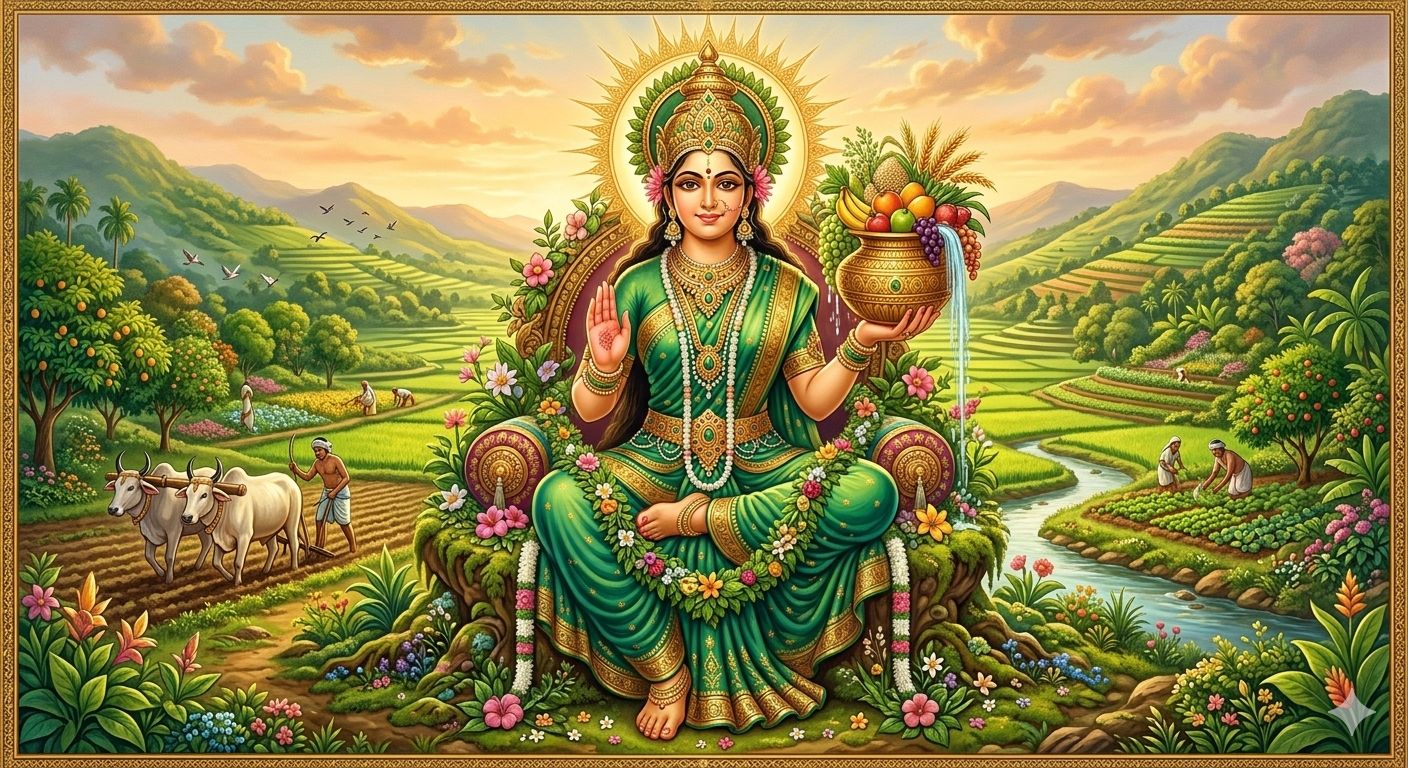
Prithvi is the goddess of the earth — the divine personification of the ground beneath all things. She is one of the most ancient deities of the Rigveda, addressed alongside Dyaus as one of the two cosmic parents. In the Puranic tradition she is also known as Bhumi or Bhudevi — the consort of Vishnu — and as Vasundhara (bearer of treasures). She is patient, sustaining, and inexhaustible — qualities the Vedic and Puranic texts consistently associate with the earth itself.
Symbols & Iconography
Birth & Origin
In the Rigveda, Prithvi is primordial — co-existent with Dyaus, the two together forming the cosmic parents. In the Vishnu Purana, the earth was submerged in the cosmic ocean after the demon Hiranyaksha dragged her down. Vishnu took the form of Varaha (a great boar) and dove into the ocean to rescue her.
Family
In the Rigveda: paired with Dyaus (the sky) as the cosmic mother. In the Puranic tradition: consort of Vishnu. Their son in some texts is Mangala (the god of Mars).
Scriptures
Prithvi appears in the Rigveda in paired hymns with Dyaus. She is the subject of the extended Prithvi Sukta in the Atharvaveda. She appears in the Vishnu Purana, Bhagavata Purana, and the Mahabharata.
Worship & Legacy
Prithvi/Bhumi is invoked in virtually every Hindu ritual involving the earth — land is asked for permission before construction (Bhoomi Puja), before ploughing, and before major life events. Bhoomi Puja remains one of the most universally practiced Hindu rituals, performed before the construction of any building, home, or temple. She is worshipped as Bhudevi alongside Lakshmi in Vaishnava temples across South India — particularly in Tamil Nadu, where she is one of Vishnu's two consorts.
Key Stories
1. The Earth Hymn — Rigvedic
The Prithvi Sukta in the Atharvaveda (Book 12, Hymn 1) is one of the longest and most celebrated hymns in the entire Vedic corpus — 63 verses addressed to the earth as a divine mother. It praises her for bearing all living things, for sustaining those who walk on her, for holding the forests and mountains and rivers. It asks her for prosperity, for strength, and for the gift of abundance. It is among the earliest environmental hymns in any religious tradition.
2. The Rescue by Varaha
When the demon Hiranyaksha dragged the earth to the bottom of the cosmic ocean, Prithvi was submerged and all life on her surface was threatened. Vishnu took the form of Varaha — a cosmic boar — dove to the bottom of the ocean, killed Hiranyaksha, and lifted Prithvi on his tusks back to the surface. This story is told in the Vishnu Purana, the Bhagavata Purana, and the Valmiki Ramayana. (See also: Varaha, Hiranyaksha)

Apas (meaning "waters") is the Vedic deity of sacred waters — rivers, rain, streams, and the cosmic ocean. In the Rigveda, the waters are addressed as divine mothers and purifiers, giving life, removing sin, and sustaining all existence. Apas is not a single personified deity in the way Indra or Agni is — rather, the waters collectively are divine and are addressed as such. They are among the most ancient divine forces in the Vedic tradition. Also invoked as the Apah or the Waters.
Symbols & Iconography
Birth & Origin
In the Rigveda, the waters are described as having existed before the world — they are the primordial medium from which creation emerges. In the Purusha Sukta, the cosmic ocean is the medium within which the first sacrifice takes place.
Family
The waters are described as divine mothers — maternal, purifying, and life-giving. They are associated with Varuna as their overseer and with Apam Napat (child of the waters), an ancient fire deity who dwells within them.
Scriptures
Apas is addressed throughout the Rigveda and the Atharvaveda. The Apah Sukta (10.9) is still recited in Vedic water purification rituals.
Worship & Legacy
The divine status of water remains one of the most alive aspects of Vedic religion in modern Hinduism. Rivers — particularly the Ganga, Yamuna, Saraswati, Godavari, Narmada, Sindhu, and Kaveri — are worshipped as goddesses. Bathing in sacred rivers is considered purifying of sin. The ritual use of water in every Hindu ceremony — from birth to death — is a direct continuation of the Vedic worship of Apas.
Key Stories
1. The Waters as Divine Mothers — Rigvedic
Rigveda Book 10, Hymn 9 (the Apah Sukta) addresses the waters directly as divine mothers and asks them to bring healing, remove disease, and purify the worshipper. The waters are called young women who bring joy, whose sound is like laughter, who flow toward Varuna and carry away sin. This hymn is still recited in Vedic ritual today.
2. The Cosmic Waters and Creation
In the Rigveda's Nasadiya Sukta (Book 10, Hymn 129) — the most philosophically celebrated hymn in the Rigveda — the primordial state before creation is described as a dark, undifferentiated water. From this water, through heat (tapas), the first germ of creation emerged. The waters are therefore not just a resource but the condition of all possibility.
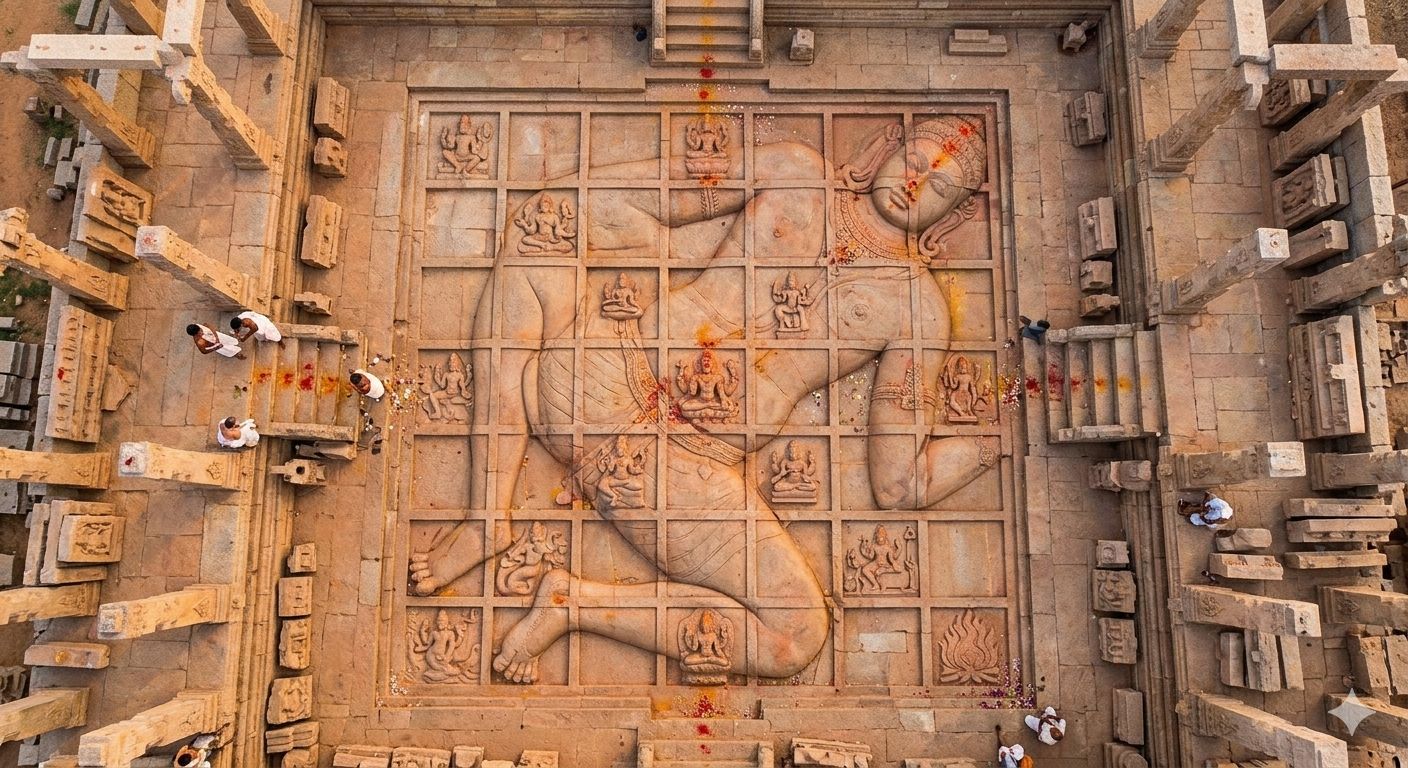
Vastu is the presiding deity of the dwelling place — the god who inhabits and sanctifies the built environment. He governs sacred architecture, spatial harmony, and the correct orientation of structures so they align with cosmic forces. He is the divine presence that must be acknowledged before construction begins. His name gives rise to Vastu Shastra — the ancient Indian system of sacred architecture still widely practiced today. In the Rigveda he is addressed as Vastoshtpati — lord of the dwelling.
Symbols & Iconography
Birth & Origin
In the Matsya Purana, a great being born of Shiva's sweat fell to the earth and grew so enormous his body covered the land. The gods collectively sat upon his body and pinned him face-down to the earth. Brahma declared that he would be worshipped by all who wished to build, in exchange for his submission.
Family
Associated with Vishwakarma, the divine architect of the gods. Sometimes regarded as a form or aspect of that deity.
Scriptures
Vastu appears in the Rigveda as Vastoshtpati (Book 7, Hymn 54). He is elaborated in the Matsya Purana and the Skanda Purana. The technical tradition of Vastu Shastra is codified in texts like the Manasara, the Mayamata, and the Arthashastra.
Worship & Legacy
Vastu Puja — the ritual worship of Vastu before laying a foundation — remains one of the most universally observed Hindu rituals, performed before the construction of homes, offices, temples, and public buildings across India.
Key Stories
1. Vastoshtpati — Rigvedic
In the Rigveda (Book 7, Hymn 54), Vastoshtpati is addressed as the lord of the dwelling who protects the household and drives away disease. He is asked to bring prosperity and wellbeing to those who live in the house. This is among the earliest recorded prayers for a home — asking a divine presence to inhabit and protect the domestic space.
2. The Demon Pinned Beneath
The foundational story of Vastu Purusha — the cosmic being pinned face-down by the gods — is the theological basis for the Vastu Purusha Mandala used to orient every traditional Hindu structure. The gods who pinned him correspond to directional guardians and elemental forces assigned to different zones of any built space.
3. Lanka and Dwaraka
Vastu Shastra holds that Vishwakarma built Lanka — the golden city of Ravana — and later Dwaraka, the city of Krishna, as perfectly aligned divine dwellings. Lanka fell when Ravana's actions violated the principles of the space. Dwaraka sank into the sea at the end of Krishna's earthly life.
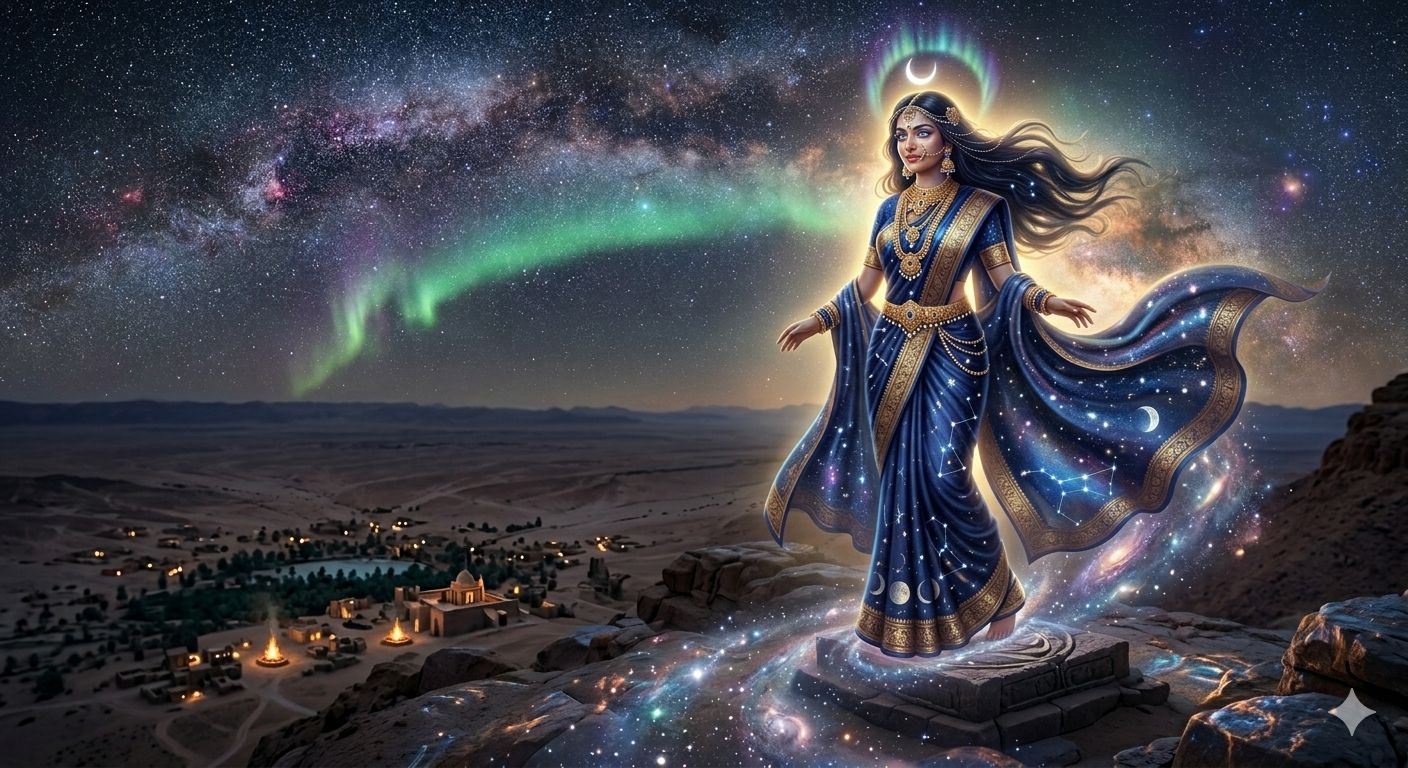
Ratri is the goddess of the night — the dark counterpart to Ushas (the dawn). She is hymned in the Rigveda as a benevolent presence who brings rest, safety, and the protection of darkness after the labors of the day. She is not feared as a goddess of darkness in the threatening sense but respected as the necessary half of the cycle — without her night, Ushas's dawn would have no meaning. Also known as Ratridevi.
Symbols & Iconography
Birth & Origin
Daughter of Dyaus (the sky) in some accounts. Sister of Ushas — the two alternate in an eternal cycle of day and night.
Family
Father: Dyaus. Sister: Ushas.
Scriptures
Ratri is hymned in the Rigveda (Book 10, Hymn 127) and mentioned in the Atharvaveda. She receives very little attention in the Puranic tradition.
Worship & Legacy
Ratri has no independent temples or festivals in modern Hinduism. Her hymn — the Ratri Sukta — is among the shorter Vedic hymns and is still recited in evening Vedic prayer in some traditions. Her theological significance is as the necessary other half of the Vedic day cycle, without whom Ushas's dawn cannot be understood.
Key Stories
1. The Night Hymn — Rigvedic
Rigveda Book 10, Hymn 127 (the Ratri Sukta) is addressed to Ratri. It is among the most peaceful hymns in the Rigveda — describing the goddess arriving in the sky, pushing away the darkness with the light of stars, bringing rest to the bird in the tree and to the wolf. It asks her to protect the worshippers through the night and pass safely into the dawn. It is still recited in some Vedic traditions as an evening prayer.
The Vasus
Eight elemental attendants of Indra — whose transgression became the birth of Bhishma
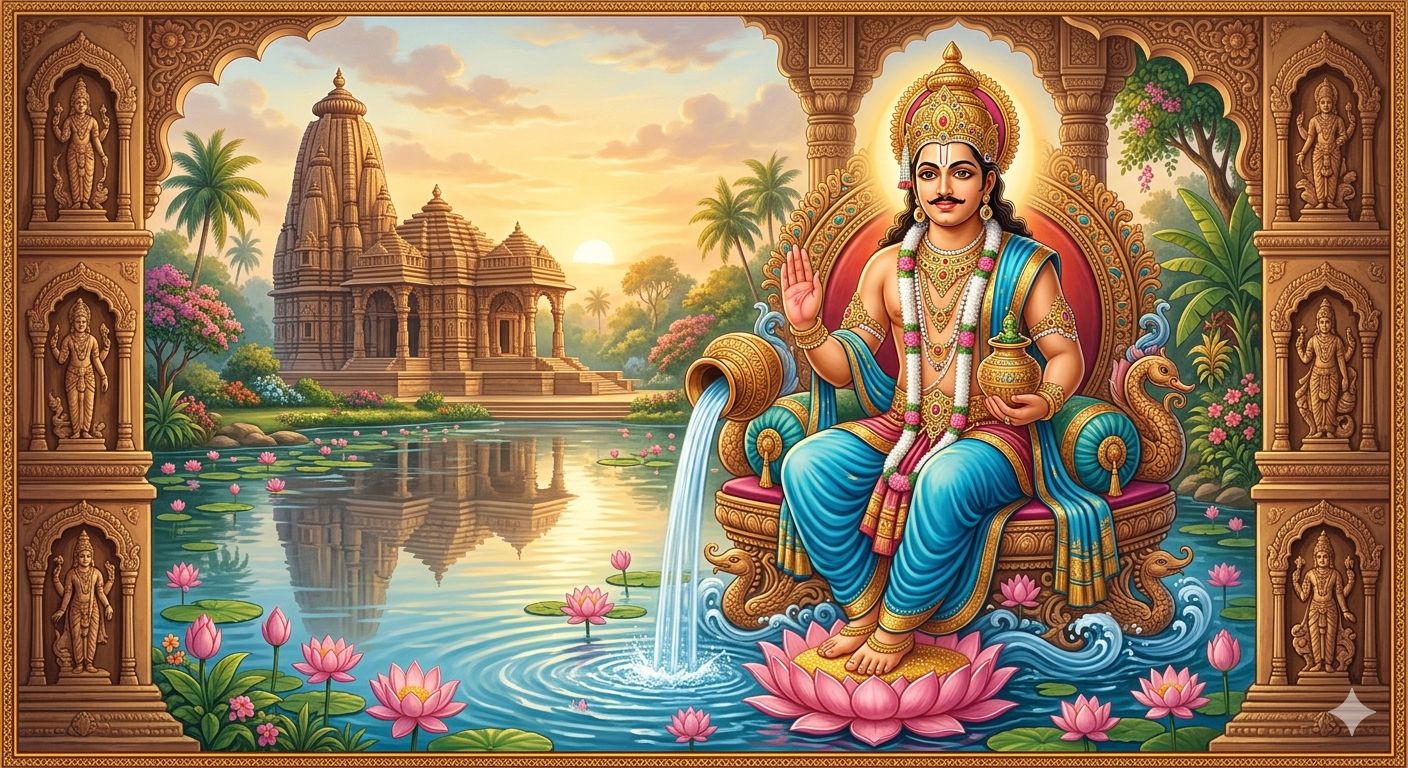
Apa is one of the eight Vasus, representing the element of water. His name means "water" and he embodies the divine principle of water as a cosmic element — distinct from Apas (the collective divine waters of the Rigveda) in that he is a specific enumerated deity within a defined group.
Symbols & Iconography
Birth & Origin
Born to Dharma (cosmic order) and Vasudhara or Manu in the Vishnu Purana. In the Mahabharata the Vasus are sons of Kashyapa and Aditi, or of Manu.
Family
One of the eight Vasus. Brothers: Dhruva, Soma, Dharitri, Anila, Anala, Pratyusha, and Prabhasa.
Scriptures
Named among the Vasus in the Taittiriya Samhita, the Vishnu Purana, and the Mahabharata.
Worship & Legacy
The Vasus as a group are invoked in Vedic ritual. Apa has no independent worship. Their collective story — the curse of Vasishtha and the birth of Bhishma — is told in full in entry 29 (The Remaining Six Vasus).
Key Stories
The Vasus' most significant story is collective — see entry 29 (The Remaining Six Vasus) for the full narrative of the Vasus' curse and their birth as the sons of Ganga and Shantanu in the Mahabharata.
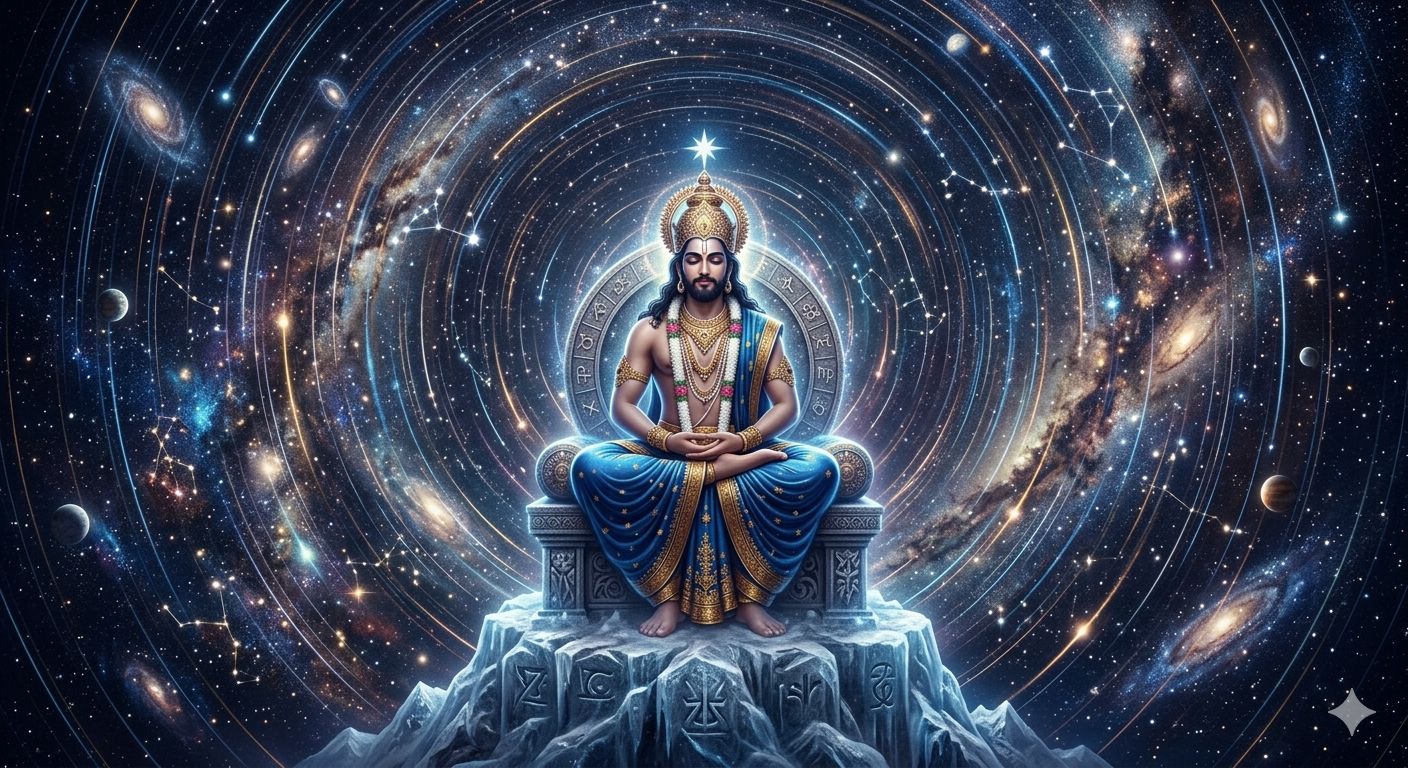
Dhruva is one of the eight Vasus associated with the pole star — the fixed point around which all celestial bodies rotate. In a separate and far more developed mythology, Dhruva is also the name of the child-devotee of Vishnu whose intense meditation earned him a permanent place as the pole star. These two figures — the Vasu Dhruva and the child Dhruva — are connected by their shared association with constancy and the fixed star.
Symbols & Iconography
Birth & Origin
As a Vasu: born among the eight elemental divine beings. As the child-devotee: son of King Uttanapada and his first wife Suniti, who was displaced in her husband's affections by his second wife Suruchi.
Family
One of the eight Vasus. As the child-devotee: Father: King Uttanapada. Mother: Suniti. Stepmother: Suruchi. Half-brother: Uttama.
Scriptures
As a Vasu: named in the Vishnu Purana and the Mahabharata. The child Dhruva story is in the Bhagavata Purana (Book 4).
Worship & Legacy
Dhruva the pole star is pointed out to the bride and groom during Hindu wedding ceremonies — they are asked to be as constant and faithful as Dhruva. This remains a living part of the Hindu marriage ritual.
Key Stories
1. Dhruva the Child Devotee
In the Bhagavata Purana, the child Dhruva — son of King Uttanapada — was humiliated when his stepmother Suruchi prevented him from sitting on his father's lap, saying he was unworthy. The child, five years old, went into the forest and performed intense meditation on Vishnu. Vishnu, moved, appeared to him. Dhruva asked for a throne greater than any before him. Vishnu granted him a place as the pole star — the fixed point of the entire universe — where he remains for eternity, unwavering, as all the stars and gods rotate around him. (See also: Vishnu)
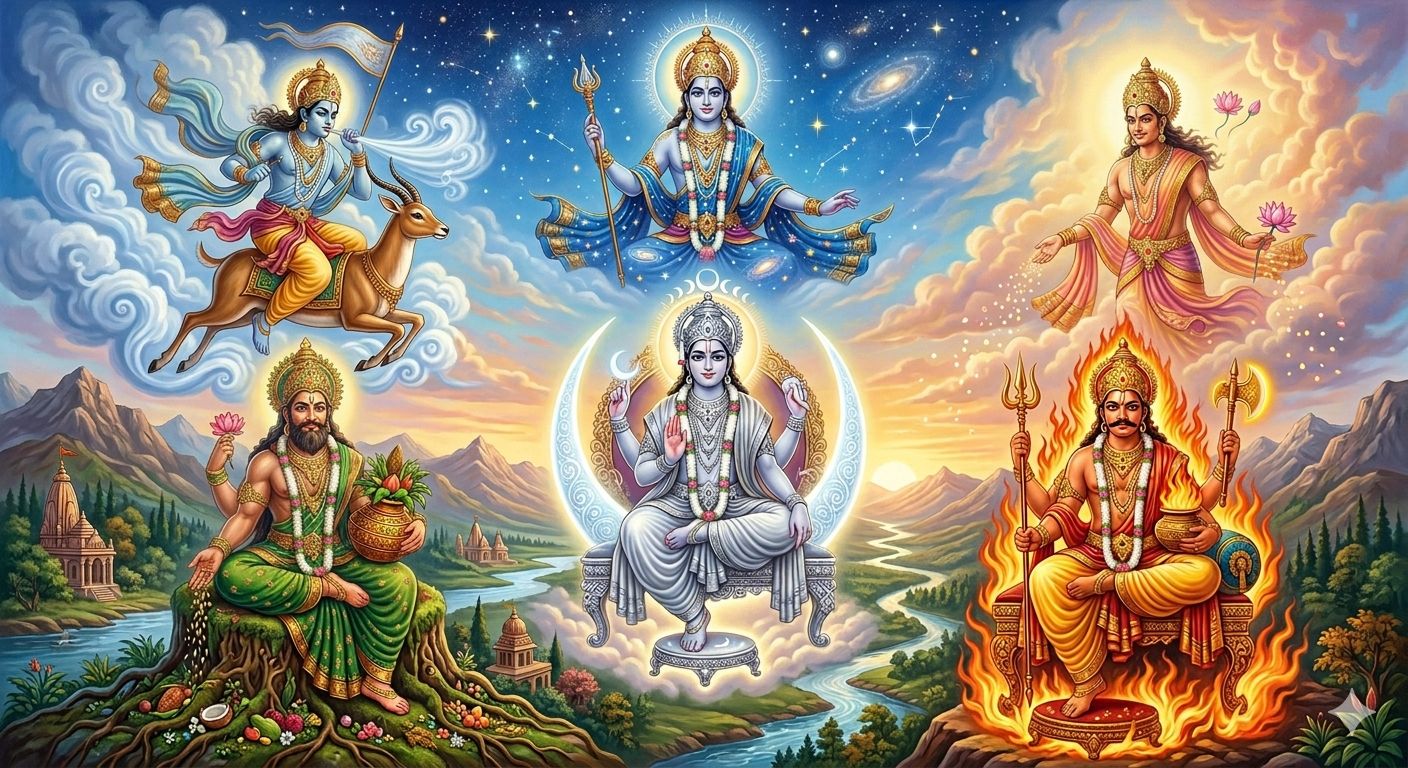
The remaining six Vasus each represent an elemental or cosmic principle: Soma (the moon, distinct from Soma the drink and Chandra the god), Dharitri (the earth, also called Dhara), Anila (the wind), Anala (fire, also called Agni in the Vasu context), Pratyusha (the dawn light), and Prabhasa (the shining sky). Together with Apa and Dhruva they form the eight Vasus — whose collective transgression produced one of the Mahabharata's greatest figures.
Symbols & Iconography
Birth & Origin
Born as a group — the Vasus are born to Kashyapa and Aditi or to Manu depending on the text. In the Mahabharata's most significant Vasu narrative, they are eight divine beings who committed a transgression that led to their curse and earthly birth.
Family
The eight Vasus together: Apa, Dhruva, Soma, Dharitri, Anila, Anala, Pratyusha, and Prabhasa. In the Mahabharata, Prabhasa is reborn as Bhishma — son of the goddess Ganga and King Shantanu.
Scriptures
The Vasus are named in the Taittiriya Samhita, Vishnu Purana, Bhagavata Purana, and the Mahabharata.
Worship & Legacy
The Vasus are invoked as a group in Vedic ritual. Their most enduring legacy is the Mahabharata story of Bhishma — one of the epic's central figures — whose entire existence is a consequence of their transgression and curse.
Key Stories
1. The Curse of Vasishtha and the Birth of Bhishma
In the Mahabharata, the eight Vasus visited the hermitage of the sage Vasishtha with their wives. One of their wives — the wife of Prabhasa — desired Vasishtha's divine cow Nandini (also called Kamadhenu). At her urging, Prabhasa stole the cow with the help of the other Vasus. Vasishtha, discovering the theft, cursed all eight Vasus to be born as mortals on earth. When the Vasus begged forgiveness, Vasishtha reduced the curse for seven of them — they would be born and die quickly. But Prabhasa, who had actually stolen the cow, would live a long human life bearing great suffering. The Vasus went to the goddess Ganga and asked her to be their mother and to release them from life quickly after birth. Ganga agreed, became the wife of King Shantanu, and drowned seven of her eight children at birth — releasing the seven Vasus from their curse immediately. The eighth child — Prabhasa reborn — she was prevented from drowning by Shantanu. This child grew up to become Bhishma, the greatest warrior and most tragic figure of the Mahabharata. (See also: Bhishma, Ganga, Shantanu)
The Maruts
The storm gods — sons of Rudra, companions of Indra, riders of the monsoon sky
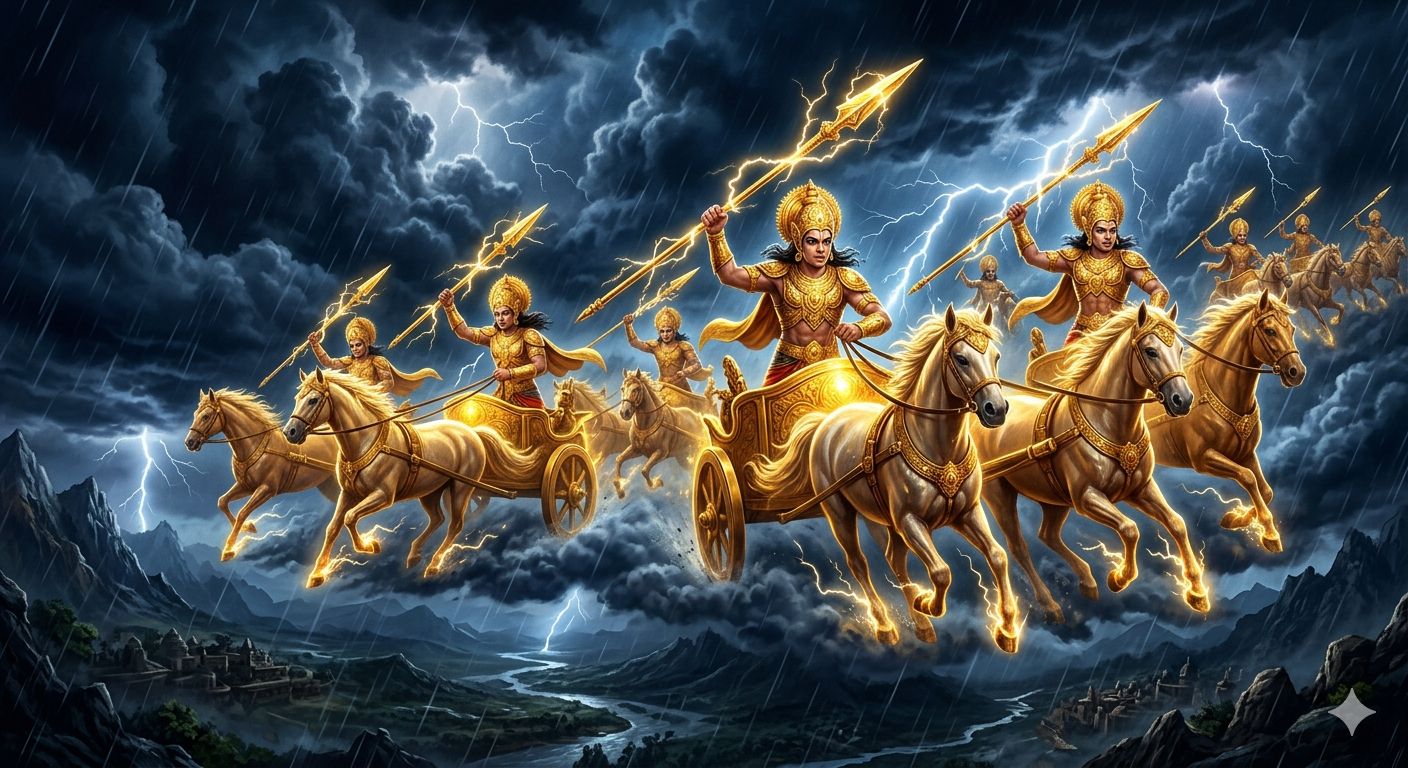
The Maruts are a group of storm gods — fierce, young, golden-armed divine warriors who ride across the sky in gleaming chariots, causing thunder, lightning, and rain. They are among the most hymned groups in the Rigveda, appearing in approximately 33 hymns. They are simultaneously the companions of Indra in his great battles and the sons of Rudra — which places them at the intersection of the two most important deities of the Rigveda. Their number varies — the Rigveda mentions 27, 49, or 180 Maruts. They are always described as a collective, never individually named with distinct mythologies.
Symbols & Iconography
Birth & Origin
In the Rigveda, the Maruts are sons of Rudra and Prishni (a cow or spotted goddess). In the Ramayana, Diti carried an embryo for a hundred years intending to birth a son who could destroy Indra. Indra entered the womb and shattered it into 49 pieces with his Vajra. Each piece became a Marut. Indra told each piece "do not weep" (ma ruda) — from which some scholars derive the name Marut. He then blessed them to become divine warriors.
Family
Father: Rudra (in the Rigveda). Born from Diti's womb (in the Ramayana). Their mother Prishni is described as a cow whose milk nourishes them.
Scriptures
The Maruts are hymned extensively in the Rigveda — approximately 33 hymns are addressed to them. They appear in the Atharvaveda, the Ramayana, the Mahabharata, and the Puranas.
Worship & Legacy
The Maruts have no independent temples or devotional tradition in modern Hinduism. They are invoked collectively in Vedic ritual. Their most enduring presence is in the Sri Rudram of the Yajurveda — addressed alongside Rudra as his divine retinue — and in the imagery of the monsoon storm, which in the Vedic imagination was always their chariot crossing the sky.
Key Stories
1. Maruts and Agastya
In the Mahabharata, the Maruts approached the sage Agastya asking to be born as his sons — wishing for a human birth with the sage's blessing. Agastya, after reflection, declined — he could see no lineage he could send them to where they would be born without reducing in stature. The Maruts remained divine and unborn in human form.
Divine Architects
The preceptors and craftsmen who sustain the divine order — teachers of gods, demons, and builders of celestial cities
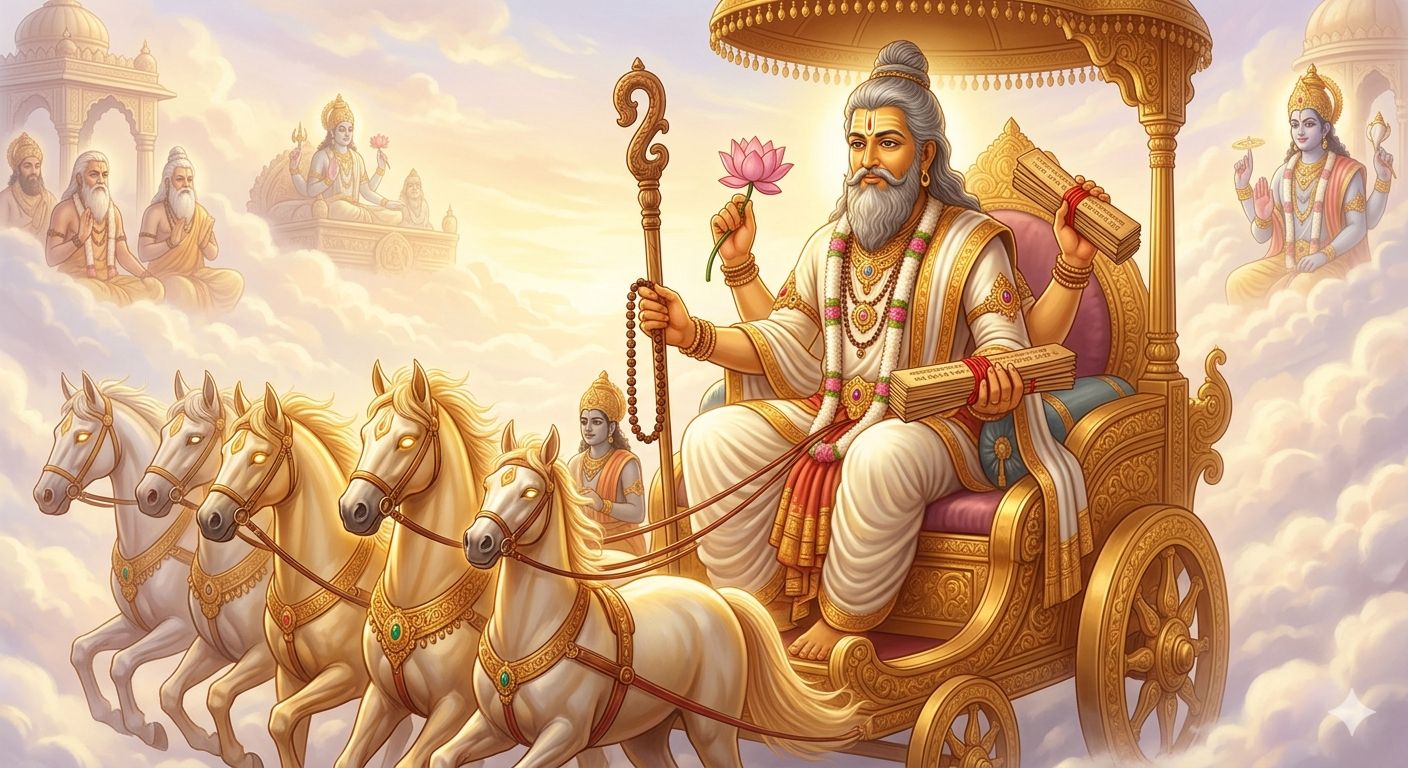
Brihaspati is the preceptor (guru) of the gods — the divine priest and teacher who guides the devas in matters of ritual, wisdom, and strategy. He is the lord of Jupiter (the planet), the largest and most auspicious of the Navagrahas, and Thursday (Guruvar or Brihaspativar) is his sacred day. He governs knowledge, eloquence, ritual correctness, and divine counsel. Also known as Guru (the teacher), Deva-guru, Vacaspati (lord of speech), and Angirasa (son of Angiras).
Symbols & Iconography
Birth & Origin
Son of the sage Angiras and a descendant of Brahma. In the Rigveda, Brihaspati is sometimes treated as an aspect of Agni — the divine priest of the sacrificial fire — or as a distinct deity associated with sacred speech and the power of prayer.
Family
Father: Angiras. First consort: Tara — who was abducted by Chandra (the moon god), leading to a war among the gods. Second consort: Mamata. Son through Tara's abduction: Budha (Mercury) — fathered by Chandra during Tara's captivity, a source of lasting shame and dispute.
Scriptures
Brihaspati appears in the Rigveda as Brahmanaspati across multiple books. He is prominent in the Mahabharata, the Vishnu Purana, and the Bhagavata Purana.
Worship & Legacy
Thursday (Brihaspativar/Guruvar) is his sacred day and is observed across India with prayers, yellow clothing, and offerings. He is one of the nine Navagrahas and is present in every Navagraha shrine in South Indian temples. The auspiciousness of Jupiter's position in the astrological chart governs marriage timing, business ventures, and major life decisions for millions of Hindus. The teacher-student relationship (guru-shishya) as a sacred bond in Hindu culture finds its divine model in Brihaspati.
Key Stories
1. Brihaspati in the Rigveda — Rigvedic
In the Rigveda, Brihaspati (also called Brahmanaspati) is the divine priest who accompanies Indra in his battles, smashing the cave where the demon Vala had imprisoned the dawn cows, and empowering the gods' actions with the force of sacred speech and ritual. He is the deity who demonstrates that the power of the word — properly used in ritual — can achieve what physical force cannot.
2. The Abduction of Tara and the Tarakamaya War
Chandra (the moon god) abducted Brihaspati's wife Tara and refused to return her despite demands from Brihaspati and the gods. A war broke out — the Tarakamaya war — with gods and demons taking different sides. Brahma eventually forced Chandra to return Tara. She was found pregnant with Chandra's son — Budha, who became the god of Mercury and ancestor of the lunar dynasty of kings. This story is told in the Vishnu Purana and the Mahabharata. (See also: Chandra, Tara, Budha)
3. Brihaspati Abandons the Gods
In the Bhagavata Purana, Indra once insulted Brihaspati by not rising to greet him when he arrived. Brihaspati, insulted, abandoned the gods without a word and disappeared. Without their preceptor, the gods lost their wisdom and ability to perform correct ritual. The demons, led by Shukracharya (their own preceptor), gained the advantage. Eventually Brihaspati returned, but the episode illustrates how dependent the gods were on his guidance.
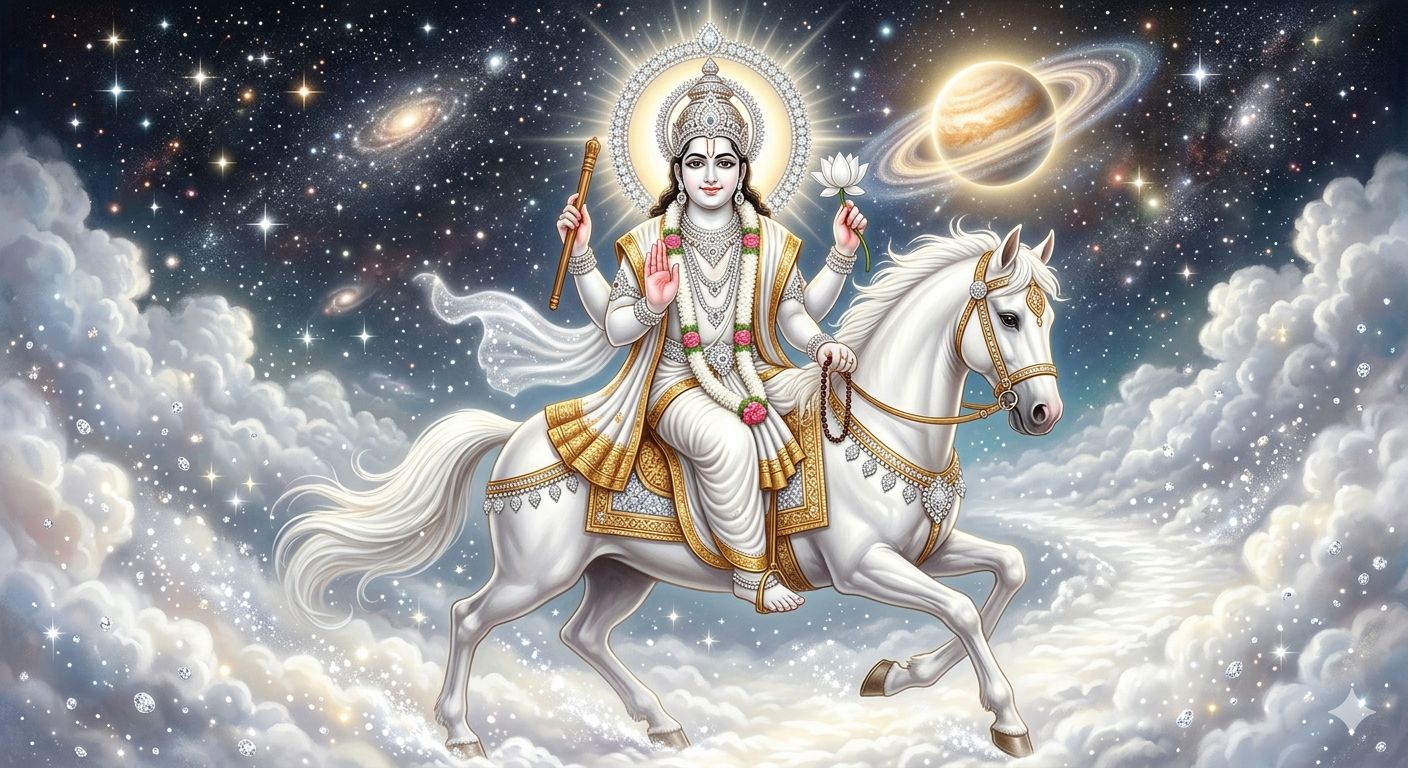
Shukra is the preceptor (guru) of the asuras (demons) — the divine teacher on the opposing side of the cosmic conflict that runs through Hindu mythology. He is also the lord of Venus (the planet Shukra), the second of the Navagrahas, and Friday (Shukravar) is his sacred day. He governs desire, material prosperity, the arts, beauty, and the Mritasanjivani — the secret knowledge of resurrecting the dead, which he alone among the gods and sages possesses. Also known as Shukracharya, Ushanas, Kavya, and Bhargava.
Symbols & Iconography
Birth & Origin
Son of the sage Bhrigu and his wife Puloma (or Kavyamata). As the son of Bhrigu he is one of the Bhargavas — a prestigious lineage of sages.
Family
Father: Bhrigu. Daughter: Devayani — whose romantic entanglement with the prince Yayati is one of the Mahabharata's significant narrative threads.
Scriptures
Shukra appears in the Rigveda as Ushanas and is elaborated in the Mahabharata, the Bhagavata Purana, and the Vishnu Purana. The Shukraniti (Shukra's code of governance) is attributed to him — a text on statecraft comparable to the Arthashastra.
Worship & Legacy
Friday (Shukravar) is his sacred day and is considered auspicious for matters of love, beauty, and financial dealings. He is one of the nine Navagrahas and is present in every Navagraha shrine. His position in a person's astrological chart governs marriage prospects and material prosperity in Jyotisha (Hindu astrology).
Key Stories
1. The Mritasanjivani — Knowledge of Resurrection
Shukra possessed the Mritasanjivani vidya — the knowledge of bringing the dead back to life. This gave the demons a crucial advantage in their wars with the gods. The gods sent Kacha — a young brahmin — to learn this knowledge from Shukra by becoming his student. Kacha won Shukra's favor and also the love of Devayani (Shukra's daughter). The demons, fearing Kacha would take this knowledge to the gods, killed him twice — the second time burning his body, mixing the ashes in wine, and feeding them to Shukra himself. Shukra, now containing Kacha within his own stomach, was compelled to teach Kacha the Mritasanjivani so Kacha could cut his way out of Shukra's body and restore him to life using the knowledge just received. Kacha took the knowledge back to the gods, breaking Devayani's heart in the process.
2. Shukra and Bali — Advisor at the Cosmic Sacrifice
When Vishnu in the form of Vamana (the dwarf) approached the demon-king Bali asking for three paces of land, Shukracharya saw through the disguise immediately and warned Bali not to grant the boon. He recognized Vishnu and knew the cosmic consequences. Bali, committed to his word as a generous host, overruled his teacher and granted the boon. Shukracharya, furious that his counsel was ignored, was literally ejected — in one version he was sitting in the spout of Bali's ritual water vessel to physically prevent the water of promise from pouring, and Vishnu poked a straw of grass into the spout, blinding Shukra in one eye. (See also: Vamana, Bali)
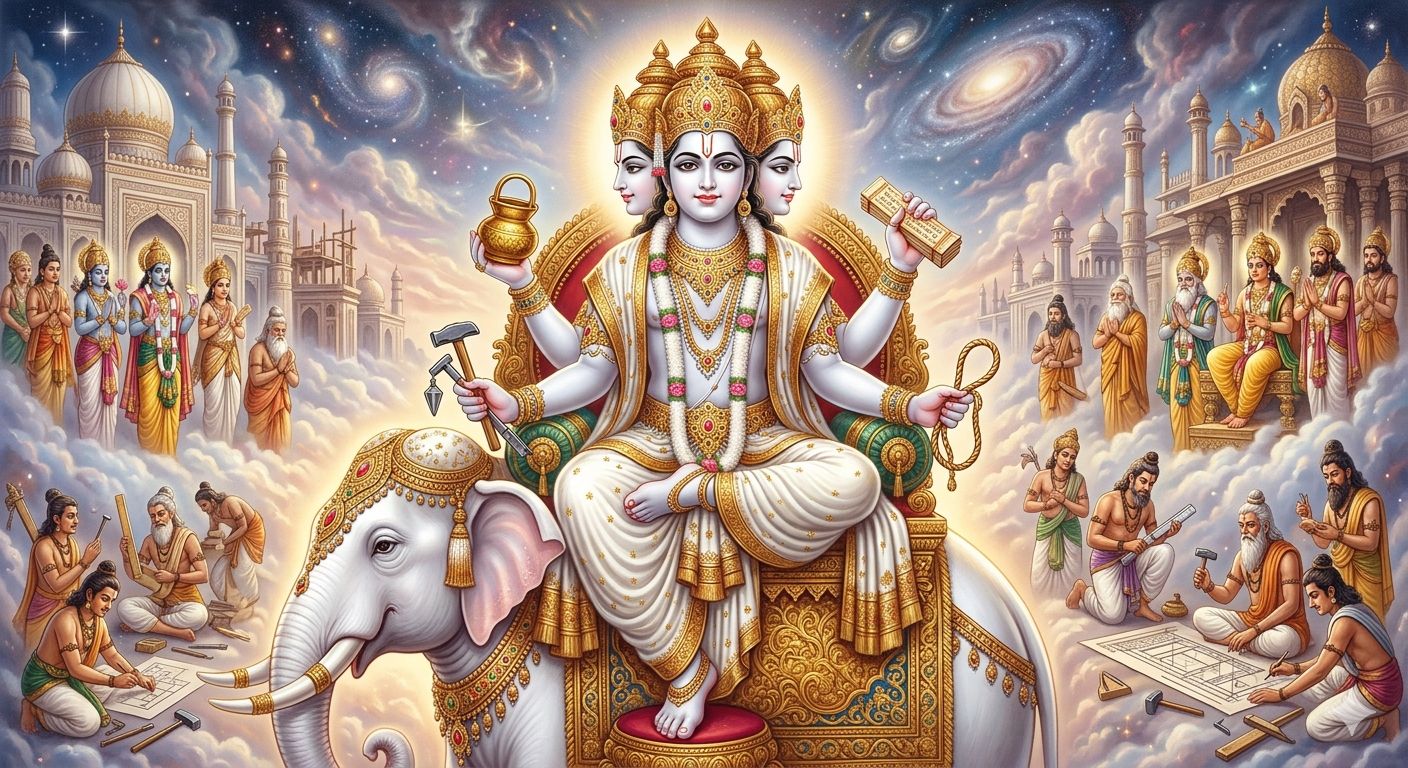
Vishwakarma is the divine craftsman and architect of the gods — the being who designed and built the celestial cities, divine weapons, and flying vehicles of the gods. He built Lanka (Ravana's golden city), Dwaraka (Krishna's city), Indraprastha (the Pandavas' city), and the celestial palace of Indra. He fashioned most of the divine weapons in the Hindu pantheon. Also known as Devashilpi (architect of the gods) and Prajapati Vishwakarma.
Symbols & Iconography
Birth & Origin
Son of Brahma in the Puranic tradition. Son of the Vasu Prabhasa and the sister of Brihaspati in the Mahabharata. In the Rigveda, his function overlaps significantly with Tvashtr.
Family
Father: Brahma or Prabhasa (depending on the text). Daughter: Sanjna (Saranyu) — who became the consort of Surya. He is the father-in-law of the sun.
Scriptures
Vishwakarma appears in the Rigveda (where his role overlaps with Tvashtr), the Mahabharata, the Ramayana, the Vishnu Purana, and the Puranas describing the construction of celestial cities.
Worship & Legacy
Vishwakarma Puja is celebrated on Vishwakarma Jayanti — falling on the last day of the Bengali month of Bhadra (typically September 17) — across factories, workshops, and industrial sites throughout India. Every artisan, engineer, and craftsman community in India acknowledges Vishwakarma as their patron. He is also the patron deity of the Indian Air Force and is worshipped at aircraft maintenance facilities.
Key Stories
1. The Reduction of Surya's Radiance
When his daughter Sanjna could not bear the full radiance of her husband Surya and fled to the forest, Vishwakarma brought Surya to his divine workshop and shaved off a portion of his light on a lathe — reducing his radiance to a bearable level. From the shaved-off solar material, Vishwakarma fashioned Vishnu's Sudarshana Chakra, Shiva's Trishula, Indra's Vajra (in some versions), and several other divine weapons. (See also: Surya, Sanjna)
2. The Building of Lanka
Vishwakarma built Lanka — the golden city on an island — for Kubera, the god of wealth. The city was made of gold and precious stones and was considered the most magnificent structure in the world. When Ravana seized Lanka from Kubera, he inherited Vishwakarma's creation. After Ravana's death, Vibhishana became Lanka's ruler. (See also: Kubera, Ravana)
3. The Building of Dwaraka
When Krishna established his kingdom after leaving Mathura, Vishwakarma built Dwaraka — an underwater city of extraordinary beauty — in a single night. The city rose from the ocean fully formed. It sank back into the ocean after Krishna's departure from the earth. Archaeological surveys in the Gulf of Khambhat have found submerged structures that some researchers associate with the mythological Dwaraka. (See also: Krishna)
The Navagrahas
The nine planetary deities — governing time, karma, and the course of every human life
Also in this page — click to visit
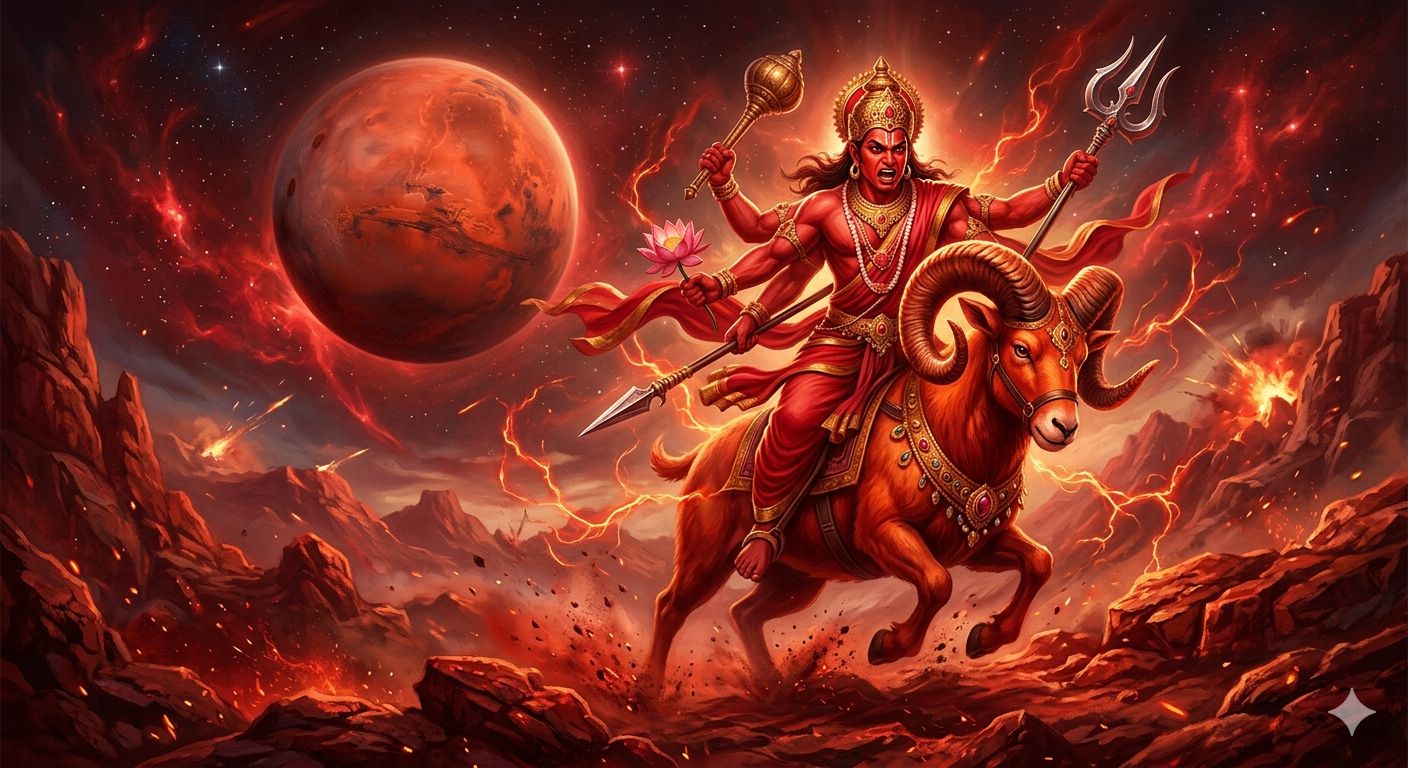
Mangala is the god of the planet Mars — the red planet, associated with energy, war, ambition, courage, and conflict. He is considered the most fiery and aggressive of the Navagrahas. A malefic placement of Mangala in a person's birth chart — particularly the Mangal Dosha (Mars affliction) — is taken seriously in Hindu astrology, especially regarding marriage compatibility. He rules Tuesday (Mangalavar). Also known as Angaraka (the red one), Kuja, Bhauma (son of the earth), and Lohitanga (red-limbed).
Symbols & Iconography
Birth & Origin
In the Shiva Purana and the Varaha Purana, Mangala was born from a drop of Shiva's sweat — or from the earth goddess Prithvi — when Shiva was in intense meditation. He is called Bhauma (son of Bhumi/Prithvi) because he was born from the earth. In the Vishnu Purana, he was born when Vishnu in the form of Varaha (the boar) lifted the earth goddess from the cosmic ocean — a drop of sweat from Varaha's brow fell and became Mangala.
Family
Mother: Prithvi (the earth goddess). Father: Shiva or Varaha-Vishnu depending on the text.
Scriptures
Mangala appears in the Shiva Purana, Varaha Purana, Vishnu Purana, and astrological texts including the Brihat Parashara Hora Shastra.
Worship & Legacy
Tuesday is his sacred day. Mangala is worshipped in Navagraha shrines across South India. His most celebrated independent temple is the Mangalnath Temple in Ujjain, Madhya Pradesh — considered by some texts to be the birthplace of Mars. Offerings of red items — red lentils, red cloth, red flowers — are made to him. He is propitiated to reduce the effects of Mangal Dosha and to grant courage and success in competitive endeavors.
Key Stories
Mangala has no independent narrative mythology. His significance is primarily astrological — his birth from the earth goddess Prithvi is the central mythological fact, described in Birth & Origin above.
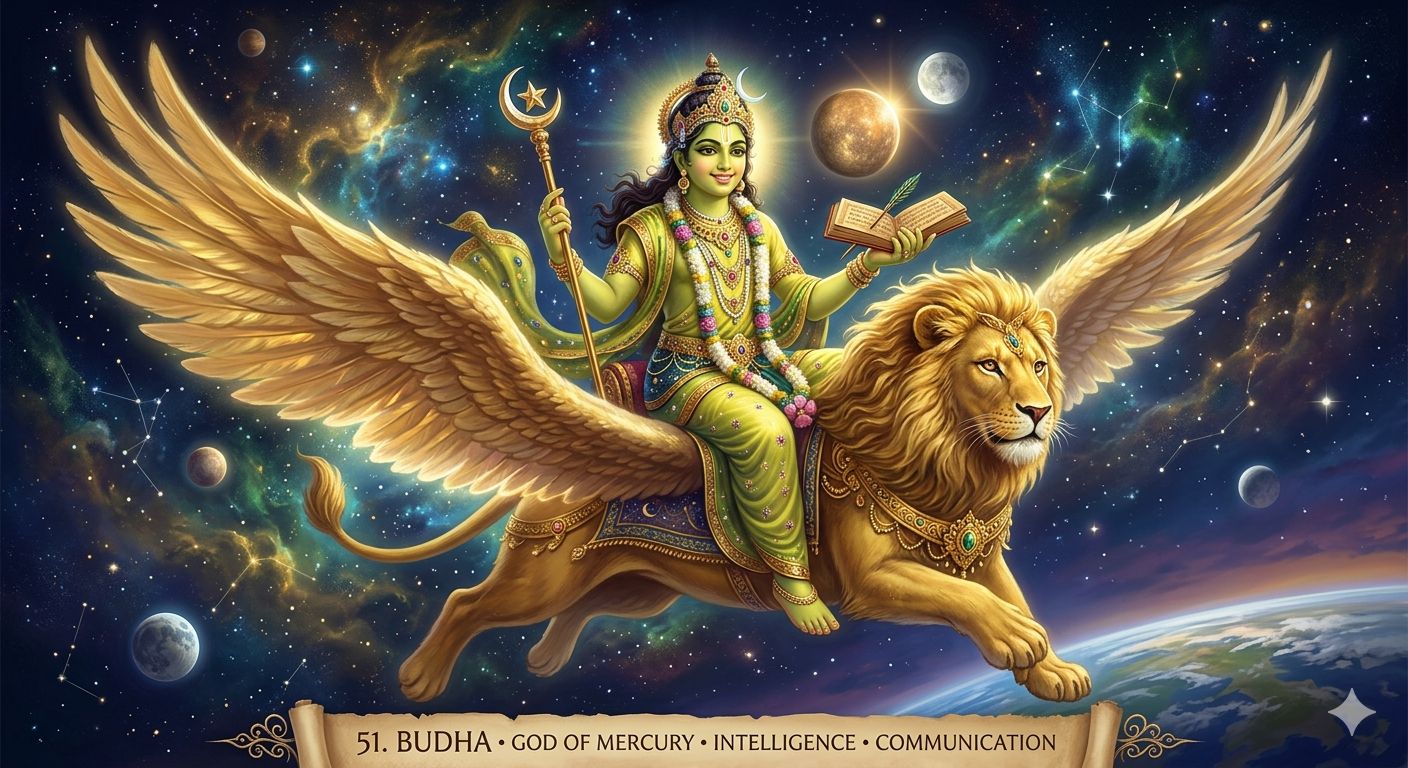
Budha is the god of the planet Mercury — the planet of intellect, communication, trade, and learning. He governs Wednesday (Budhavar) and rules over intelligence, speech, business acumen, and adaptability. He is distinct from the Buddha of Buddhism — the name is spelled and pronounced differently in Sanskrit and shares only an etymological root meaning "awakened" or "intelligent." Also known as Soumya (gentle) and Rauhineya (son of Rohini).
Symbols & Iconography
Birth & Origin
Son of Chandra (the moon god) and Tara — the wife of Brihaspati, who was abducted by Chandra. His birth was contested — Brihaspati claimed Tara's son as his own, Chandra claimed paternity. When Brahma intervened and compelled Tara to name the father, she admitted it was Chandra. Budha was thus born from an adulterous union, making his origins a source of shame and complexity from the beginning.
Family
Father: Chandra (the moon). Mother: Tara (wife of Brihaspati). He married Ila (in some versions a king transformed into a woman). Their son: Pururavas — the ancestor of the Chandravamsha (lunar dynasty) from which the Pandavas and Kauravas descend.
Scriptures
Budha appears in the Vishnu Purana, Mahabharata, and astrological texts. His parents' story — the Tarakamaya war — appears in multiple Puranas.
Worship & Legacy
Wednesday (Budhavar) is his sacred day, considered auspicious for business, communication, and learning. Budha is worshipped in Navagraha shrines. His most celebrated temple is the Thingalur Kailasanathar Temple in Tamil Nadu, where he is the presiding Navagraha. Green offerings — green gram, emeralds, green cloth — are made to him.
Key Stories
1. The Birth from Tara's Shame
Budha was born from Chandra's union with Tara during her captivity — his paternity disputed, acknowledged only when Brahma compelled Tara to speak. (See Brihaspati entry 31 for the full Tarakamaya war narrative.)
2. Pururavas and Urvashi
Budha's son Pururavas fell in love with the Apsara Urvashi and they lived together under conditions she set — conditions he eventually broke. Urvashi left him and he searched for her across the earth. Their reunion and separation is told in the Rigveda (one of the earliest dialogues in Sanskrit literature) and elaborated in the Vishnu Purana. Pururavas became the ancestor of both the Pandavas and the Kauravas — making Budha the ultimate divine ancestor of the Mahabharata's central characters.
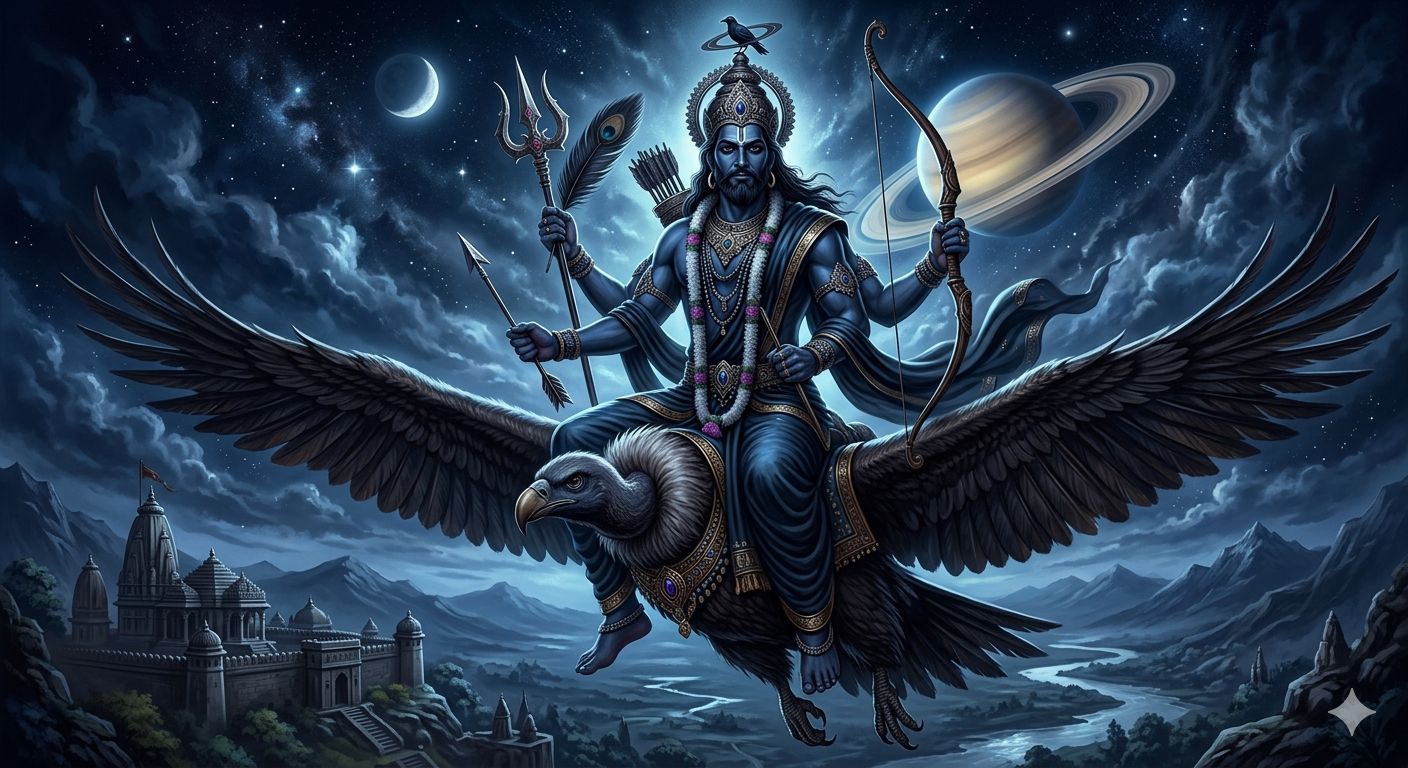
Shani is the god of the planet Saturn — the most feared of the Navagrahas. He governs karma, discipline, justice, hardship, delay, and the consequences of past actions. His influence is slow and heavy — his planet takes approximately 29 years to complete its orbit. He is both the strictest judge and the greatest teacher — his hardships are understood as karmic corrections rather than punishments. He rules Saturday (Shanivar). Also known as Shanaischarya (the slow mover), Krura (the cruel one), and Manda (the slow).
Symbols & Iconography
Birth & Origin
Son of Surya and Chhaya — the shadow-double that Sanjna created and left in her place. Shani was born dark because his mother Chhaya performed austerities to Shiva during her pregnancy. When Surya first saw his dark son, he doubted Chhaya's fidelity. Shani, enraged at his father's rejection, turned his gaze on Surya and caused the sun to waver in the sky. Surya eventually accepted him. Shani's difficult relationship with his father Surya is considered the source of his complex, austere nature.
Family
Father: Surya. Mother: Chhaya (shadow-double of Sanjna). Half-siblings: Yama, Yami, and Vaivasvata Manu (through Sanjna). Brother: Savarni Manu (through Chhaya).
Scriptures
Shani appears in the Brahmanda Purana, the Skanda Purana, the Shiva Purana, and astrological texts. The Shani Mahatmya — the glory of Shani — is recited on Saturdays in his worship.
Worship & Legacy
Shani is the most actively propitiated of the Navagrahas. Saturday (Shanivar) is his sacred day, widely observed with prayers, fasting, and offerings of sesame oil, black sesame seeds, black cloth, and blue flowers. The Shani Shingnapur temple in Maharashtra and the Thirunallar Saniswara temple in Tamil Nadu are his most important shrines. His worship involves pouring sesame oil over his image — a practice still performed by millions weekly. The concept of Sade Sati shapes major life decisions for hundreds of millions of people.
Key Stories
1. Shani's Gaze and Its Consequences
Shani is most famous for the devastating effects of his direct gaze. His glance is so powerful that it brings catastrophe — this is the theological basis for the concept of Shani's evil eye in Hindu astrology. The most dramatic story of his gaze involves Ganesha — when Shani looked directly at the infant Ganesha at his birth, the child's head was separated from his body. Parvati, furious, cursed Shani to always look downward. As a result, Shani is depicted in iconography looking down or sideways — never directly forward.
2. Shani and the King Vikramaditya
In one of the most famous stories of Shani's influence, the great king Vikramaditya of Ujjain once ranked the planets in order of power. Shani, placed last, was displeased. He told Vikramaditya that the 7.5-year period of Sade Sati — Saturn's transit over the moon sign — would test even the greatest king. During Shani's period, Vikramaditya lost his kingdom, was sold into slavery, had his hands cut off, and suffered every indignity. He ultimately regained everything at the end of the Saturn period and acknowledged Shani's supreme power among the planets.
3. Shani and Ravana
In the Ramayana tradition, Ravana once imprisoned all the Navagrahas and forced them to occupy auspicious positions in his son Indrajit's astrological chart to make him invincible. Shani, at the urging of Hanuman, moved one leg out of position — placing himself in the twelfth house instead — which introduced a fatal flaw into Indrajit's chart and eventually contributed to his defeat.
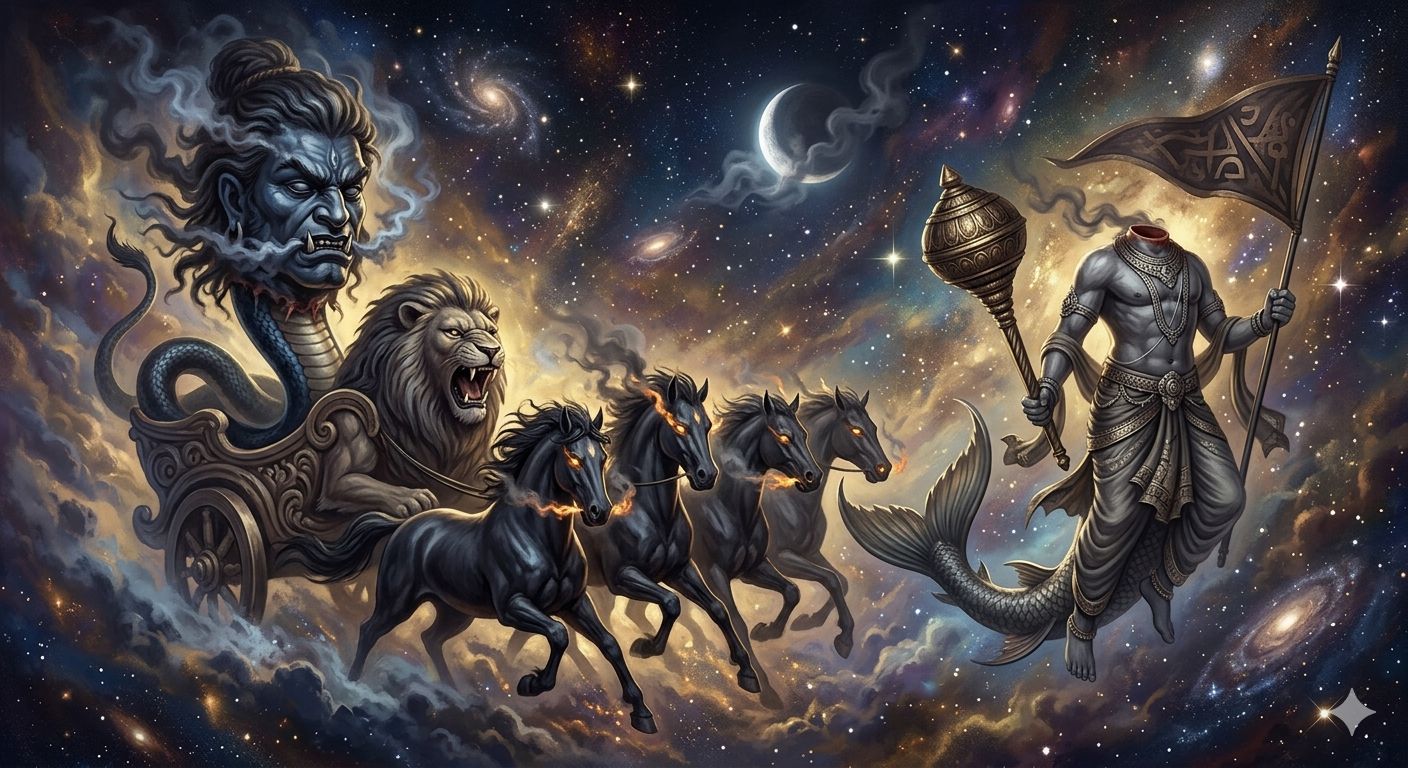
Rahu is one of the two shadow planets (Chaya Grahas) in Hindu astrology — not a visible celestial body but the north node of the moon. In mythology he is the severed head of a demon who drank the nectar of immortality. He governs illusion, obsession, worldly desire, foreign influences, and the unexpected. Ketu is the headless body — the south node — governing detachment, renunciation, and moksha (liberation). Together they are two halves of the demon Svarbhanu, severed by Vishnu's discus.
Symbols & Iconography
Birth & Origin
Rahu and Ketu were born as Svarbhanu — an asura (demon) who disguised himself as a god during the distribution of the Amrita (nectar of immortality) after the Samudra Manthan. He sat between Surya and Chandra and drank the nectar. Surya and Chandra recognized him and alerted Vishnu, who immediately severed Svarbhanu's head with his Sudarshana Chakra. But the head had already swallowed the nectar and thus became immortal. The head became Rahu, the tail became Ketu.
Family
The two halves of the demon Svarbhanu. Both are aspects of the same being — separated for eternity.
Scriptures
Rahu appears in the Mahabharata, the Bhagavata Purana, the Vishnu Purana, and extensively in the astrological literature — the Brihat Parashara Hora Shastra and the Brihat Samhita. The Rigveda contains a reference (5.40) to Svarbhanu — an asura who darkened the sun — one of the earliest textual acknowledgments of the eclipse phenomenon in Indian literature.
Worship & Legacy
Rahu has dedicated shrines in Navagraha temples across South India. The Thirunageswaram Rahu temple in Tamil Nadu is the most significant. Rahu Kalam — the inauspicious period attributed to Rahu each day, lasting approximately 90 minutes — is widely observed across South India. Ketu's most significant temple is the Keezhperumpallam temple in Tamil Nadu. Offerings of grey items, sesame seeds, and kusha grass are made to Ketu.
Key Stories
1. The Drinking of Amrita — Puranic
The story of Svarbhanu's deception and Vishnu's severing of his head is the central Rahu-Ketu myth, told in the Mahabharata and the Bhagavata Purana. Svarbhanu disguised himself as a god and drank the nectar of immortality during the Samudra Manthan distribution. Surya and Chandra, sitting on either side of him, recognized the impostor and warned Vishnu. Vishnu's Sudarshana Chakra severed Svarbhanu's neck instantly — but a split second too late. The nectar had already passed the throat. Both halves became immortal. From this origin comes the explanation for solar and lunar eclipses: Rahu and Ketu periodically swallow the sun and moon in revenge for exposing him, causing the sky to darken.
2. Rahu and the Eclipses
The swallowing of the sun by Rahu during a solar eclipse and the moon during a lunar eclipse is the mythological explanation for these astronomical events. During eclipses, Hindus traditionally bathe in sacred rivers, fast, and chant — the eclipse is a time of cosmic disruption when Rahu momentarily succeeds in his revenge against Surya and Chandra. The brevity of the eclipse is explained by Rahu's severed neck — the sun or moon slips out before it can be fully swallowed.