
- Creation of the Universe
- Creation of Adam
- Creation of Eve
- The Garden, the Forbidden Tree & the Fall
- Origin of Iblis / Satan
- Origin of All Animals
- Origin of Angels
- Origin of the Jinn
Story 1: Creation of the Universe
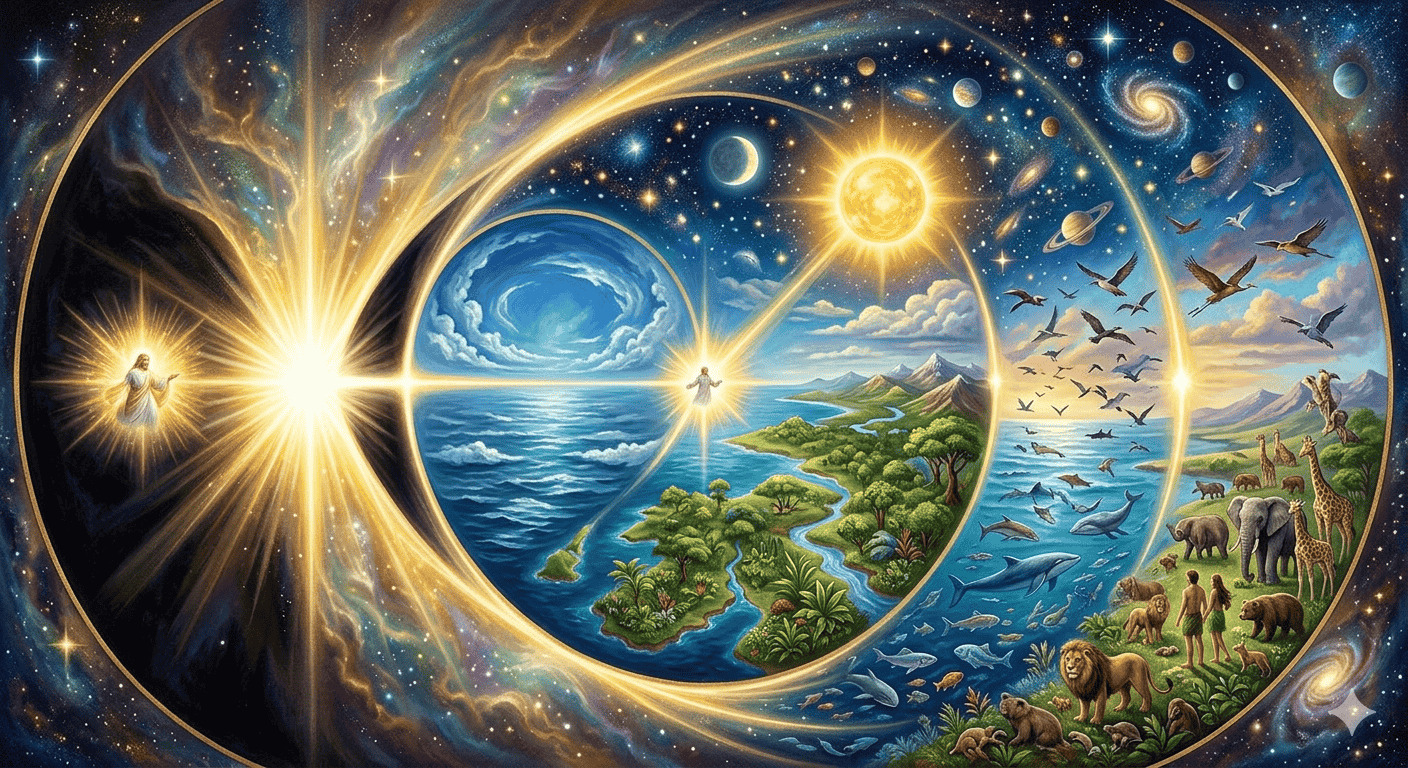
Core narrative: God created the universe and everything in it in six days/periods in a specific sequence — light, sky, land, vegetation, celestial bodies, creatures, and finally humans.
Sources that share this core:
- Torah/Bible — Genesis 1:1-2:3
- Quran — Surah Al-Anbiya 21:30
- Quran — Fussilat 41:9-12
- Quran — Al-Araf 7:54
- Quran — Yunus 10:3
- Quran — Al-Furqan 25:59
- Quran — As-Sajdah 32:4
- Book of Jubilees 2:1-16
- 1 Enoch 1:1-9
Differences:
- Genesis 1:1-2:3 (Torah/Bible): Day 1: light separated from darkness. Day 2: firmament (raqia) created separating waters above from waters below. Day 3: dry land gathered, seas named, vegetation created. Day 4: sun, moon, and stars placed in the firmament. Day 5: sea creatures and birds created and told to multiply. Day 6: land animals created, then man and woman together in God's image (tzelem Elohim), given dominion over all creatures. Day 7: God rested and sanctified the day. Notably the earth is described as tohu vavohu (formless and void) before God begins — something already existed before the first creative act.
- Quran — Fussilat 41:9-12 (most detailed Quranic account): God created the earth in two days (ayyam). Then placed mountains and decreed sustenance over four days total. Then turned to the sky which was smoke (dukhan) and formed it into seven heavens in two days. Total: six periods. The word ayyam means both days and long periods — Islamic scholarship generally interprets these as epochs not literal 24-hour days. Crucially the sequence differs from Genesis — earth is created before the sky here.
- Quran — Al-Anbiya 21:30: The heavens and earth were one joined entity (ratqan) and God split them apart (fataqnahuma). This is the only place in Abrahamic scripture where the universe begins as a unified state that was then separated.
- Book of Jubilees 2:1-16 (Ethiopian Orthodox): Follows Genesis's six-day sequence but adds that seven categories of angels were created on the first day along with light — angels of the presence, sanctification, fire, wind, clouds, darkness, and snow and hail. Genesis does not mention angels being created at all.
- 1 Enoch 1:1-9 (Ethiopian Orthodox): Does not describe the mechanics of creation but frames the entire created order — mountains, valleys, rivers, stars — as having been set in their places by God before the present age, with everything in creation subject to his command and seasonal order.
Story 2: Creation of Adam
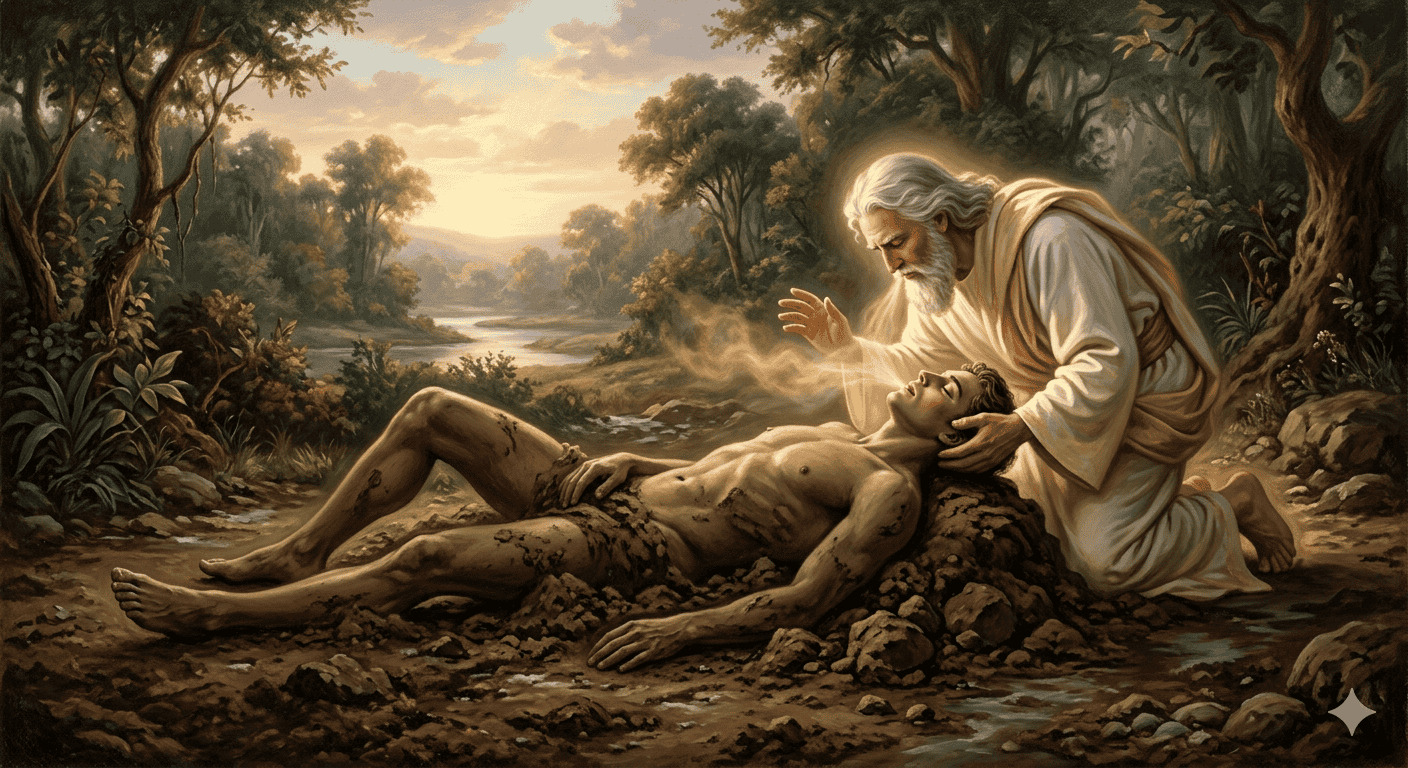
Core narrative: God created the first man from earth/dust/clay and breathed life into him.
Sources that share this core:
- Torah/Bible — Genesis 2:4-7
- Quran — Al-Baqarah 2:30-33
- Quran — Al-Hijr 15:26-29
- Quran — As-Sajdah 32:7-9
- Quran — Al-Araf 7:11-12
- Quran — Sad 38:71-72
Differences:
- Genesis 2:4-7 (Torah/Bible): God formed (yatsar) man from dust of the ground (afar min ha-adamah) and blew into his nostrils the breath of life (nishmat chayyim) — man became a living soul (nefesh chayya). The name Adam derives from adamah meaning ground.
- Quran — Al-Hijr 15:26, Sad 38:71: Adam was created from dried clay (salsalin) of black mud (hama'in masnun). Surah Al-Araf 7:12 adds the material contrast when Iblis refuses to bow — "I am better than him, you created me from fire and him from clay."
- Quran — As-Sajdah 32:7-9: God began creating Adam from clay, then made his progeny from semen, then breathed his spirit into him. This surah explicitly distinguishes between Adam's unique creation (clay + divine breath) and all subsequent humans (born from semen).
Story 3: Creation of Eve
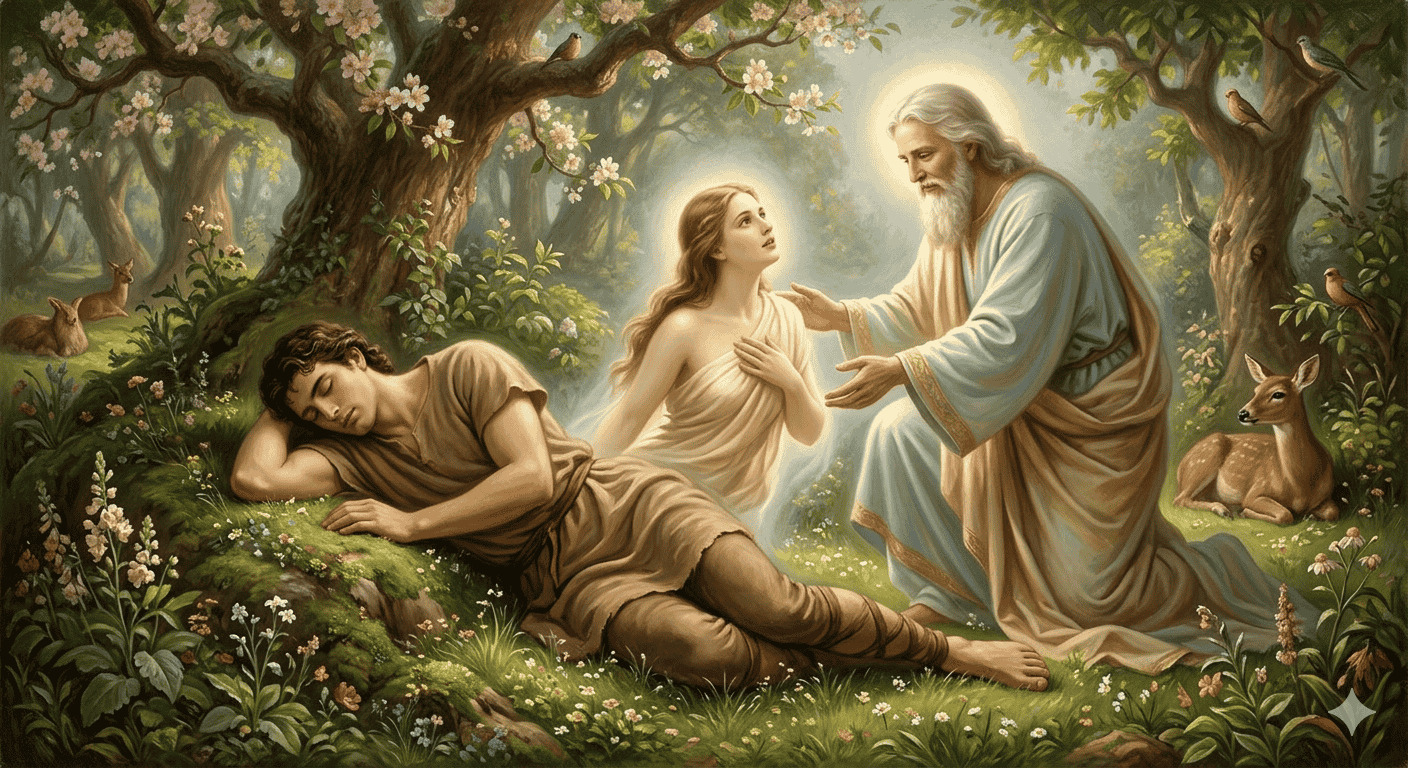
Core narrative: God created a female companion for Adam from part of Adam's body.
Sources that share this core:
- Torah/Bible — Genesis 2:18-23
- Quran — An-Nisa 4:1
- Book of Jubilees 3:1-7
Differences:
- Genesis 2:18-23 (Torah/Bible): God said it was not good for man to be alone. He brought all animals to Adam to name — none was a suitable partner. God caused Adam to sleep, took one of his ribs (tzela), and built it into a woman. Adam said "bone of my bones and flesh of my flesh — she shall be called woman (ishah) because she was taken from man (ish)."
- Quran — An-Nisa 4:1: God created humanity from a single soul (nafs wahida) and created from it its mate. No method of Eve's creation is specified in the Quran — the rib tradition is accepted in Islamic scholarship through tafsir but is not in the Quran itself.
- Book of Jubilees 3:1-7 (Ethiopian Orthodox): Eve was made from Adam's rib on the sixth day but kept in the eastern section of the garden for 80 days before being brought to Adam. The 40/80 day gap mirrors Jewish purification laws for male and female births in Leviticus — applying those laws retroactively to the first man and woman.
Story 4: The Garden, the Forbidden Tree & the Fall
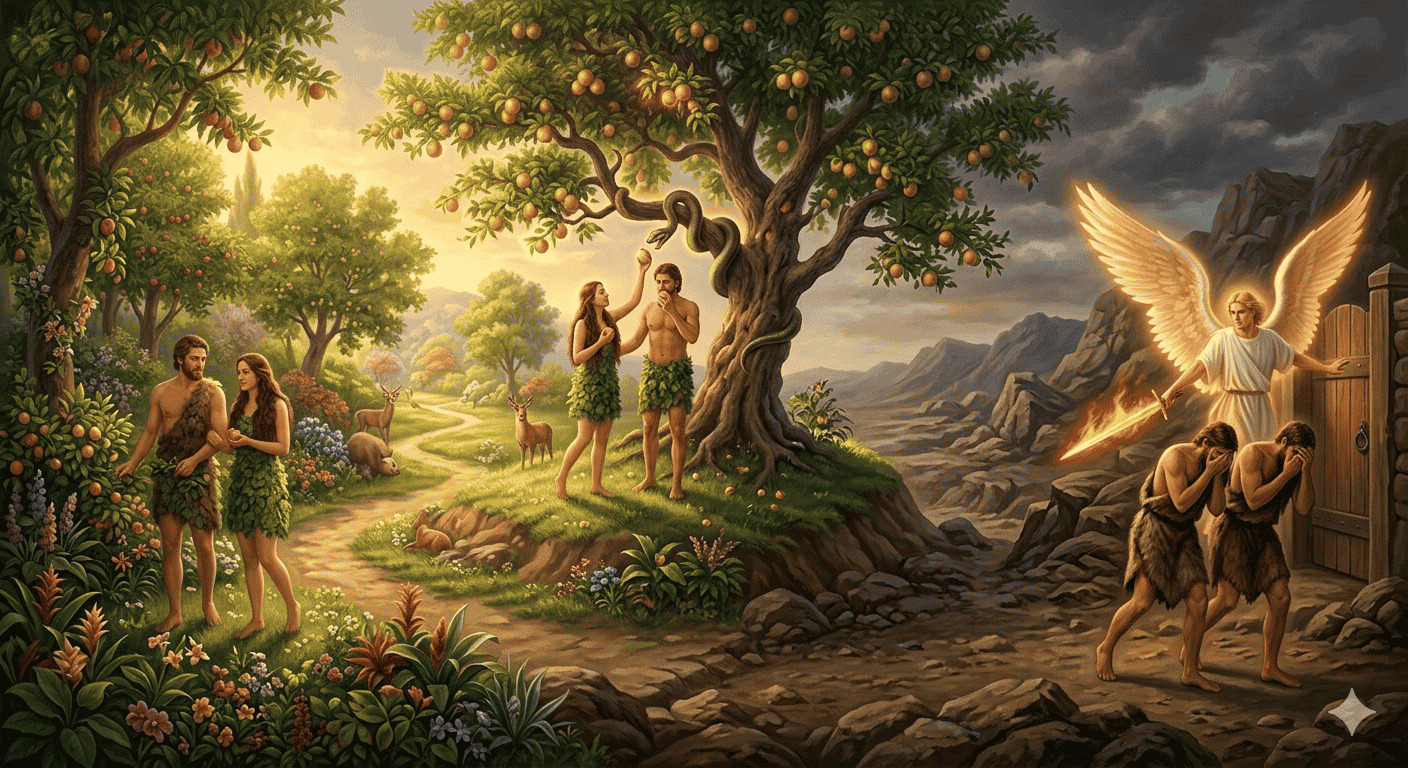
Core narrative: God placed Adam and Eve in a garden, forbade one tree, Satan tempted them, they ate, and were expelled.
Sources that share this core:
- Torah/Bible — Genesis 2:8-3:24
- Quran — Al-Baqarah 2:35-39
- Quran — Al-Araf 7:19-25
- Quran — Ta-Ha 20:117-123
- Book of Jubilees 3:1-35
Differences:
- Genesis 2:8-3:24 (Torah/Bible, most detailed): The garden contained two special trees — the Tree of Life and the Tree of Knowledge of Good and Evil. Adam was forbidden the latter or he would die. The serpent (nachash) told Eve she would not die but would become like God knowing good and evil. Eve ate and gave to Adam. Their eyes opened — they knew they were naked. God questioned them — Adam blamed Eve, Eve blamed the serpent. God cursed the serpent to crawl on its belly with enmity between it and humans forever. Eve received pain in childbirth and subordination to her husband. Adam received toil and sweat. Both were expelled. Cherubim with a flaming sword were placed to guard the Tree of Life.
- Quran — Al-Baqarah 2:35-36: The tree is not named. Satan caused them to slip (azallahumash-shaytan) from their state. God said "Go down as enemies to one another — on earth you will have a dwelling for a time." Critically God immediately accepted Adam's repentance after the fall — Adam and Eve are forgiven in the Quran. There is no permanent curse on them or their descendants. This is the single most significant difference between the Biblical and Quranic accounts.
- Quran — Ta-Ha 20:117-121: Satan whispered to Adam specifically — not Eve — saying "Shall I lead you to the Tree of Eternity and a kingdom that never decays?" Both then ate. This directly contradicts Genesis where the serpent approaches Eve first.
- Quran — Al-Araf 7:20: Satan whispered to both together — "Your Lord only forbade you this tree lest you become angels or become immortal." The temptation here is immortality and angelic status rather than knowledge of good and evil.
- Book of Jubilees 3:1-35 (Ethiopian Orthodox): The most chronologically precise account. The temptation occurred on the seventeenth day of the third month. All animals lost the ability to speak at the moment of the fall — the serpent had been the only animal with speech. Specific purification periods were assigned before Adam and Eve could begin working the earth after expulsion.
Story 5: Origin of Iblis / Satan
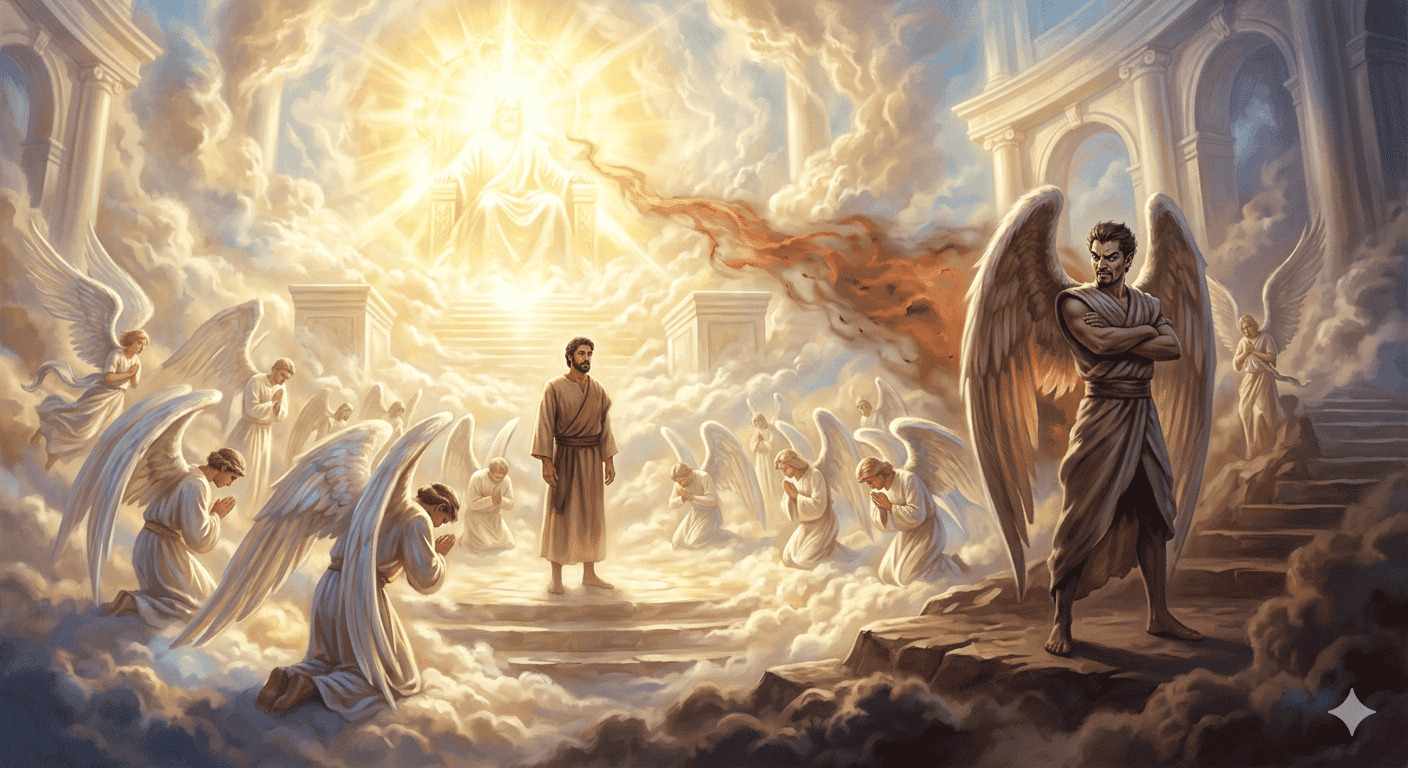
Core narrative: God commanded all angels to bow to Adam. All bowed except Iblis who refused out of pride, was expelled, and became the eternal adversary of humanity.
Sources that share this core:
- Quran — Al-Baqarah 2:30-34
- Quran — Al-Araf 7:11-18
- Quran — Al-Hijr 15:28-44
- Quran — Al-Isra 17:61-65
- Quran — Al-Kahf 18:50
- Quran — Sad 38:71-85
- Torah/Bible — Isaiah 14:12-15
- Torah/Bible — Ezekiel 28:12-17
Differences:
- Quran — Al-Baqarah 2:30-34: God announced to the angels he was placing a khalifa on earth. They questioned this. God taught Adam the names of all things and tested the angels — they could not name them. Adam named them all demonstrating his unique knowledge. God commanded all to bow — all did except Iblis.
- Quran — Sad 38:75-85 (most detailed exchange): God asked Iblis directly — "What prevented you from bowing?" Iblis replied "I am better than him — you created me from fire and him from clay." God expelled him. Iblis asked for respite until the Day of Resurrection — God granted it. Iblis declared he would mislead all of Adam's descendants except God's sincere servants.
- Quran — Al-Kahf 18:50: Iblis is explicitly identified as one of the Jinn (min al-jinn) — not an angel. This is the only verse that states this directly. The majority position in Islamic scholarship is that Iblis was a Jinn who had risen among the angels through worship and piety, which is why the command to bow applied to him.
- Isaiah 14:12-15 (Torah/Bible) — disputed: Describes a being who said "I will ascend to heaven, I will raise my throne above the stars of God, I will make myself like the Most High" — and was cast down. Christian tradition reads this as describing Satan's original fall from heaven. Jewish tradition reads it as a taunt against the king of Babylon — not a reference to Satan at all.
- Ezekiel 28:12-17 (Torah/Bible) — disputed: Describes a being who was "the seal of perfection, full of wisdom and perfect in beauty" — a guardian cherub in Eden, blameless from the day of his creation until wickedness was found in him and he was expelled. Christian tradition reads this as Satan's original state and fall. Jewish tradition reads it as referring to the king of Tyre.
Story 6: Origin of All Animals and Living Creatures
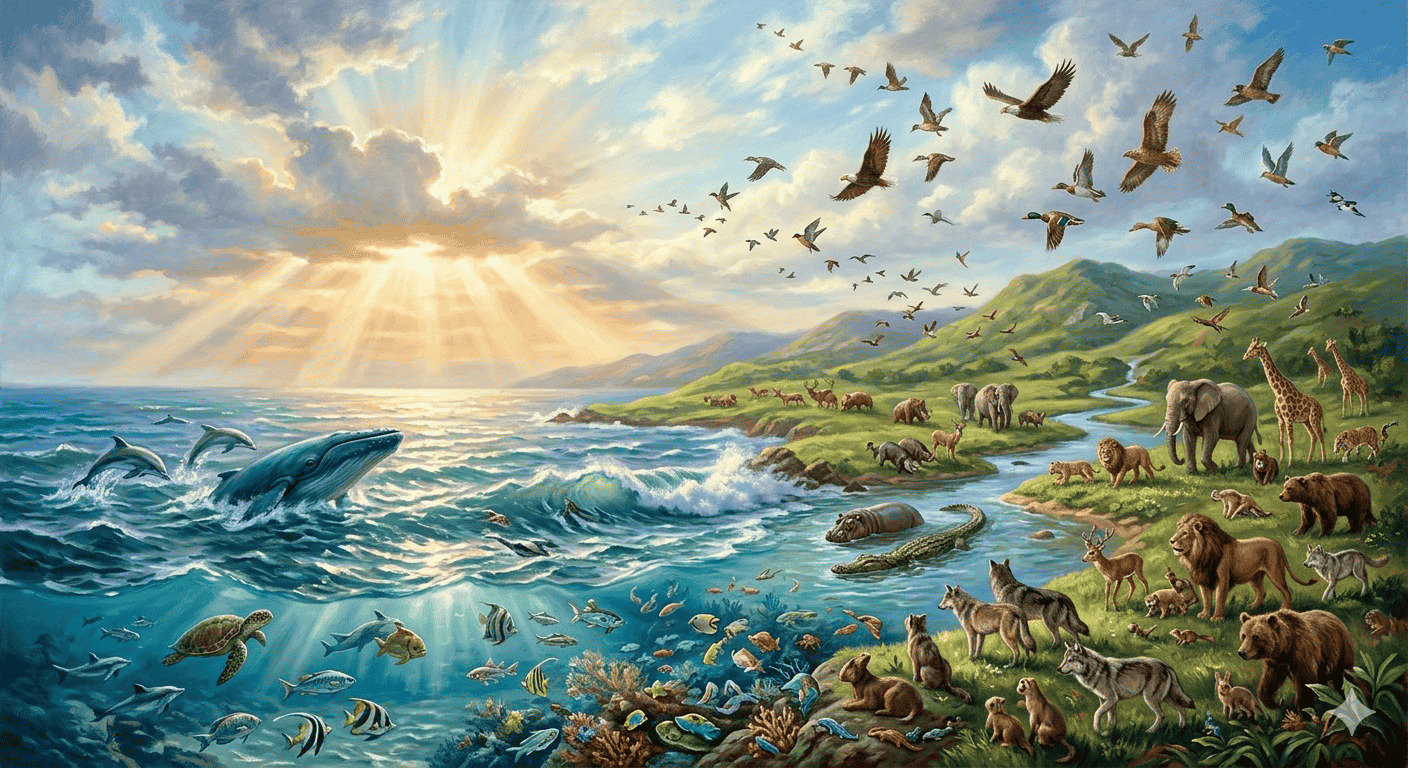
Core narrative: God created all animals, birds, sea creatures, and living beings as part of the six days of creation.
Sources that share this core:
- Torah/Bible — Genesis 1:20-25
- Torah/Bible — Genesis 2:19
- Quran — Al-Anbiya 21:30
- Quran — An-Nur 24:45
- Book of Jubilees 2:11-13
Differences:
- Genesis 1:20-25 (Torah/Bible): Day 5: God commanded the waters to swarm with living creatures and birds to fly above the earth. He created the great sea monsters (taninim gedolim) and every water creature and winged bird — blessed them to multiply. Day 6: God commanded the earth to bring forth livestock, creeping things, and beasts — each according to its own kind (min). All animals created by God's spoken command.
- Genesis 2:19 (second account — contradicts Genesis 1): God formed (yatsar) every beast and bird out of the ground and brought them to Adam to name — implying animals were created after Adam. This directly contradicts Genesis 1 where animals are created on days five and six before humans on day six. Scholars widely identify Genesis 1 and Genesis 2 as two originally separate accounts woven together.
- Quran — An-Nur 24:45: "God created every living creature from water." Some crawl on their bellies, some walk on two legs, some on four. This is the Quran's most comprehensive statement on animal origins — all living creatures share water as their primordial material regardless of their physical form.
- Quran — Al-Anbiya 21:30: "We made from water every living thing" — reaffirming water as the universal origin of all life.
- Book of Jubilees 2:11-13 (Ethiopian Orthodox): Follows Genesis's sequence exactly — sea creatures and birds on day five, land animals on day six. Adds that the angelic host rejoiced and celebrated as each new category of creature appeared before them.
Story 7: Origin of Angels
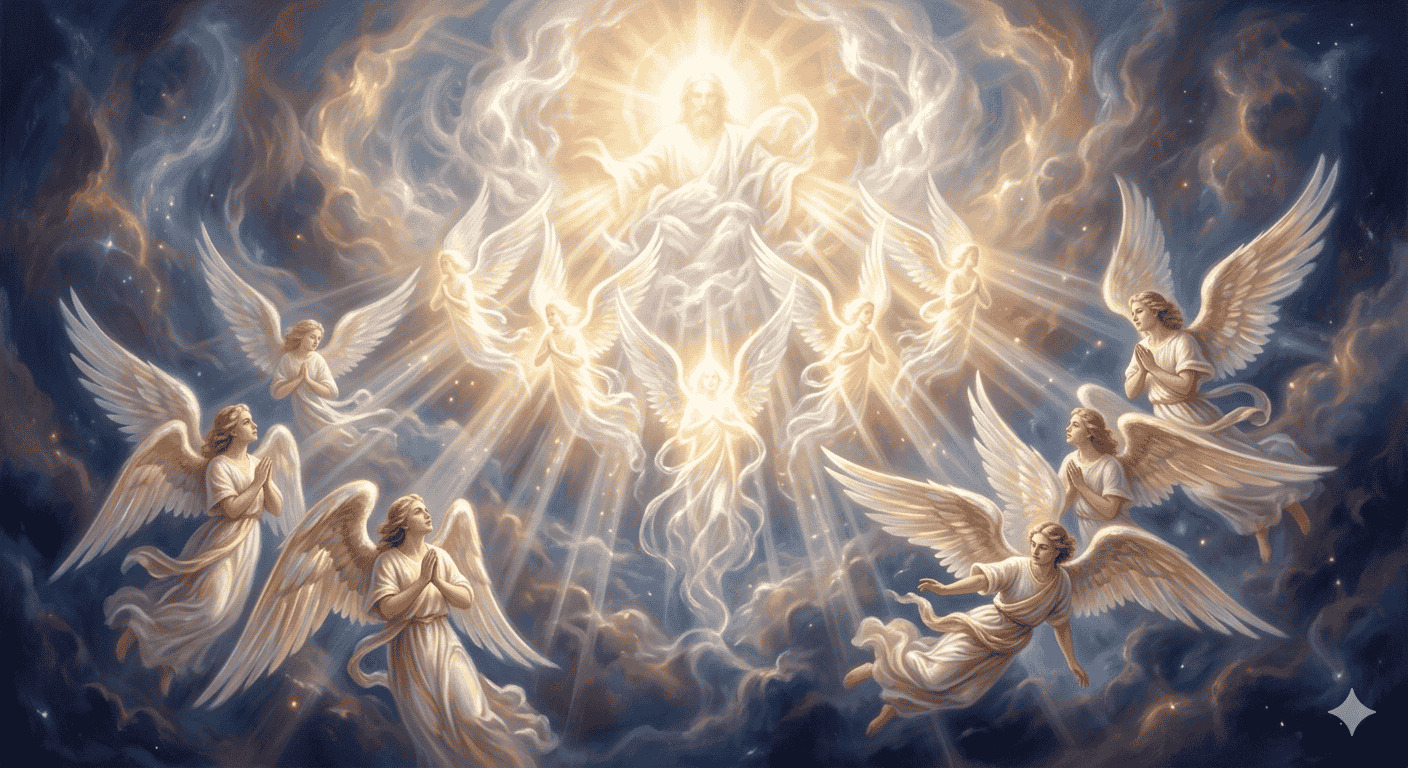
Core narrative: Angels are divine beings created by God to serve him. Their creation preceded or accompanied the creation of the physical universe.
Sources that share this core:
- Torah/Bible — Psalm 148:2-5
- Torah/Bible — Job 38:4-7
- Torah/Bible — Nehemiah 9:6
- New Testament — Colossians 1:16
- Book of Jubilees 2:2-3
- 1 Enoch 61:10
- 1 Enoch 71:7
Differences:
- Psalm 148:2-5 (Torah/Bible): "He commanded and they were created" — angels were created by God's spoken command, the same mechanism as all other creation. No specific timing or material given.
- Job 38:4-7 (Torah/Bible): God asks Job "Where were you when I laid the foundations of the earth — when the morning stars sang together and all the sons of God shouted for joy?" Angels (sons of God / morning stars) were already present and rejoicing during the earth's creation — placing their own creation before the earth itself.
- Nehemiah 9:6 (Torah/Bible): God made the heavens and all their host — and the host of heaven worships him. Angels are part of the host of heaven created by God though no timing or method is specified.
- Colossians 1:16 (New Testament — Christian): All things were created through Christ — "things in heaven and on earth, visible and invisible, whether thrones or powers or rulers or authorities." These ranks are understood in Christian tradition as angelic hierarchies — their creation attributed to Christ as the agent of God's creation.
- Book of Jubilees 2:2-3 (Ethiopian Orthodox — most precise timing): Seven categories of angels were created on the very first day of creation — before light, before the firmament, before earth — making them the very first created beings. The categories: angels of the presence, sanctification, fire, wind, clouds of darkness, snow and hail, and thunder and lightning.
- 1 Enoch 61:10 & 71:7 (Ethiopian Orthodox): Lists specific angelic ranks — Seraphim, Cherubim, Ophannim, angels of power, angels of the principalities — all described as existing and serving God before the physical world was created.
Story 8: Origin of the Jinn
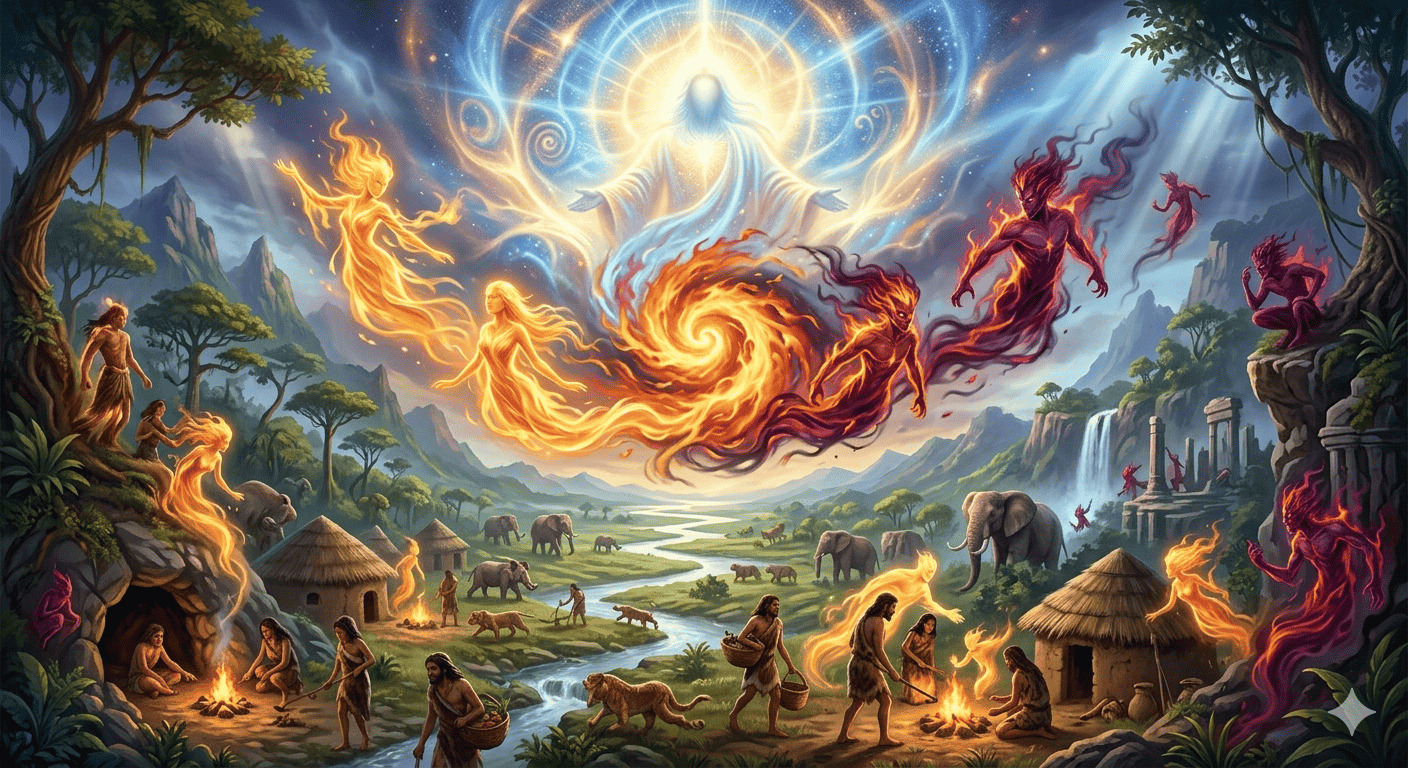
Core narrative: The Jinn are beings created by God from fire before the creation of humans, capable of good and evil, inhabiting the earth alongside humans.
Sources that share this core:
- Quran — Al-Hijr 15:26-27
- Quran — Ar-Rahman 55:14-15
- Quran — Al-Kahf 18:50
- Quran — Al-Jinn 72:1-15
- Quran — Al-Araf 7:12
Differences:
- Quran — Al-Hijr 15:26-27: Before man God created the Jinn (jann) from smokeless fire (nar al-samum). The sequence is clear — Jinn were created before humans, from fire, while humans were made from clay.
- Quran — Ar-Rahman 55:14-15: Man was created from clay like fired pottery (sal-salin kal-fakhar). The Jinn from a smokeless flame (marij min nar) — the word marij denoting a pure or mixed flame rather than ordinary fire.
- Quran — Al-Kahf 18:50: Iblis is explicitly one of the Jinn — not an angel. The Jinn as a category include both believers and disbelievers with full moral agency, just as humans do.
- Quran — Al-Jinn 72:1-15 (Jinn speaking in first person): A group of Jinn heard the Quran being recited and were amazed — "We have heard a wondrous recitation that guides to right conduct." Some accepted faith, others refused. They describe their prior attempts to eavesdrop on heavenly news, finding it guarded by shooting stars. This surah gives the Jinn their own voice and spiritual journey — they are beings with full moral accountability not merely background creatures.
- Quran — Al-Araf 7:12: Iblis said "I am better than him — you created me from fire and him from clay." This captures the Jinn's self-perception of superiority over humans based on their material of creation — the pride that led directly to Iblis's expulsion.