
Hindu Pantheon · The Feminine Divine
Hindu Goddesses
Tridevi · Mahadevi · Navadurga · Mahavidyas · River Goddesses
57 goddesses of the Hindu tradition — from the Vedic rivers to the Tantric forest
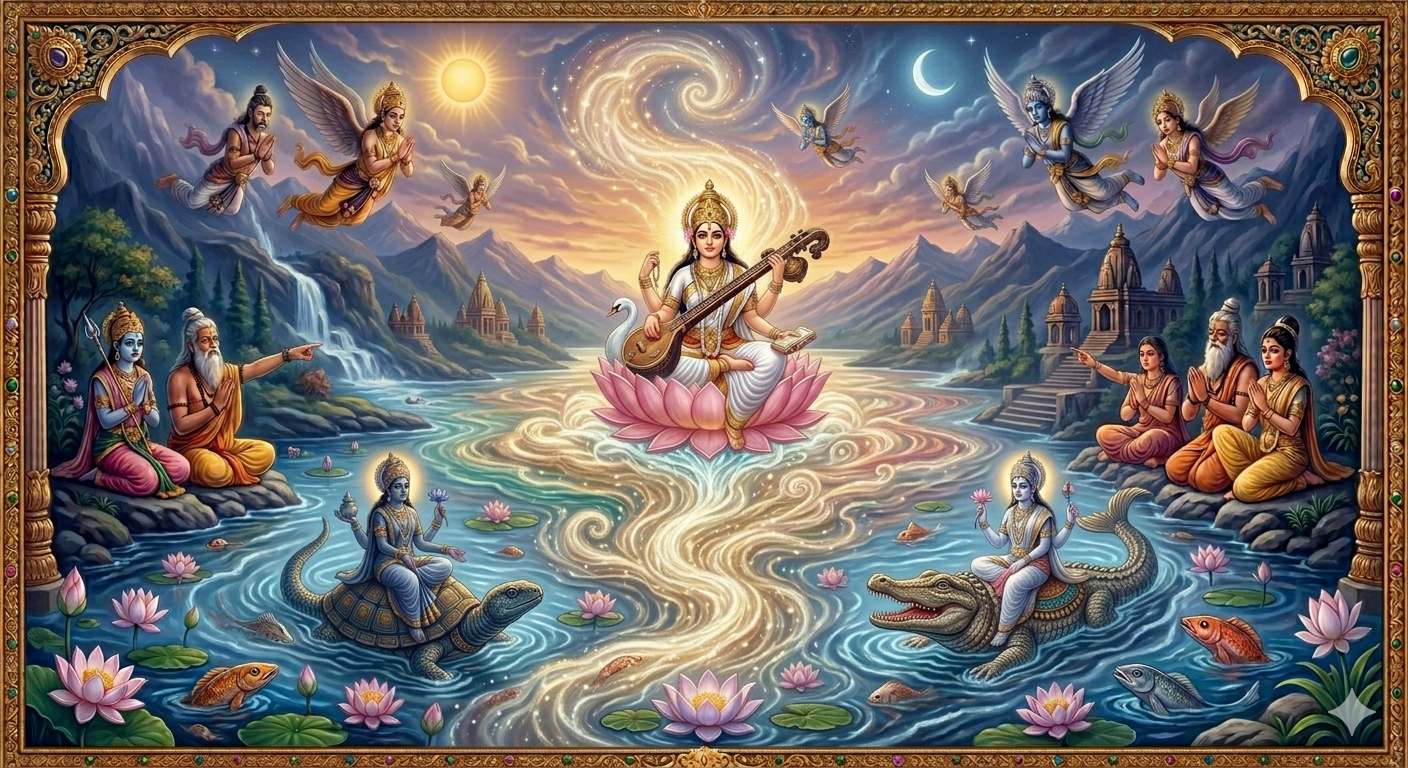
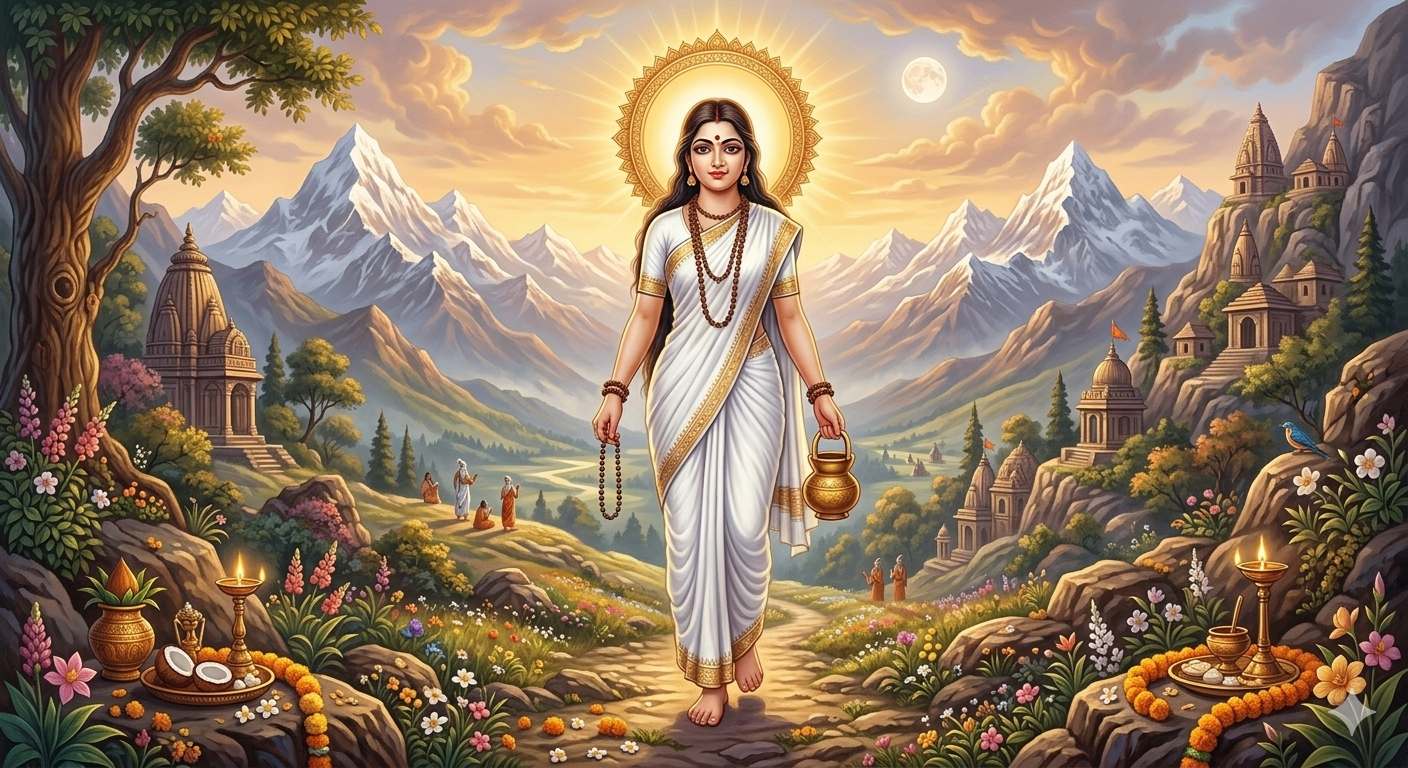
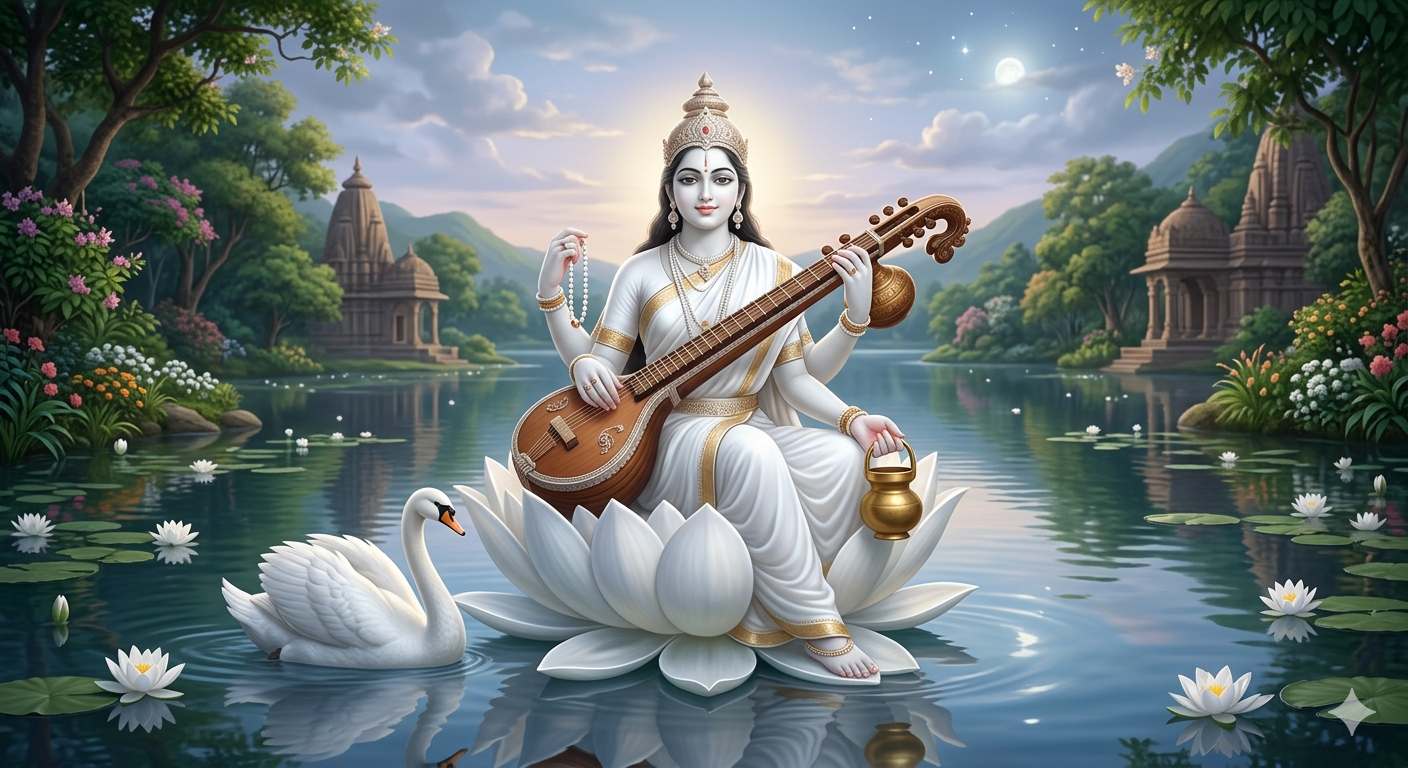
Saraswati is the goddess of knowledge, learning, speech, music, and the arts. She is the consort of Brahma and one of the three Tridevi — the divine triad of the feminine. She is the embodiment of Vak — sacred speech — and the patron of all learning, from the Vedas to classical music to the fine arts. She is among the oldest goddesses in the Vedic tradition, hymned in the Rigveda both as a great river and as a goddess of wisdom. Also known as Vak, Vagdevi, Bharati, Sharada, and Veena-Panini.
Symbols & Iconography
Birth & Origin
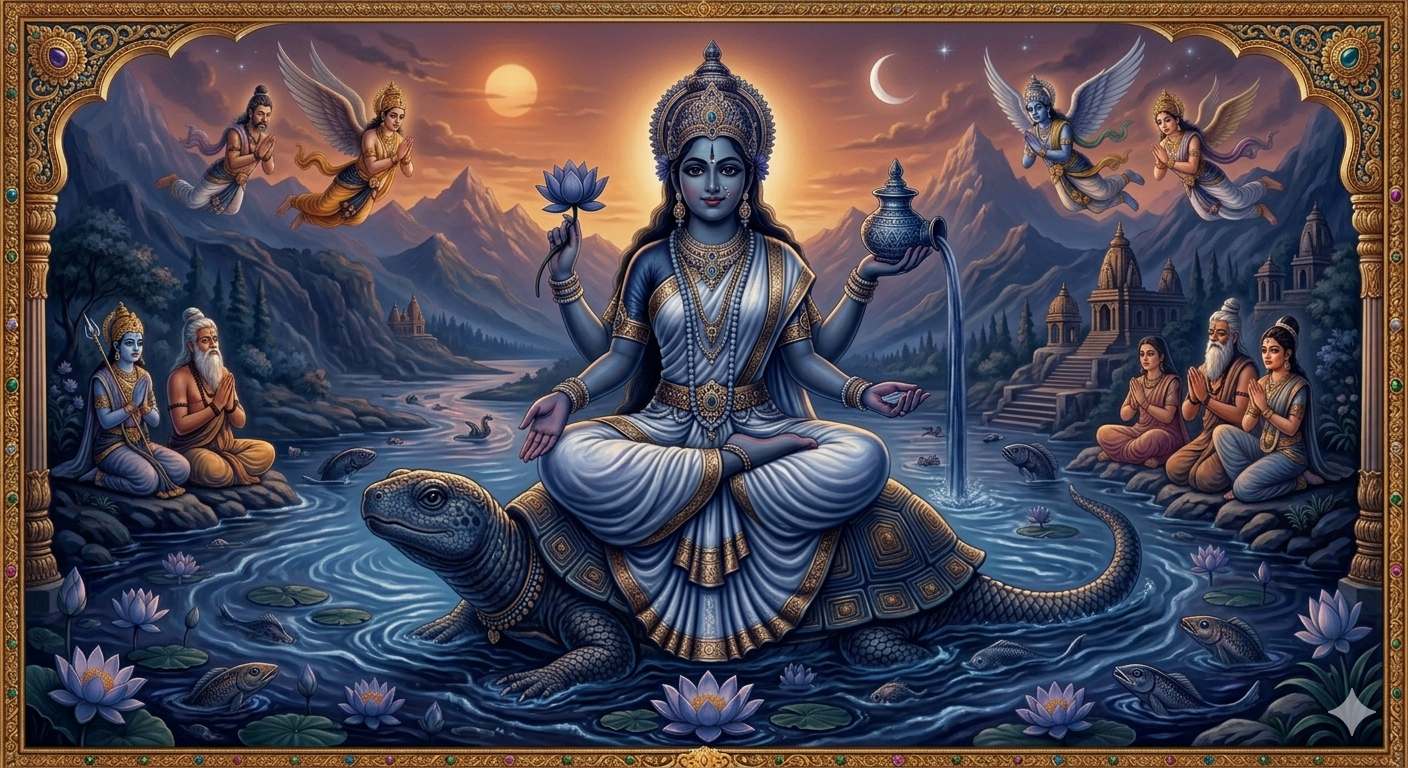
In the Rigveda, Saraswati is the divine river — praised as the greatest of rivers (Naditama) and associated with purity and the sacred space of Vedic ritual. Several hymns address her simultaneously as a river and as a goddess of speech and inspiration.
In the Puranic tradition she is born from Brahma's mind or body — creative wisdom emerging from the creator himself at the beginning of the cosmos. In the Devi Bhagavata Purana she is one of the three primary aspects of the supreme Goddess.
Family
Consort: Brahma — though some texts describe her as his daughter, and the relationship is treated with theological complexity in the Puranas. She is also described as a daughter of Vishnu in some Vaishnava texts.
Scriptures
Saraswati is hymned in the Rigveda across Books 1, 2, 6, 7, and 10. She is elaborated in the Mahabharata, Devi Bhagavata Purana, Brahma Vaivarta Purana, and the Saraswati Purana. The Saraswati Vandana — the invocation of Saraswati before study or performance — remains among the most universally recited Sanskrit hymns.
Worship & Legacy
Saraswati Puja — also called Vasant Panchami — is celebrated in late January or February. Students place their books, instruments, and tools of learning before her image and seek her blessing. The festival is widely observed in Bengal, Odisha, and Bihar. She is invoked at the start of every formal study, every musical performance, and every educational institution in the Hindu tradition. The Sharda Peeth at Sharda in Pakistan-administered Kashmir was among the most sacred Saraswati temples in ancient India.
Key Stories
1. Saraswati as the Divine River — Rigvedic
In the Rigveda, Saraswati is praised as the greatest of rivers — Naditama. She is asked to bring prosperity, health, and nourishment. She is associated with the Brahmavarta — the sacred stretch between the Drishadvati and Yamuna rivers where Vedic culture flourished. The historical Saraswati, which appears to have dried up thousands of years ago, is the subject of ongoing archaeological and geological research. Several Rigvedic hymns invoke her simultaneously as a river and as a goddess of speech, suggesting the two identities were always intertwined.
2. Saraswati and Brahma's Incomplete Sacrifice
In the Padma Purana and Skanda Purana, Brahma was performing a great yagna that required his consort to be present at a specific auspicious moment. Saraswati was delayed. Brahma took Gayatri — a milkmaid — as a temporary ritual wife to complete the sacrifice on time. When Saraswati arrived and saw this, she cursed Brahma to be seldom worshipped by humans. She also cursed Vishnu, Indra, Agni, and Gayatri — each curse was then mitigated. This story offers a narrative explanation for why Brahma, despite being the creator, has almost no temples.
3. Saraswati and Lakshmi's Conflict
In the Brahma Vaivarta Purana, Saraswati, Lakshmi, and Ganga are described as Vishnu's three wives who quarrel with each other. Saraswati curses Lakshmi to live among mortals; Lakshmi curses Saraswati to dwell on the tongues of men — making her the goddess of speech that every person carries. The story is told to explain why wealth and learning so rarely coexist in one person — the two goddesses are in perpetual conflict.
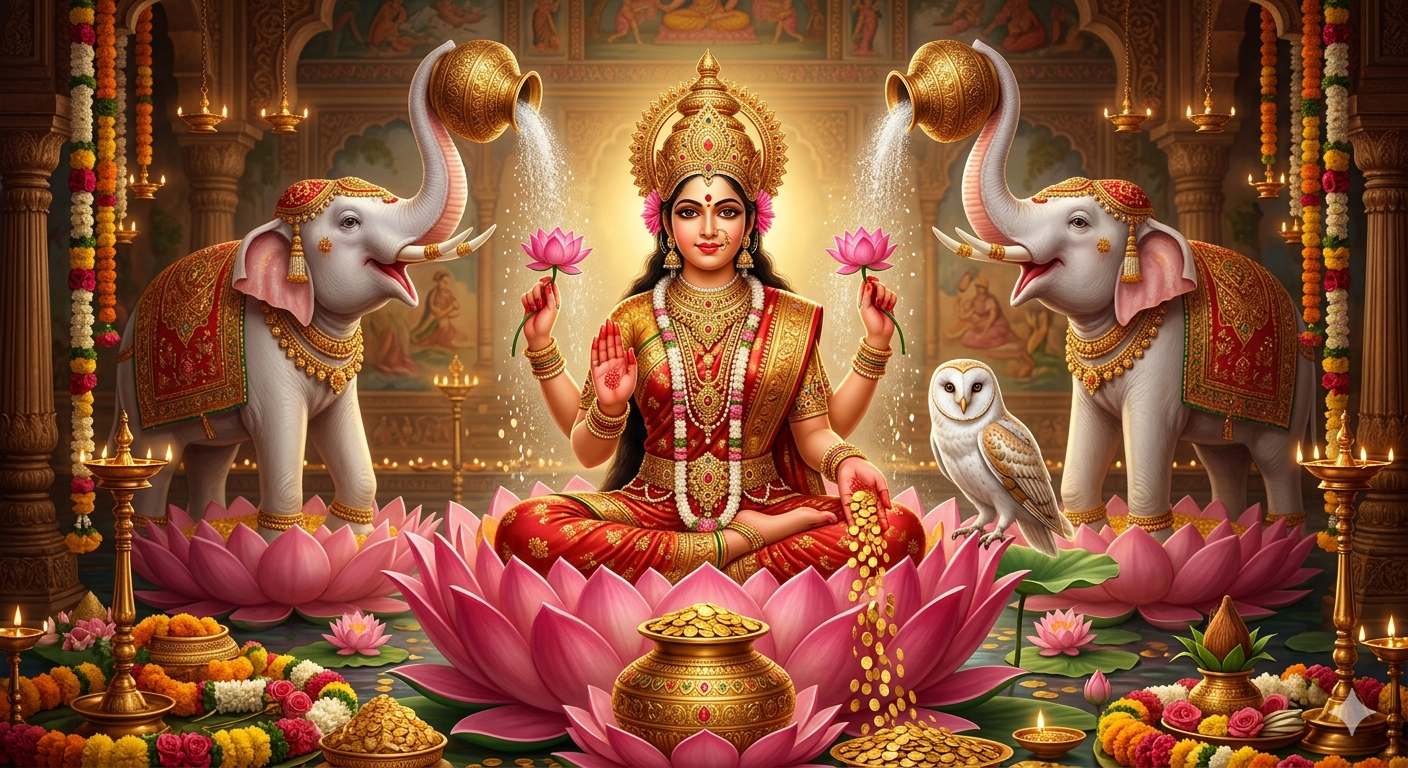
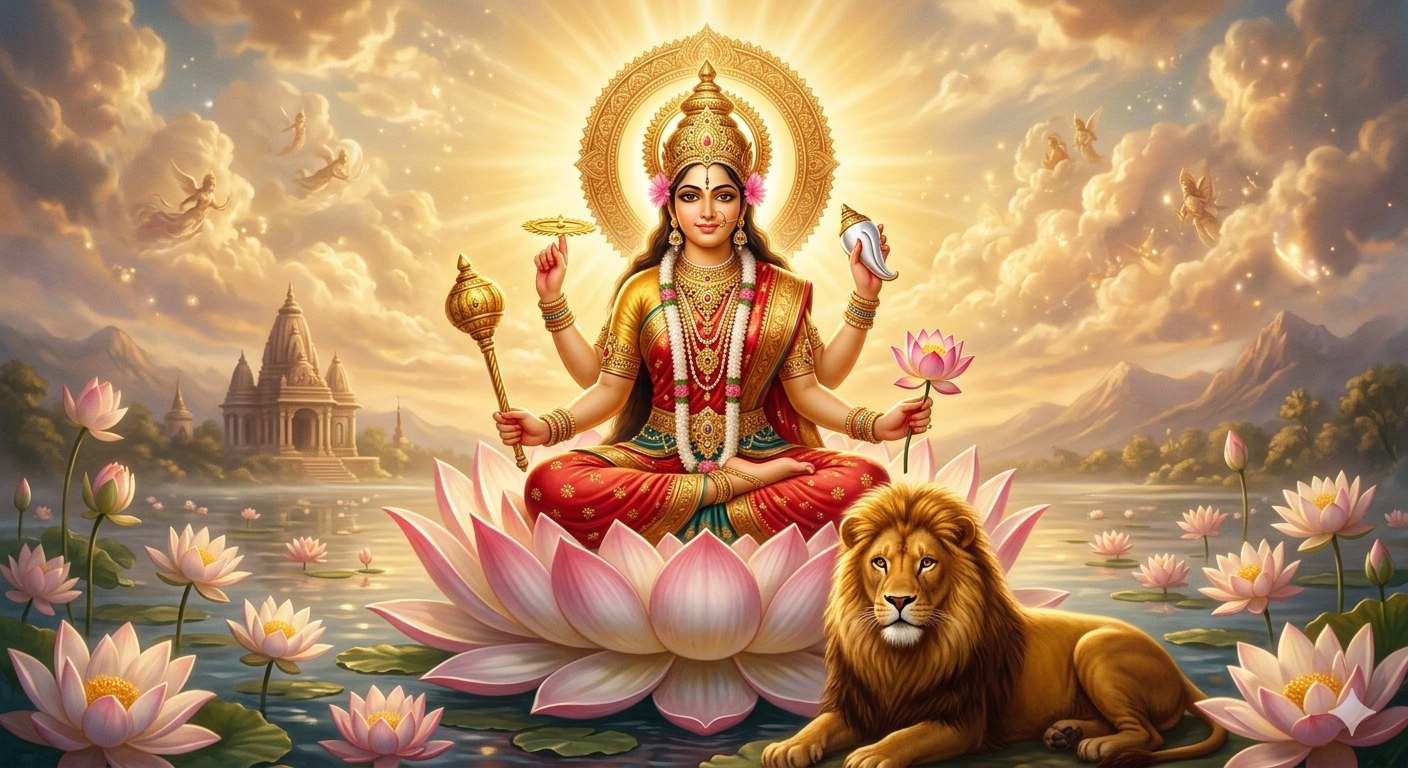
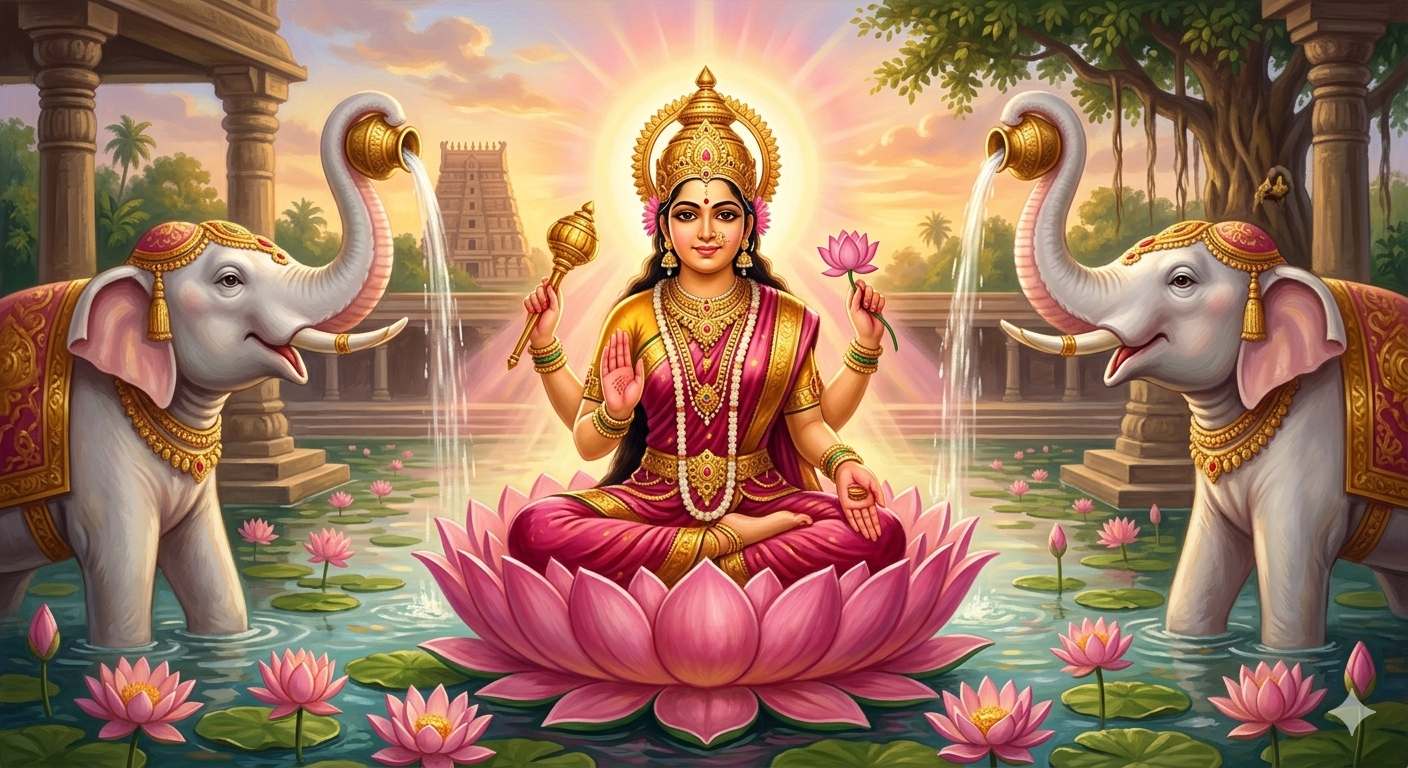
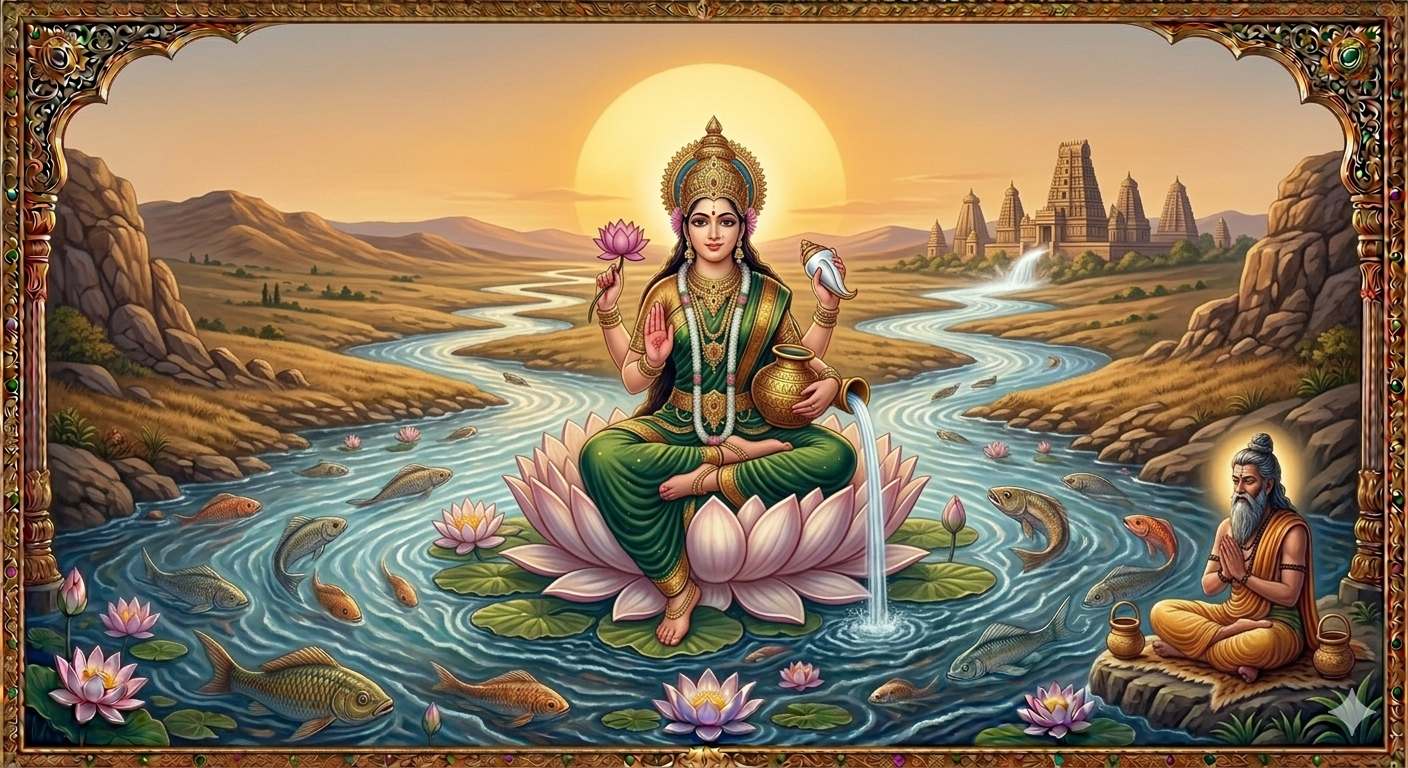
Lakshmi is the goddess of wealth, good fortune, prosperity, beauty, and auspiciousness. She is the consort of Vishnu and one of the three Tridevi. She descends with Vishnu in each avatar — as Sita with Rama, as Rukmini with Krishna. She is the divine principle of Shri — radiant beauty and auspiciousness — which the Rigveda acknowledges in the Shri Sukta. Also known as Shri, Padma, Kamala, Mahalakshmi, and Lokamata (mother of the world).
Symbols & Iconography
Birth & Origin
In the most celebrated account, Lakshmi emerged from the Samudra Manthan — the churning of the cosmic ocean — rising from the waters holding a lotus, radiant and complete. Both gods and demons were stunned. She chose Vishnu as her consort.
In the Rigveda, Shri is hymned as divine radiance and fortune in the Shri Sukta — still recited daily in Vaishnava temples. In the Vishnu Purana she is Vishnu's eternal consort, present with him from before creation began.
Family
Consort: Vishnu. In avatar forms: Sita (as Rama's consort) and Rukmini (as Krishna's queen). In the Shakta tradition: one of three primary aspects of the supreme Goddess. Sons in some traditions: Kama (the god of desire) and Dhruva.
Scriptures
Lakshmi is hymned in the Rigveda through the Shri Sukta — still recited daily in Vaishnava temples. She is elaborated in the Vishnu Purana, Bhagavata Purana, Devi Bhagavata Purana, and the Lakshmi Tantra — a Pancharatra Agama text dedicated entirely to her theology. The Sri Stuti and the Lakshmi Ashtottara are among the most widely recited devotional hymns in India.
Worship & Legacy
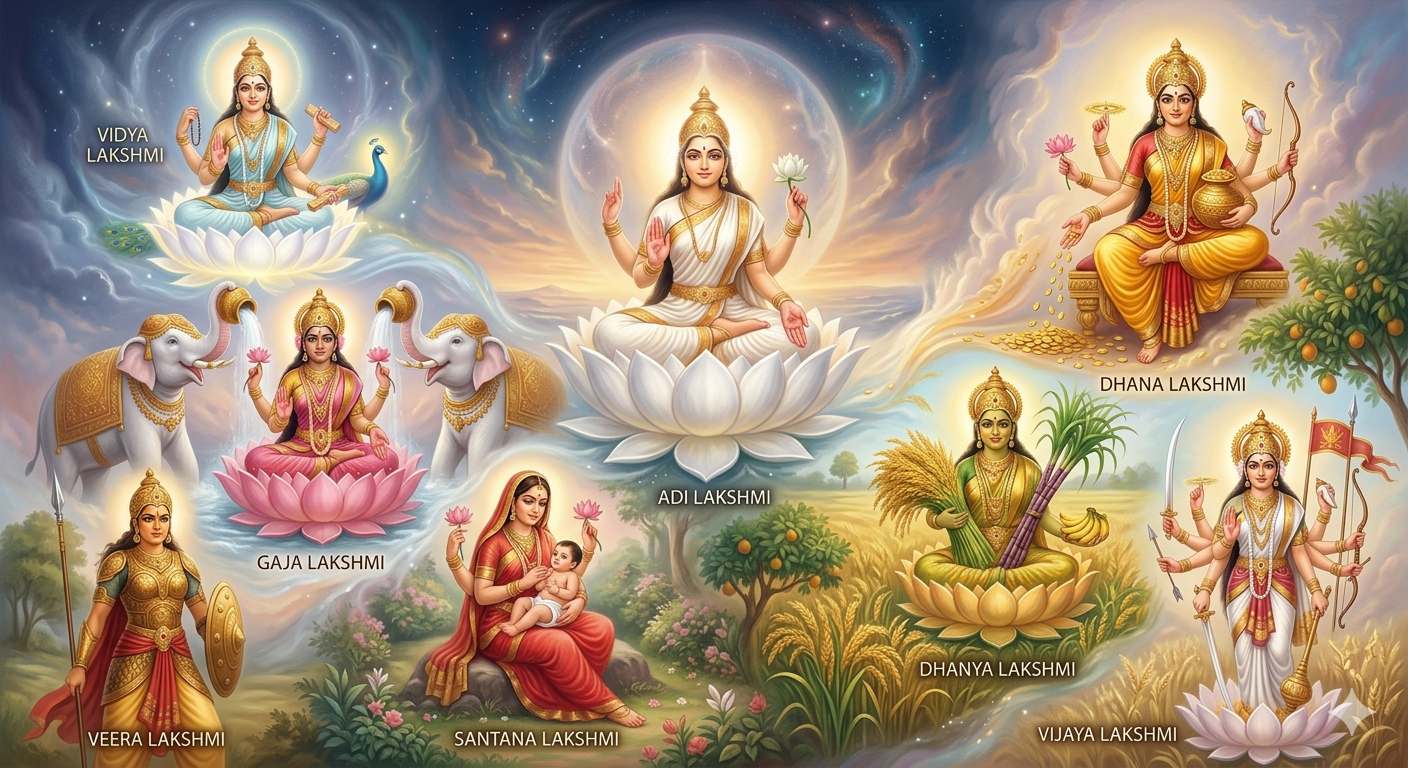
Lakshmi is worshipped on Diwali — particularly on the main night of the festival — when homes are lit with lamps and she is invited in. The Varalakshmi Vratam is observed by married women across South India on the Friday before the Shravana full moon. The Mahalakshmi Temple at Kolhapur in Maharashtra and the Padmavathi Temple at Tirupati are major pilgrimage sites. The Ashtalakshmi Temple at Besant Nagar, Chennai, brings all eight of her forms together in a single shrine.
Key Stories
1. The Emergence from the Ocean
During the Samudra Manthan, Lakshmi emerged from the churning ocean seated on a lotus, holding lotuses, surrounded by elephants pouring water over her. All the gods and demons desired her. She chose Vishnu and placed a garland around his neck. Her choice is celebrated as the divine confirmation of Vishnu's supremacy as preserver — that even abundance and fortune choose the one who preserves rather than creates or destroys.
2. Lakshmi and the Sage Bhrigu
In the Bhagavata Purana, the sage Bhrigu visited Vishnu's heaven and kicked Vishnu in the chest to test his temperament. Vishnu, in complete equanimity, pressed Bhrigu's foot and asked if it had been hurt. Lakshmi, watching from Vishnu's chest — where she resides, represented by the Srivatsa mark — was furious at the disrespect shown by Bhrigu and abandoned Vishnu's abode. Her absence caused a decline in prosperity across the universe. Vishnu himself came to earth to restore her. The story explains why Lakshmi is sometimes capricious — why fortune comes and goes from even the most devoted.
3. The Eight Forms — Ashta Lakshmi
In the theological tradition of the Ashta Lakshmi, she governs eight specific domains of prosperity: Adi Lakshmi (primordial wealth), Dhana Lakshmi (financial wealth), Dhanya Lakshmi (agricultural wealth), Gaja Lakshmi (power), Santana Lakshmi (progeny), Veera Lakshmi (courage), Vijaya Lakshmi (victory), and Vidya Lakshmi (knowledge). The Ashtalakshmi Kovil at Besant Nagar, Chennai, is the most celebrated temple where all eight are worshipped together.
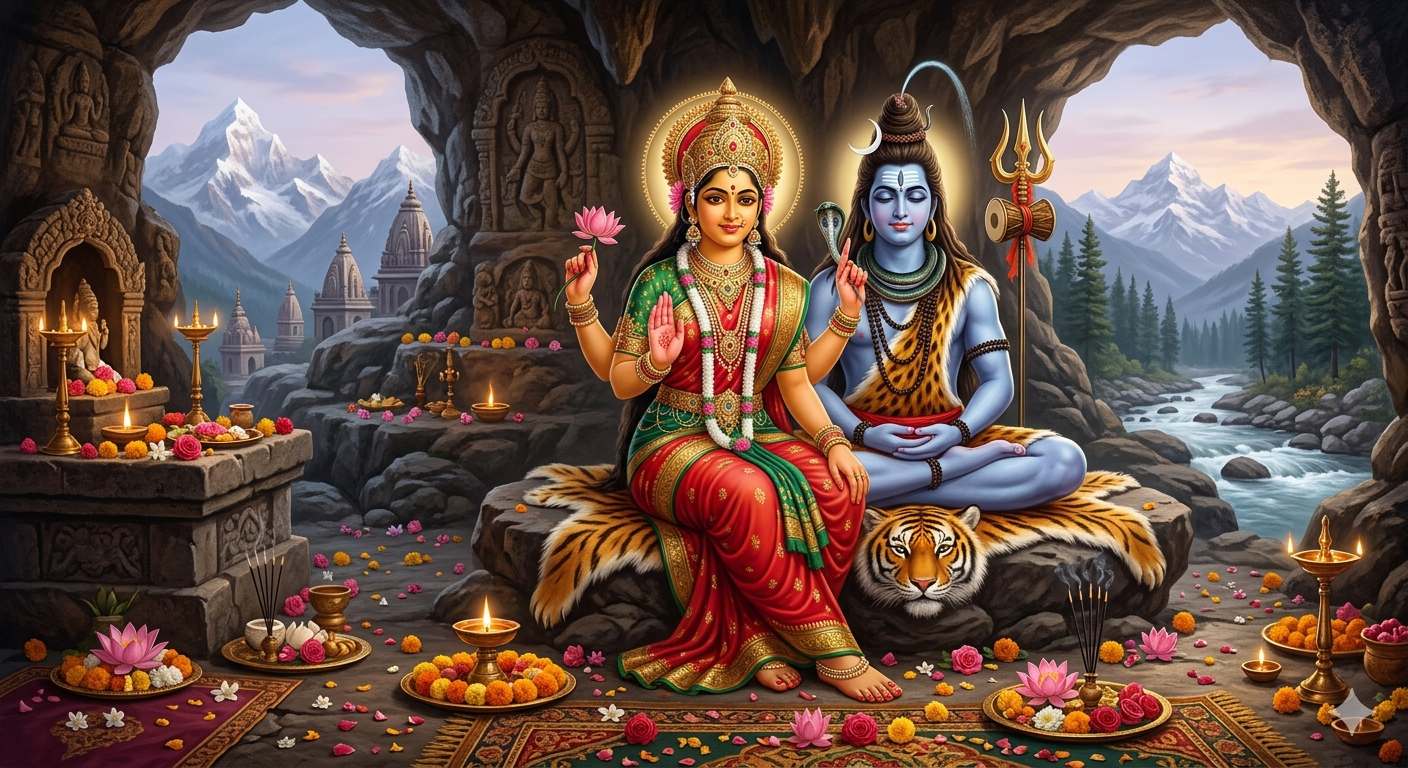
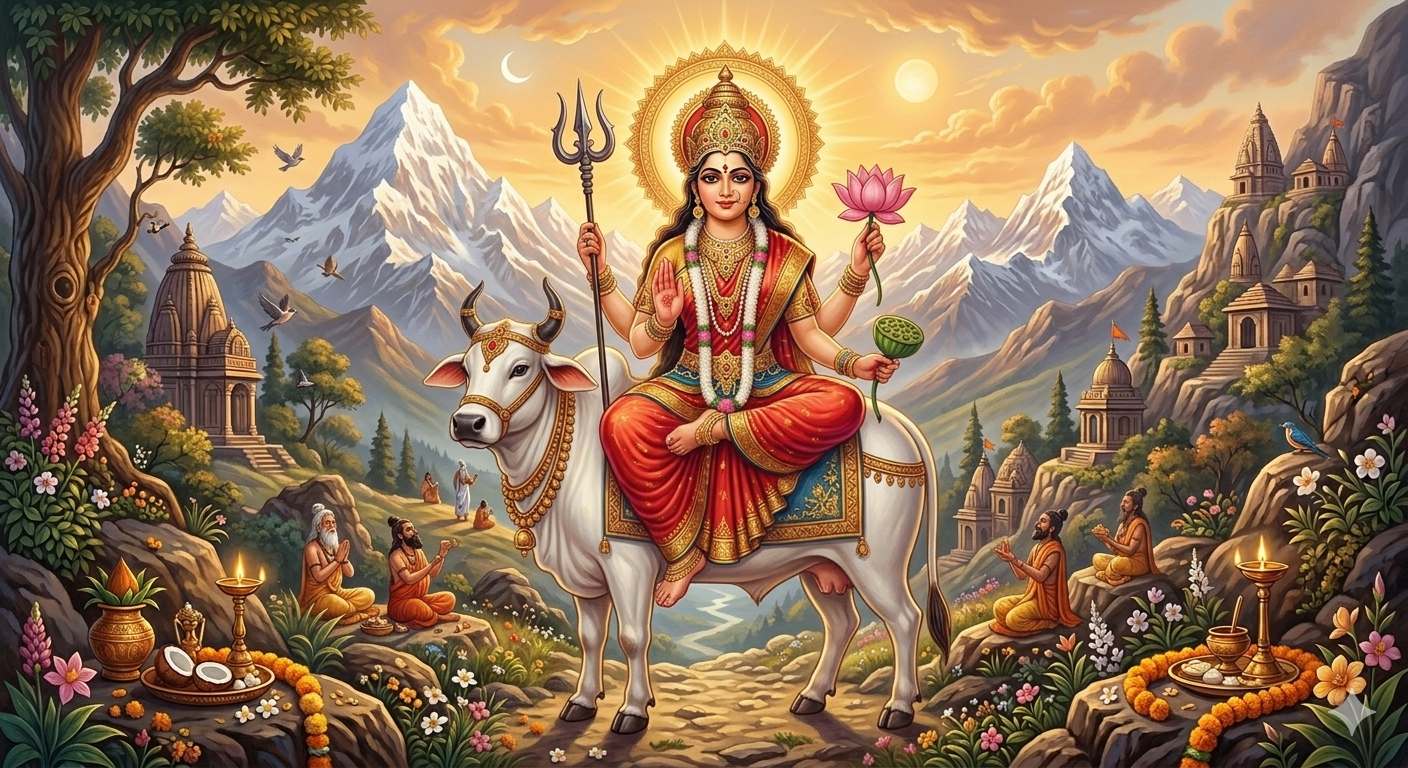
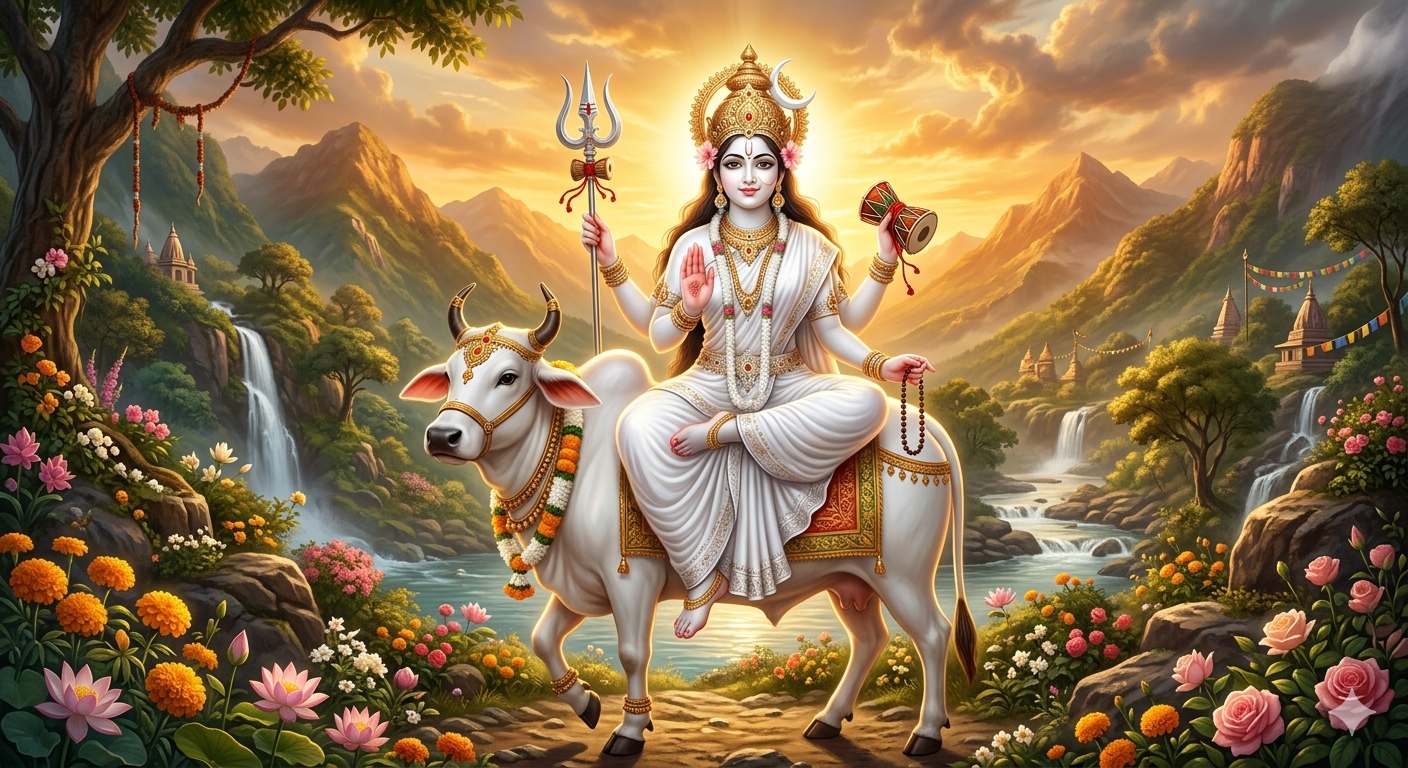
Parvati is the daughter of the mountain king Himavat and the consort of Shiva — the second birth of Sati after she immolated herself at Daksha's sacrifice. She is the gentle, nurturing form of the supreme Goddess — who embodies love, devotion, and divine power won through intense personal austerity. She is the mother of Ganesha and Kartikeya. In the Shakta tradition, she is the supreme Goddess whose other forms — Durga, Kali, and all the fierce aspects — are expressions of her power. Also known as Uma, Gauri, Haimavati, Aparna, and Bhavani.
Symbols & Iconography
Birth & Origin
Sati — the daughter of Daksha — was Shiva's first consort. When she immolated herself at Daksha's sacrifice, Shiva carried her body across the universe in grief. Vishnu used his Sudarshana Chakra to dismember the body — it fell to earth in 51 pieces, each becoming a Shakti Peetha. Sati was reborn as Parvati, daughter of Himavat and his wife Mena, with the specific divine purpose of winning Shiva back through devoted austerity.
Family
Father: Himavat (the Himalaya personified). Mother: Mena. Sister: Ganga (in some traditions). Consort: Shiva. Sons: Ganesha and Kartikeya. Previous birth: Sati.
Scriptures
Parvati appears in the Shiva Purana — where her story is told most fully — the Linga Purana, Skanda Purana, Mahabharata, and the Devi Bhagavata Purana. The Kumara Sambhava of Kalidasa — considered one of the masterpieces of classical Sanskrit poetry — narrates her austerities and marriage to Shiva in extraordinary detail.
Worship & Legacy
Parvati is worshipped across all Shaiva temples as Shiva's consort. The Meenakshi Amman Temple in Madurai — dedicated to Parvati as Meenakshi — is one of the largest and most visited temples in India. The Kamakshi Amman Temple at Kanchipuram and the Vishalakshi Temple at Varanasi are major Shakti Peethas in her honor. The Shiva Parivar image is among the most common scenes in Hindu household shrines. Hartalika Teej celebrates her austerities and devotion to Shiva.
Key Stories
1. The Winning of Shiva Through Austerity
Parvati, knowing she was born to become Shiva's consort, went to the Himalayas and performed such intense austerities that she became known as Aparna — she gave up eating even leaves. The entire natural world fell silent in awe. Shiva appeared disguised as a Brahmin and spoke ill of himself — calling himself a cremation-ground dweller unworthy of her devotion. Parvati defended Shiva fiercely and refused to be dissuaded. Shiva revealed himself and accepted her. Their marriage is one of the central events of the Puranic tradition.
2. The Creation of Ganesha
Parvati created Ganesha from the clay or turmeric paste of her own body — fashioning him as a guard while she bathed, with a command that no one should enter. When Shiva returned and was barred by the boy, the incident led to Ganesha's decapitation and his restoration with an elephant head. The story establishes Parvati as the original source and protector of Ganesha.
3. Parvati as Kali
In the Devi Mahatmya and in the Linga Purana, when the demon Daruka could only be killed by a woman, Parvati entered Shiva's body and drew upon the Halahala poison he had swallowed to manifest as Kali — the fierce, consuming form. Kali emerged from Parvati's forehead to destroy the demon. The relationship between the gentle Parvati and the ferocious Kali as two aspects of the same being is the central theological teaching of the Shakta tradition: every goddess of terror is also a goddess of love.
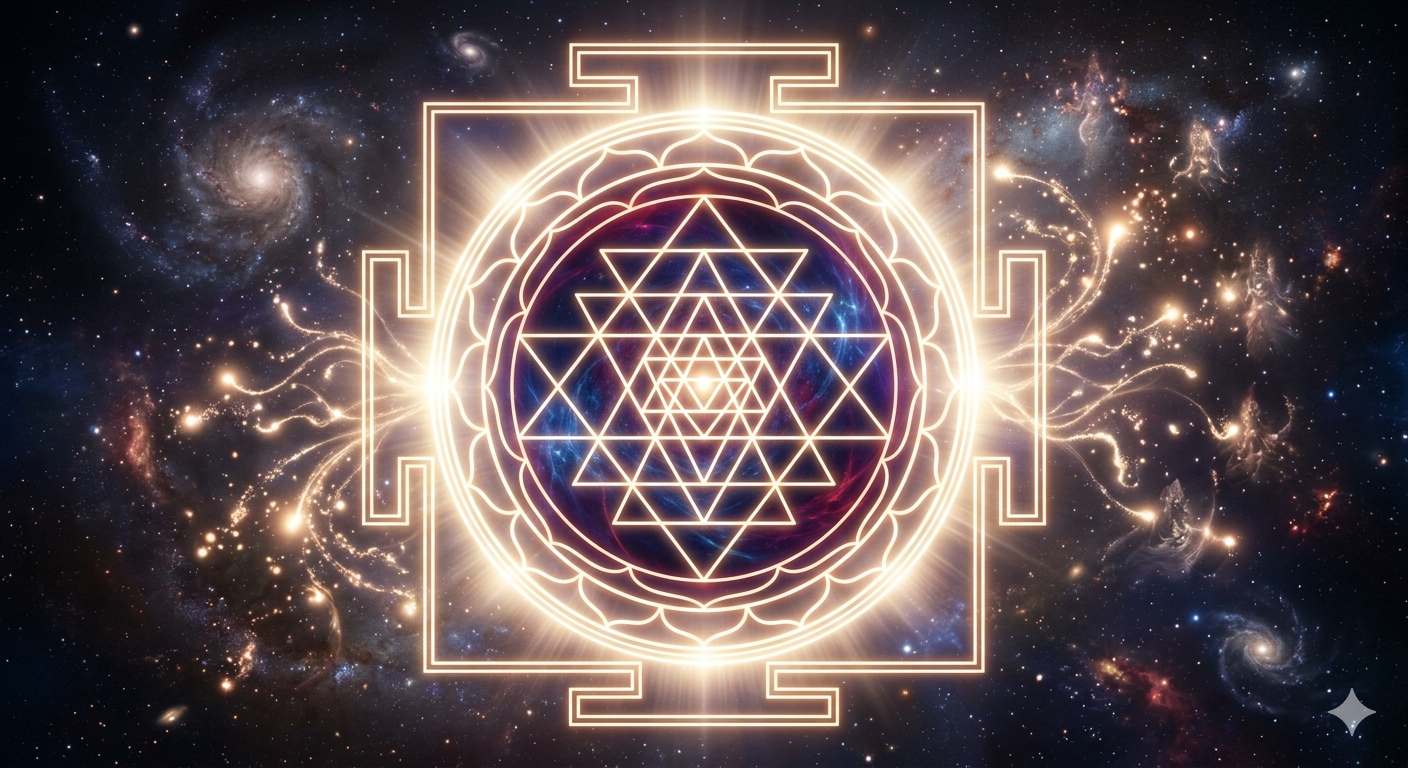
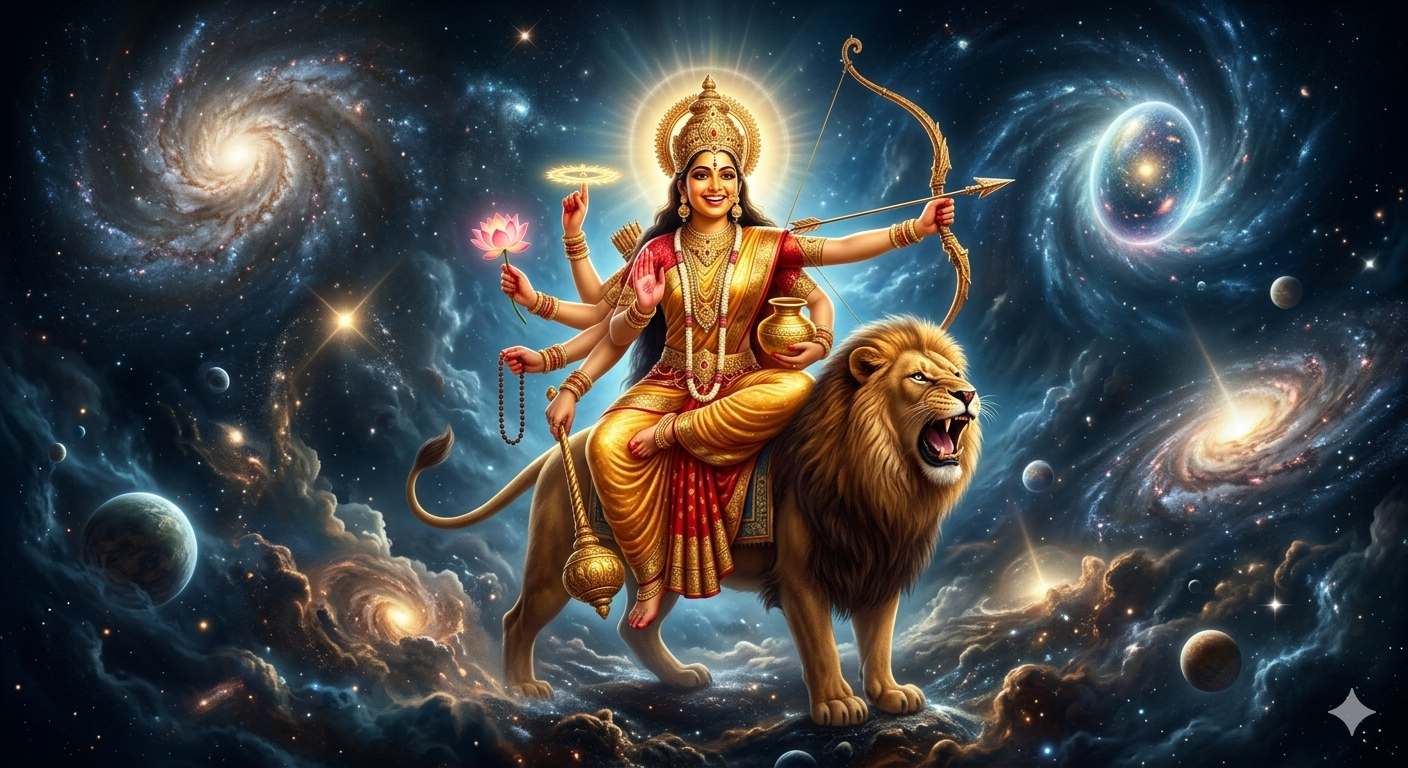
Adi Shakti is the supreme reality in the Shakta tradition — the primordial power from which all gods emerge and without whom none can act. Brahma creates, Vishnu preserves, and Shiva dissolves only because her Shakti (divine energy) flows through them. She is the source before all sources. She has no consort, no superior, no origin — she is the self-existent ground of existence. In the Devi Bhagavata Purana, she is described as the mother from whom the Trimurti themselves are born. Also known as Mahadevi, Devi, Jagadamba (mother of the universe), Adi Para Shakti, and Bhagavati.
Symbols & Iconography
Nature & Origin
In the Shakta tradition, the Goddess has no origin — she is the self-existent ultimate reality. In the Devi Bhagavata Purana, she is the source from whom Brahma, Vishnu, and Shiva are born and into whom they return.
The Devi Mahatmya describes her as emerging from the combined powers of all the gods when they were helpless — but this is her manifestation for a purpose, not her origin. Her nature is without beginning or end. The gods create and sustain only because her power runs through them.
The Sri Yantra
The Sri Yantra (Sri Chakra) is the geometric body of Adi Shakti. Nine interlocking triangles — five pointing downward (Shakti) and four pointing upward (Shiva) — surround a central Bindu point representing undivided consciousness. The Sri Yantra is the most widely used sacred geometric form in Tantric practice and is present in most Shakta temples and households.
Scriptures
The Devi Bhagavata Purana, Devi Mahatmya (Markandeya Purana, chapters 81–93), Lalita Sahasranama (Brahmanda Purana), Soundarya Lahari (attributed to Adi Shankaracharya), and the Shakta Tantras and Agamas. The Devi Mahatmya — also called the Durga Saptashati or Chandi Path — is the foundational scripture of the Shakta tradition and is recited in its entirety during Navratri across India.
Worship & Legacy
Navratri — nine nights of the Goddess — is observed twice a year (Chaitra Navratri in spring and Sharada Navratri in autumn). The Durga Puja of Bengal during Sharada Navratri is among the largest cultural-religious events in the world. The 51 Shakti Peethas — sacred sites where the body of Sati fell — span the subcontinent and form the most important pilgrimage network of the Goddess tradition. The Kamakhya Temple in Assam is one of the most powerful Shakti Peethas and a major center of Tantric practice.
Key Stories
1. The Devi Mahatmya — Three Great Battles
The Devi Mahatmya narrates three cosmic battles. First: when Brahma could not wake Vishnu from cosmic sleep to deal with the demons Madhu and Kaitabha, he prayed to the Goddess who had lulled Vishnu into sleep (Yoga Maya). She withdrew her veil of illusion, Vishnu woke, and killed the demons. Second: the demon Mahishasura had conquered the three worlds. The gods combined their powers and created Durga — who fought for nine days and killed him. Third: when Shumbha and Nishumbha conquered the universe, Ambika emerged from Parvati, Kali from Ambika, and together the goddesses destroyed the entire demonic army — including the demon Raktabija, whose every drop of blood spawned a new demon, until Kali drank all his blood before it could fall.
2. The Goddess Before the Trimurti
In the Devi Bhagavata Purana, Brahma, Vishnu, and Shiva were once disputing which of them was supreme. The Goddess appeared before them as an infinite column of light — as the Trimurti had done before each other in the Shiva-Vishnu disputes, but this time none of them could find its end. She revealed to them that each of them had been born from a particular aspect of her being — Brahma from her right side, Vishnu from her left, Shiva from her center. Their powers of creation, preservation, and dissolution were all hers, flowing through them.
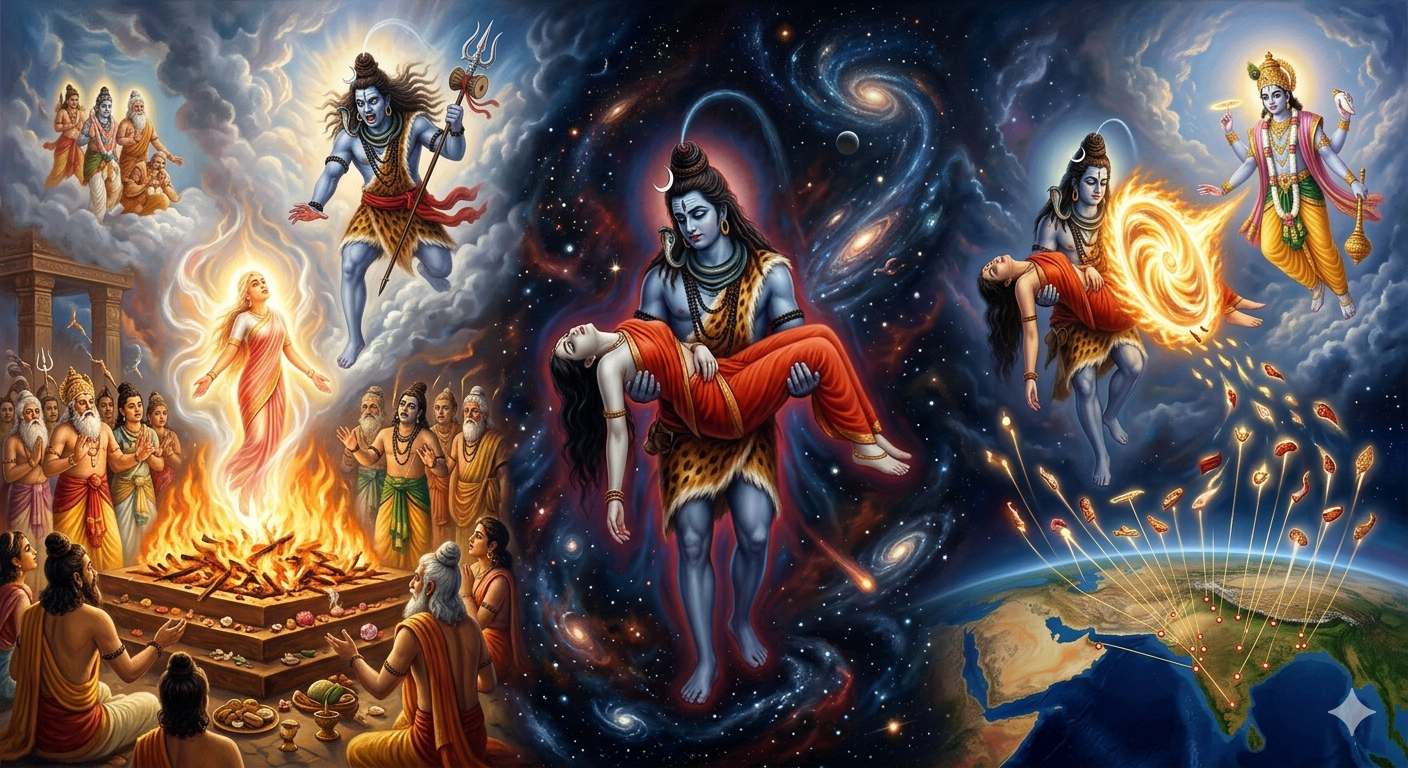
Sati is the first consort of Shiva and the daughter of Daksha. She is the archetype of devoted wifehood — her name has come to mean a chaste, devoted wife in Sanskrit. She was born with the divine purpose of becoming Shiva's consort, a purpose her father Daksha opposed throughout her life. Her death and its aftermath are among the most consequential events in the entire Puranic tradition, producing the 51 Shakti Peethas that form the most important pilgrimage network of the Goddess tradition. She was later reborn as Parvati.
Symbols & Iconography
Birth & Origin
Daughter of Daksha and Prasuti. She was born with the specific divine intention of becoming Shiva's consort — born from the Goddess's will into Daksha's household precisely because Daksha opposed the union most strenuously. Her name became synonymous with devoted wifehood across all of Sanskrit literature.
Family
Father: Daksha. Mother: Prasuti. Consort: Shiva. Reborn as: Parvati, daughter of Himavat. Her 49 sisters were given as wives to various sages and the Nakshatras.
Scriptures
Sati's story is told in the Shiva Purana, Devi Bhagavata Purana, Bhagavata Purana, and Vishnu Purana. The Shiva Purana gives the most detailed account of Daksha's sacrifice and its consequences. The creation of the Shakti Peethas from her dismembered body is described across multiple Puranic texts, with slightly varying lists of the 51 sites.
Worship & Legacy
The 51 Shakti Peethas created by the fall of Sati's body parts remain among the most visited pilgrimage sites in India — each with a specific body part, a specific name of the Goddess, and a specific Bhairava (form of Shiva) worshipped there. The Kamakhya Temple in Assam (where her womb fell) is the most powerful of all. The historical practice of widow self-immolation, also called Sati after her, was declared illegal in 1829.
Key Story
The Sacrifice, the Death, and the 51 Shakti Peethas
Daksha held a grand sacrifice and invited all the gods except Shiva, whom he despised for his wild, ash-smeared, cremation-ground ways. Sati arrived uninvited, hoping to represent her husband. Daksha publicly humiliated Shiva in her presence. Unable to endure the dishonor to her husband and unable to defend him against her own father without destroying all family bonds, Sati immolated herself in the sacrificial fire.
On hearing of her death, Shiva tore a lock from his matted hair and sent Virabhadra to destroy the sacrifice. Virabhadra beheaded Daksha, blinded Bhaga, knocked out Pushan's teeth, and scattered the assembled gods. Then Shiva himself arrived, took Sati's body from the fire, and wandered the universe in inconsolable grief — carrying her corpse.
Vishnu used his Sudarshana Chakra to dismember Sati's body — both to release Shiva from his grief and to sanctify the earth. The 51 places where body parts fell became the Shakti Peethas, the most sacred pilgrimage sites of the Goddess tradition. Sati was later reborn as Parvati, daughter of Himavat, with the sole purpose of winning Shiva back through austerity. The 51 Peethas span the subcontinent from Kamakhya in Assam to Kanyakumari at India's southern tip.
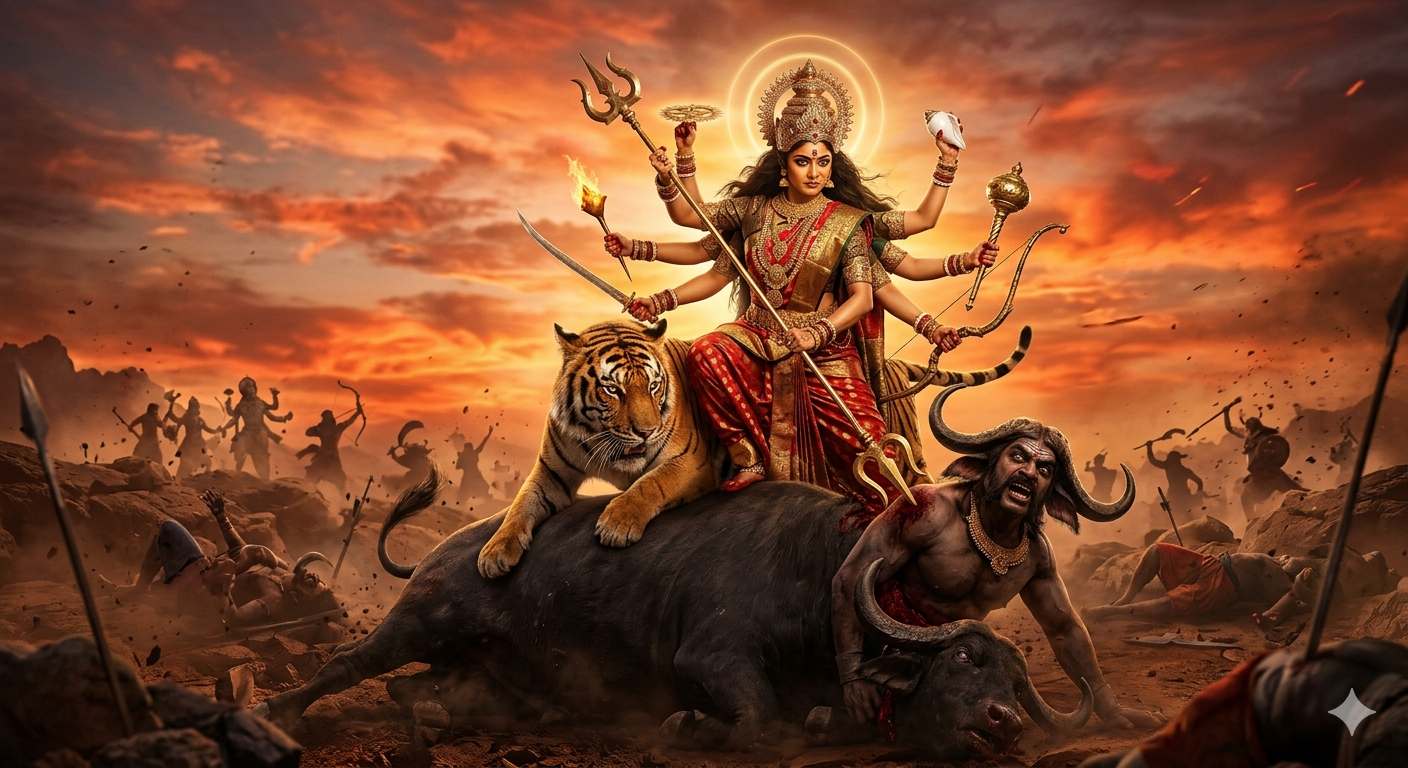
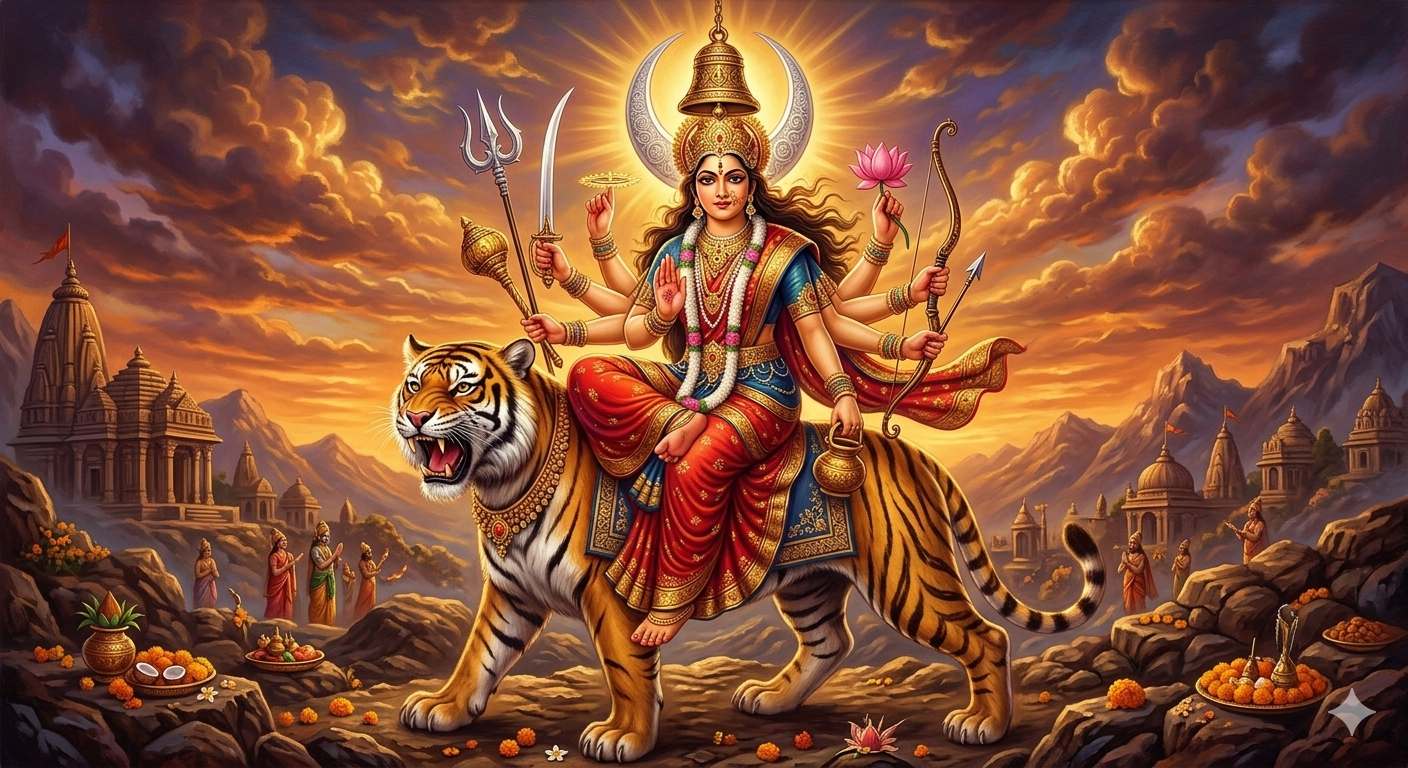
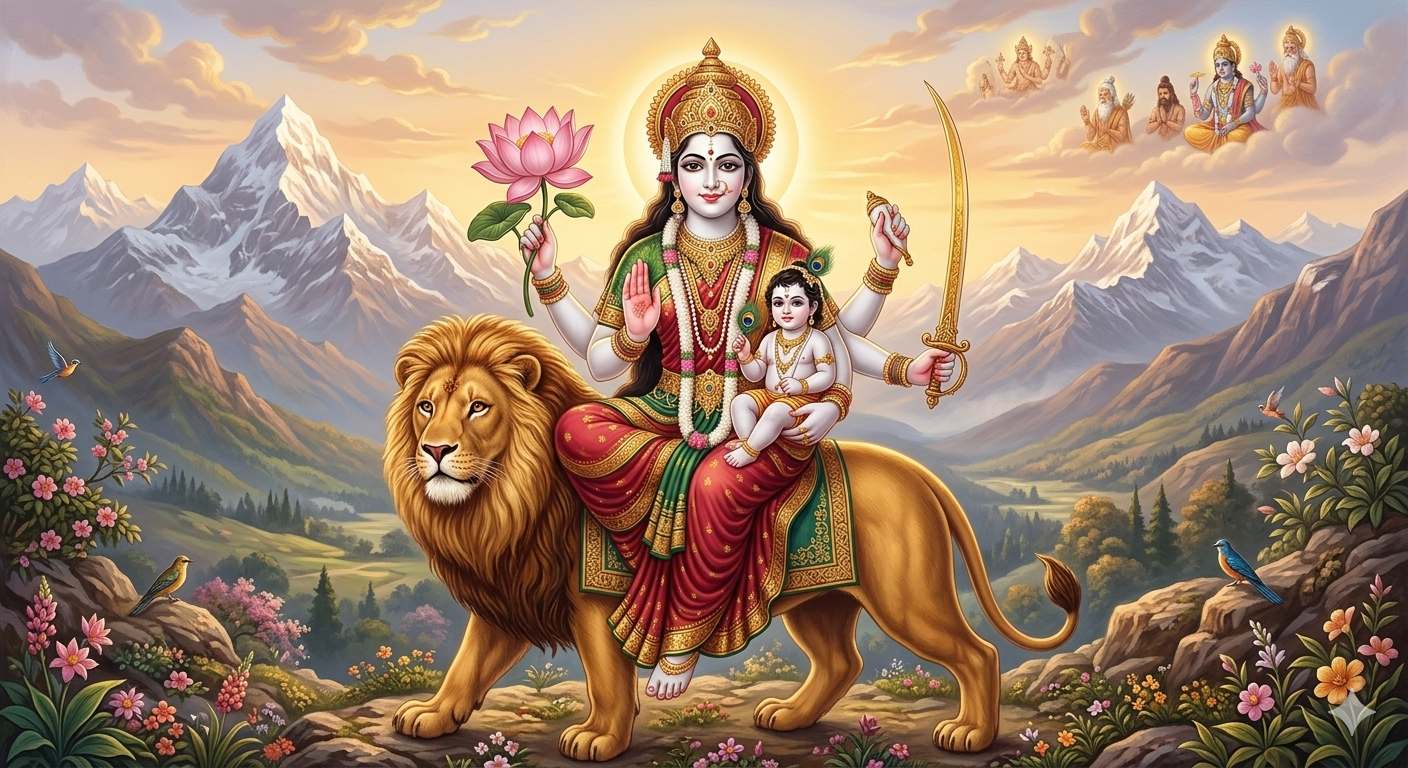
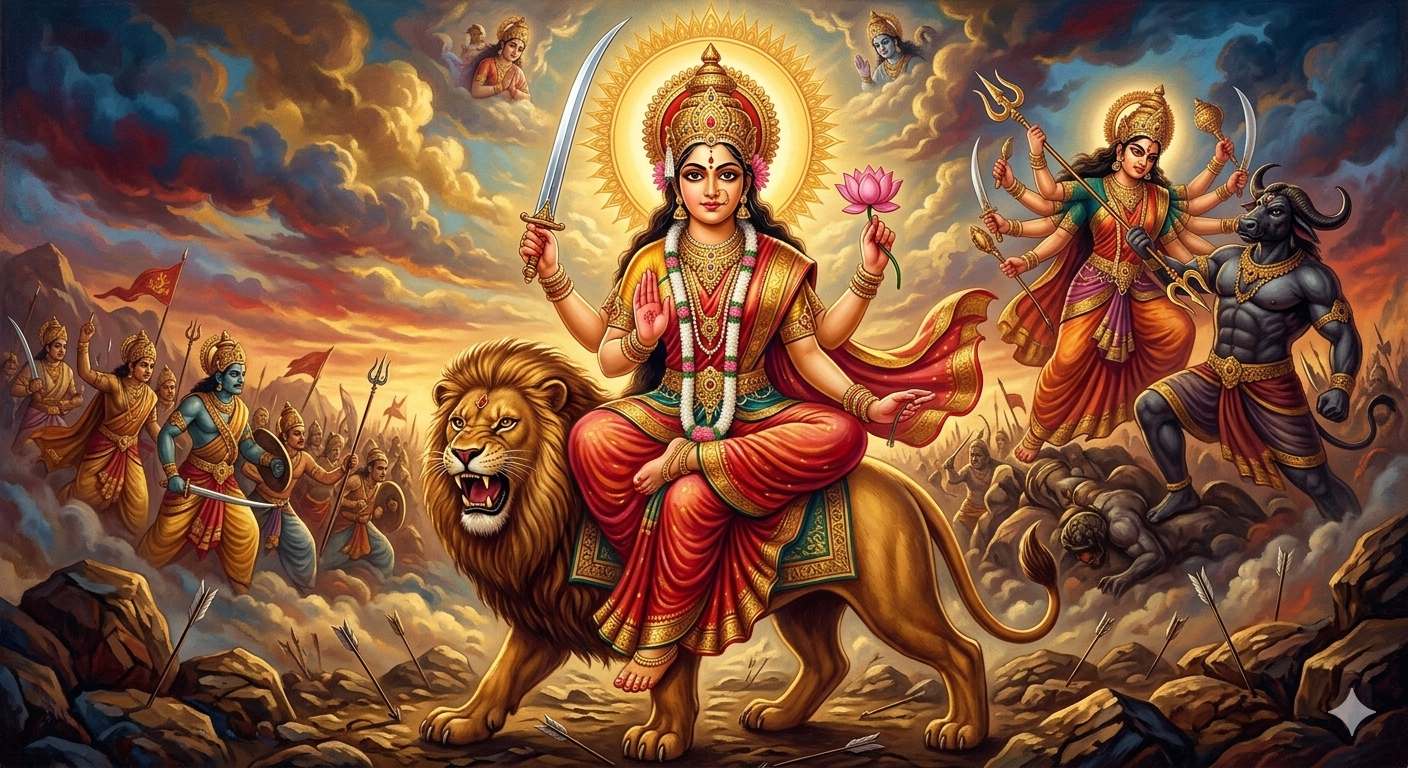
Durga is the warrior form of the supreme Goddess — invincible, unconquerable, the power the gods combined when they faced demons beyond their individual strength. Her name means "the one who is difficult to approach" or "the fortress." She is one of the most widely worshipped deities in all of Hinduism. In the Shakta tradition she is a manifestation of Adi Shakti; in the Shaiva tradition she is an aspect of Parvati. Also known as Chandika, Ambika, Sheranwali, and Durgati Nashini (destroyer of misfortune).
Symbols & Iconography
Birth & Origin
In the Devi Mahatmya, Durga was not born in the ordinary sense — she arose from the combined divine energies (tejas) of all the gods when Mahishasura had rendered them powerless. Each god contributed a portion of his power and one of his weapons. From this combined radiance Durga manifested — more powerful than any individual god and capable of defeating what none of them could. In other accounts she is an eternal form of Parvati.
Family
Identified with Parvati in the Shaiva tradition. In the Durga Puja tradition of Bengal she is depicted with her four children: Saraswati, Lakshmi, Ganesha, and Kartikeya — all surrounding her as she kills Mahishasura.
Scriptures
Durga is the central deity of the Devi Mahatmya (Markandeya Purana, chapters 81–93). She appears in the Devi Bhagavata Purana, Shiva Purana, Skanda Purana, and across the Shakta Tantra literature. The Mahishasura Mardini Stotram is one of the most widely recited goddess hymns in India, chanted daily in many Shakta temples.
Worship & Legacy
Durga Puja in West Bengal is among the largest religious festivals in the world — a five-day celebration featuring elaborate clay images of Durga killing Mahishasura in every neighborhood. The Vaishno Devi temple in Jammu receives over 8 million pilgrims annually. The Chamundeshwari Temple in Mysuru, the Naina Devi Temple in Himachal Pradesh, and dozens of other major temples are dedicated to her forms.
Key Stories
1. The Slaying of Mahishasura
The demon Mahishasura received a boon that no man or god could kill him. He conquered the three worlds and drove the gods from heaven. The gods combined their power into Durga. She fought Mahishasura's armies for nine days. Mahishasura himself kept changing form — from buffalo to lion to elephant to man — and she killed every form. Finally she killed him as he emerged from the neck of the slain buffalo, pinning him with her lion and driving her trident through him. Mahishasura Mardini — Destroyer of Mahishasura — became her most celebrated epithet. This battle is the central narrative of Navratri.
2. Shumbha, Nishumbha, and the Demon Raktabija
The demons Shumbha and Nishumbha conquered the universe after Mahishasura's defeat. The gods appealed to the Goddess, who manifested from Parvati's body as Ambika. The demon general Raktabija had a terrible power — every drop of his blood that touched the ground spawned a new demon identical to him. The battlefield was multiplying. Ambika manifested Kali from her forehead, who stretched her tongue across the entire field and licked up every drop of Raktabija's blood before it could fall, preventing new demons from forming. Kali then killed Raktabija. Shumbha and Nishumbha were killed by Ambika herself.
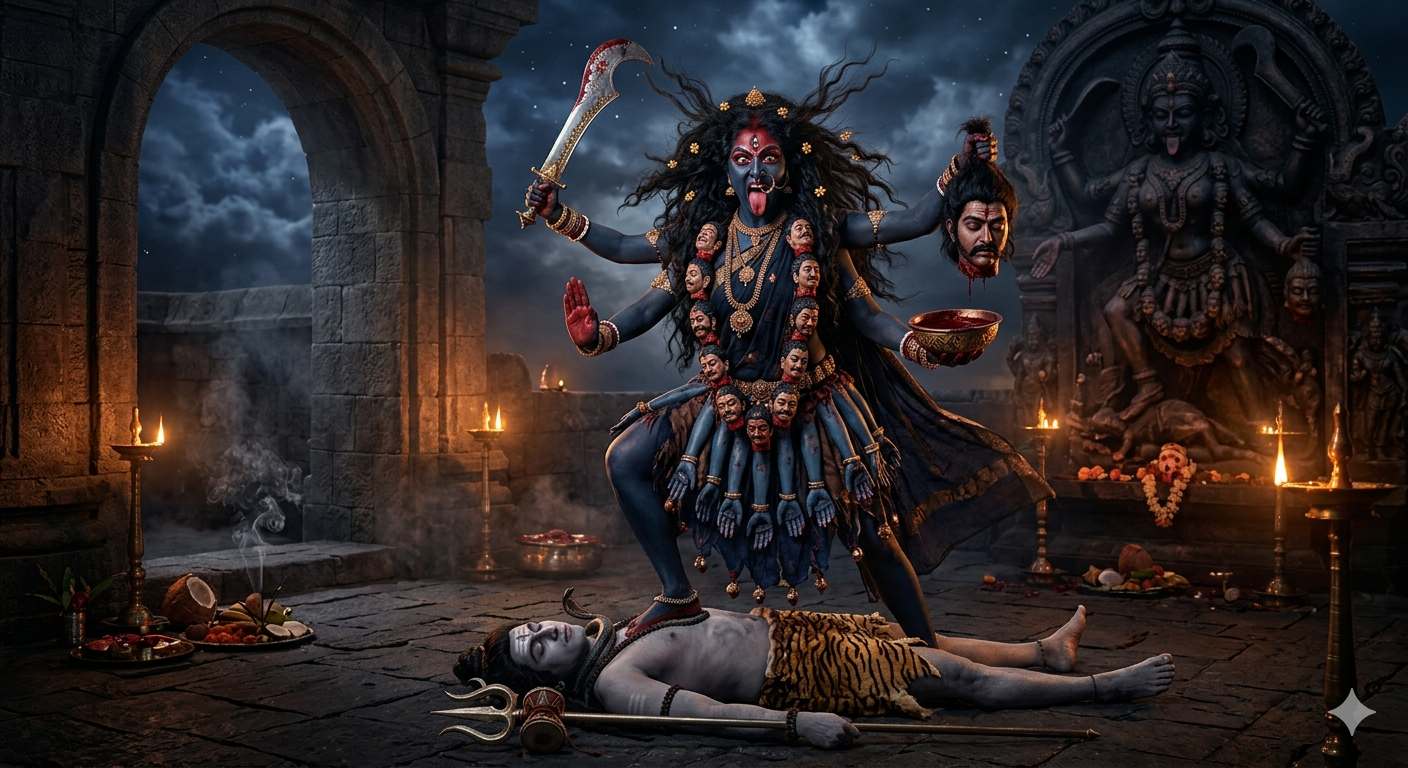
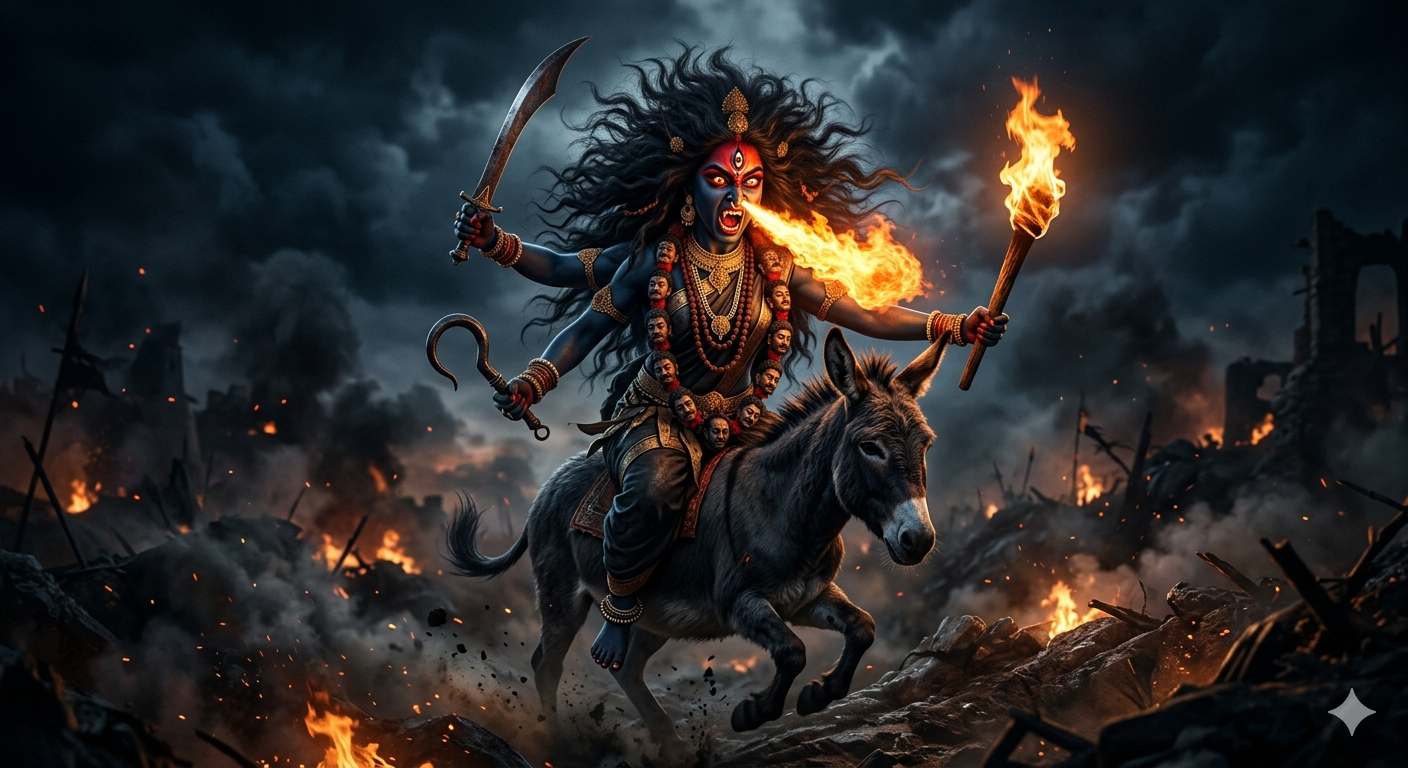
Kali is the most fierce and fearsome form of the Goddess — the dark mother who destroys ego, time, and illusion. She is associated with death, transformation, Tantra, and the liberation that comes through confronting existence at its most terrifying. In the Shakta tradition she is not a destructive force but the ultimate liberating power — her ferocity destroys only ignorance and bondage, never the devotee. She is the Goddess of Kalighat and of the burning ghats. Also known as Mahakali, Chamunda, Bhadrakali, and Shyama.
Symbols & Iconography
Birth & Origin
In the Devi Mahatmya, Kali emerged from the forehead of Chandika (Durga) when the demon Raktabija proved impossible to defeat — every drop of his blood creating a new demon. Kali stretched her tongue across the battlefield and consumed all the blood. She then killed Raktabija.
In the Linga Purana, Kali emerged from Parvati when the demon Daruka could only be killed by a woman. She drew on the Halahala poison in Shiva's throat and manifested as Kali.
Family
In the Shakta tradition: an aspect or daughter of Parvati. Consort of Mahakala (Shiva's fierce form). She stands on Shiva — he is her consort, her moderating force, and the ground of consciousness beneath her dance of energy.
Scriptures
Kali appears in the Devi Mahatmya, Linga Purana, Devi Bhagavata Purana, and Kalika Purana — a Purana dedicated entirely to her. She is extensively discussed in the Mahanirvana Tantra and across the Shakta Tantric literature of Bengal and Assam. The first of the ten Mahavidyas, she is the supreme Tantric Goddess.
Worship & Legacy
Kali is the presiding deity of Kalighat in Kolkata — one of the 51 Shakti Peethas. The Dakshineswar Kali Temple near Kolkata — where Ramakrishna served as a priest and had his visions — receives millions of pilgrims annually. The Kamakhya Temple in Assam and the Tarapith temple in West Bengal are other major centers. Kali Puja is observed on the new moon of Kartik — coinciding with Diwali — with great intensity in Bengal, Assam, and Kerala.
Key Stories
1. The Battlefield Frenzy and Shiva Beneath Her Feet
After killing Raktabija and drinking his blood, Kali became intoxicated and began a terrifying dance on the battlefield that threatened to shake the universe apart. Shiva lay down in her path. She stepped on him without noticing, then looked down and realized whose chest was beneath her foot. She stuck out her tongue in shame — and this gesture became one of her most iconic poses, depicted in virtually every Kali image. The story encodes a theological point: Kali is energy without direction; Shiva beneath her is consciousness that gives her dance meaning without limiting her power.
2. Kali and Ramakrishna
In the 19th century, the mystic Ramakrishna Paramahamsa at the Dakshineswar Kali Temple near Calcutta had visions of Kali as a living, breathing Mother — not a symbol but a goddess who responded, laughed, and consoled. He is said to have seen her eating the food offered to her image, speaking to him in the small hours, and appearing to him in states of profound samadhi. His devotion fundamentally shaped the Ramakrishna Mission's theology and through his disciple Vivekananda, this understanding of the Mother reached the West.
3. The 64 Yoginis
In the Tantric tradition, Kali presides over the 64 Yoginis — fierce, independent goddesses associated with cremation grounds, wild nature, and Tantric practice. The open-air circular temples of the 64 Yoginis found at Hirapur in Odisha and Khajuraho in Madhya Pradesh represent this tradition. Kali is the supreme Yogini — the one from whom all the others radiate. Her connection to the margins of society, to cremation grounds, and to practitioners who sit outside the boundaries of conventional religion places her at the center of every tradition of radical Tantric practice.
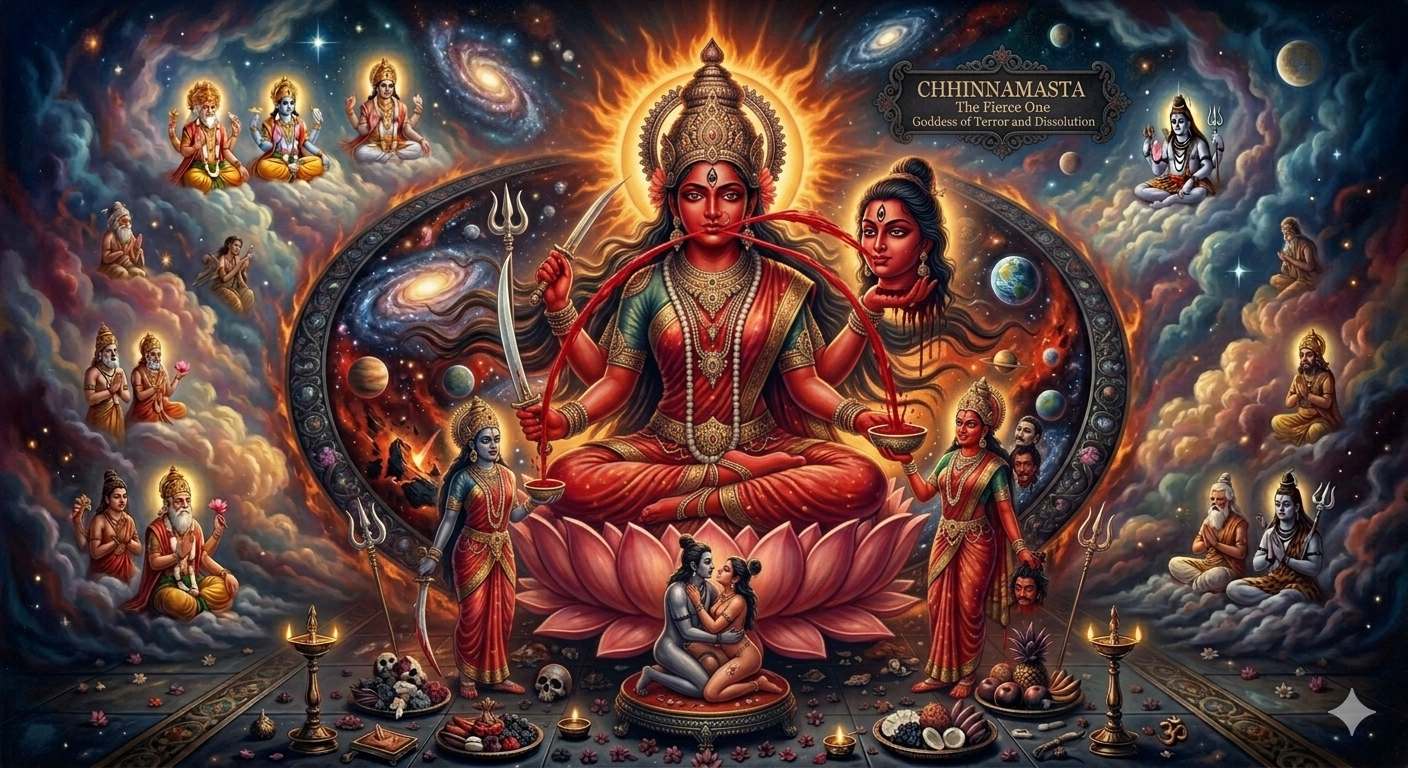
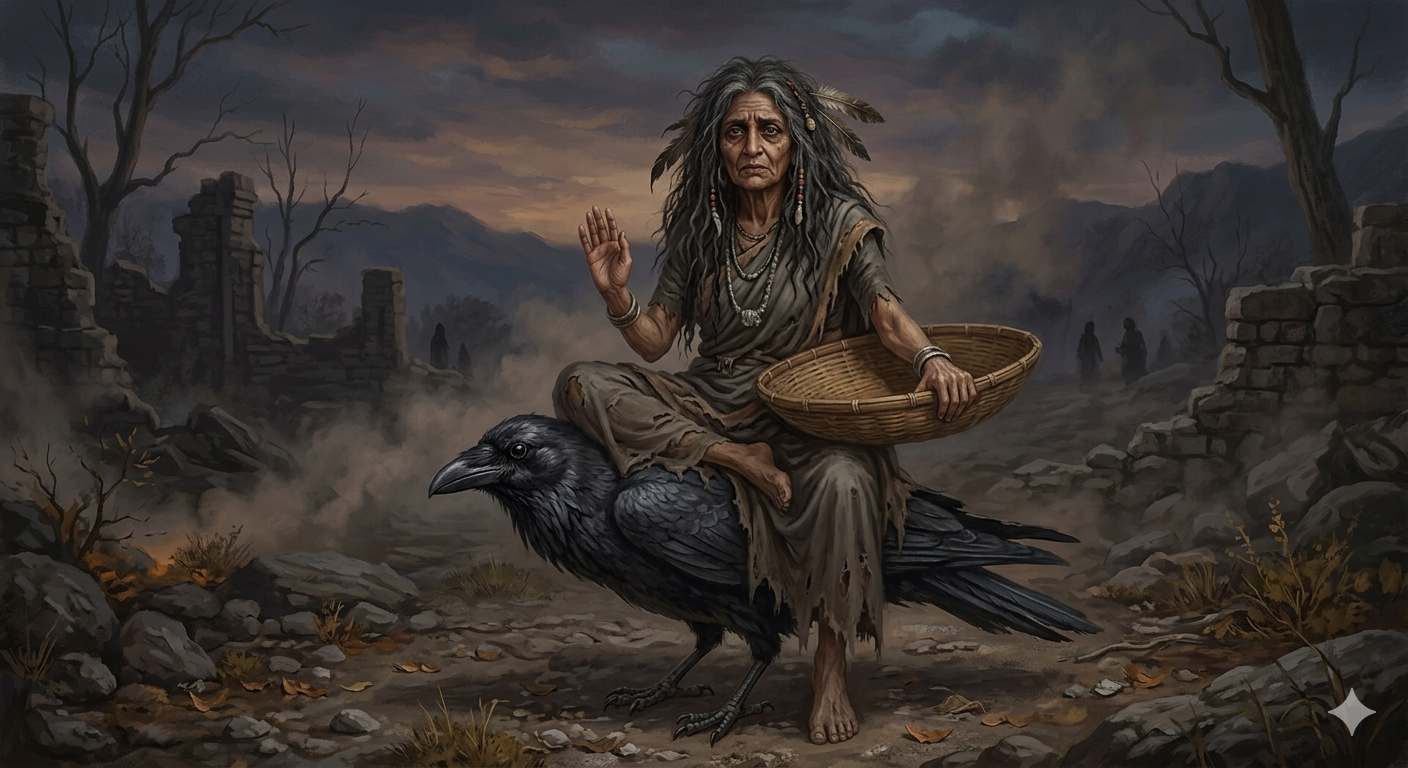
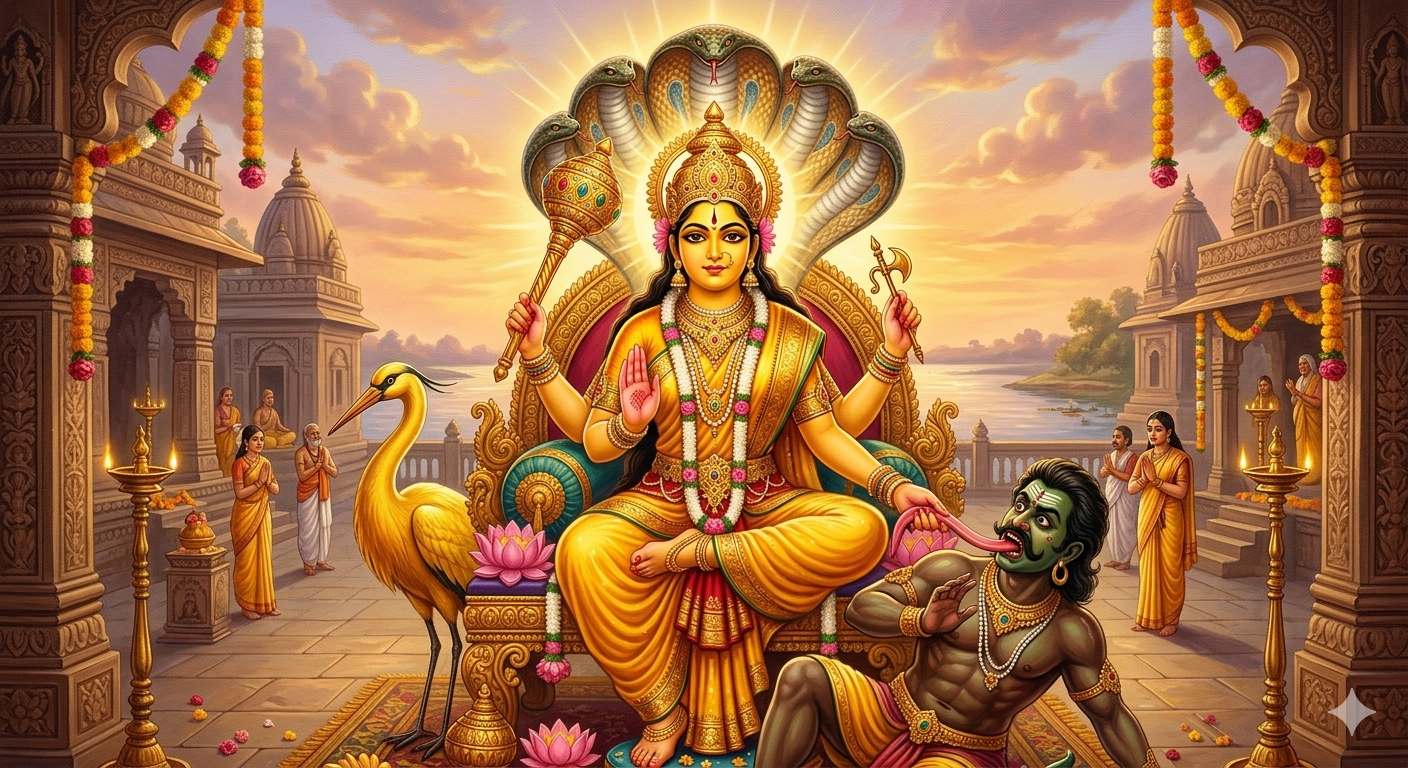
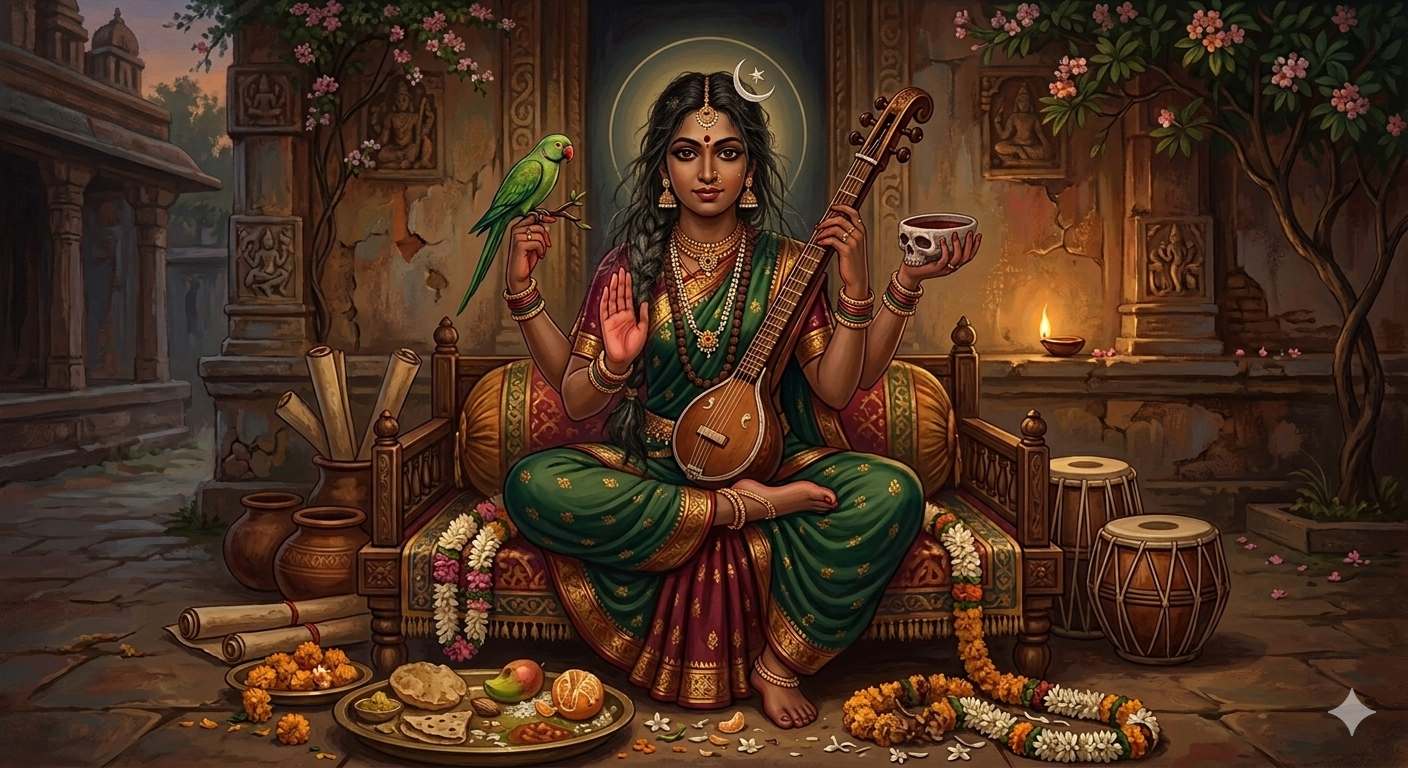
The Mahavidyas
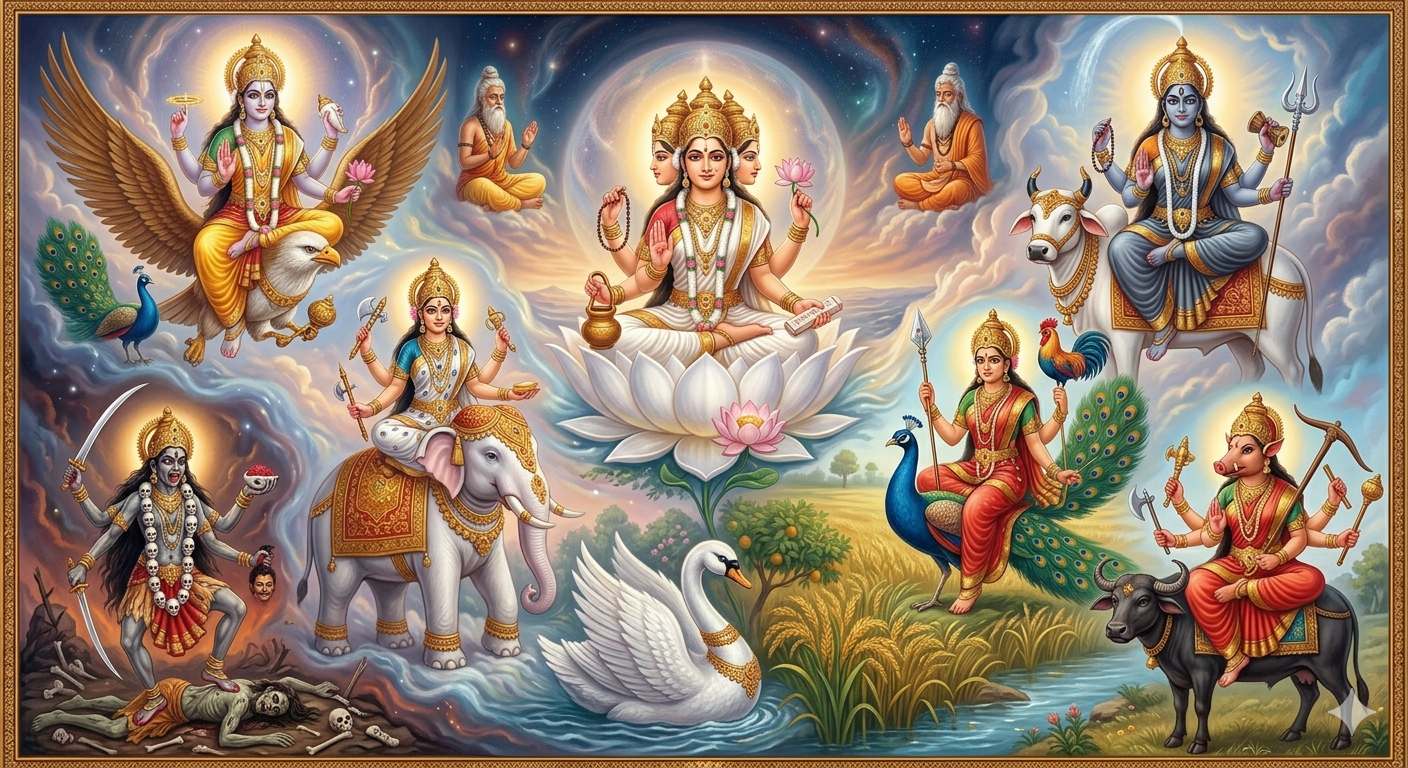
Ten Tantric forms of the Goddess — from the most terrifying to the most beautiful
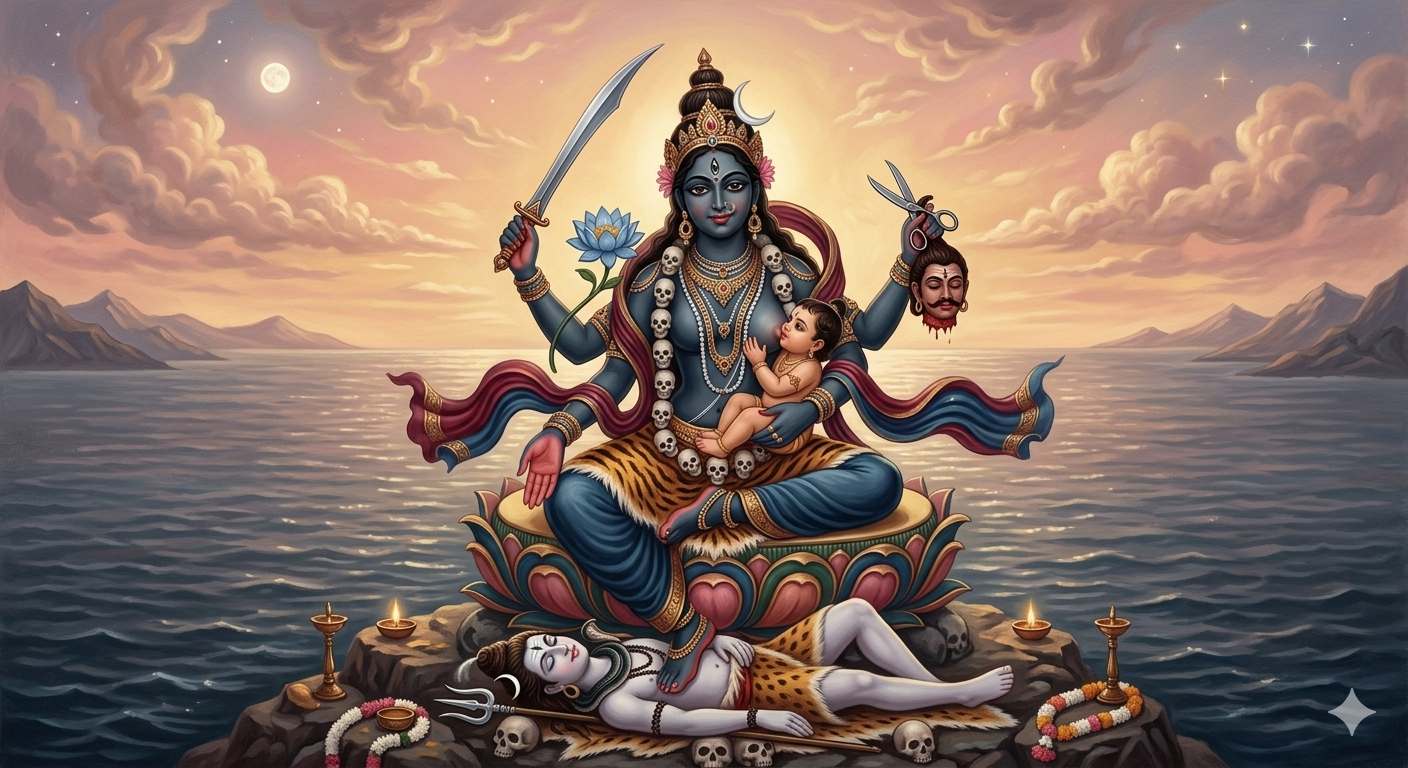
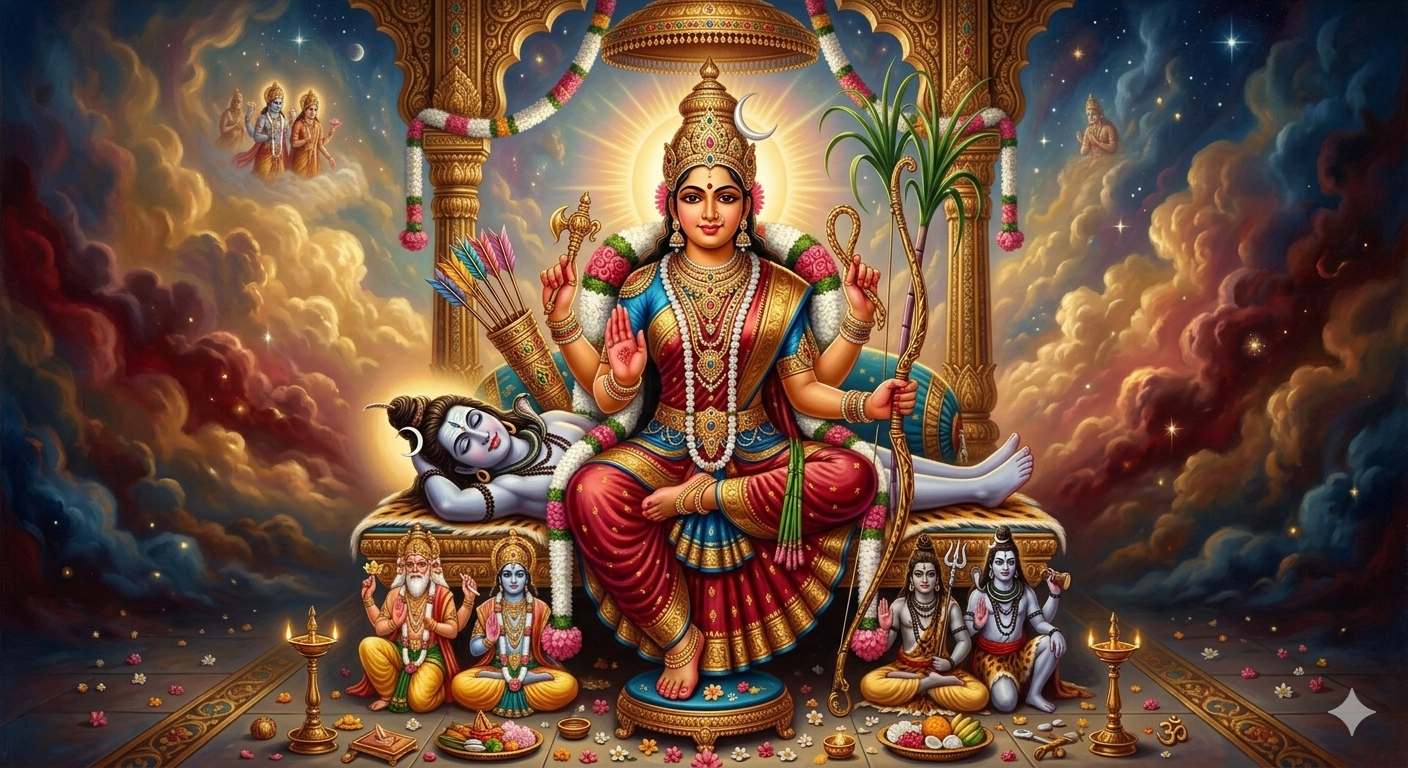
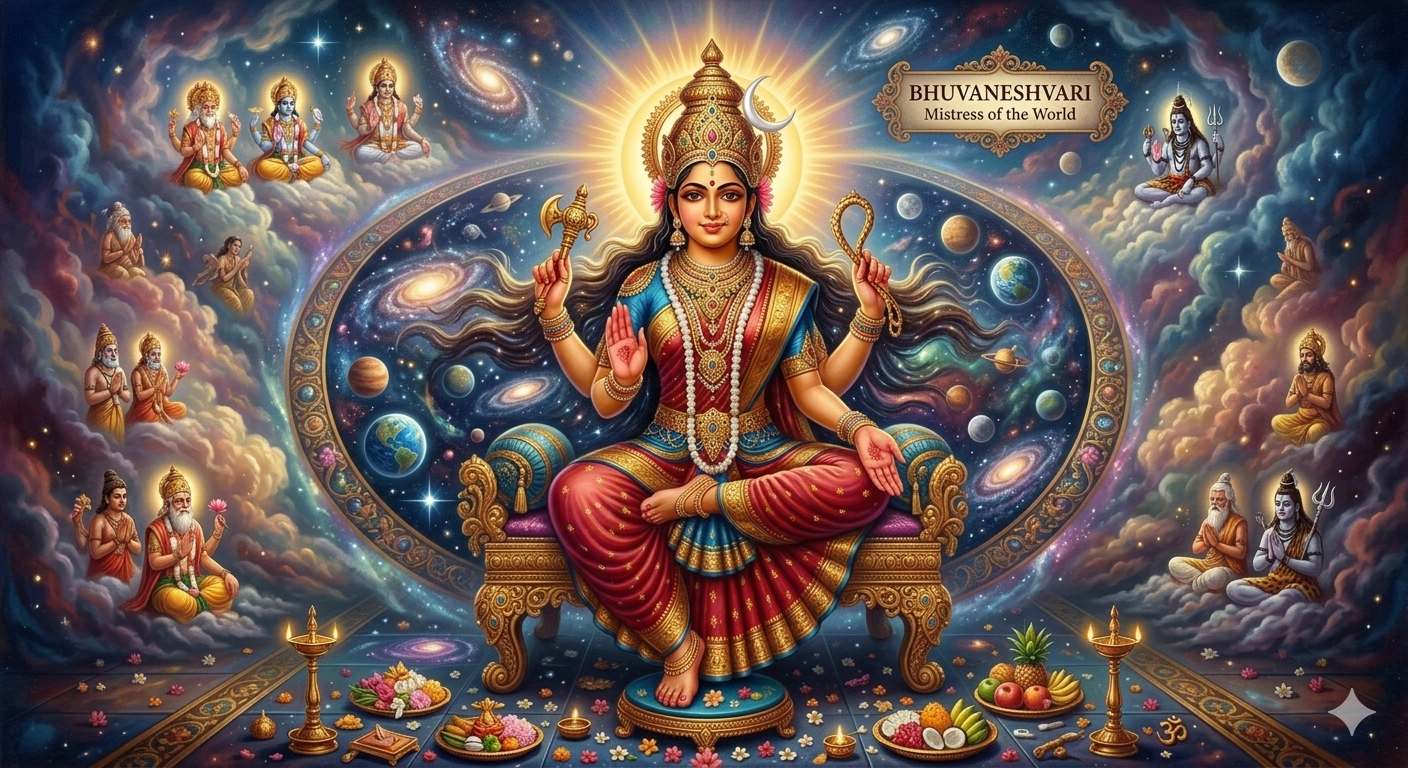
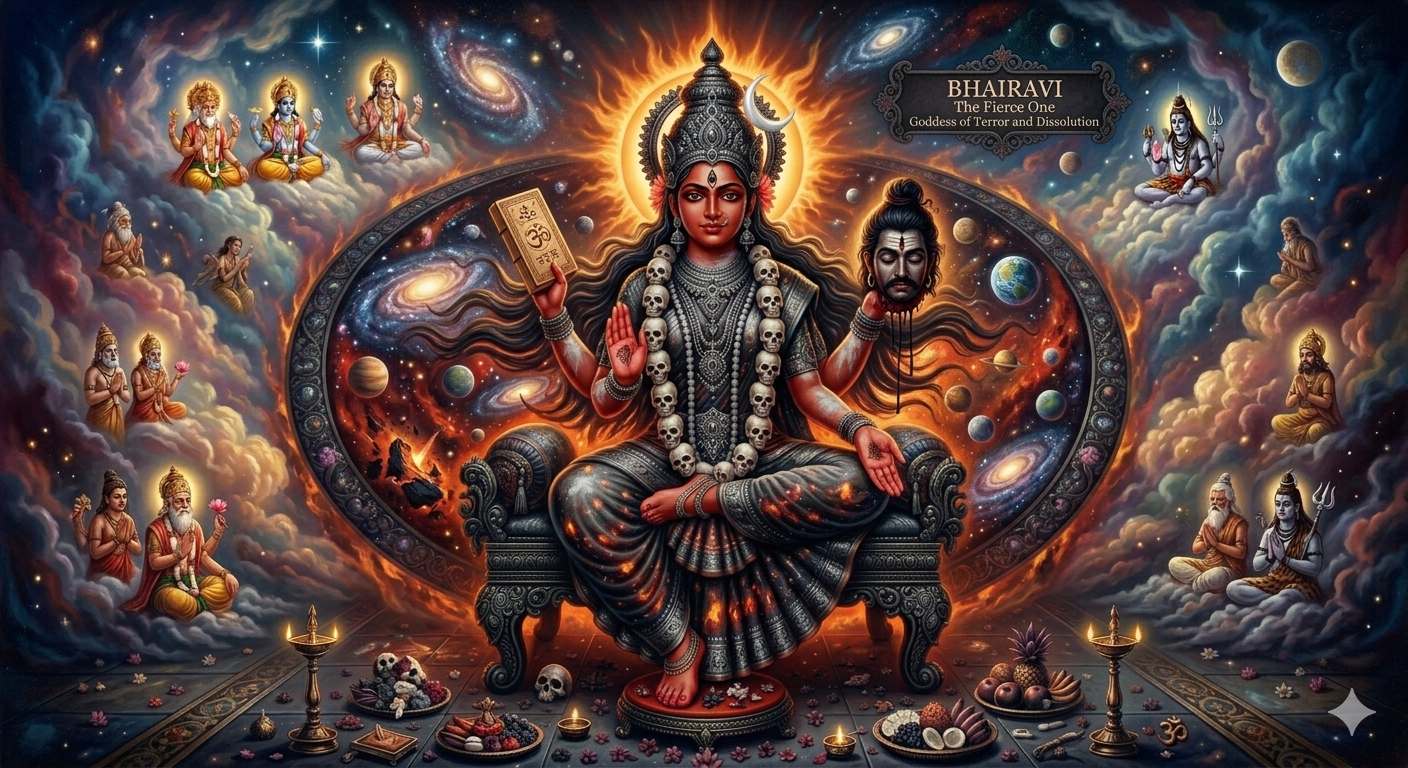
The Saptamatrikas
Seven fierce mother goddesses — the feminine powers of the great male deities
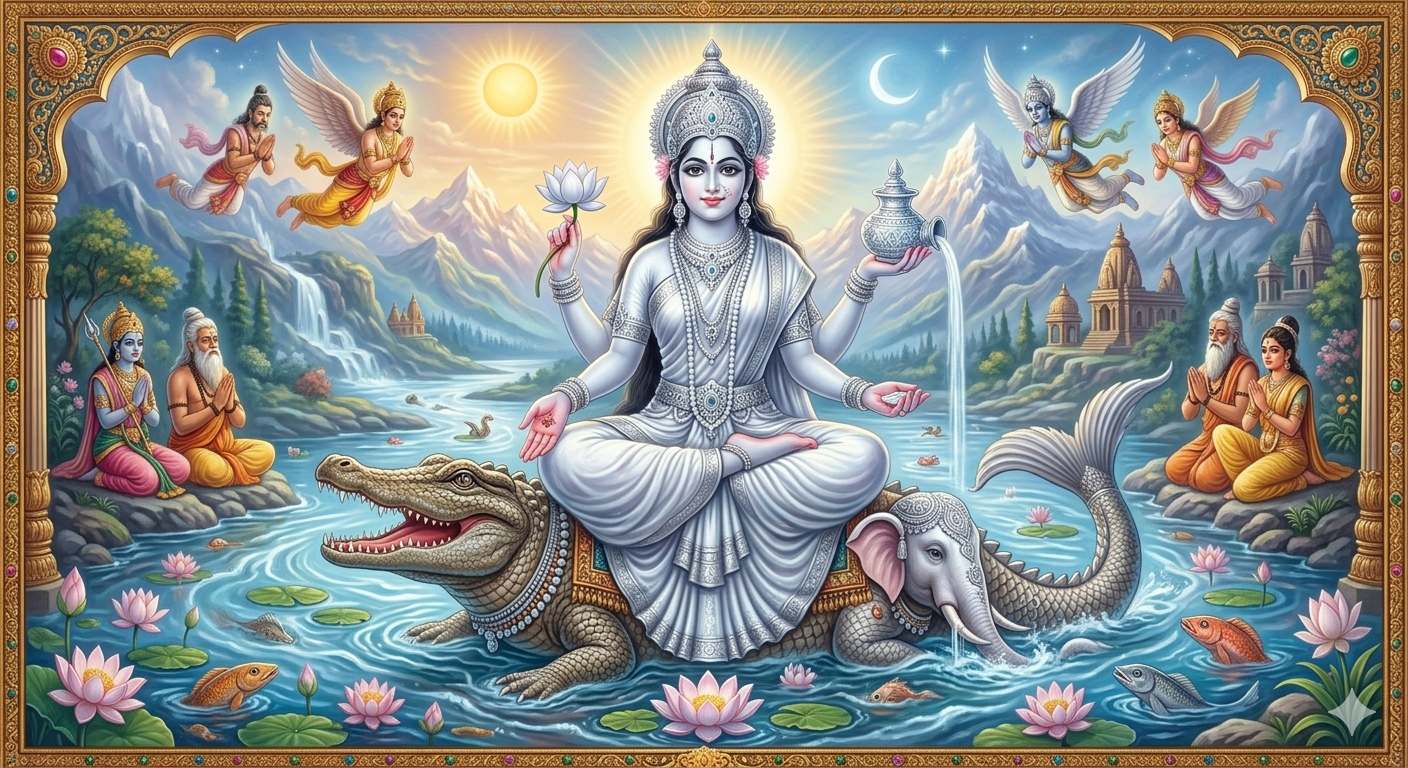
Ganga is the goddess of the river Ganges — the holiest river in Hinduism. She is the divine mother who purifies all who enter her, washes away sins, and liberates the souls of the dead. She flows from the matted hair of Shiva and is a daughter of Himavat. Also known as Gangadevi, Bhagirathi (named for the king who brought her to earth), Jahnavi (associated with the sage Jahnu), and Tripathaga (flowing through the three worlds — heaven, earth, and the underworld).
Symbols & Iconography
Birth & Origin
In the Vedic tradition, Ganga flows from the heavens — a celestial river. She descended to earth through the austerities of King Bhagiratha, who performed penance for thousands of years to bring her down to purify the ashes of his sixty thousand ancestors burned by the sage Kapila.
The force of her descent would have destroyed the earth — so Bhagiratha asked Shiva to catch her in his matted hair, breaking her fall. She flowed from Shiva's locks to the Himalayas and then across the plains. This is why she is shown flowing from Shiva's jata in all iconography.
Family
Father: Himavat (the Himalaya). Sister: Parvati (in some traditions). Her son Bhishma — the greatest warrior of the Mahabharata — is the eighth Vasu she bore to Shantanu and the only one she did not drown at birth, fulfilling the Vasus' curse. (See also: Vasus, Bhishma)
Scriptures
Ganga is hymned in the Rigveda and extensively described in the Mahabharata (the story of Bhishma's birth), the Ramayana (Bhagiratha's penance), the Bhagavata Purana, Skanda Purana, and Devi Bhagavata Purana. The Ganga Stotram is recited at river bathing sites.
Worship & Legacy
Bathing in the Ganga is considered purifying of all sins. The ashes of the dead are immersed in her waters as the final act of the funeral. Major pilgrimage sites along her banks: Gangotri (her source), Haridwar (where she descends to the plains), Prayagraj (the Triveni Sangam), Varanasi (where dying in her presence grants liberation), and Ganga Sagar (where she meets the sea). The Kumbh Mela at Prayagraj — held every twelve years — is the largest human gathering on earth. The Ganga Aarti at Haridwar and Varanasi, performed every evening with enormous lamps, is one of the most visually striking religious rituals in the world.
Key Stories
1. The Descent of Ganga — Bhagiratha's Penance
King Bhagiratha's sixty thousand ancestors — sons of Sagara — had been burned to ash by the sage Kapila's furious glance when they disturbed his meditation while searching for a stolen horse. Their souls could not reach liberation without a proper water rite, and no ordinary water would serve — only the Ganga, flowing from the heavens. Bhagiratha performed austerities for thousands of years to persuade Ganga to descend, then more austerities to persuade Shiva to receive her force. He then led Ganga across the earth to the ashes of his ancestors. As she flowed over them, their souls were liberated. The upper Ganga is still called the Bhagirathi. The idiom "Bhagirathi effort" in Sanskrit and Hindi describes any extraordinary sustained endeavor.
2. The Three Rivers at Prayagraj
The confluence of the Ganga, the Yamuna, and the mythological underground Saraswati at Prayagraj — the Triveni Sangam — is considered the holiest spot in all of India. The Saraswati, though dried up thousands of years ago, is believed to flow invisibly underground and join the other two at this point. Bathing at the Triveni Sangam is held to wash away the sins of many lifetimes. The Kumbh Mela — held at Prayagraj every twelve years and drawing tens of millions of pilgrims — is the world's largest periodic human gathering.
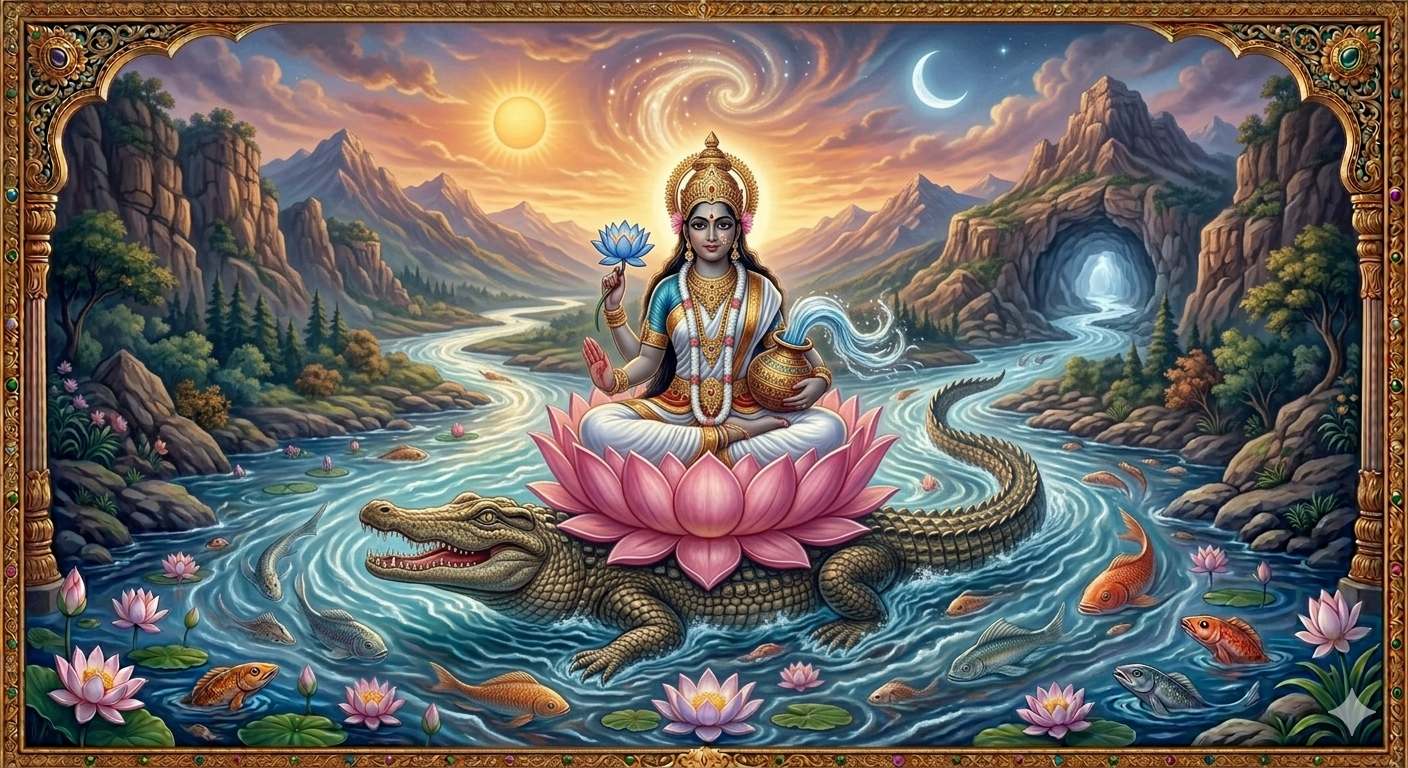
Yamuna is the goddess of the river Yamuna — the second holiest river in Hinduism after the Ganga. She is the daughter of Surya (the sun god) and Sanjna, and the twin sister of Yama (the god of death). She is deeply connected to Krishna — he was carried across her waters at birth, he played on her banks in Vrindavan, and she is central to all the mythology of his early years. Also known as Kalindi (the dark one) and Surya-suta (daughter of the sun).
Symbols & Iconography
Birth & Origin
Daughter of Surya and Sanjna. Her twin brother Yama became the god of death — the first mortal. She became the river that flows through the heart of Krishna's land. The Rigveda's dialogue of Yama and Yami (Book 10, Hymn 10) — in which Yami pleads with her twin to be with her and Yama refuses — is one of the earliest dramatic dialogues in Sanskrit literature. The Yamuna's name is connected to this primordial longing.
Family
Father: Surya (Vivasvat). Mother: Sanjna. Twin brother: Yama. Half-siblings through Chhaya: Shani and Savarni Manu. She is especially associated with Krishna — the river of his childhood and his first miracle.
Scriptures
Yamuna appears in the Rigveda, Mahabharata, Bhagavata Purana, Harivamsha, and extensively in the devotional poetry of the Vrindavan tradition — particularly the works of Surdas, Nandadasa, and other Ashtachhap poets. The Yamunastakam attributed to Vallabhacharya is among the most celebrated hymns addressed to her.
Worship & Legacy
The Keshi Ghat and other ghats at Vrindavan are the primary Yamuna pilgrimage sites. Yamuna Chhath — an extension of the Chhath Puja festival — is celebrated on her banks. The Yamuna has faced severe pollution in recent decades; her devotional tradition has become entangled with environmental activism. In 2017 the Uttarakhand High Court declared her a living entity with legal rights, though the Supreme Court later stayed this ruling.
Key Stories
1. The Crossing at Birth and the Serpent Kaliya
When Vasudeva carried the newborn Krishna from the prison in Mathura to Gokul on a monsoon night, the Yamuna was flooded. She parted to allow Vasudeva through, recognizing the divine child — the infant's feet touching her waters, sanctifying both of them. Years later, Krishna dove into the Yamuna to confront the serpent Kaliya whose venom had poisoned a deep pool, killing birds and animals on her banks. Krishna fought Kaliya and danced on his hoods until Kaliya's wives pleaded for his life. Krishna spared Kaliya and sent him to the ocean. The Yamuna was purified. These two stories frame Krishna's entire relationship with his river — welcomed into her at birth, her defender throughout his Vrindavan years.
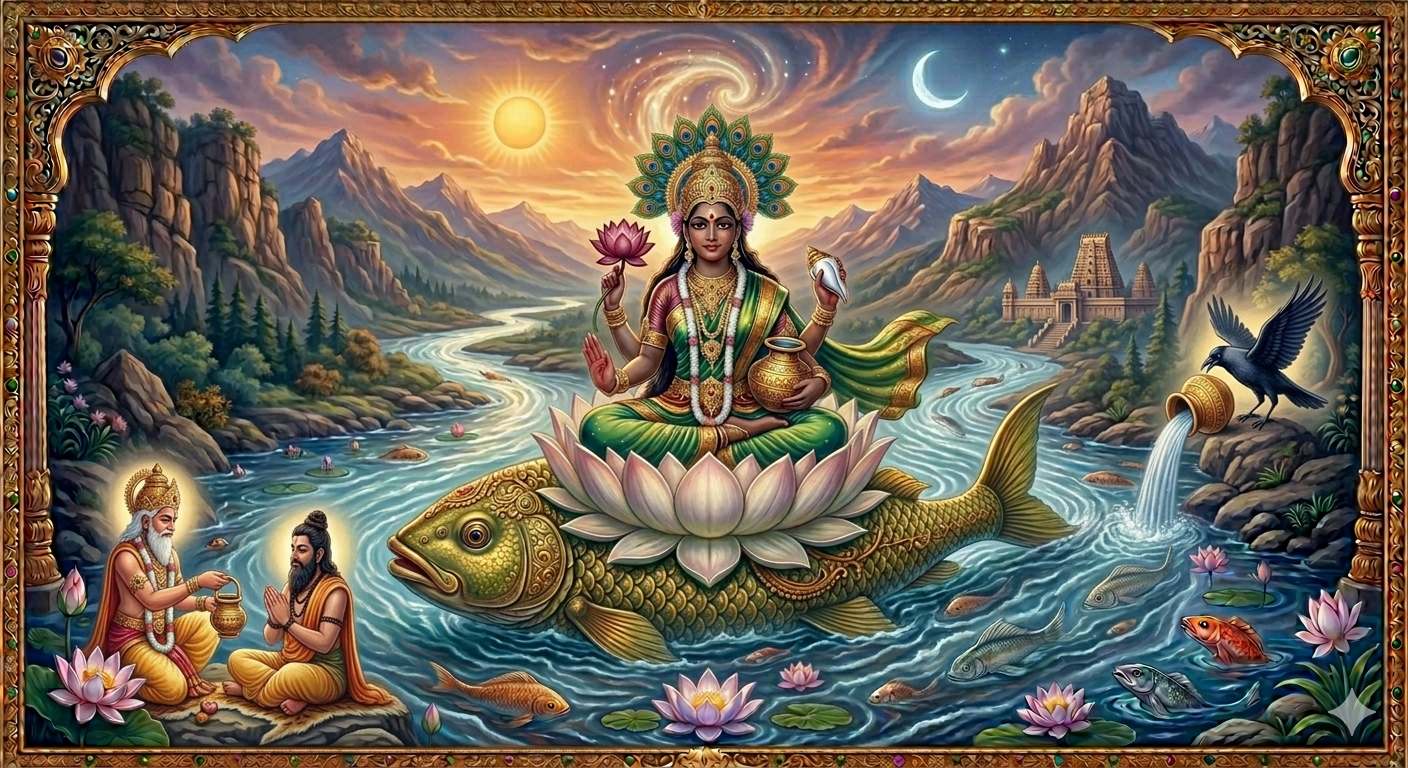
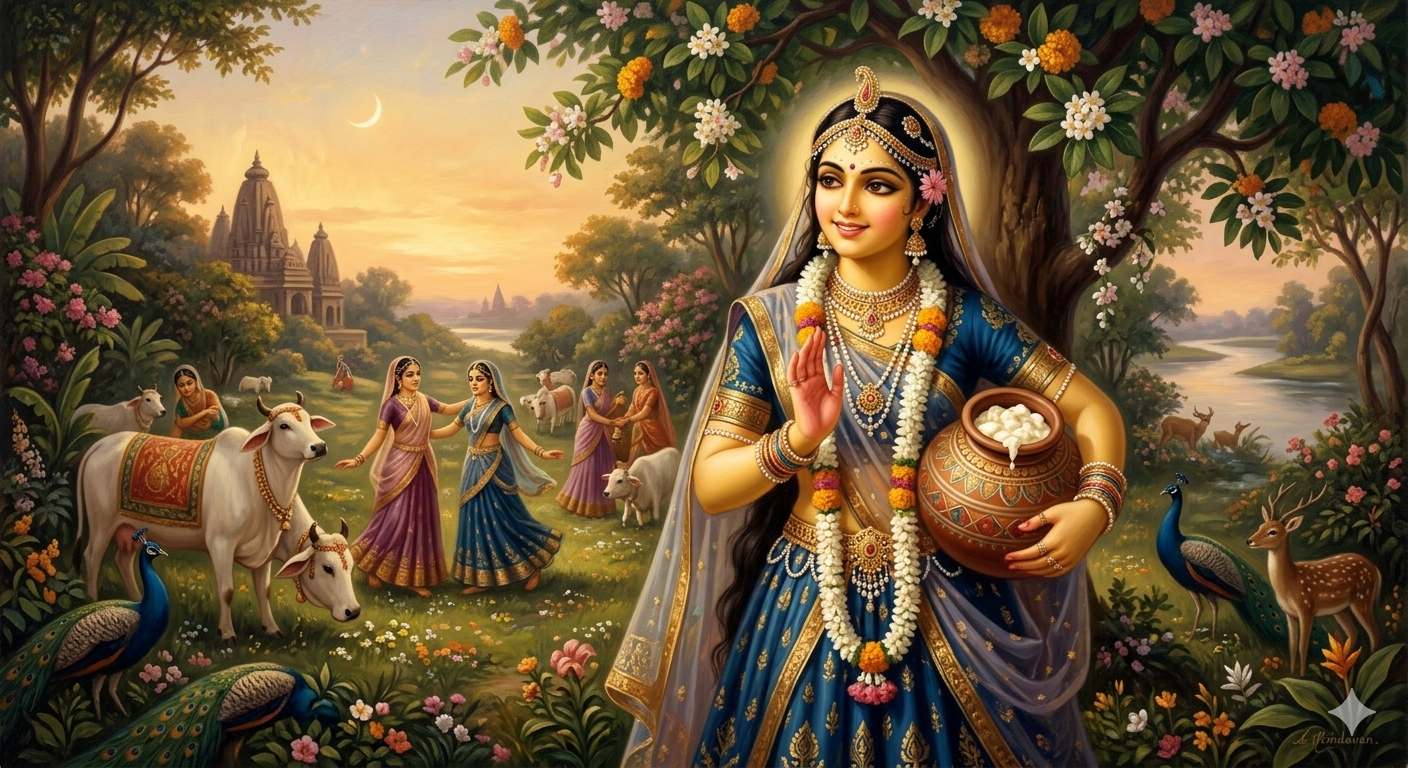
Radha is the primary beloved of the young Krishna in Vrindavan and the supreme devotee in the Vaishnava devotional tradition. In the Gaudiya Vaishnava tradition founded by Chaitanya Mahaprabhu, she is not merely a devotee but the supreme Shakti of Krishna — his essential feminine power — and is worshipped equally with him. Her theology transforms romantic longing into the highest spiritual path. Also known as Radhika, Kishori, Vrindavaneshvari, and Hladini Shakti (the power of divine bliss).
Symbols & Iconography
Origin in Scripture
Radha is not mentioned in the Bhagavata Purana's tenth canto — the main source of Krishna's childhood stories. She appears in the Brahma Vaivarta Purana, the Gita Govinda of Jayadeva (12th century), and the devotional poetry of the medieval Vaishnava saints.
In the Gaudiya Vaishnava theology founded by Chaitanya Mahaprabhu (16th century), Radha is identified as Krishna's Hladini Shakti — his power of bliss — inseparable from him and equal to him. Without her, Krishna cannot experience his own joy.
Worship & Legacy
Radha-Krishna temples span the Vrindavan-Mathura region and worldwide. The Banke Bihari Temple in Vrindavan is particularly associated with her presence. Radhashtami (her birthday) is celebrated eight days after Janmashtami. ISKCON temples worldwide worship Radha-Krishna together as their primary deity pair.
Scriptures
Radha is the central figure of the Gita Govinda (Jayadeva, 12th century Sanskrit), the Brahma Vaivarta Purana, and the poetry of the medieval Vaishnava saints — Vidyapati (Maithili), Chandidas (Bengali), Surdas (Braj Bhasha), and Mirabai (Rajasthani/Braj). The Narada Bhakti Sutras and the theology of the Gaudiya Vaishnava tradition elaborate her significance as the supreme devotee whose love defines the path of Bhakti.
Key Stories
1. The Rasa Lila
In the Bhagavata Purana, Krishna played his flute on a moonlit autumn night in the forest of Vrindavan. The Gopis (cowherd women) heard it and were irresistibly drawn — leaving their homes, their duties, their sleeping families — to come to him in the forest. He danced the Rasa Lila with them, multiplying himself to be with each of them simultaneously. In the Gaudiya tradition, Radha is identified as the chief among the Gopis — the one for whom the Rasa Lila ultimately was. The dance is understood not as romance but as the supreme metaphor for the soul's complete, unconditional surrender to the divine.
2. The Separation — Viraha
The central emotional state of Radha in the devotional tradition is Viraha — the agonizing pain of separation from Krishna after he leaves Vrindavan for Mathura and never returns. This separation became the most powerful devotional theme in Indian religious literature — explored across languages and centuries as the universal experience of the soul longing for the divine. Jayadeva's Gita Govinda, Surdas's padas, and Mirabai's songs all circle this ache of sacred absence. In the Gaudiya theology, Radha's love is so total that even her pain of separation is a form of ecstasy — Viraha Bhakti, the devotion of longing.
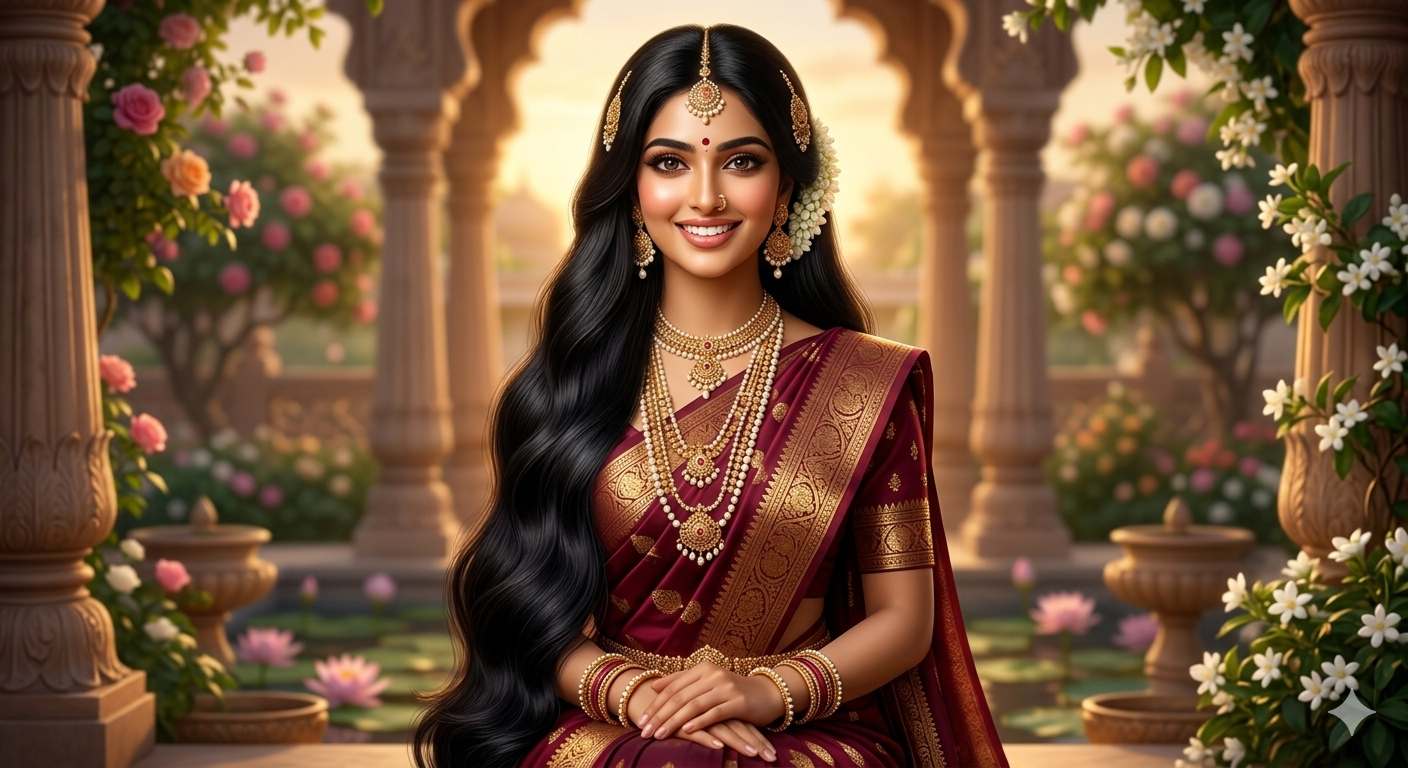
Sita is the consort of Rama and one of the most beloved figures in all of Hindu tradition. Found in a field by King Janaka — a child of the earth itself, born from the furrow (Sita means furrow in Sanskrit). She is one of the Panchakanyas — the five supremely chaste women whose names are recited on waking as a purifying mantra. Also known as Janaki (daughter of Janaka), Vaidehi (princess of Videha), Maithili (from Mithila), and Bhoodevi (earth-born).
Symbols & Iconography
Birth & Origin
King Janaka of Mithila found Sita as an infant in a golden box while ploughing a field for a sacred ritual. The furrow yielded a child — earth-born, a daughter of Prithvi (the earth goddess). She was raised as his daughter and named Sita for the furrow. In the Devi Bhagavata Purana she is identified with Lakshmi, descending as Rama's consort just as Lakshmi descends with each avatar of Vishnu.
Worship & Legacy
The Janaki Mandir in Janakpur, Nepal — the city of her birth — is the most significant Sita temple. The Sitamarhi district of Bihar is also identified as a possible birthplace. Vivah Panchami celebrates her marriage to Rama. Her story has been retold across all Indian languages and she is one of the most re-interpreted figures in modern Indian literature — her trials questioned and examined by writers from Valmiki's time to the present.
Scriptures
Sita is the central female figure of the Valmiki Ramayana and the Ramcharitmanas of Tulsidas. She appears in the Devi Bhagavata Purana, the Ananda Ramayana, and hundreds of regional retellings. The Sundara Kanda of the Valmiki Ramayana — which describes Hanuman's search for her in Lanka — is the most recited section of the entire epic in daily Hindu practice.
Key Stories
1. The Swayamvara and the Breaking of Shiva's Bow
Sita's swayamvara required lifting and stringing the great bow of Shiva — which no king or prince had been able to even move. Rama not only lifted it but broke it in the act of stringing it, winning Sita. The sound was heard across the universe. The breaking of Shiva's bow brought the warrior Parashurama in fury — who was then subdued by Rama.
2. The Captivity in Lanka
Ravana abducted Sita through a trick — creating an illusory golden deer to draw Rama and Lakshmana away. She was held in the Ashoka grove of Lanka for a year. Despite Ravana's every entreaty and threat, she remained unbroken — clutching a blade of grass between herself and any demon who approached her. She did not cry out, did not despair, did not submit. Her endurance in Lanka is as celebrated as Rama's war.
3. The Agnipariksha and the Return to the Earth
After her rescue, Sita underwent the Agnipariksha — the fire ordeal — at Rama's request, proving her purity. She was reunited with Rama and returned to Ayodhya. But when public doubt arose again, Rama exiled her to the forest while she was pregnant. She gave birth to Luba and Kusha in the sage Valmiki's hermitage and raised them alone. When the twins were grown and finally brought before Rama, Sita called on her mother the earth to receive her — and the earth opened. She descended into it, returning to her origin. It is the most emotionally charged ending in the Ramayana tradition.
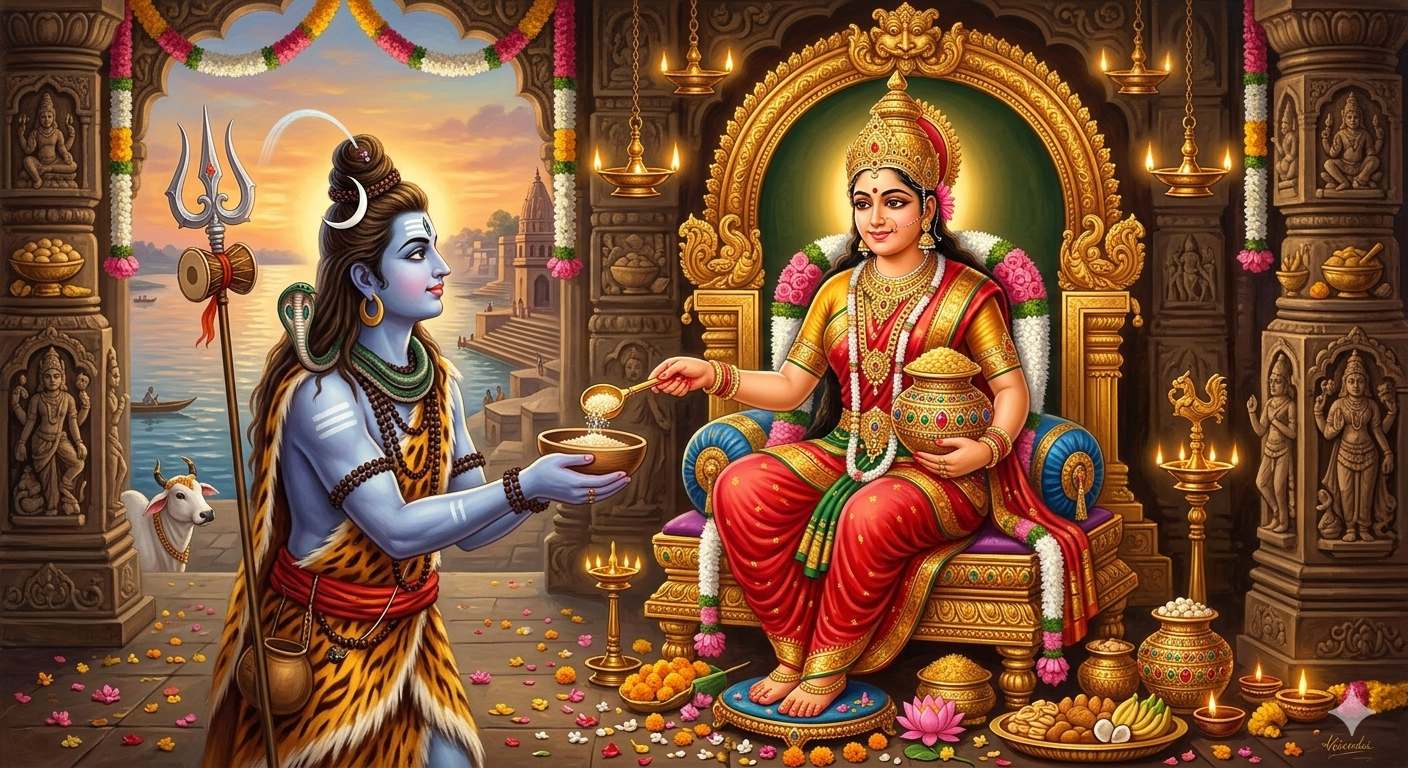
Annapurna is the goddess of food and nourishment — the divine mother who feeds all creation. She is an aspect of Parvati. Her name means "she who is full of food" (Anna = food/grain, Purna = full). She is worshipped for abundance of sustenance and for the understanding that food is divine — that the act of feeding and being fed is sacred. The sacred city of Varanasi is considered her domain. She is present at every act of giving food, every temple kitchen, every household meal.
Symbols & Iconography
Origin & Stories
Annapurna is described in the Skanda Purana and the Annapurna Upanishad. The Annapurna Stotram attributed to Adi Shankaracharya is among the most widely recited goddess hymns in North India.
In the Annapurna Stotram, Shiva comes to Annapurna's kitchen door with a begging bowl. This image — the supreme god of the universe standing at the goddess's door asking for food — makes the theological statement that even supreme consciousness depends on the energy of nourishment. Varanasi is the city where this feeding never stops.
Worship & Legacy
The Annapurna Temple in Varanasi — near the Kashi Vishwanath temple — is widely visited. Every pilgrim to Varanasi visits both. The goddess is invoked before every meal in many Hindu traditions — the understanding that food is Annapurna's gift and that wasting it is an offense against her. The Himalayan peak Annapurna in Nepal is named for her — a mountain that feeds the surrounding rivers and plains as she feeds all living beings.
Theological Significance
Annapurna represents the sacralization of the most basic human act — eating. In the Hindu tradition, preparing and offering food is a form of worship (Anna Danam — the gift of food — is considered among the highest acts of merit). Temple kitchens (Annadhana) feeding pilgrims are considered sacred acts of service to the goddess herself.
Her relationship with Shiva is the most direct statement of this theology: Shiva, who can destroy the universe with a glance, is helpless before hunger. Even Mahadeva must eat. Even the divine principle of dissolution depends on the goddess of nourishment. Power, in this theology, depends on sustenance — and sustenance is the goddess's domain.
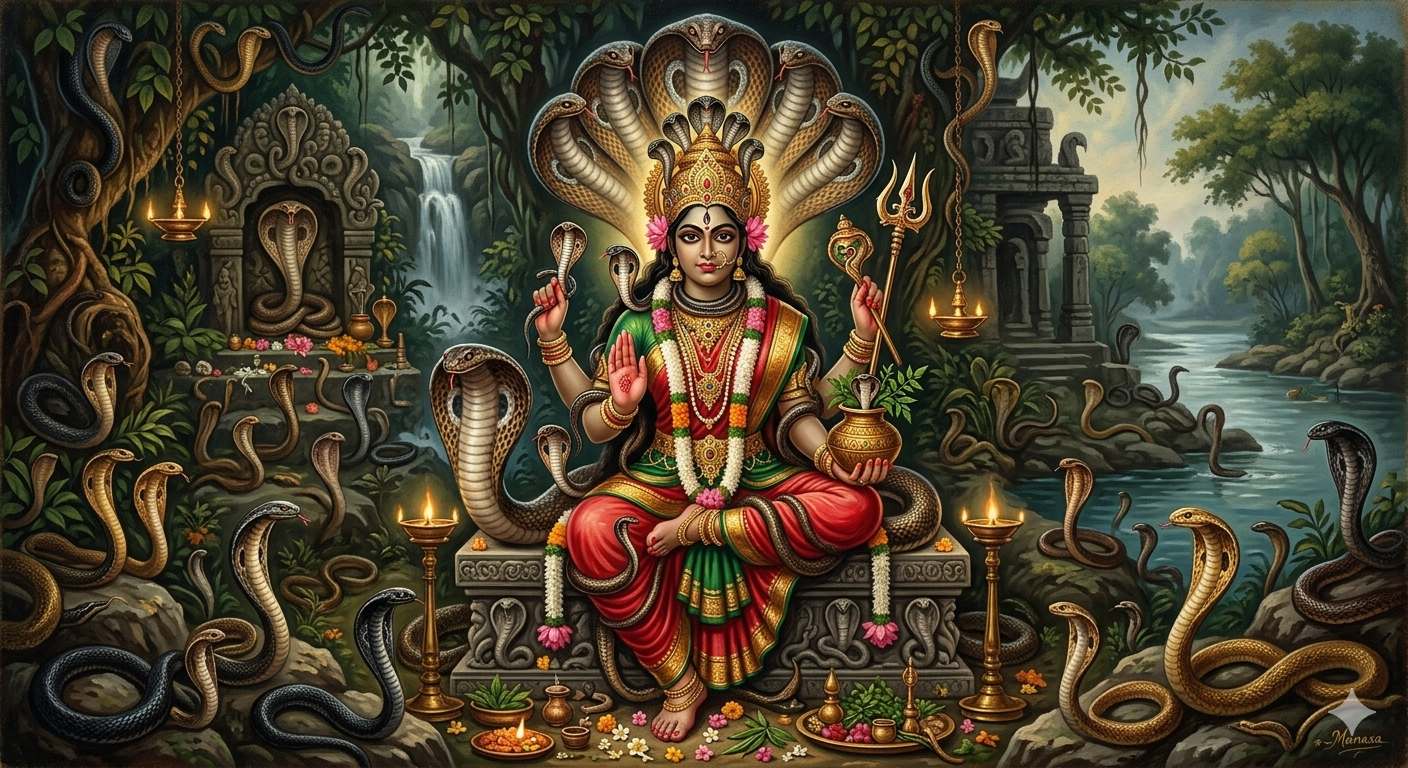
Manasa is the goddess of serpents — the daughter of Shiva who governs snakebites, snake worship, and the protection of those who work near serpents. She is a major deity of the folk tradition of Bengal, Odisha, and northeastern India. Her mythology is unusually dramatic — full of conflict, rejection, and persistence. She is among the few Hindu deities who actively demands worship and punishes those who refuse it, making her mythology one of the most vivid in the folk tradition.
Symbols & Iconography
Birth & Origin
Manasa is the daughter of Shiva — born from his mind (Manasa = mind/born of the mind) or from a drop of his seed that fell on a lotus in some accounts. She was raised by the sage Jaratkaru, whom she later married, bearing him a son — the serpent sage Astika, who would later save the serpent race from Janamejaya's massacre.
Worship & Legacy
Manasa Puja is observed widely in Bengal, Odisha, Assam, Bihar, and Jharkhand on Naga Panchami and on the last day of Shravana. She is among the most important folk goddesses of eastern India. Her worship involves offering milk and flowers to snakes — the most direct continuation of ancient Naga worship in India.
Scriptures
Manasa is described in the Manasamangal Kavya — a major cycle of medieval Bengali texts — and in the Devi Bhagavata Purana. The Manasamangal is among the most celebrated works of medieval Bengali literature, telling her conflict with the merchant Chand Sadagar across multiple episodes of escalating tragedy and eventual submission.
Key Story
The Resistance of Chand Sadagar — Manasamangal
The merchant Chand Sadagar refused to worship Manasa, insisting on worshipping only Shiva. Manasa destroyed his ships, killed his sons, and brought catastrophe upon his household repeatedly. Chand rebuilt, refused, lost again. Her persistence was absolute; his refusal was equally absolute. At last, Chand's youngest son Lakshmindara was killed by a snake on his wedding night despite every precaution. His widowed daughter-in-law Behula refused to accept his death. She loaded his body onto a raft and drifted down the river to the realm of the gods, arguing and bargaining with the divine assembly for her husband's life. She danced before the gods, impressed them with her devotion and skill, and recovered her husband's life. Only then did Chand Sadagar finally agree to worship Manasa — but with his left hand and his face turned away, a deliberate gesture of disrespect, reflecting his continuing resistance even in defeat. This final detail of the left-handed worship — technically correct, spiritually defiant — is the most discussed element of the entire mythology.
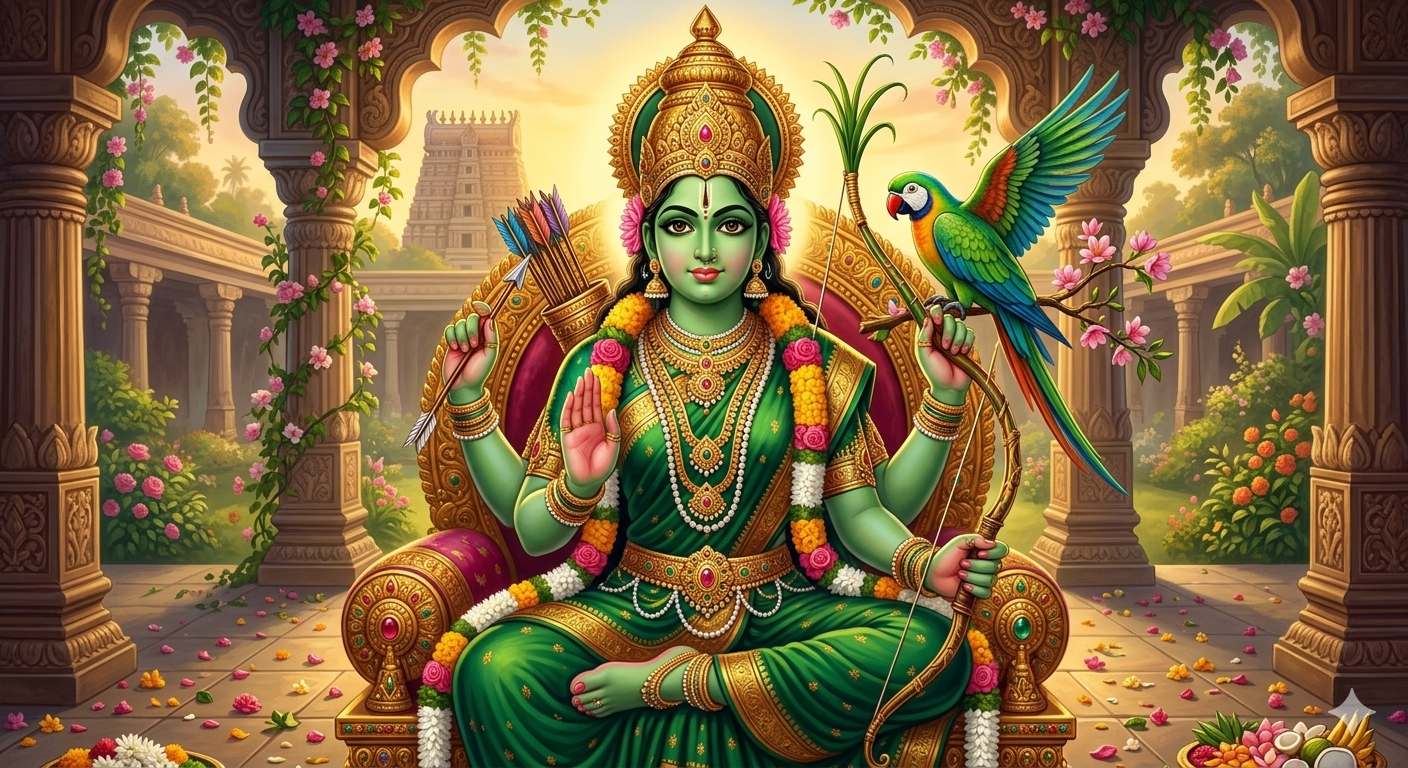
Meenakshi is the patron goddess of Madurai in Tamil Nadu — one of the most beloved goddess forms in South India. She is an aspect of Parvati who reigned as a warrior queen before marrying Shiva (who came to Madurai as Sundareshvara — the beautiful lord). Her temple is one of the largest and most visited in all of India. Her name means "fish-eyed" — the fish-eye being a classical Tamil metaphor for perfectly shaped, beautiful eyes. She is the goddess as sovereign ruler, warrior, and wife — all three simultaneously.
Symbols & Iconography
Birth & Origin
King Malayadwaja Pandya of Madurai performed a great sacrifice praying for a son. A girl was born from the sacrificial fire — with three breasts. A divine voice declared that the third breast would disappear when she met her true consort. She grew up to be a fierce warrior-queen who conquered the three worlds. When she came to Mount Kailash and met Shiva, the third breast vanished and she recognized him as her lord. They married in Madurai in what is called the greatest divine wedding in the Tamil tradition.
Worship & Legacy
The Meenakshi Amman Temple in Madurai — with its fourteen towering gopurams covered in thousands of painted sculptures — receives approximately 15,000 to 25,000 pilgrims daily. The Meenakshi Thirukalyanam (divine wedding of Meenakshi and Shiva) celebrated during the Chithirai festival in April-May draws approximately one million pilgrims and is the largest annual festival in Tamil Nadu.
Scriptures
Meenakshi's story is told in the Skanda Purana (Tatva Prakasha Khanda) and in the Tamil text Thiruvilaiyadal Puranam — a collection of stories about Shiva's divine games in Madurai. The Meenakshi temple's own sthalapurana elaborates her mythology in detail. The Tiruppugazh of Arunagirinathar and other classical Tamil devotional texts celebrate her.
The Meenakshi Temple
The temple complex covers 14 acres and contains the shrines of both Meenakshi and Sundareshvara (Shiva), a hall of a thousand pillars, sacred tanks, and enormous gateway towers (gopurams) rising to 52 meters. The complex has been continuously active for at least two thousand years. It was described by Marco Polo as one of the most magnificent structures he had seen on his journeys through Asia. The evening ceremony in which Shiva is carried to Meenakshi's chamber is performed every day without interruption.
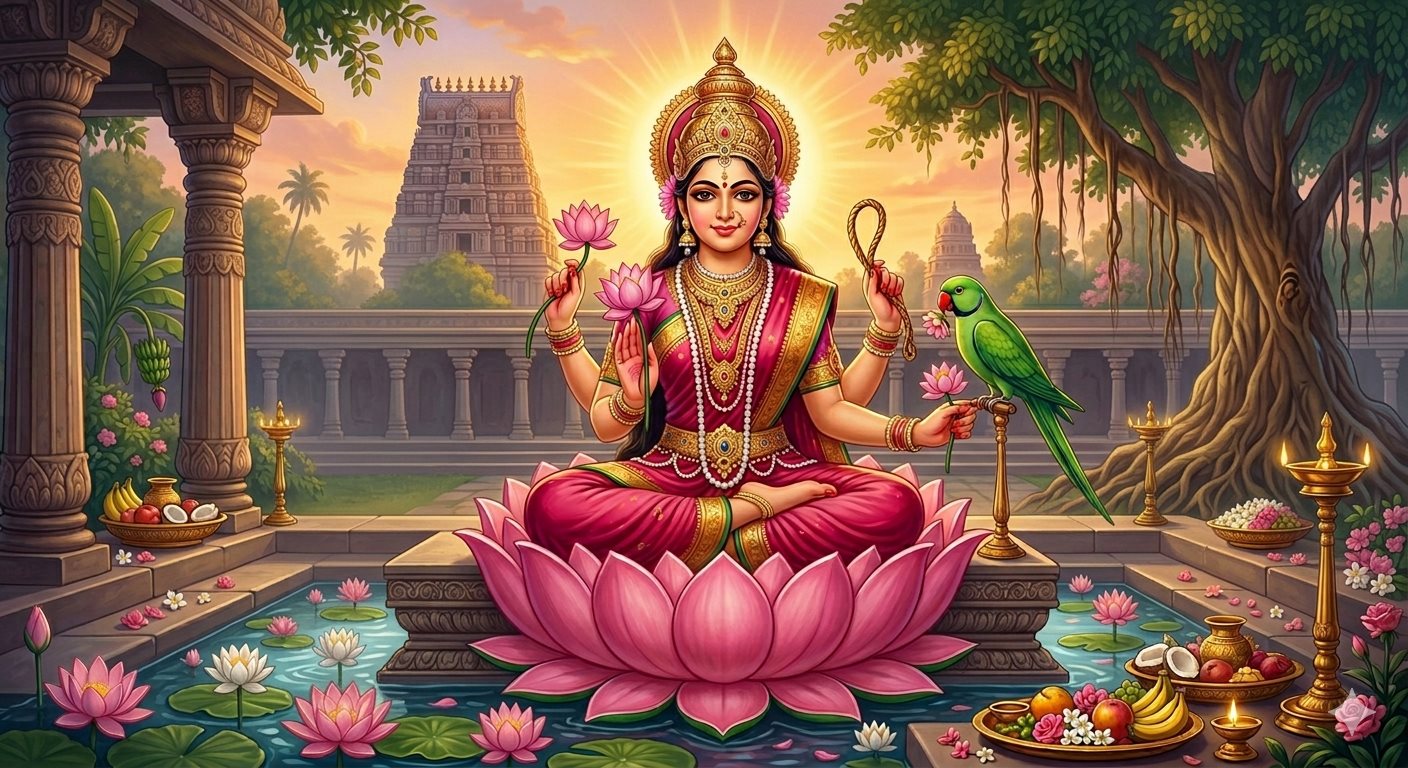
Kamakshi is the presiding goddess of Kanchipuram — one of the seven sacred cities of Hinduism and a major pilgrimage centre of South India. She is a form of Parvati and of Tripura Sundari — the supreme Goddess in the Sri Vidya tradition. Her name means "one whose eyes are filled with love and desire." Unlike most South Indian goddesses, she is depicted seated — a posture of supreme, settled sovereignty.
Symbols & Iconography
Worship & Legacy
The Kamakshi Amman Temple in Kanchipuram is one of the most important Goddess temples in India and one of the three principal Shakti Peethas of the Sri Vidya tradition — alongside Madurai's Meenakshi and Varanasi's Vishalakshi. The Kanchi Kamakoti Peetham — the most influential Shaiva-Advaita religious institution in South India — is based in Kanchipuram, with Kamakshi as its presiding deity. Navaratri celebrations at her temple are among the most elaborate in Tamil Nadu.
Scriptures
Kamakshi is celebrated in the Soundarya Lahari of Adi Shankaracharya and in numerous Sanskrit and Tamil devotional hymns. The Sri Vidya tradition, which traces its lineage through Shankaracharya, regards her as the supreme form of the Goddess — the living embodiment of the Sri Chakra.
Key Story
1. Shankaracharya and the Sri Chakra
Adi Shankaracharya is said to have come to Kanchipuram, where the goddess was in an extremely fierce form, unsettling the city with her wild energy. He installed the Sri Chakra — the geometric body of the Goddess — beneath her feet, symbolically grounding her fierce power into the benign, seated Kamakshi form worshipped today. The act transformed a terrifying force into a sovereign, compassionate presence. The Sri Chakra installed by Shankaracharya is still worshipped at the temple.
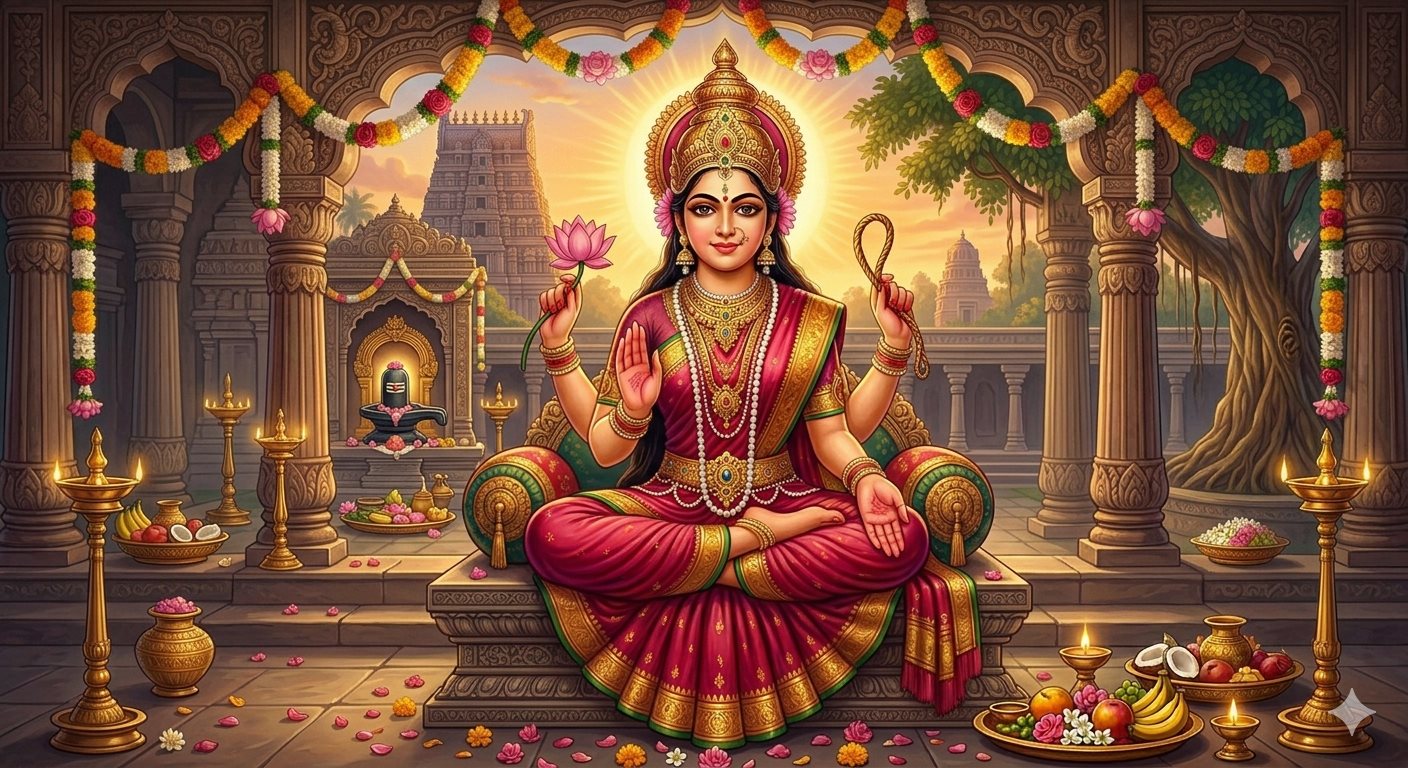
Vishalakshi is the presiding goddess of Varanasi — the city of Shiva — and one of the 51 Shakti Peethas. Her name means "wide-eyed" or "large-eyed." She is a form of Parvati worshipped at the Vishalakshi temple near the Manikarnika ghat — the most sacred cremation ghat on the Ganga. She completes the trinity of the three principal Sri Vidya Shakti Peethas alongside Kamakshi of Kanchipuram and Meenakshi of Madurai.
Symbols & Iconography
Worship & Legacy
The Vishalakshi temple is visited by all pilgrims to Varanasi. The city's identity as home to both Kashi Vishwanath (Shiva) and Vishalakshi (the Goddess) makes it unique in the Hindu tradition — both Shaiva and Shakta poles of the divine are fully present together. The goddess receives enormous numbers of pilgrims, particularly during Navaratri.
Scriptures
The Shakti Peetha tradition is described in the Devi Bhagavata Purana and the Devi Gita. Vishalakshi's temple at Varanasi appears in multiple Purana references to the sacred geography of Kashi. The Kashi Khanda of the Skanda Purana describes her as inseparable from the sanctity of Varanasi.
Key Story
1. The Shakti Peetha at Varanasi
According to the Shakti Peetha tradition, when Shiva carried the body of Sati across the subcontinent in grief, Vishnu dismembered her body with his Sudarshana Chakra to free Shiva from his inconsolable wandering. At Varanasi, Sati's earrings fell to earth, consecrating the site as one of the most powerful Shakti Peethas. Vishalakshi is the Goddess at this site, with Vishvanatha — Shiva as Kashi Vishwanath — as her Bhairava. The simultaneous presence of the Shakti Peetha and the Jyotirlinga at a single city is found only at Varanasi, making it the supreme meeting point of the divine masculine and feminine.
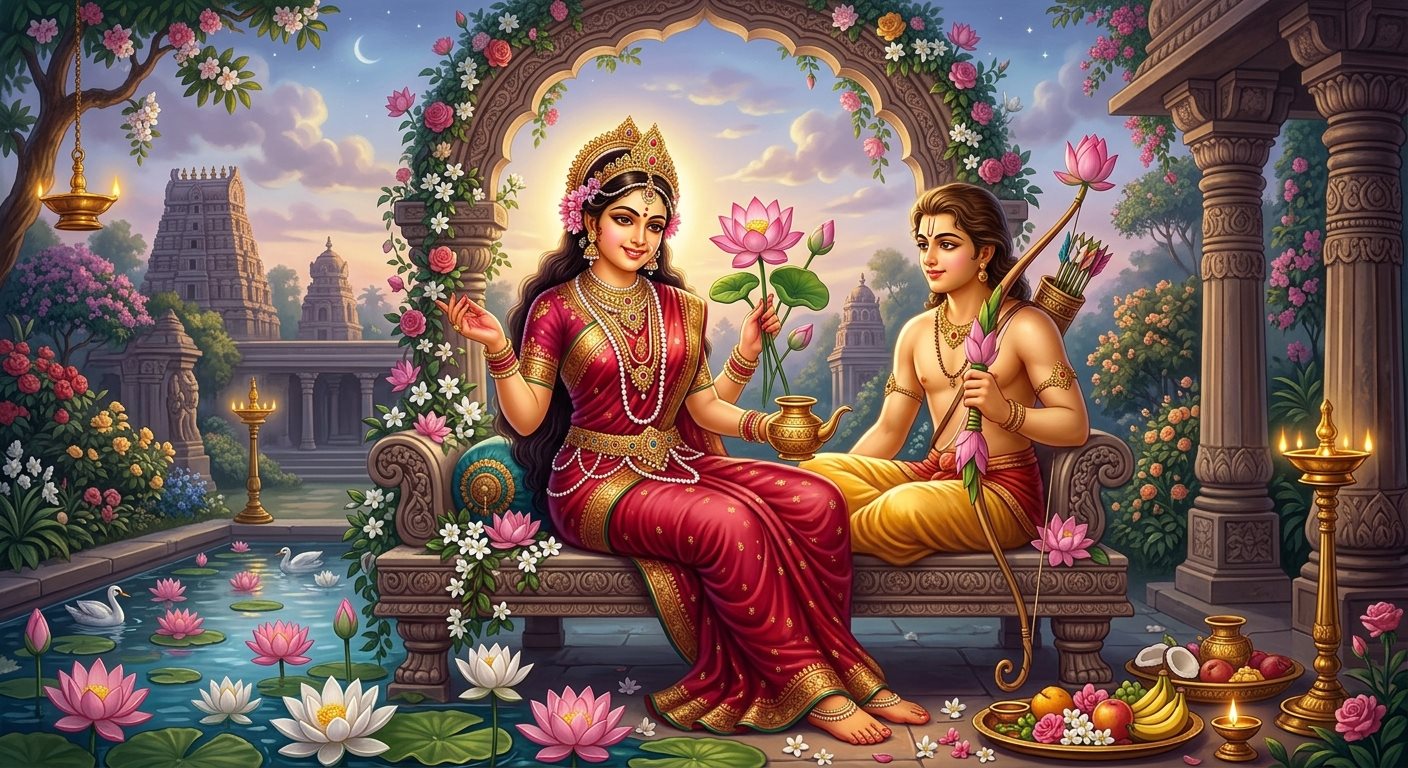
Rati is the goddess of passion, desire, and sensual love — the consort of Kama, the god of love. She is considered the most beautiful of all divine beings, and represents the emotional experience of love as a divine force: desire, longing, and the ecstasy that accompanies it. Where Kama is the arrow, Rati is the flame that the arrow ignites.
Symbols & Iconography
Scriptures
Rati appears in the Shiva Purana, the Bhagavata Purana, and is the subject of extended description in Kalidasa's Kumara Sambhava — one of the greatest works of Sanskrit literature. The Kumara Sambhava's passages on her grief after Kama's destruction are among the most emotionally powerful in Sanskrit poetry.
Worship & Legacy
Rati has no independent temples. She is invoked alongside Kama in love-related rituals and is present in the Holi tradition, which celebrates Kama's destruction and partial restoration. The beauty ideal she represents shaped classical Indian aesthetics across poetry, sculpture, and dance.
Key Stories
1. The Grief After Kama's Destruction
When Shiva's third eye burned Kama to ash — punishing him for interrupting Shiva's meditation — Rati was inconsolable. Her grief, described in the Shiva Purana and the Kumara Sambhava of Kalidasa, is an emotionally shattering passage in Sanskrit literature. She pleaded with Shiva and eventually with Parvati to restore her husband. Kama was restored, but as Ananga — the bodiless one — felt everywhere but seen nowhere. In some tellings Rati could see him; the rest of the world could not.
2. Rati Reborn as Mayavati
In the Bhagavata Purana, Rati was reborn as Mayavati — a woman in the household of the demon Shambhara. When Kama was reborn as Pradyumna (son of Krishna and Rukmini), Shambhara kidnapped the infant and threw him into the ocean. Mayavati — recognizing her husband across the veil of rebirth — raised him in secret, taught him the maya-vidya (knowledge of illusion), and helped him kill Shambhara when the time came. The story is one of love that persists across death and rebirth, across disguise and forgetting.
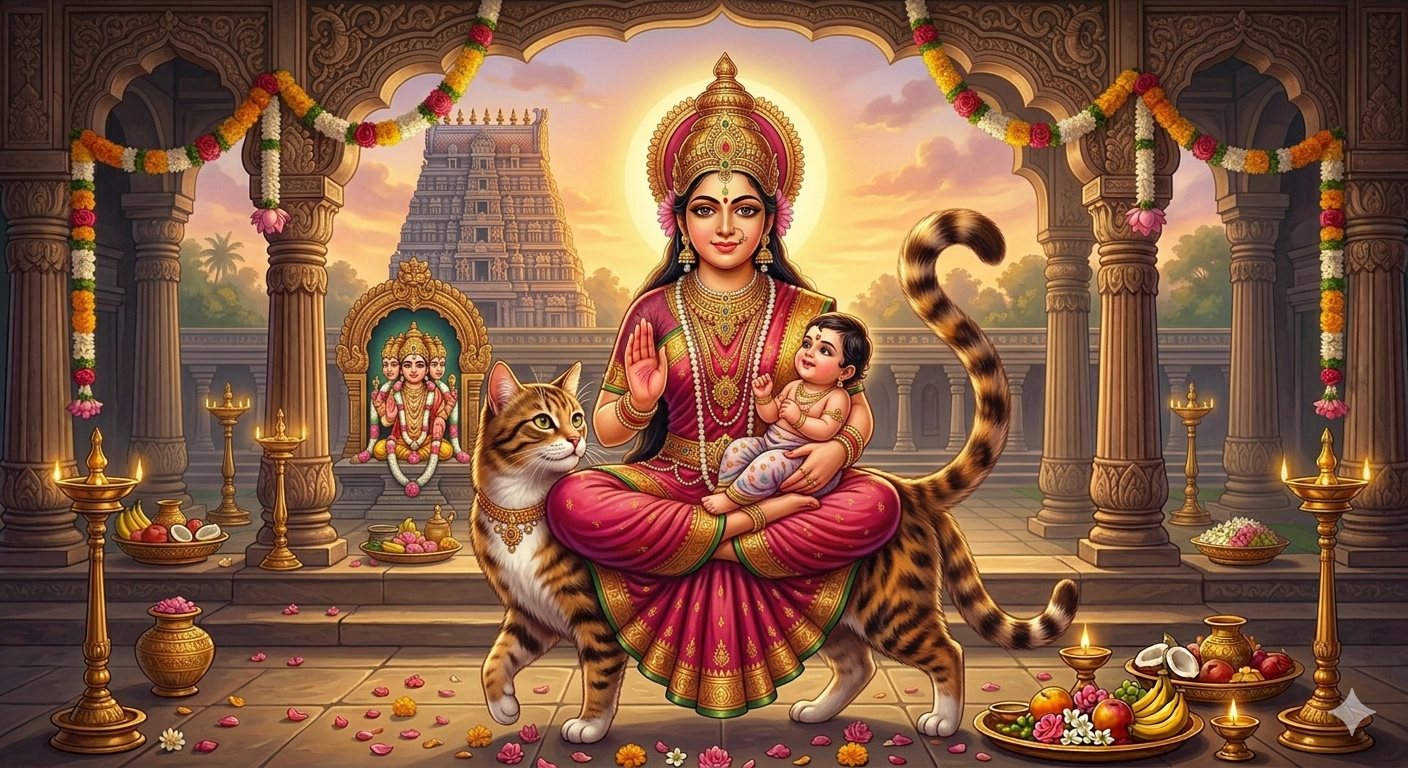
Shashthi is the goddess who governs childbirth, the protection of infants, and the health of children. She is worshipped on the sixth day after a birth — Shashthi means "sixth" — when the naming ceremony traditionally occurs and when the mother and child are considered most vulnerable. Widely worshipped in Bengal, Bihar, and eastern India. Also known as Shashthidevi and Chhath Mata.
Symbols & Iconography
Worship & Legacy
Jamai Shashthi (Son-in-law's Sixth) in Bengal is a festival in her honour. The sixth day after a child's birth is observed with rituals in her name across eastern India. She is one of the most practically significant goddess traditions — her worship directly tied to childbirth and infant survival in a pre-modern context where both were dangerously uncertain. She represents the goddess as protector of the most vulnerable: the newborn and the newly delivered mother.
Scriptures & Tradition
Shashthi appears in the Brahma Vaivarta Purana, which describes her as a form of Devasena — the wife of Kartikeya — or as an independent goddess created by Brahma to protect children. She is one of the Matrikas in some regional traditions. Her worship is primarily oral and folk in character, transmitted through women's rituals rather than Sanskrit texts.
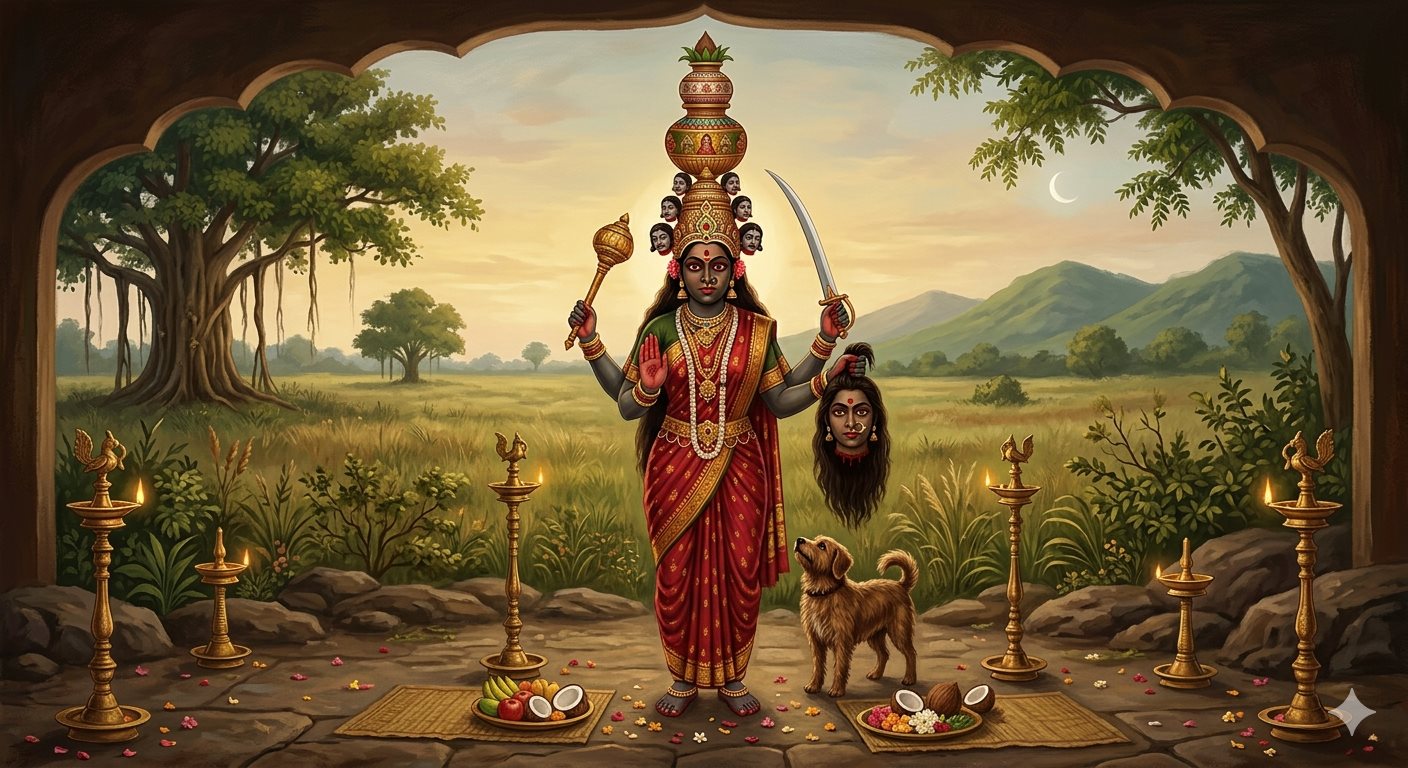
Renuka is the wife of the sage Jamadagni and mother of Parashurama — the axe-wielding avatar of Vishnu. She is a figure of both profound devotion and shattering mythology: the mother killed by her own son at her husband's command, and miraculously restored. Across Karnataka, Maharashtra, and Andhra Pradesh she is worshipped as a village goddess of tremendous power. In Karnataka she is known as Yellamma or Yellama Devi — a goddess particularly associated with marginalized communities.
Symbols & Iconography
Worship & Legacy
The Renuka Yellamma Temple at Saundatti in Karnataka is one of the most significant folk goddess shrines in India, drawing enormous numbers of pilgrims from marginalized communities. The Renuka temple at Mahur in Maharashtra is one of the Saptashringi — seven goddesses — of Maharashtra. Her worship has been historically associated with the Devadasi system and with the Jogini communities who served her temples. Contemporary scholarship has engaged seriously with the social dimensions of her cult.
Scriptures
The story of Renuka's beheading and restoration appears in the Mahabharata (Aranyaka Parva), the Bhagavata Purana, and the Brahmanda Purana. She is described in the context of Parashurama's birth and his dual nature as both brahmin sage and warrior destroyer. The emotional weight of the story — a son who obeys a terrible command — has made it one of the most discussed episodes in Puranic ethics.
Key Story
1. The Beheading and Restoration
Renuka was sent to fetch water from the river. On the way she momentarily experienced desire at the sight of a gandharva king sporting in the river with his wives. When she returned, her husband Jamadagni read her lapse in her dishevelled appearance and loss of divine composure. In his rage he ordered each of his five sons to kill her. Four refused. Only Parashurama — the most devoted — obeyed. For this absolute obedience, Jamadagni offered him a boon. Parashurama asked for his mother's life and that she remember nothing of her death. She was restored — whole, alive, and unknowing. The story raises questions about obedience and devotion that Sanskrit commentators have wrestled with for centuries.