
- Primordial Waters & First Desire
- Cosmic Egg
- Brahma from Vishnu's Navel
- Prajapati Creates Through Austerity
- Purusha Sukta
- Brahma's Nine Prajapatis
- Manu as First Man & Flood
- Shiva as Original Creator
- Goddess as Sole Origin
- Creation Through Sound/Om
- Samkhya Tattva Evolution
- Origin of Gods & Demons via Kashyapa
- Samudra Manthan
- Daksha's Creation of Species
- Origin of the Nagas
- Origin of Garuda
- Varaha Avatar
- Narasimha Avatar
- Vamana Avatar
- Yuga Cycle & Dissolution
- Solar & Lunar Dynasties
- Origin of Vanaras
- Origin of Lanka & Rakshasas
- Shaiva Agamas
- Devi as Sole Origin
- Skanda Purana Regional Accounts
Story 1: The Primordial Waters & the First Desire
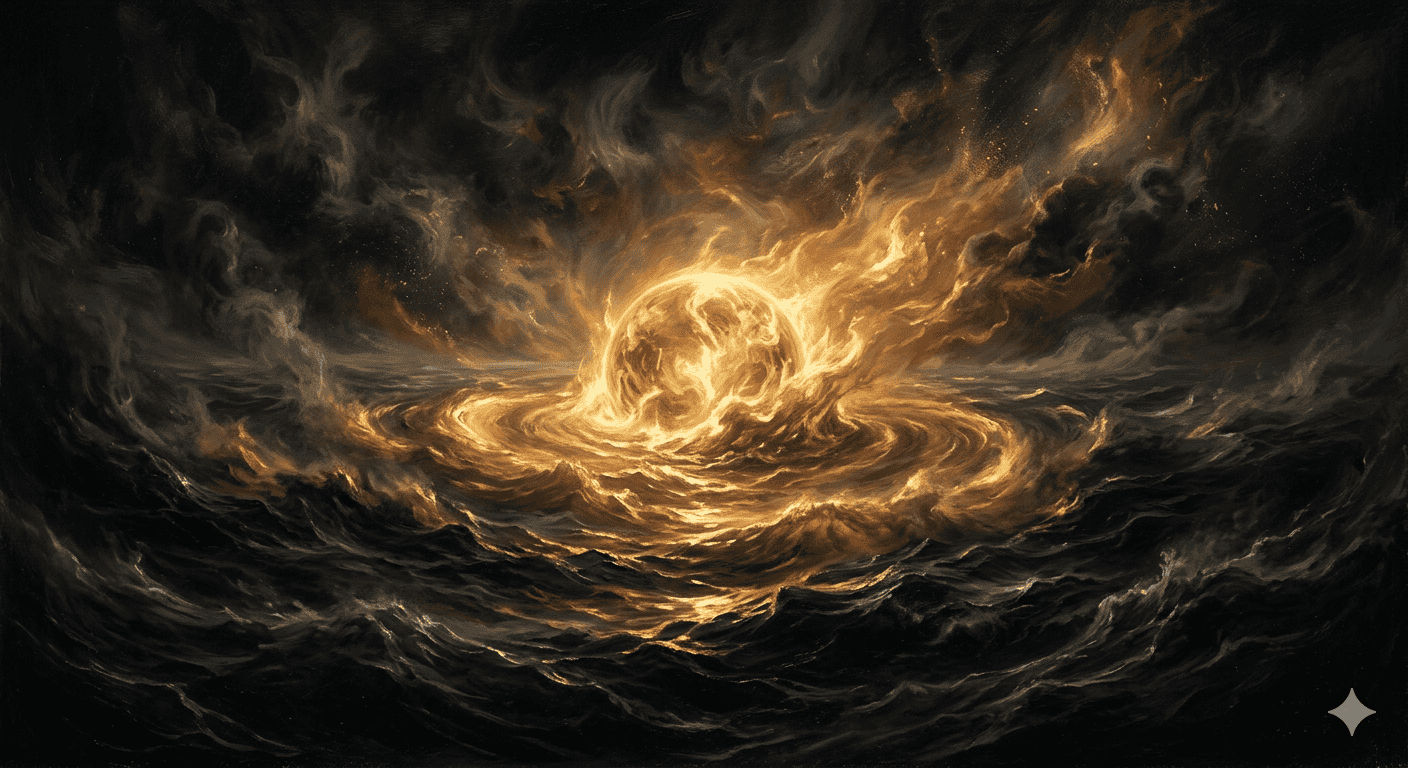
Core narrative: Before creation, there was only dark, undifferentiated water. Nothing existed — no earth, no sky, no gods. From within those waters, a desire or impulse arose, and creation began.
Sources that share this core:
- Rigveda 10.129 (Nasadiya Sukta) — Mandala 10, Hymn 129
- Shatapatha Brahmana 11.1.6.1 — Shatapatha Brahmana, Kanda 11
- Taittiriya Brahmana 2.2.9.1
- Manusmriti 1.5-9
- Vishnu Purana 1.2 — Amsha 1, Adhyaya 2
- Bhagavata Purana 2.9.10 — Skanda 2, Adhyaya 9
- Matsya Purana 2.1-5
Differences:
- Rigveda 10.129: No agent is named. Neither being nor non-being existed. Darkness was wrapped in darkness. "That One" breathed without breath. Desire (kama) arose first — but who or what desired is left unanswered. The hymn ends questioning whether even the creator knows how it happened.
- Shatapatha Brahmana 11.1.6.1: Prajapati alone existed in the waters. He felt lonely and afraid. He desired company. From that desire he created.
- Taittiriya Brahmana 2.2.9.1: The waters existed first. They desired to reproduce. They heated themselves through austerity (tapas). From that heat a golden egg (Hiranyagarbha) arose.
- Manusmriti 1.5-9: The universe was darkness, unknowable, without form. The self-existent Lord (Svayambhu) appeared and dispelled the darkness. He then willed creation into being.
- Vishnu Purana 1.2: Vishnu himself is identified as the primordial water (Nara) and also the one who rests upon it (Narayana). He is both the ocean and the one sleeping on it.
- Matsya Purana 2.1-5: Brahma woke in the primordial waters with no memory of the previous creation and had to rediscover how to create.
Story 2: The Cosmic Egg (Hiranyagarbha / Brahmanda)
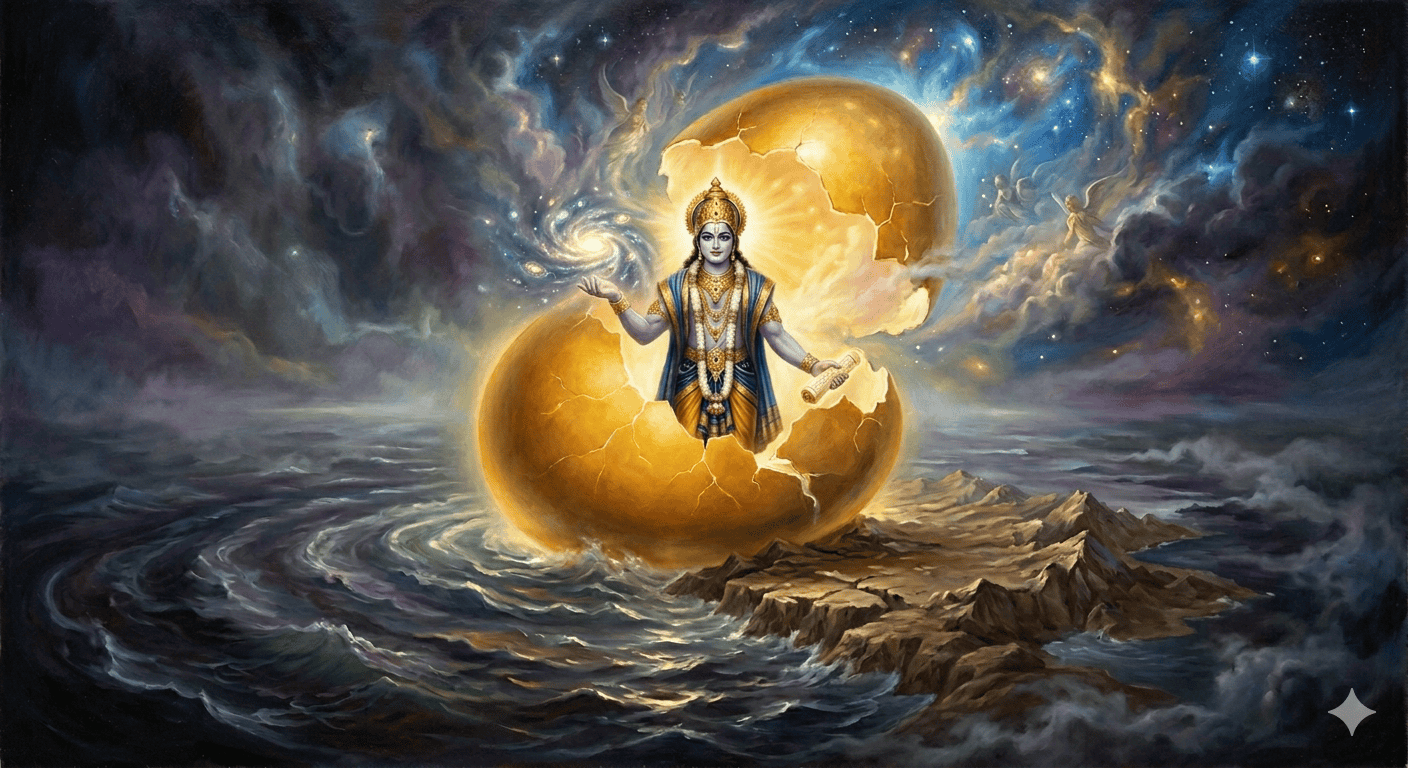
Core narrative: A golden egg appeared in the primordial waters. The creator deity was born inside it, existed within it for a period, then broke it open. The two halves became heaven and earth.
Sources that share this core:
- Rigveda 10.121 (Hiranyagarbha Sukta) — Mandala 10, Hymn 121
- Shatapatha Brahmana 11.1.6.2 — Kanda 11
- Chandogya Upanishad 3.19.1-4 — Prapathaka 3
- Manusmriti 1.9-13
- Vishnu Purana 1.2.50-61
- Bhagavata Purana 3.10.8-14 — Skanda 3, Adhyaya 10
- Brahmanda Purana 1.1.3 — Purva Bhaga, Adhyaya 3
- Matsya Purana 2.25-32
- Vayu Purana 4.1-15 — Adhyaya 4
- Padma Purana 1.1 — Srishti Khanda
Differences:
- Rigveda 10.121: Hiranyagarbha is described as already floating on the waters at the beginning — the egg is not described as breaking. The hymn asks who the god behind all this is, suggesting Hiranyagarbha is the first manifest form of the unnamed creator.
- Shatapatha Brahmana: The egg floated for exactly one year. Prajapati then broke it open. The shell became silver (earth) and gold (sky). The inner membrane became mountains. The outer membrane became clouds and mist. The veins became rivers. The fluid inside became the ocean.
- Chandogya Upanishad 3.19.1-4: The egg split after a year. The silver half became the earth, the gold half became the sky. The outer membrane became mountains, the inner became clouds, the veins became rivers, the amniotic fluid became the ocean. The child born from it was Aditya (the sun). When he was born, shouts and sounds arose from all beings.
- Manusmriti 1.9-13: Brahma himself was inside the egg. He divided it into two halves by his mere thought. From those halves he made heaven and earth, with sky, water, and the eight directions in between.
- Brahmanda Purana 1.1.3: Most elaborate account. Lists the exact dimensions of the egg — 500 million yojanas across. Describes ten layers of shells surrounding it, each ten times thicker than the last, made of water, fire, air, space, and ego (ahamkara) respectively.
- Bhagavata Purana 3.10.8-14: The egg arose from the causal waters which came from Vishnu's exhaled breath. Brahma was born inside it and meditated for 1,000 divine years before the Vedas were revealed to him from Vishnu's breath.
- Vayu Purana 4.1-15: Identifies Vayu (wind) as the first force that stirred the waters and caused the egg to form through friction and heat.
Story 3: Brahma Born from Vishnu's Navel
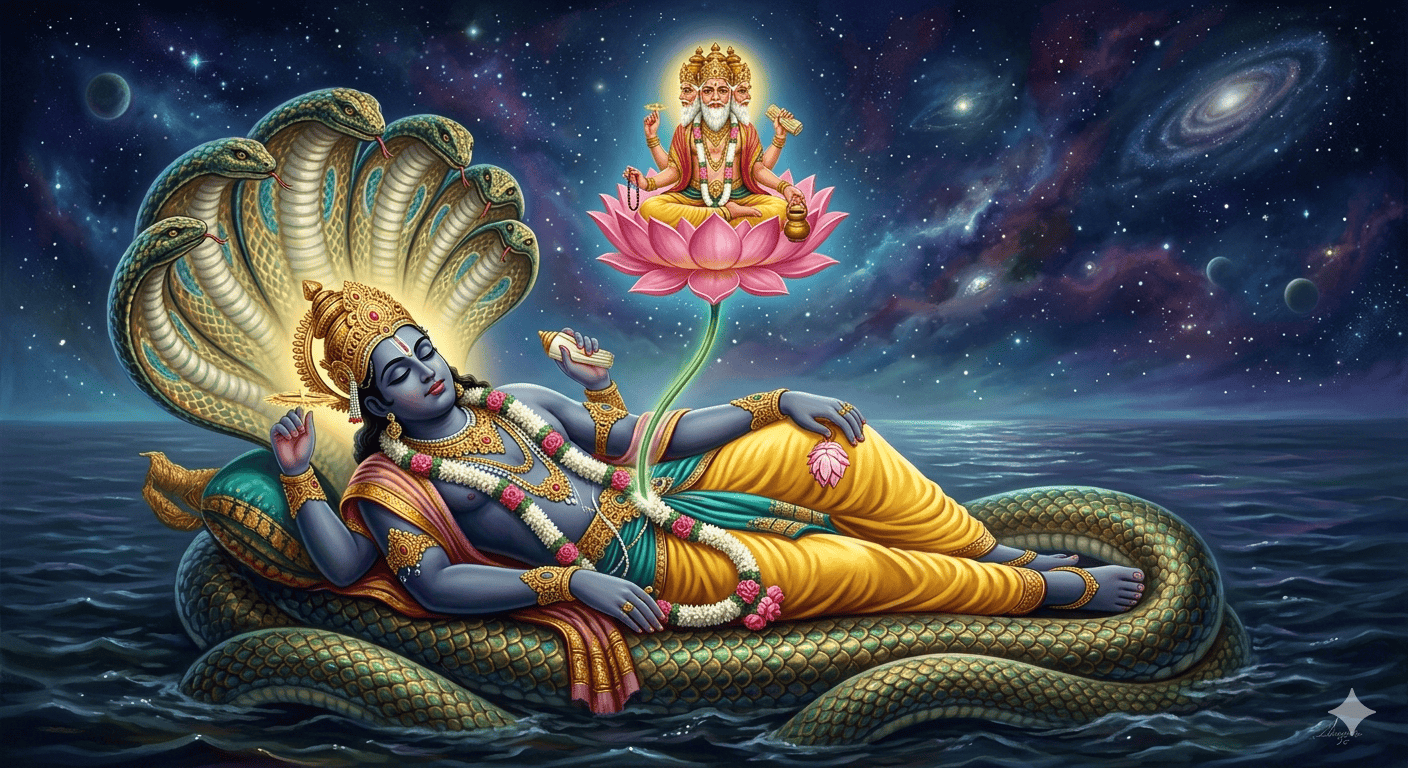
Core narrative: Vishnu lies sleeping on the serpent Shesha on the cosmic ocean. A lotus grows from his navel. Brahma is born on that lotus and begins creation.
Sources that share this core:
- Vishnu Purana 1.4 — Amsha 1, Adhyaya 4
- Bhagavata Purana 3.8.10-17 — Skanda 3, Adhyaya 8
- Padma Purana 1.3 — Srishti Khanda
- Brahmanda Purana 1.1.5
- Narada Purana 1.3
- Markandeya Purana 78.5-12
- Mahabharata, Shanti Parva 335.20-28 — Shantiparva, Adhyaya 335
Differences:
- Vishnu Purana 1.4: Brahma looks in four directions upon being born (giving him four faces). He then begins creation through meditation. He first creates the five great elements, then the senses, then the mind.
- Bhagavata Purana 3.8.10-17: Most detailed. Brahma cannot find the source of the lotus stalk. He travels down the stalk for 100 years trying to find its root, fails, comes back up, and meditates. Only then does Vishnu reveal himself to Brahma and grant him the knowledge to create. The four Vedas emerge from Vishnu's four mouths at this point.
- Padma Purana 1.3: The lotus is described as having a thousand petals of gold. Brahma first creates water, fire, wind, sky, and earth from his own body before beginning the wider creation.
- Markandeya Purana 78.5-12: During the lotus-birth scene, two demons — Madhu and Kaitabha — emerge from Vishnu's ear wax and threaten Brahma. Vishnu wakes to fight and kill them before creation can proceed.
- Mahabharata, Shanti Parva: Gives a shorter version of the same narrative but frames it philosophically — Vishnu as the unchanging, Brahma as the changing, and the lotus as the bridge between them.
4: Prajapati Creates Through Austerity & Speech
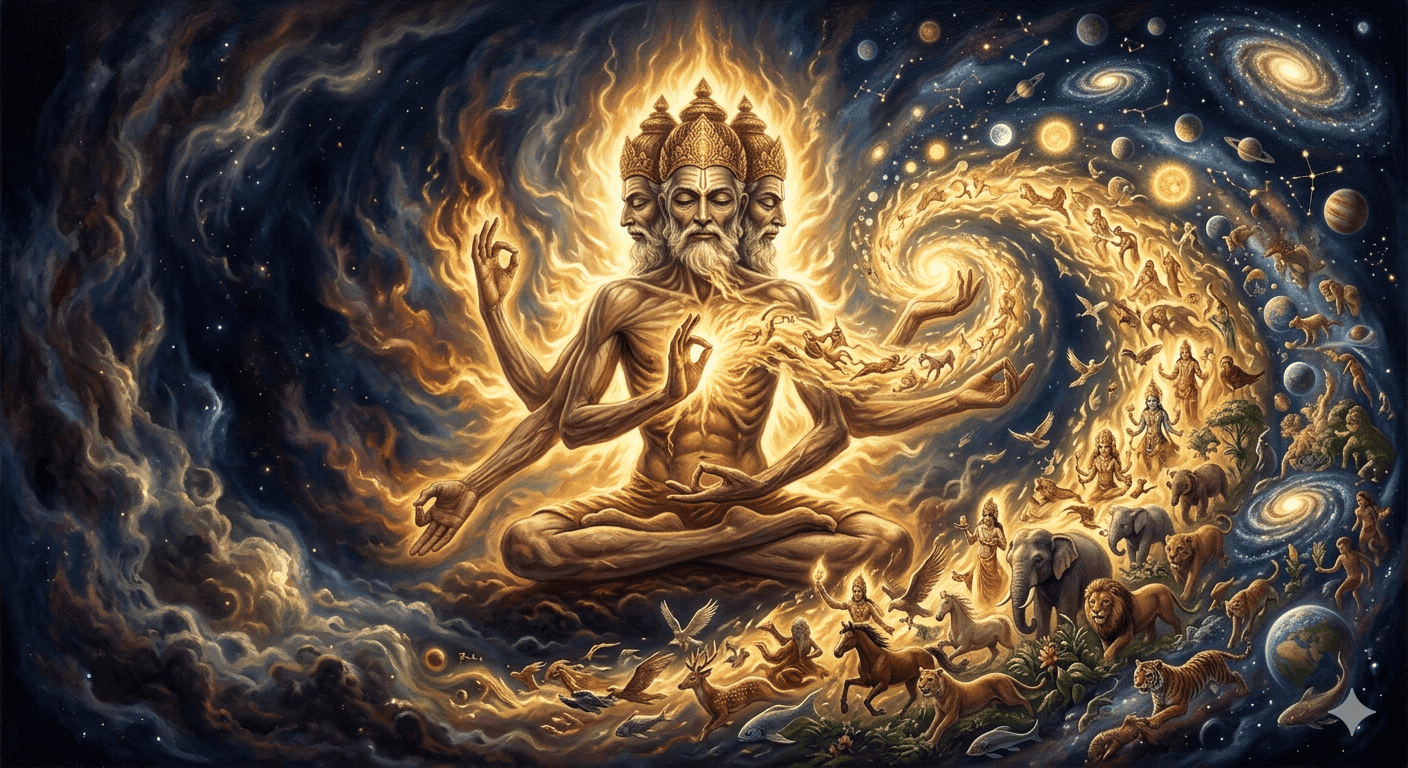
Core narrative: Prajapati (Lord of Creatures) existed alone. Through intense austerity (tapas) and/or speech, he created the universe and all beings.
Sources that share this core:
- Shatapatha Brahmana 6.1.1 — Kanda 6
- Shatapatha Brahmana 11.5.8
- Aitareya Brahmana 5.32
- Taittiriya Brahmana 2.2.9
- Brihadaranyaka Upanishad 1.2.1-7 — Adhyaya 1, Brahmana 2
- Aitareya Upanishad 1.1.1-4 — Adhyaya 1
- Chandogya Upanishad 6.2.1-4
Differences:
- Shatapatha Brahmana 6.1.1: Prajapati created fire first through speech — he said "Bhuh" and earth appeared, "Bhuvah" and atmosphere appeared, "Svah" and sky appeared. Then fire, wind, and the sun appeared from those three.
- Shatapatha Brahmana 11.5.8: Prajapati was unhappy being alone. He rubbed his hands together, generating heat (tapas). From that heat he produced a cosmic fire, then poured it as an offering into himself — from that self-offering came the universe and all beings.
- Brihadaranyaka Upanishad 1.2.1-7: In the beginning was Death (Mrityu) alone — identified with Prajapati. Death desired a self. He heated himself, and from that heat came water. From the waters came froth, then earth. He then lit fire on the earth. This is the only account where Death, not life or desire, is the first principle.
- Aitareya Upanishad 1.1.1-4: Atman (the Self) alone existed. It desired "Let me create worlds." It created the worlds: ambhas (waters above), marichi (light), mara (mortal earth), and the waters below. Then it created the guardians of these worlds from the primordial waters. Then it created food. Then it entered the human body through the crown of the head.
- Chandogya Upanishad 6.2.1-4: In the beginning was Sat (pure existence) alone — one without a second. It desired "Let me become many." It created fire. Fire desired "Let me become many" — created water. Water desired "Let me become many" — created food/earth. This is the only account where each element itself has desire and creates the next.
Story 5: The Purusha Sukta — Universe from a Cosmic Being's Sacrifice
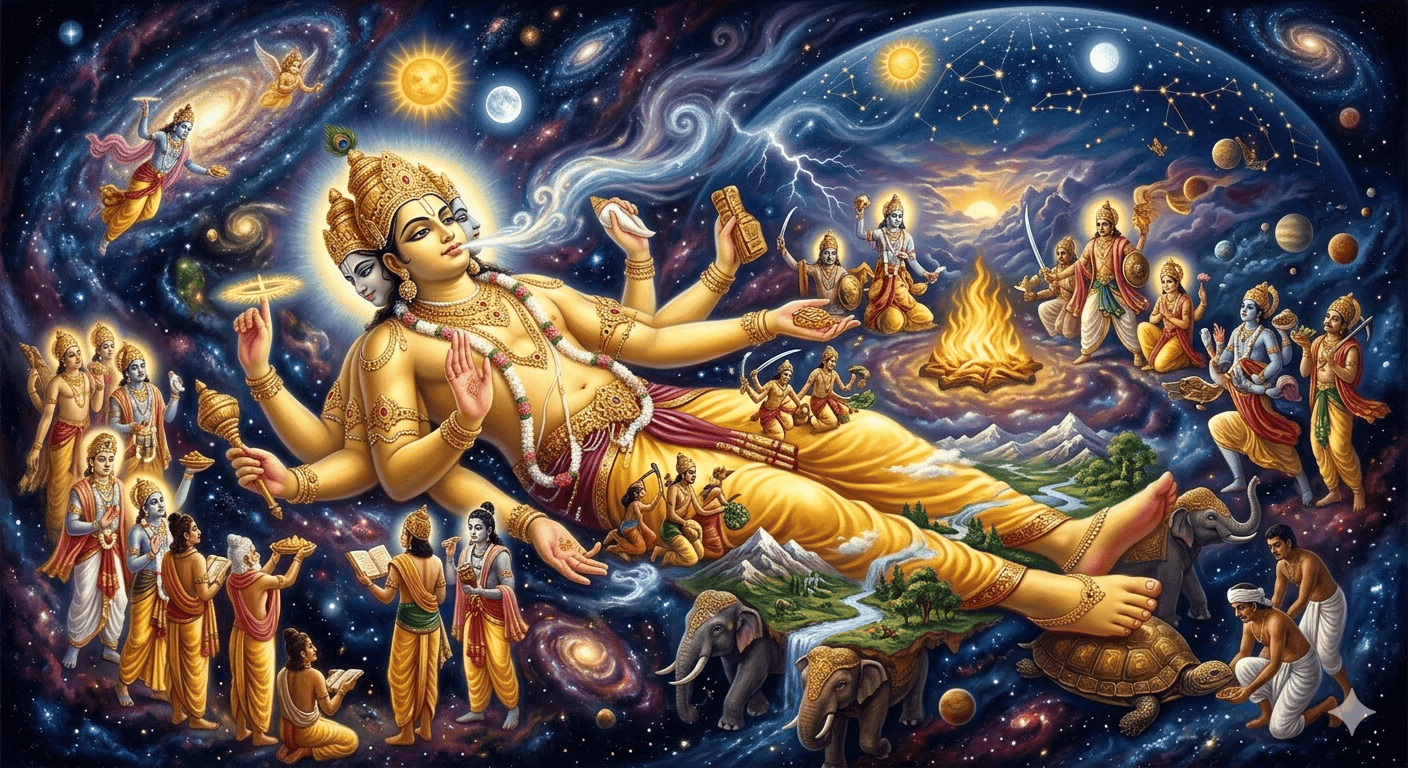
Core narrative: A cosmic being (Purusha) of infinite size was sacrificed by the gods. The universe and all of its components — natural, cosmic, and social — were formed from his body parts.
Sources that share this core:
- Rigveda 10.90 (Purusha Sukta) — Mandala 10, Hymn 90
- Atharva Veda 19.6 — Kanda 19, Sukta 6
- Vajasaneyi Samhita (Yajurveda) 31.1-22 — Adhyaya 31
- Taittiriya Aranyaka 3.12-13
- Shatapatha Brahmana 13.6
- Bhagavata Purana 2.5.35 — Skanda 2
Differences:
- Rigveda 10.90 (original): Purusha had 1,000 heads, 1,000 eyes, 1,000 feet. Three-quarters of him is in the immortal realm; only one-quarter became this universe. From the sacrifice: his mind became the moon, his eye the sun, his mouth Indra and Agni, his breath Vayu (wind), his navel the atmosphere, his head the sky, his feet the earth, his ear the directions. The four varnas came from his mouth (Brahmin), arms (Kshatriya), thighs (Vaishya), feet (Shudra).
- Atharva Veda 19.6: Similar to Rigveda but adds that time (kala) itself was born from Purusha — making time a created entity, not a pre-existing framework.
- Vajasaneyi Samhita (Yajurveda) 31: Essentially the same hymn as Rigveda 10.90 with minor variations in phrasing. Adds that the Vedas themselves (Rig, Sama, Yajur) came from Purusha's sacrifice.
- Bhagavata Purana 2.5.35: Reinterprets Purusha as Vishnu (Maha-Vishnu). The body parts are mapped differently — his eyes became the sun and moon, his ears became the directions, his skin became wind, his hairs became plants, his semen became water, his heart became the moon.
Story 6: Brahma's Self-Creation & the Nine Prajapatis (Progenitors of All Life)
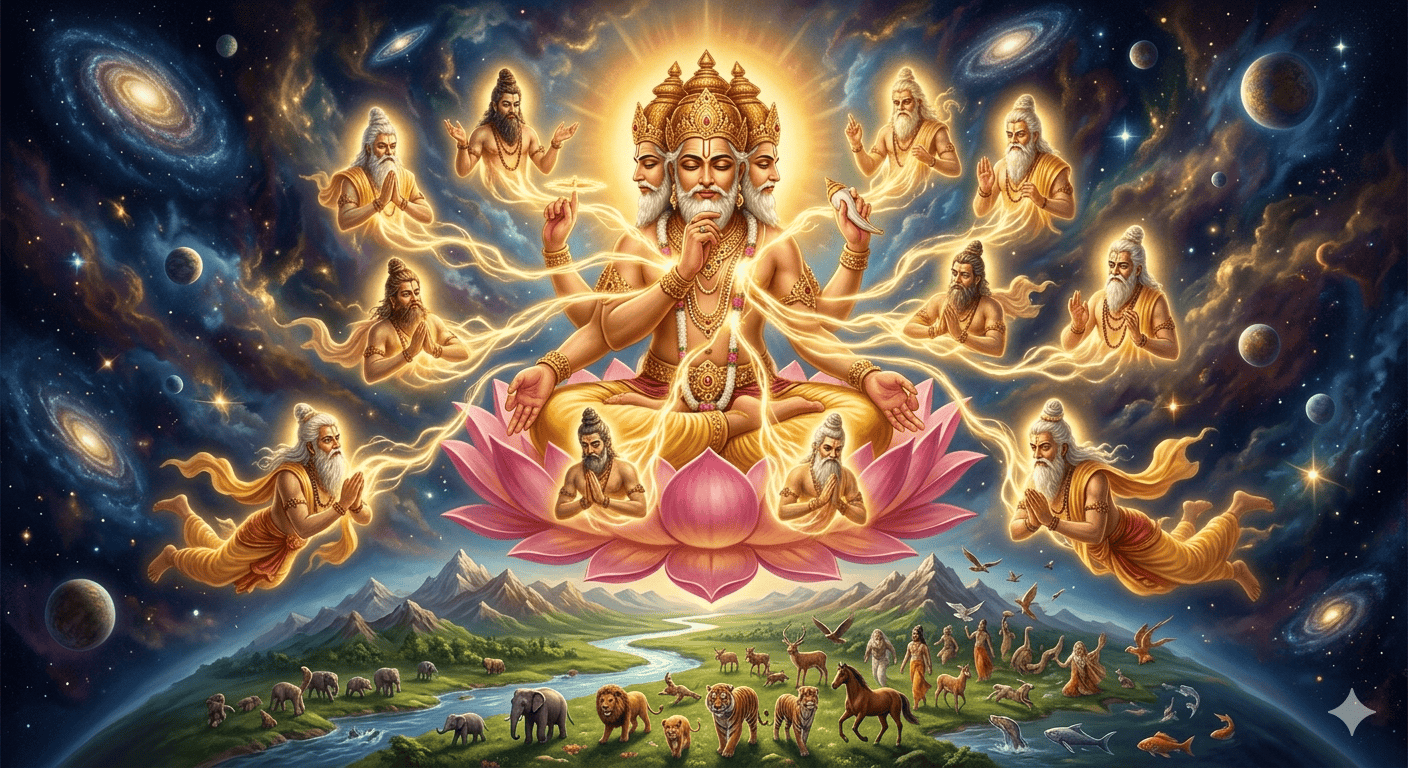
Core narrative: Brahma created ten or nine progenitor sages (Prajapatis or Manasaputras — mind-born sons) directly from his mind or body parts. These sages then created all living species.
Sources that share this core:
- Manusmriti 1.34-36
- Vishnu Purana 1.7 — Amsha 1, Adhyaya 7
- Bhagavata Purana 3.12.1-25 — Skanda 3, Adhyaya 12
- Brahma Purana 1.1
- Matsya Purana 3.1-10
- Vayu Purana 9.1-20
- Mahabharata, Adi Parva 1.60 — Adiparva, Adhyaya 60
Differences:
- Manusmriti 1.34-36: Names six mind-born sons: Marichi, Atri, Angiras, Pulastya, Pulaha, Kratu. These six created the rest of creation.
- Vishnu Purana 1.7: Names ten: Marichi, Atri, Angiras, Pulastya, Pulaha, Kratu, Vasishtha, Prachetas, Bhrigu, Narada. Also says Brahma created Rudra from between his eyebrows when he became angry.
- Bhagavata Purana 3.12: Most elaborate. Brahma first created the five types of ignorance (avidya), then four mind-born sons (Sanaka, Sanandana, Sanatana, Sanatkumara) who refused to create and became ascetics. Frustrated, Brahma's anger produced Rudra from between his brows. Rudra was told to create but created beings like himself — fearsome and destructive — so Brahma stopped him. Then Brahma created the ten Prajapatis.
- Mahabharata, Adi Parva 1.60: Lists the Prajapatis and traces every species of animal, bird, demon, and god to a specific progenitor sage and his wife, in elaborate genealogical detail.
Story 7: Origin of Humans — Manu as the First Man
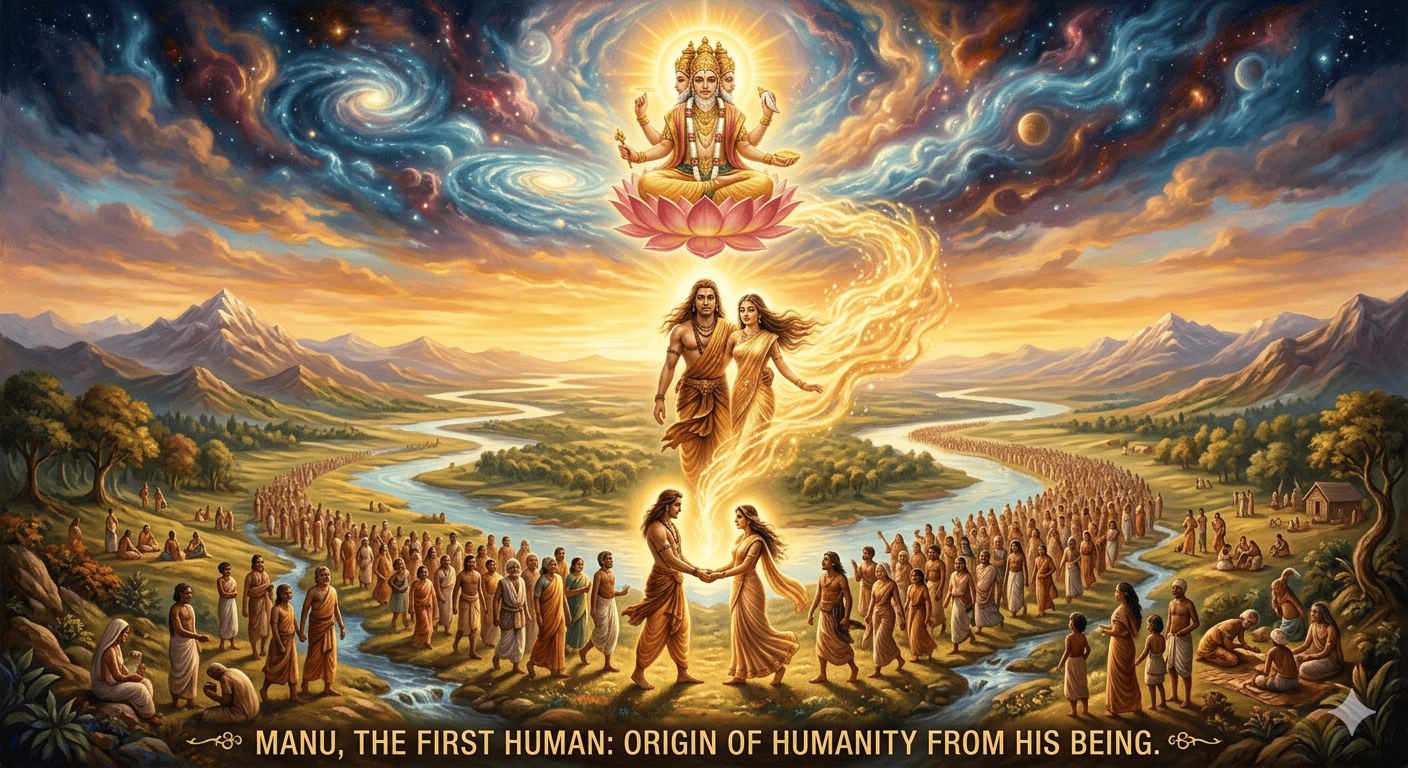
Core narrative: Manu was the first human being, born from Brahma. He produced a woman from half his own body. From their union came the human race.
Sources that share this core:
- Manusmriti 1.32-34
- Shatapatha Brahmana 1.8.1 — Kanda 1 (the fish and flood story)
- Vishnu Purana 1.7.14-19
- Bhagavata Purana 8.1.1-8 — Skanda 8
- Matsya Purana 1.1-35 (the most detailed flood narrative)
- Mahabharata, Shanti Parva 336 — Shantiparva, Adhyaya 336
Differences:
- Manusmriti 1.32-34: Brahma created Manu from half his own body. Manu created a woman (Shatarupa) from the other half. From them came all humans. No flood story here — purely genealogical.
- Shatapatha Brahmana 1.8.1 (the Hindu Flood narrative): A small fish came to Manu asking him to save it from bigger fish. Manu kept it in a jar, then a larger vessel, then a lake, then the ocean. The fish then warned Manu of a coming flood, told him to build a boat. The flood came, the fish (revealed to be Brahma/Prajapati) towed Manu's boat to a northern mountain. Manu then performed sacrifices and austerities. After a year, a woman was born from those offerings — she revealed herself as Manu's daughter. From Manu and this daughter came the human race.
- Matsya Purana 1.1-35: Identifies the fish explicitly as Vishnu in his Matsya (fish) avatar. Much more elaborate — names the mountain as Malaya or Himavat. Vishnu instructs Manu to gather the seven sages (Saptarishis), seeds of all plants, and one of every animal into the boat.
- Bhagavata Purana 8.1: Lists 14 Manus across 14 cosmic time periods (Manvantaras) — each with their own creation. The current Manu is Vaivasvata Manu, the seventh. This means the origin of humanity has happened 7 times and will happen 7 more times in the current cosmic cycle.
- Mahabharata, Shanti Parva 336: Manu is described as the source of all dharma (law) for humans, and his genealogy is traced forward to all the royal dynasties of the epic.
Story 8: Shiva as the Original Creator (Shaiva Accounts)
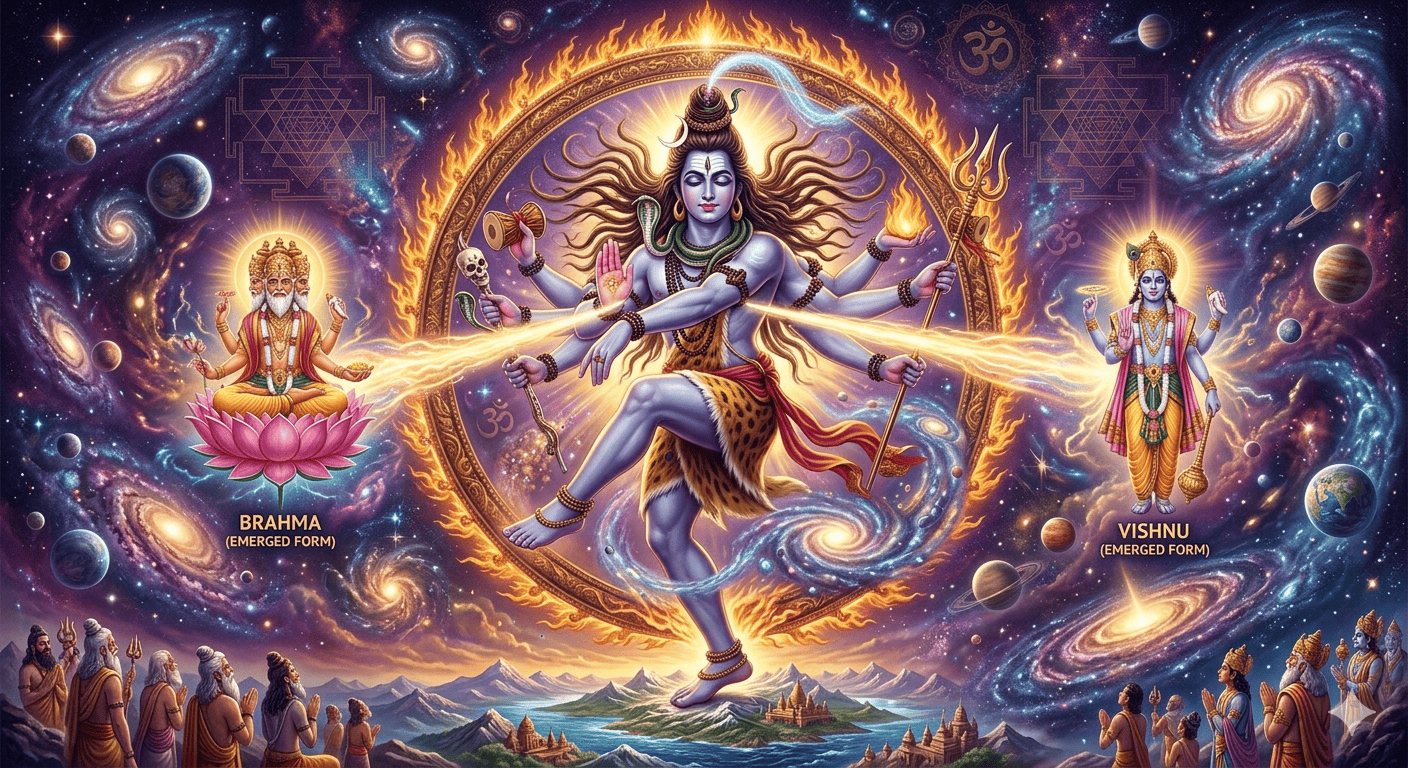
Core narrative: Shiva, not Brahma or Vishnu, is the original and supreme creator. Brahma and Vishnu themselves emerged from Shiva. The universe is an expression of Shiva's cosmic dance or will.
Sources that share this core:
- Shiva Purana — Vidyeshvara Samhita, Adhyaya 5-9
- Linga Purana 1.70-75 — Purva Bhaga
- Skanda Purana (Shiva-focused sections)
- Kurma Purana 1.10
- Vayu Purana 1.1 (in its Shaiva sections)
- Mahabharata, Anushasana Parva 14 — Anushasanaparva, Shiva Sahasranama section
Differences:
- Shiva Purana (Vidyeshvara Samhita 5-9): In the beginning was only Shiva and his Shakti. Vishnu was born from Shiva's left side, Brahma from his right. Brahma was given the task of creating, Vishnu of sustaining. Shiva himself remains beyond creation as the witness and destroyer at the end of time.
- Linga Purana 1.70-75: A column of fire (Jyotirlinga) appeared between Brahma and Vishnu who were arguing over who was supreme. It had no top and no bottom. Brahma took the form of a swan and flew upward for 1,000 years — could not find the top. Vishnu took the form of a boar and dug downward for 1,000 years — could not find the bottom. Then Shiva revealed himself from within the pillar. Both acknowledged Shiva's supremacy. This is the origin of the Shivalinga as a symbol.
- Kurma Purana 1.10: Shiva and Vishnu are described as two aspects of one being — neither is prior to the other. Brahma is still the functional creator, but Shiva and Vishnu together are the source from which Brahma emerged.
- Skanda Purana: Contains the most extensive regional variants — Shiva as creator is connected to specific sacred geography (Varanasi, Kailash, etc.), each location having its own creation sub-narrative.
Story 9: The Goddess as the Original Creator (Shakta Accounts)
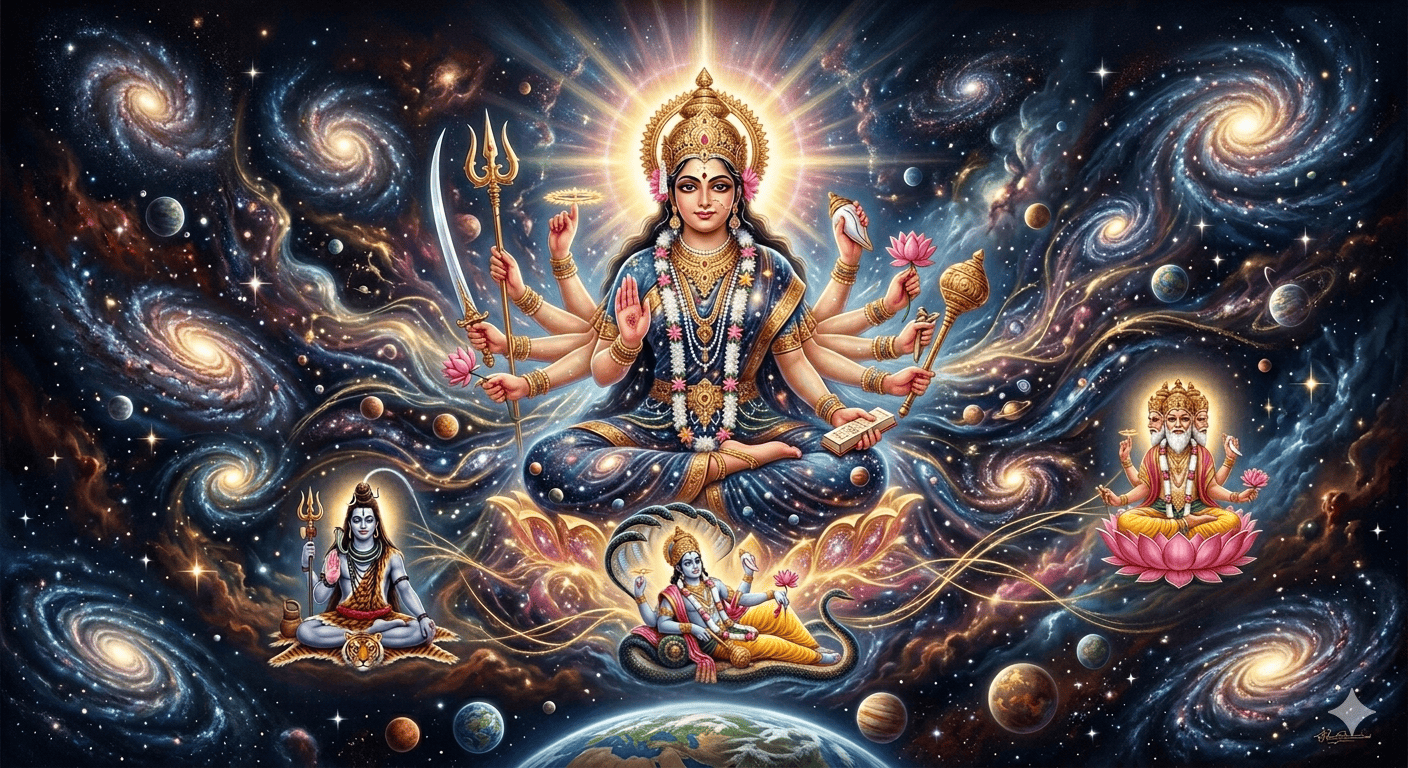
Core narrative: The Goddess (Adi Shakti / Devi) is the supreme original power. She created Brahma, Vishnu, and Shiva. The universe itself is her body or her projection.
Sources that share this core:
- Devi Bhagavata Purana 1.5-9 — Skanda 1
- Markandeya Purana 81-93 (Devi Mahatmya / Chandi) — Adhyaya 81
- Devi Upanishad (Atharva Veda tradition)
- Shakta Tantras (Mahanirvana Tantra, Kularnava Tantra)
Differences:
- Devi Bhagavata Purana 1.5-9: The Goddess existed alone before anything. She willed creation. From her body she produced Brahma (for creation), Vishnu (for sustenance), and Shiva (for destruction). She is described as both the material cause and the efficient cause of the universe — she is what everything is made of, and also the one who made it.
- Devi Mahatmya (Markandeya Purana 81): Does not deal with the origin of the universe directly but describes the origin of the Goddess herself — she emerged from the combined energy (tejas) of all the gods when they could not defeat the demon Mahishasura. Every god contributed a ray of light; those rays combined into the form of Devi. However, the Devi Bhagavata Purana explicitly contradicts this — saying the Goddess was never "created" by anyone and has always existed.
- Devi Upanishad: The Goddess declares herself to be Brahman — the ultimate reality. She says she is the origin of all the Vedas, all the gods, and all the worlds. She is both the beginning and the end.
Story 10: Creation Through Sound — Om & the Vedas
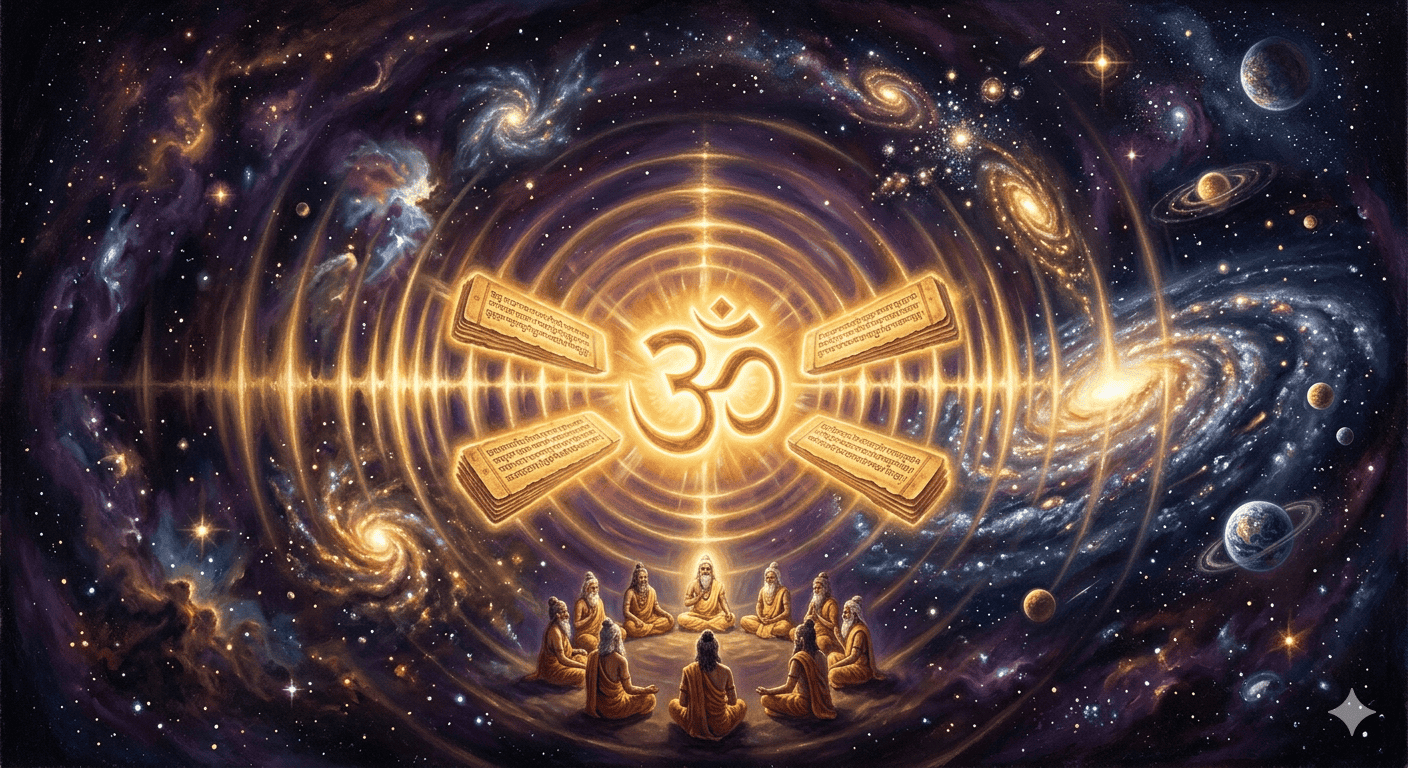
Core narrative: The universe began with sound. The syllable Om existed before creation. The Vedas emerged first, and from the Vedas the universe was created.
Sources that share this core:
- Mandukya Upanishad 1-2 — (entire Upanishad)
- Brihadaranyaka Upanishad 1.2.4
- Bhagavata Purana 3.12.37-50 — Skanda 3
- Narada Purana 1.3.1-15
- Agni Purana 1.1
- Vayu Purana 1.60-65
Differences:
- Mandukya Upanishad: Om encompasses all of time — past, present, future, and what is beyond time. The four quarters of Om correspond to four states of consciousness: waking, dreaming, deep sleep, and turiya (pure consciousness). The universe is a manifestation of this sound.
- Brihadaranyaka Upanishad 1.2.4: Speech (Vak) is specifically identified as what Prajapati used to create — speech was the first creation and everything else followed from it.
- Bhagavata Purana 3.12.37-50: After Brahma meditated for a long time, the four Vedas emerged from his four mouths — Rigveda from the east-facing mouth, Yajurveda from the south, Samaveda from the west, Atharvaveda from the north. From those Vedas he then created the universe following their instructions.
- Narada Purana 1.3: The universe was created in the exact sequence described in the Vedas — the Vedas are not just books but the actual blueprint of reality.
Story 11: The Samkhya Creation — Evolution of Elements (Tattvas)
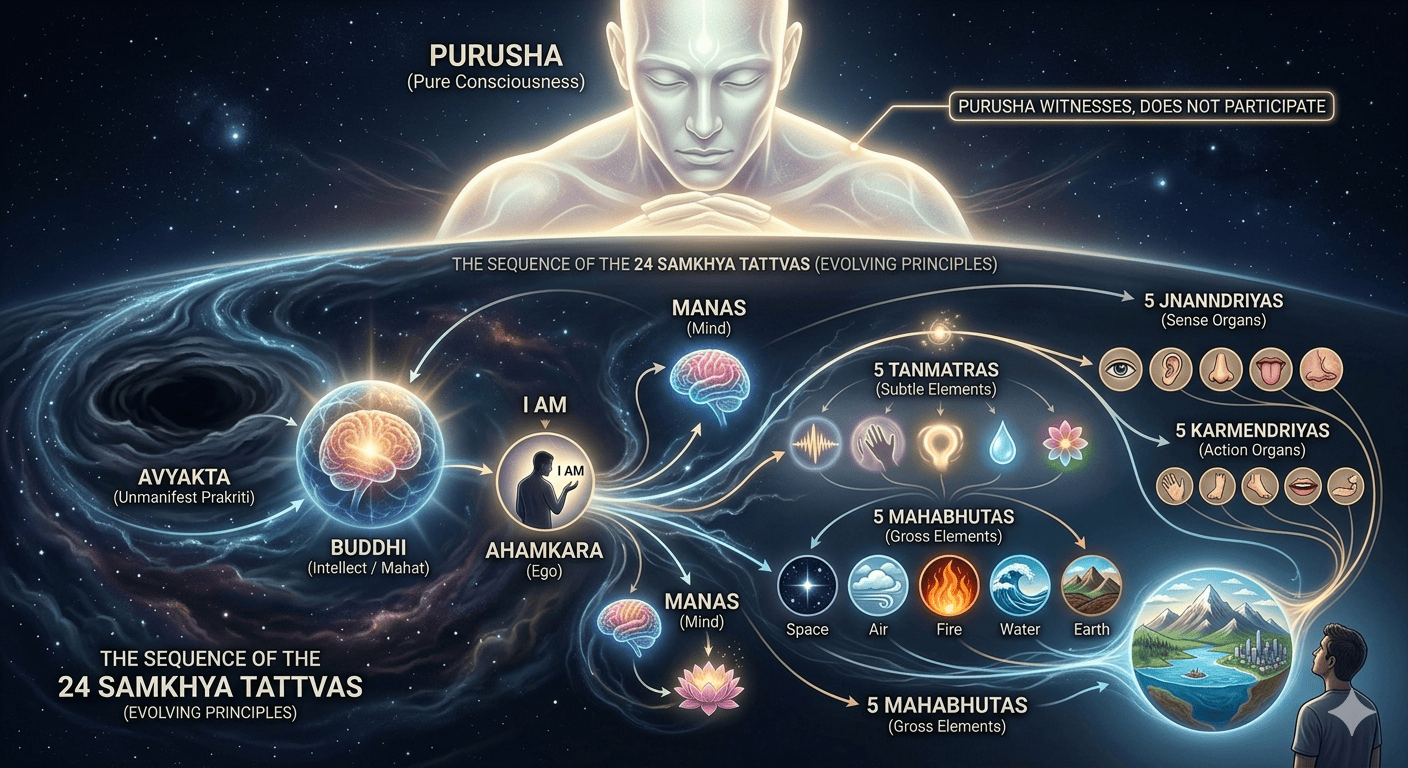
Core narrative: Creation proceeded through a sequence of 24 or 25 evolving principles (tattvas): from the unmanifest (avyakta) came intellect (buddhi), then ego (ahamkara), then mind (manas), then the five subtle elements (tanmatras), then the five gross elements (space, air, fire, water, earth), then the ten senses. Purusha (pure consciousness) witnesses but does not participate.
Sources that share this core:
- Samkhya Karika (Ishvarakrishna) — the primary Samkhya text
- Mahabharata, Shanti Parva 301-310 — Mokshadharma section
- Bhagavata Purana 3.26 — Skanda 3, Adhyaya 26
- Katha Upanishad 3.10-11
- Svetasvatara Upanishad 6.11-13
Differences:
- Samkhya Karika: Most systematic. 25 tattvas listed precisely. Purusha (consciousness) and Prakriti (matter) are the two eternal realities. Purusha does not create — Prakriti evolves on its own in the presence of Purusha, like iron moving near a magnet. No god is involved in this account — it is the only major Hindu creation framework with no deity.
- Mahabharata, Shanti Parva 301-310: Bhishma narrates both 24-tattva and 25-tattva versions in different chapters, sometimes including a 26th tattva — the supreme self (Paramatman). This section is a debate between multiple sages each presenting different counts.
- Bhagavata Purana 3.26: Absorbs Samkhya into a Vaishnava framework — Purusha is identified as Vishnu, and Prakriti as his creative energy (maya/shakti). God is thus brought back into the Samkhya framework.
- Katha Upanishad 3.10-11: Gives the Samkhya hierarchy but frames it as a ladder of consciousness — the goal is to trace back through the tattvas to reach the supreme self, not merely to explain physical creation.
Story 12: Origin of the Gods, Demons & Their Conflict
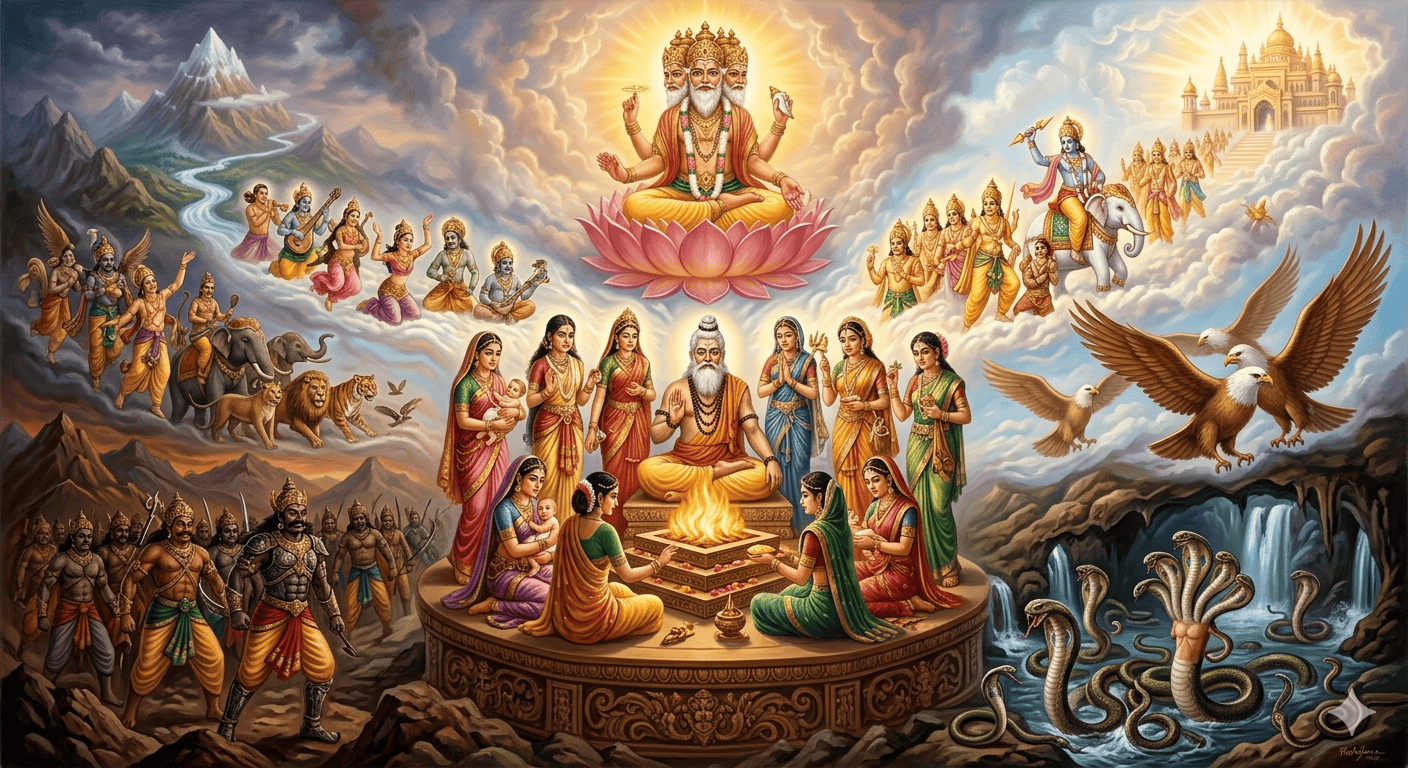
Core narrative: Brahma's mind-born son Kashyapa married thirteen of Daksha's daughters. From different wives came the gods (Devas), demons (Asuras), serpents (Nagas), eagles (Garudas), and all other beings.
Sources that share this core:
- Vishnu Purana 1.15 — Amsha 1, Adhyaya 15
- Bhagavata Purana 6.6 — Skanda 6
- Mahabharata, Adi Parva 65 — Adiparva, Adhyaya 65
- Matsya Purana 6.1
- Vayu Purana 65-70
Differences:
- Vishnu Purana 1.15: Kashyapa's wife Aditi bore the 12 Adityas (solar gods including Vishnu). His wife Diti bore the Daityas (demons). His wife Danu bore the Danavas (another class of demons). His wife Vinata bore Garuda and Aruna. His wife Kadru bore the thousand Nagas (serpents). His other wives bore the animals, plants, and other beings.
- Mahabharata, Adi Parva 65: Gives the most comprehensive genealogy — lists every major god, demon, snake, and creature by name and parentage. This is the most complete version.
- Bhagavata Purana 6.6: Same framework but focuses on the moral and spiritual nature of each lineage — why Diti's children became demonic (her impatience and impurity when conceiving) vs Aditi's children becoming divine.
Story 13: The Churning of the Cosmic Ocean (Samudra Manthan) — Re-creation After Loss
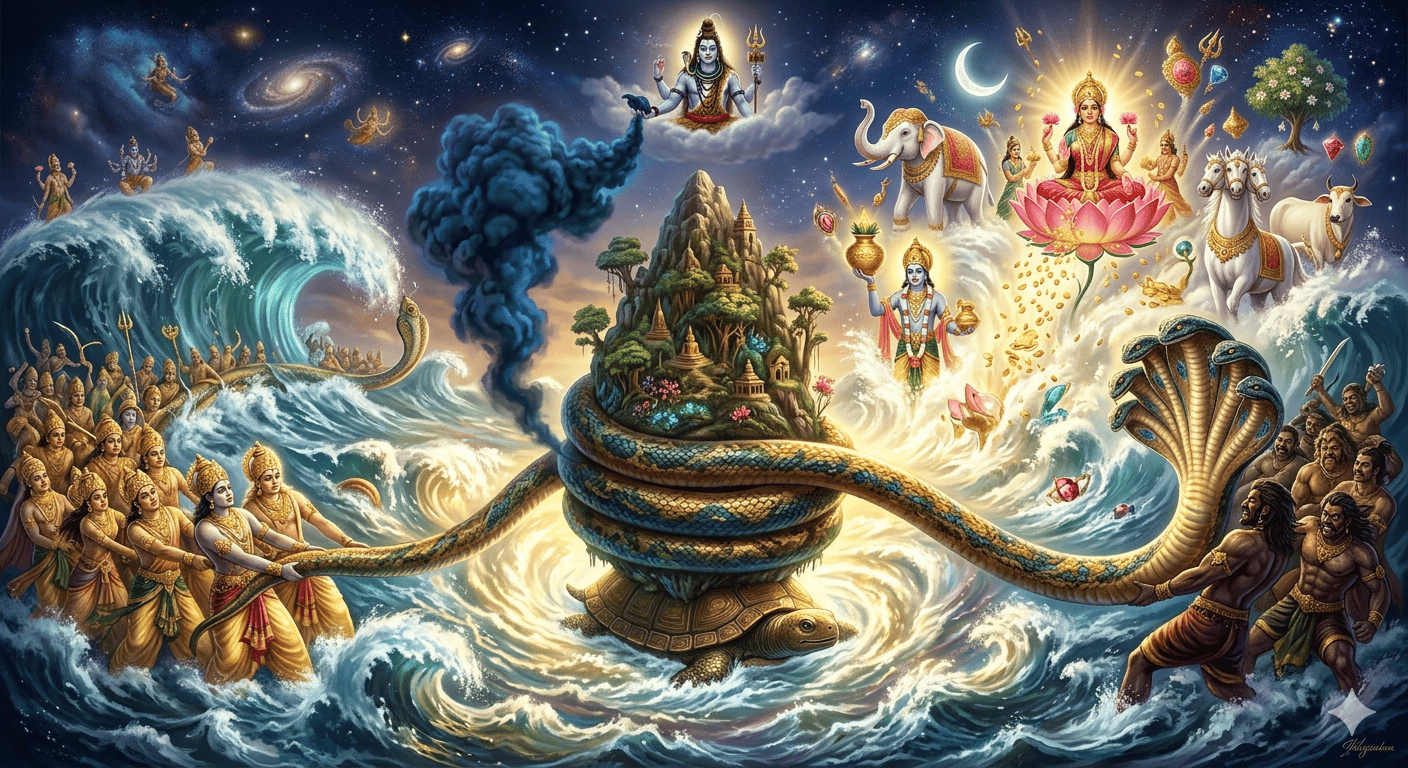
Core narrative: The gods lost their power due to a curse. They churned the cosmic ocean using Mount Mandara as a churning rod and the serpent Vasuki as a rope. From the churning emerged both poison and gifts — including the nectar of immortality (amrita), the goddess Lakshmi, and several other beings and objects.
Sources that share this core:
- Vishnu Purana 1.9 — Amsha 1, Adhyaya 9
- Bhagavata Purana 8.6-9 — Skanda 8
- Mahabharata, Adi Parva 17-18 — Adiparva, Adhyaya 17-18
- Matsya Purana 249-250
- Ramayana, Bala Kanda 45 — Balakanda, Sarga 45
Differences:
- Mahabharata, Adi Parva 17-18: The earliest and most concise version. The mountain sank — Vishnu supported it as a tortoise. Lists 9 things that emerged: Varuni (goddess of wine), Parijata tree, Apsaras, Chandra (moon), Kaustubha gem, Dhanvantari with amrita, Lakshmi, poison (halahala) which Shiva drank.
- Bhagavata Purana 8.6-9: Most elaborate. Adds that Vishnu appeared as Mohini (an enchantress) to distract the demons and distribute the amrita only to the gods. The demon Rahu disguised himself among gods and drank some — the sun and moon exposed him, and Vishnu beheaded him. His head became Rahu and tail Ketu — explaining the origin of eclipses.
- Vishnu Purana 1.9: Emphasizes the emergence of Lakshmi — describes her bath in the cosmic ocean, being worshipped by the sages before choosing Vishnu as her eternal consort.
- Ramayana, Bala Kanda 45: Shorter retelling, focused on establishing the backstory of the ocean before the narrative of the Ramayana begins.
Story 14: Daksha's Creation of Species
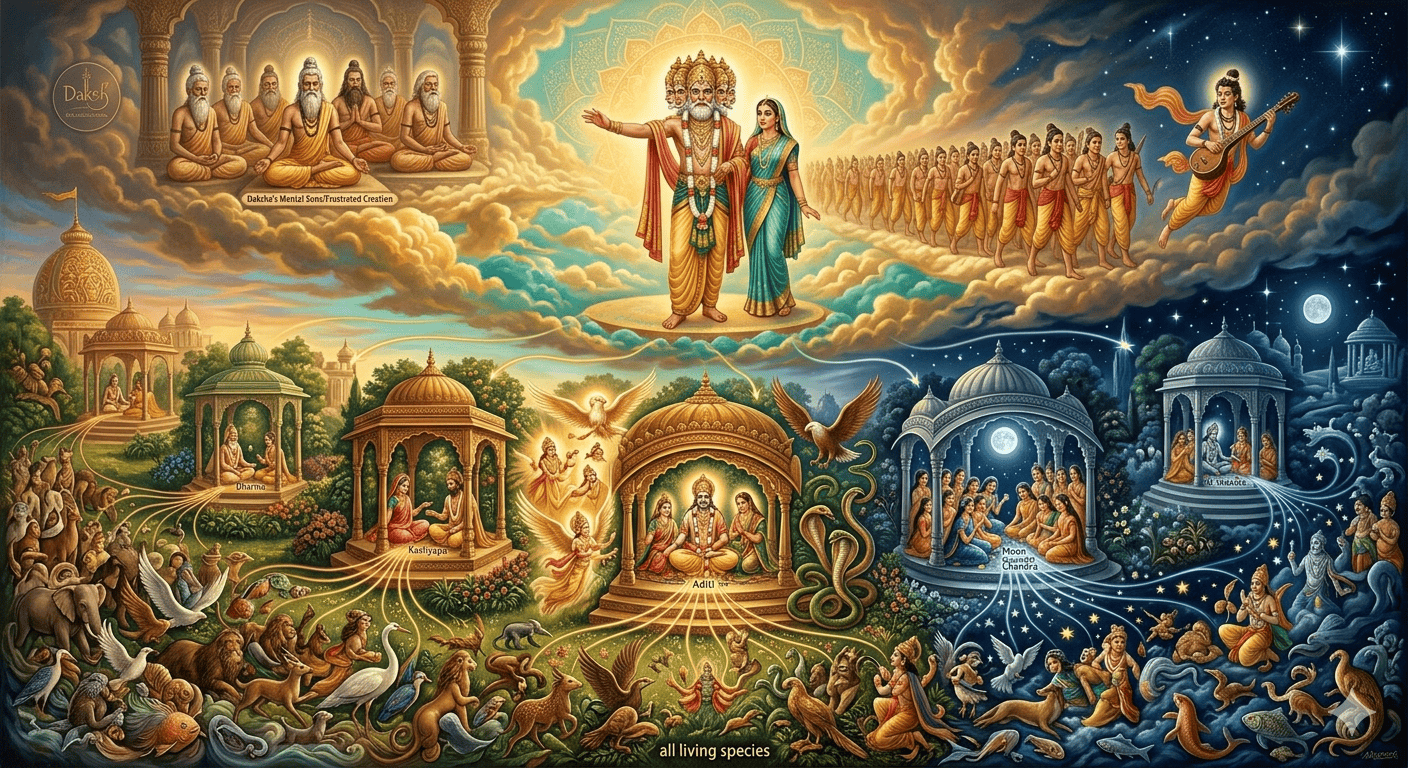
Core narrative: Daksha, one of Brahma's mind-born sons, was tasked with populating the universe. He first created beings mentally, then through asceticism, then through sexual reproduction with his wife Asikni (also called Panchajani).
Sources that share this core:
- Vishnu Purana 1.15 — Amsha 1, Adhyaya 15
- Bhagavata Purana 6.4-6 — Skanda 6, Adhyaya 4-6
- Matsya Purana 4.1-30
- Vayu Purana 63.1-40
- Brahma Purana 1.37-42
- Mahabharata, Adi Parva 59-66 — Adiparva, Adhyaya 59-66
Differences:
- Vishnu Purana 1.15: Daksha first created beings mentally — they came out as celibate sages with no desire to reproduce. Frustrated, he then created beings from his body — they too went off meditating. Finally he married Asikni and produced 10,000 sons called Haryashvas. The sage Narada convinced them all to wander the universe and never return. Daksha then had 1,000 more sons (Shavalashvas) — Narada convinced them too. Furious at Narada, Daksha then produced 60 daughters from Asikni. He gave 13 to Kashyapa, 27 to the moon god Chandra (these 27 became the lunar mansions/Nakshatras), 10 to Dharma, and others to various gods and sages. From these unions came all living species.
- Bhagavata Purana 6.4-6: Adds detail on why Narada convinced Daksha's sons to abandon creation — Narada told them the universe is an illusion and liberation is better than perpetuating creation. Daksha cursed Narada to wander eternally without rest as punishment. The 60 daughters and their offspring are listed in great detail with the moral nature of each lineage explained.
- Matsya Purana 4.1-30: Focuses on the 60 daughters and their specific unions. Lists every category of being — gods, demons, humans, animals, birds, serpents, plants — as descending from a specific daughter of Daksha.
- Mahabharata, Adi Parva 59-66: The most genealogically exhaustive. Lists thousands of named beings across every species, each traced to a specific mother from Daksha's daughters and a specific father. This section is essentially the biological origin story of every creature in the Hindu cosmos.
- Vayu Purana 63: Adds that Daksha's mental creation produced beings without physical bodies — pure consciousness entities. Only after sexual reproduction did physical, mortal beings appear. This distinguishes two categories of existence: immortal mental creations and mortal physical creations.
Story 15: Origin of the Nagas (Serpent Beings)
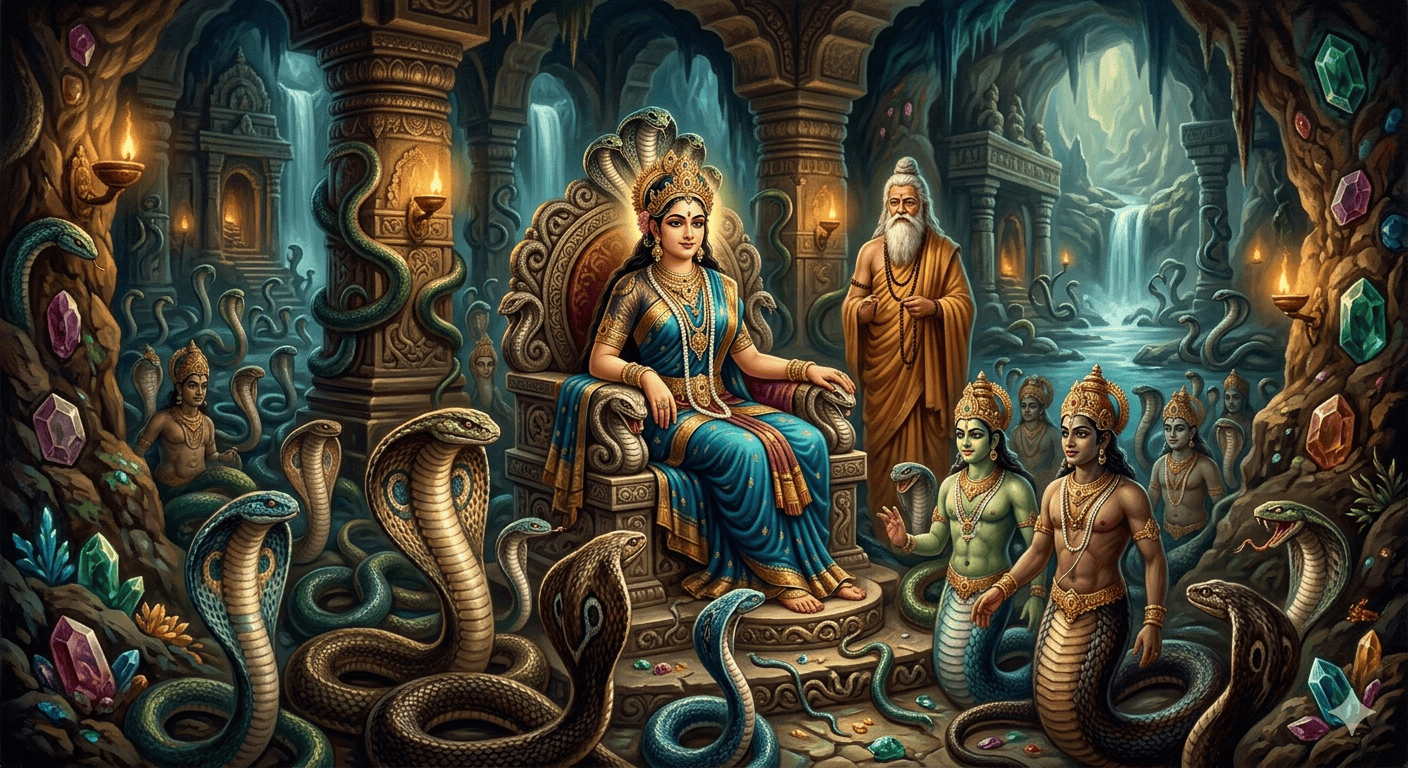
Core narrative: Kadru, one of Daksha's daughters and wife of Kashyapa, gave birth to the thousand Nagas — semi-divine serpent beings who inhabit the underworld (Patala). Their origin is tied to a conflict with Garuda and a curse.
Sources that share this core:
- Mahabharata, Adi Parva 14-35 — Adiparva, Adhyaya 14-35
- Vishnu Purana 1.21 — Amsha 1, Adhyaya 21
- Bhagavata Purana 6.6.24-27 — Skanda 6
- Matsya Purana 6.15-22
- Vayu Purana 69.1-30
Differences:
- Mahabharata, Adi Parva 14-35 (most detailed): Kashyapa gave both his wives Kadru and Vinata a boon. Kadru asked for 1,000 serpent sons. Vinata asked for only two sons but more powerful than all of Kadru's. Kadru's eggs hatched after 500 years — producing the thousand Nagas. The eldest and most powerful were Shesha, Vasuki, Takshaka, and Karkotaka. Later, Kadru and Vinata made a bet over the color of the divine horse Uchchaishravas's tail. Kadru cheated by having her Naga sons hang from the horse's tail to make it appear black. Vinata lost and became Kadru's slave. This episode established the eternal enmity between Nagas and Garuda. Brahma then cursed the Nagas that they would be consumed at the snake sacrifice of King Janamejaya — this is the framing story for the entire Mahabharata.
- Vishnu Purana 1.21: Shorter. Focuses on naming the principal Nagas and their underground kingdom of Patala rather than the origin conflict.
- Bhagavata Purana 6.6.24-27: Simply lists Kadru as the mother of the Nagas without the extended narrative of the bet or the curse.
- Matsya Purana 6.15-22: Adds a geographic dimension — names specific rivers, forests, and underground regions where different Naga clans settled after birth.
Story 16: Origin of Garuda
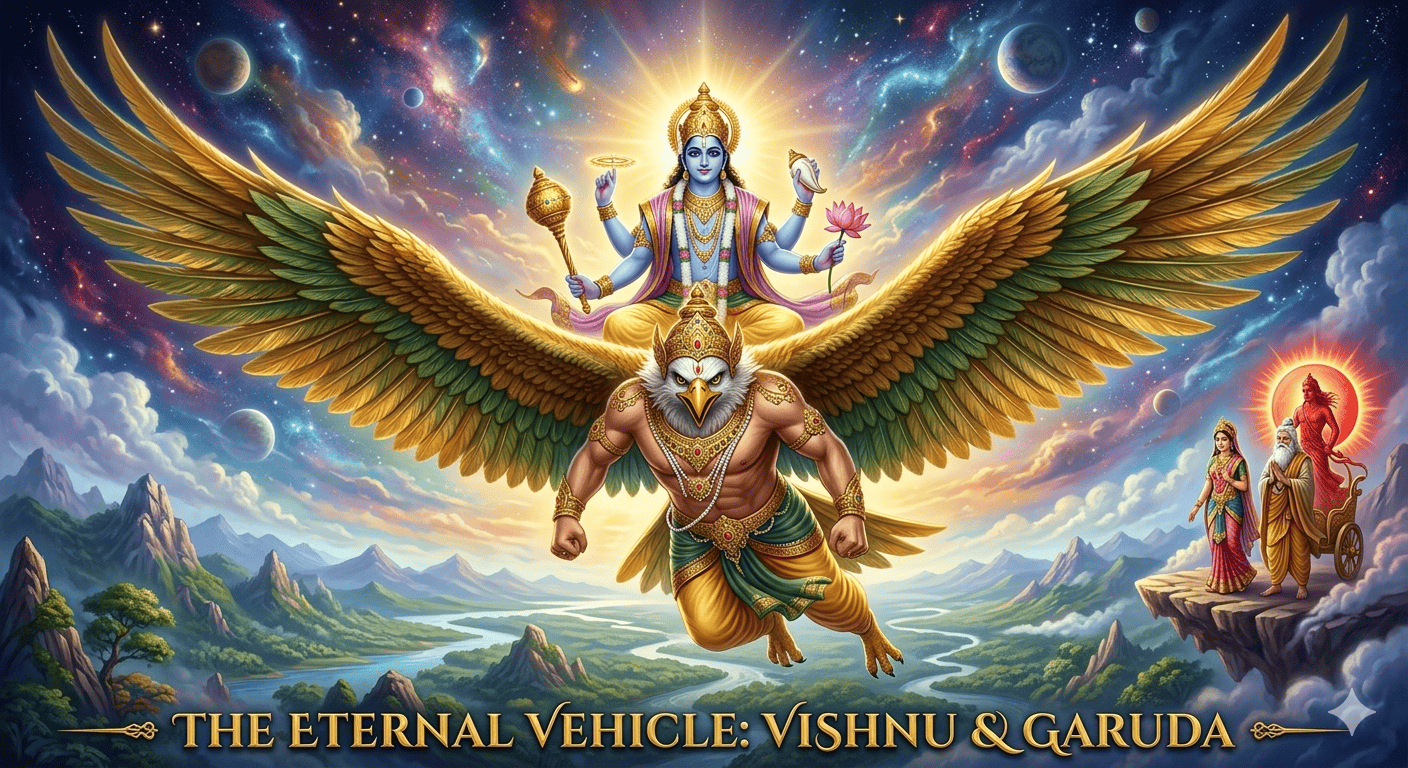
Core narrative: Vinata, Kashyapa's other wife, gave birth to two sons — Aruna and Garuda. Garuda became the king of birds and eternal vehicle of Vishnu. His origin is tied to slavery, a quest for amrita, and the defeat of the gods.
Sources that share this core:
- Mahabharata, Adi Parva 23-35 — Adiparva, Adhyaya 23-35
- Vishnu Purana 1.21 — Amsha 1, Adhyaya 21
- Bhagavata Purana 6.6.21-22 — Skanda 6
- Vayu Purana 69.40-75
Differences:
- Mahabharata, Adi Parva 23-35 (most detailed): Vinata, impatient, cracked one of her two eggs open early — from it emerged Aruna, half-formed, legless. He cursed his mother for her impatience and became the charioteer of the sun. The second egg hatched fully — Garuda emerged with enormous power, his body blazing like fire, frightening even the gods. The gods attacked him thinking he was a threat; he defeated all of them. Indra struck him with his thunderbolt; Garuda shed one feather gently as a concession to Indra's pride but was otherwise unharmed. Garuda then went to free his mother from slavery to Kadru. The Nagas demanded the amrita (nectar of immortality) as the price. Garuda flew to heaven, defeated the gods guarding the amrita, took it, and brought it to the Nagas. On the way back, Vishnu appeared and asked Garuda to be his vehicle in exchange for immortality without needing to drink the amrita himself. Garuda agreed. He delivered the amrita to the Nagas but Indra immediately took it back before they could drink it — thus the Nagas only licked the sharp grass it was placed on, which split their tongues, which is why serpents have forked tongues.
- Vishnu Purana 1.21: Shorter version of the same story. Emphasizes Garuda's role as Vishnu's vehicle rather than the conflict with the Nagas.
- Vayu Purana 69.40-75: Focuses on Garuda's cosmic proportions — his wingspan covered the sky, his flight created storms, the gods mistook his arrival for the sun itself.
Story 17: The Varaha Avatar — Earth Rescued from the Cosmic Ocean
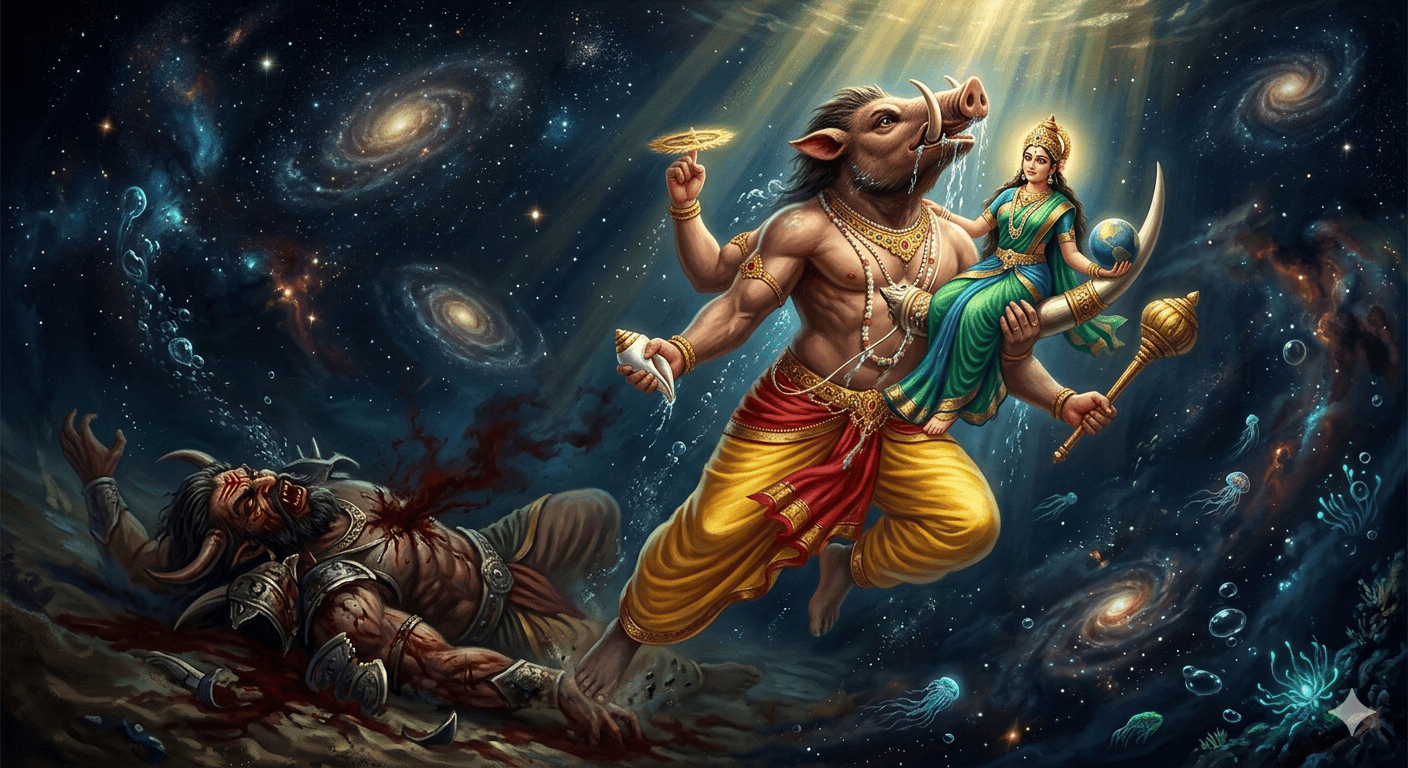
Core narrative: The earth (Bhudevi, personified as a goddess) sank to the bottom of the cosmic ocean. Vishnu took the form of a great boar (Varaha), dove into the ocean, killed the demon holding the earth, and carried the earth back on his tusks.
Sources that share this core:
- Shatapatha Brahmana 14.1.2.11 — (earliest version, Kanda 14)
- Taittiriya Samhita 7.1.5.1
- Rigveda 10.72.6 — (brief mention)
- Vishnu Purana 1.4.7-45 — Amsha 1, Adhyaya 4
- Bhagavata Purana 3.13 — Skanda 3, Adhyaya 13
- Varaha Purana 1.1-4 — (entire Purana frames this event)
- Matsya Purana 247.1-29
- Brahma Purana 1.213
- Mahabharata, Shanti Parva 340.67 — Shantiparva, Adhyaya 340
- Valmiki Ramayana, Bala Kanda 1.17 — (brief mention)
Differences:
- Shatapatha Brahmana 14.1.2.11 (earliest version): Prajapati takes the form of a boar and raises the earth from the waters. No demon is mentioned — this is purely a creative act, not a rescue from a demon. The boar is identified with Prajapati, not Vishnu.
- Taittiriya Samhita 7.1.5.1: Similarly, the boar is Prajapati. He found the earth the size of a hand floating in the waters. He expanded it to its current size. No demon present.
- Vishnu Purana 1.4.7-45: The earth sank during the dissolution (pralaya) between cosmic cycles. The demon Hiranyaksha dragged it to the bottom of the ocean. Vishnu became a boar the size of a mountain, dove into the ocean, killed Hiranyaksha in a battle lasting 1,000 years, then lifted the earth on his tusk and restored it to its place. This is the first version to introduce the demon and frame it as a battle rather than a creative act.
- Bhagavata Purana 3.13 (most elaborate): Brahma sneezed and a tiny boar the size of a thumb emerged from his nostril. It grew instantly to the size of a mountain before Brahma's eyes. The battle with Hiranyaksha is described in detail — they fought underwater with maces. Vishnu kills Hiranyaksha after a long battle. The earth is then established on the cosmic waters supported by Vishnu's power. After rescuing the earth, Varaha and Bhudevi (earth goddess) have a son — Mangala (the planet Mars).
- Varaha Purana 1.1-4: This entire Purana is narrated by Varaha to Bhudevi while he holds her on his tusk above the ocean. It frames the rescue as the beginning of a long discourse — Varaha then teaches Bhudevi all of cosmic knowledge as he carries her back.
Story 18: The Narasimha Avatar — Origin of a Hybrid Being
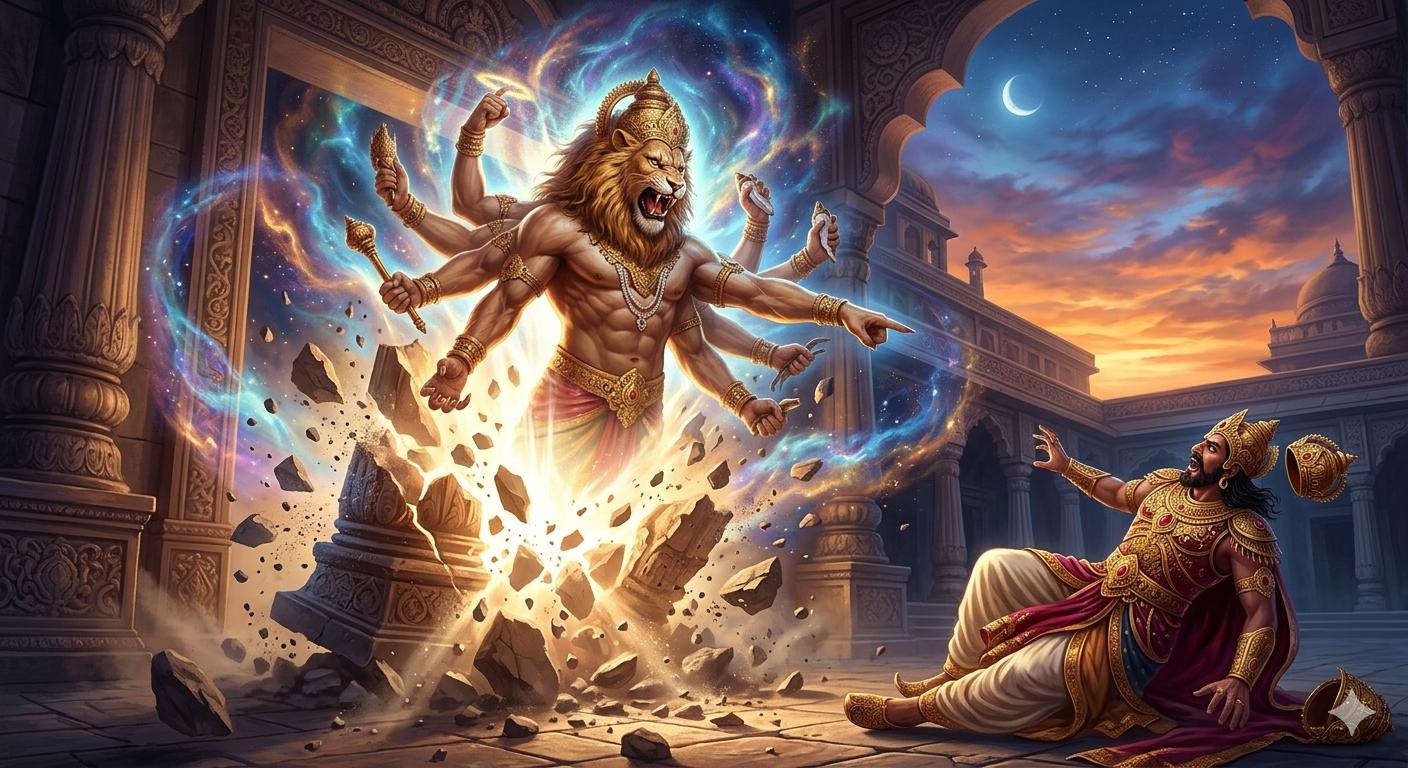
Core narrative: The demon king Hiranyakashipu could not be killed by man or beast, by day or night, inside or outside, on earth or in the sky, by any weapon. Vishnu manifested as Narasimha — half-man, half-lion — to circumvent every condition of the boon and kill him.
Sources that share this core:
- Vishnu Purana 1.17-20 — Amsha 1, Adhyaya 17-20
- Bhagavata Purana 7.2-9 — Skanda 7, Adhyaya 2-9
- Matsya Purana 161-163
- Agni Purana 4.1-12
- Brahma Purana 2.73
- Padma Purana 1.37 — Srishti Khanda
Differences:
- Vishnu Purana 1.17-20: Hiranyakashipu's son Prahlada was a devotee of Vishnu. Hiranyakashipu tortured Prahlada for this. Prahlada was thrown off cliffs, trampled by elephants, bitten by serpents, burned — survived every time through Vishnu's protection. Finally Hiranyakashipu pointed to a pillar and asked if Vishnu was in it. Prahlada said yes. Hiranyakashipu struck the pillar — Narasimha emerged from it. He placed Hiranyakashipu on his thighs (neither earth nor sky), at the threshold of the courtyard (neither inside nor outside), at dusk (neither day nor night), and tore him apart with his bare claws (no weapon). This is primarily a story of devotion with the origin of Narasimha as its climax.
- Bhagavata Purana 7.2-9 (most detailed): Adds extensive backstory — Hiranyakashipu and his brother Hiranyaksha were originally the gatekeepers of Vishnu's heaven (Jaya and Vijaya) cursed to be born as demons three times. Their demonic birth was itself predestined. After killing Hiranyakashipu, Narasimha's anger did not subside — he continued raging. The gods and even Lakshmi could not calm him. Finally Prahlada approached and calmed him with devotion.
- Matsya Purana 161-163: Focuses on the exact conditions of the boon given by Brahma and how each condition was circumvented — framed as a philosophical puzzle about the nature of divine boons and their loopholes.
Story 19: The Vamana Avatar — Reclaiming the Three Worlds
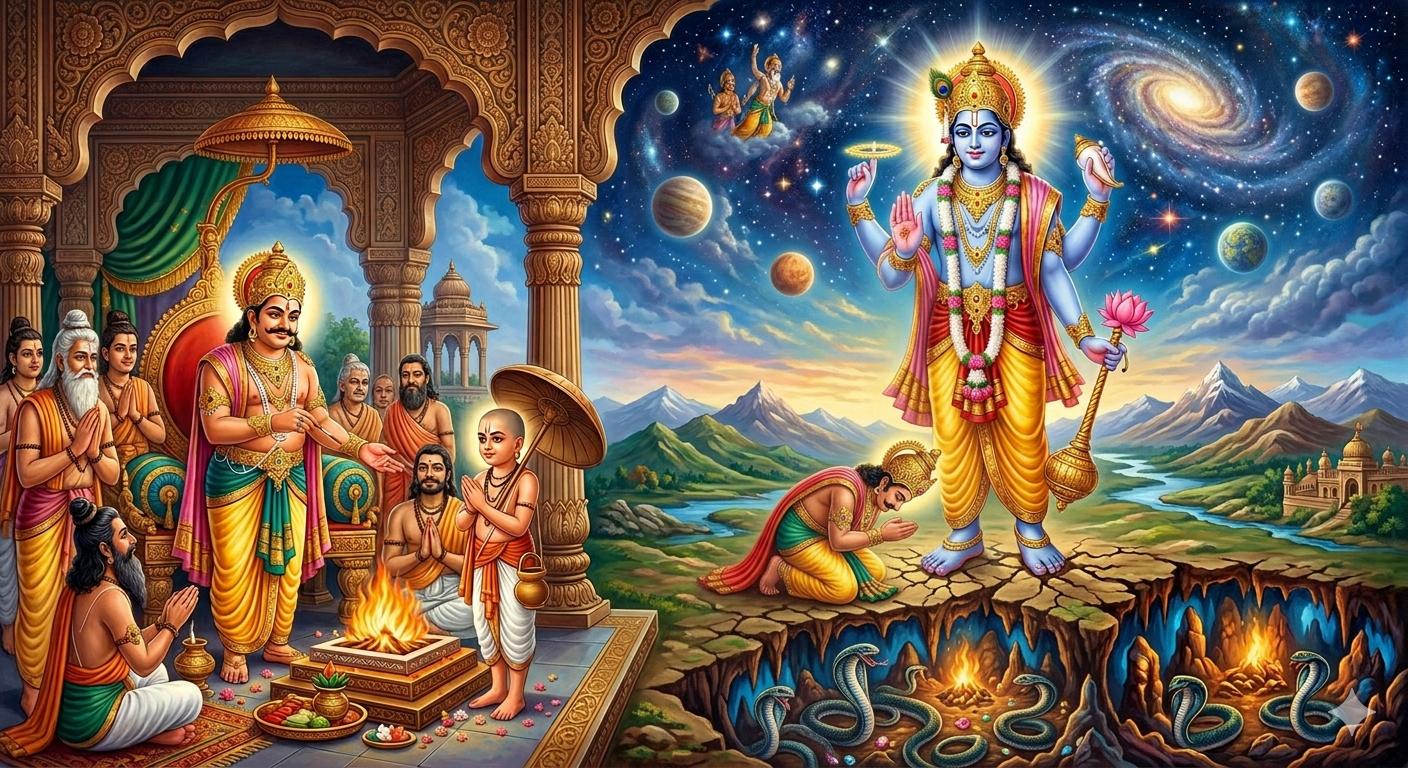
Core narrative: The demon king Bali conquered all three worlds through his virtue and sacrifices. Vishnu was born as a dwarf brahmin (Vamana), approached Bali for a gift of three steps of land, then expanded to cosmic size and covered heaven and earth in two steps. The third step he placed on Bali's head, pushing him to the underworld.
Sources that share this core:
- Rigveda 1.154 — (Vishnu's three strides, the earliest reference)
- Shatapatha Brahmana 1.9.3
- Vishnu Purana 2.10 — Amsha 2, Adhyaya 10
- Bhagavata Purana 8.15-23 — Skanda 8, Adhyaya 15-23
- Matsya Purana 244-246
- Vamana Purana 1-90 — (entire Purana)
- Mahabharata, Shanti Parva 343 — Shantiparva, Adhyaya 343
- Ramayana, Bala Kanda 32 — Balakanda, Sarga 32 (brief mention)
Differences:
- Rigveda 1.154 (earliest): No dwarf, no Bali, no demon at all. Simply describes Vishnu taking three steps — one on earth, one in the atmosphere, one in the sky — establishing the three realms. This is purely a cosmic act, not a battle narrative.
- Shatapatha Brahmana 1.9.3: The gods were losing to the demons. Vishnu was the smallest of the gods. He contracted himself into the smallest possible form and asked the demons for as much land as he could cover in three steps. They agreed thinking the small god could not cover much. He then expanded to fill all three worlds. No Bali named — the demons collectively are outwitted.
- Bhagavata Purana 8.15-23 (most elaborate): Vamana was born from Aditi and Kashyapa as the 12th Aditya. He arrived at Bali's sacrifice. Bali's guru Shukracharya recognized Vishnu in disguise and warned Bali not to grant the gift. Bali refused to break his word. As Shukracharya tried to obstruct the ritual pot's spout, Vamana poked a straw through it — blinding Shukracharya in one eye. Vamana expanded to cosmic Trivikrama form. His first step covered the earth, the second step covered the heavens — his foot pierced through the cosmic shell. The gods bathed his toe with their sacred rivers, creating the Ganga. There was no space for the third step. Bali offered his own head. Vishnu placed his foot on Bali, pushing him to Patala (underworld). As a reward for his virtue, Bali was made the king of Patala and was promised he would become the next Indra in the following cosmic age.
Story 20: The Yuga Cycle — Cosmological Time & Periodic Destruction
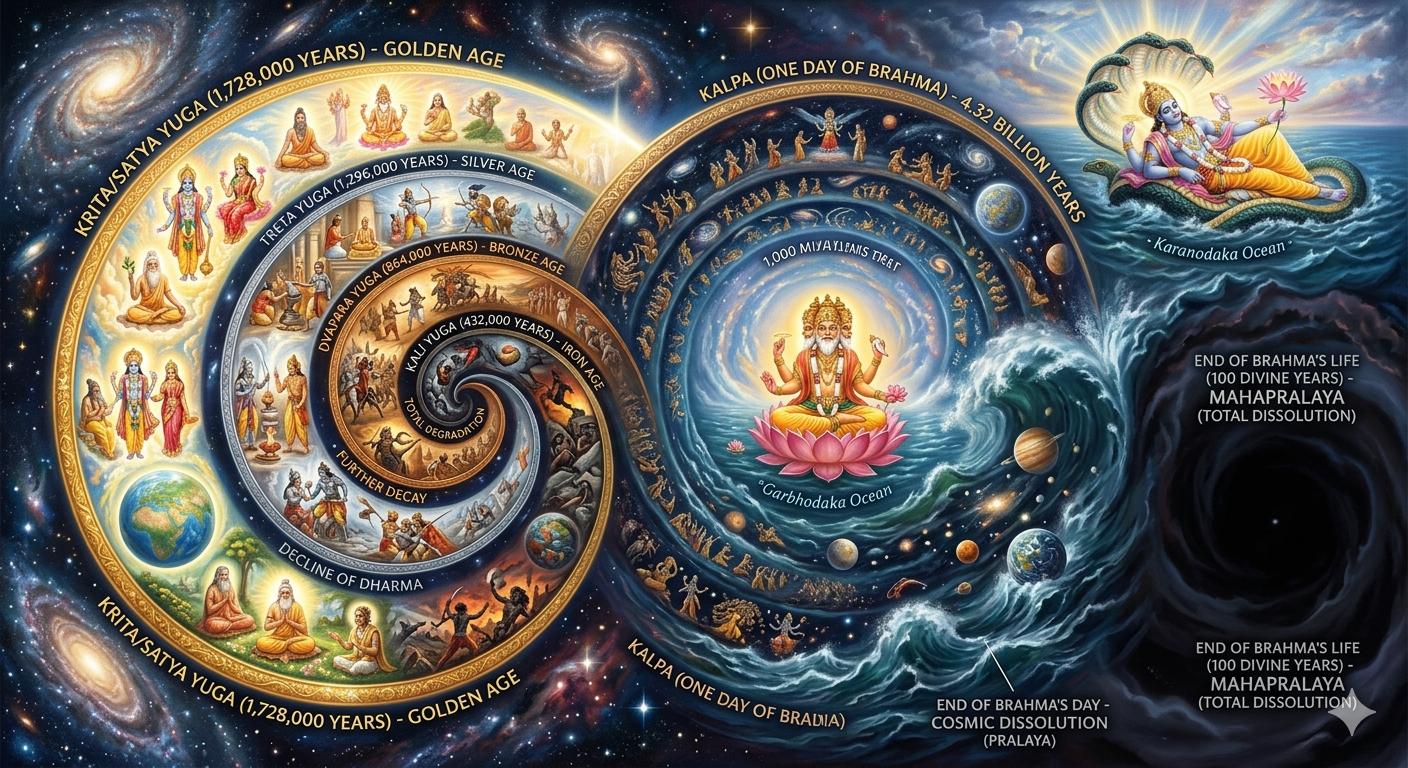
Core narrative: Time moves in cycles of four ages (Yugas) — Krita/Satya, Treta, Dvapara, and Kali — each shorter and more degraded than the last. 1,000 such cycles make one day of Brahma (Kalpa). At the end of each day, the universe dissolves (pralaya). At the end of Brahma's life, total dissolution (mahapralaya) occurs and everything returns to the unmanifest before the next creation.
Sources that share this core:
- Vishnu Purana 1.3 and 6.3-4 — Amsha 1 and 6
- Bhagavata Purana 3.11 and 12.4 — Skanda 3 and 12
- Matsya Purana 290-291
- Vayu Purana 57-58
- Brahma Purana 229-230
- Mahabharata, Shanti Parva 231 — Shantiparva, Adhyaya 231
- Manusmriti 1.67-86
Differences:
- Vishnu Purana 1.3 & 6.3-4: Most systematic. Gives exact lengths — Krita Yuga is 1,728,000 human years, Treta is 1,296,000, Dvapara is 864,000, Kali is 432,000. One Mahayuga (all four) = 4,320,000 years. 1,000 Mahayugas = one Kalpa (one day of Brahma). Describes what happens at each dissolution — fire consumes the three worlds, then water, then everything merges back into Vishnu who sleeps until the next creation.
- Bhagavata Purana 3.11: Adds the concept of Brahma's lifespan — 100 Brahma-years (each Brahma-year being 360 Brahma-days). We are currently in the first day of the 51st year of the current Brahma. Also describes partial dissolutions (naimittika pralaya) at the end of each Brahma-day vs total dissolution (prakritika pralaya) at the end of Brahma's life.
- Manusmriti 1.67-86: Gives the same numbers as Vishnu Purana. Adds description of moral decline across the Yugas — in Krita Yuga dharma stands on four legs, in Treta three, Dvapara two, Kali Yuga one. Describes specific moral deteriorations: caste mixing, decline of Vedic practice, shortening of human lifespan, increase in disease and vice.
- Mahabharata, Shanti Parva 231: Adds that the transition between Yugas is not abrupt — there is a twilight (sandhya) and a twilight period (sandhyamsa) at the beginning and end of each Yuga during which the characteristics of both ages are mixed.
- Vayu Purana 57-58: Describes seven different types of dissolution in detail — the daily dissolution, the occasional dissolution, the elemental dissolution, and the absolute dissolution — each dissolving progressively more of reality.
Story 21: Origin of the Solar & Lunar Dynasties — Genealogy of Humanity
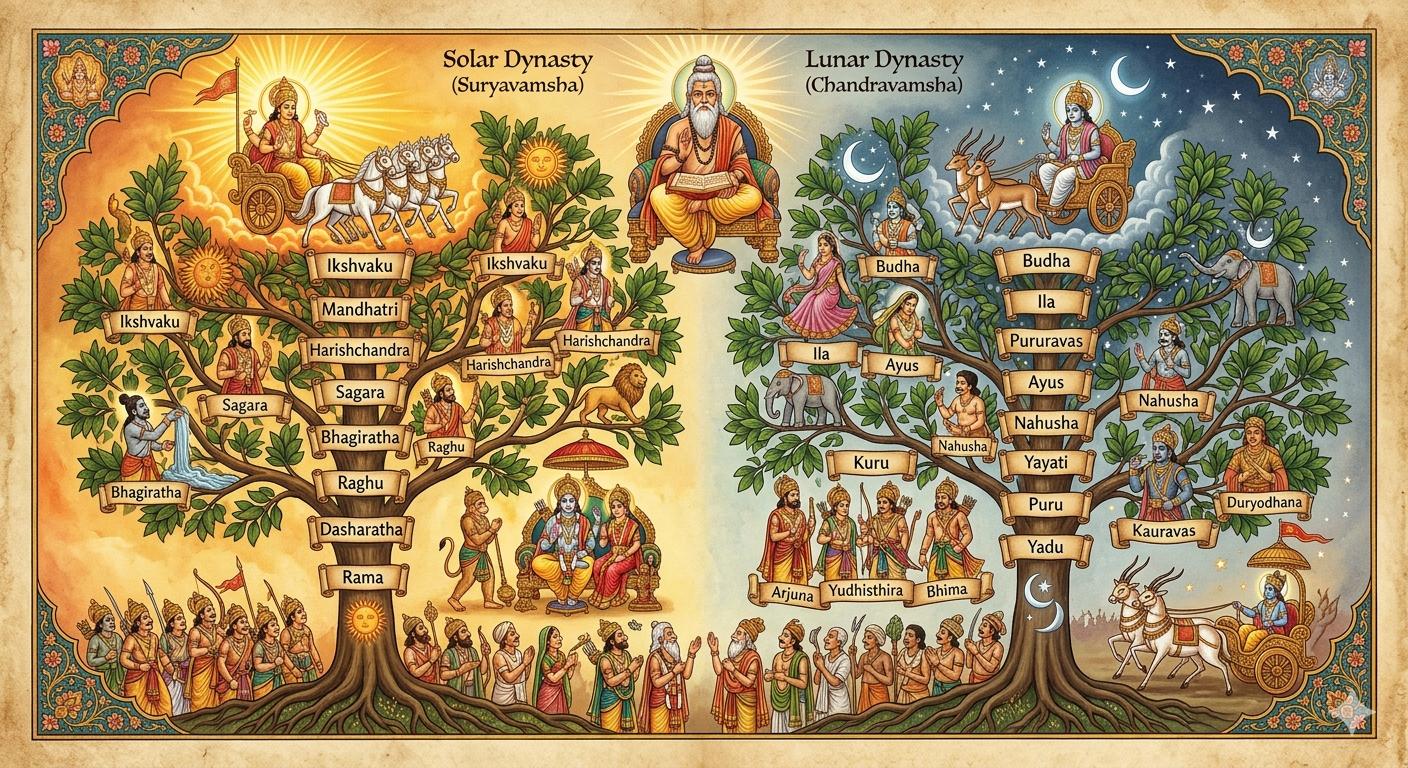
Core narrative: All human kings and heroes trace their lineage to either the Solar dynasty (Suryavamsha) descending from Manu through Ikshvaku, or the Lunar dynasty (Chandravamsha) descending from Manu through Ila/Budha. These two dynasties are the origin of all humanity in the epics.
Sources that share this core:
- Vishnu Purana 4.1-19 — Amsha 4
- Bhagavata Purana 9.1-24 — Skanda 9
- Matsya Purana 11-50
- Vayu Purana 85-99
- Mahabharata, Adi Parva 75 — Adiparva, Adhyaya 75
- Valmiki Ramayana, Bala Kanda 70-73 — Balakanda, Sarga 70-73
Differences:
- Vishnu Purana 4.1-19: Most systematic genealogy. Traces the Solar dynasty: Brahma → Marichi → Kashyapa → Vivasvat (the sun) → Vaivasvata Manu → Ikshvaku → (line continues to Rama). Traces the Lunar dynasty: Brahma → Atri → Chandra (moon) → Budha → Pururavas → Nahusha → Yayati → Puru → (line continues to Pandavas and Kauravas). Every king in between is named.
- Bhagavata Purana 9.1-24: Same dynasties but adds narrative detail for specific kings — their births, deeds, and deaths. Adds the story of Ila (Manu's son/daughter) who was transformed into a woman by Shiva's forest, then alternated between male and female monthly due to a compromise between Shiva and Vishnu, and in female form bore Budha's child Pururavas, beginning the lunar dynasty.
- Valmiki Ramayana, Bala Kanda 70-73: Narrates the Solar dynasty specifically from Brahma down to Rama in a single continuous list — given by the sage Shatananda to King Janaka at Rama and Sita's wedding. This is framed as a formal genealogy recitation.
- Mahabharata, Adi Parva 75: Gives both dynasties with the specific focus of establishing the Pandavas and Kauravas as legitimate heirs through their lunar lineage tracing back to Brahma.
Story 22: Origin of the Vanaras (Monkey Race) — Ramayana
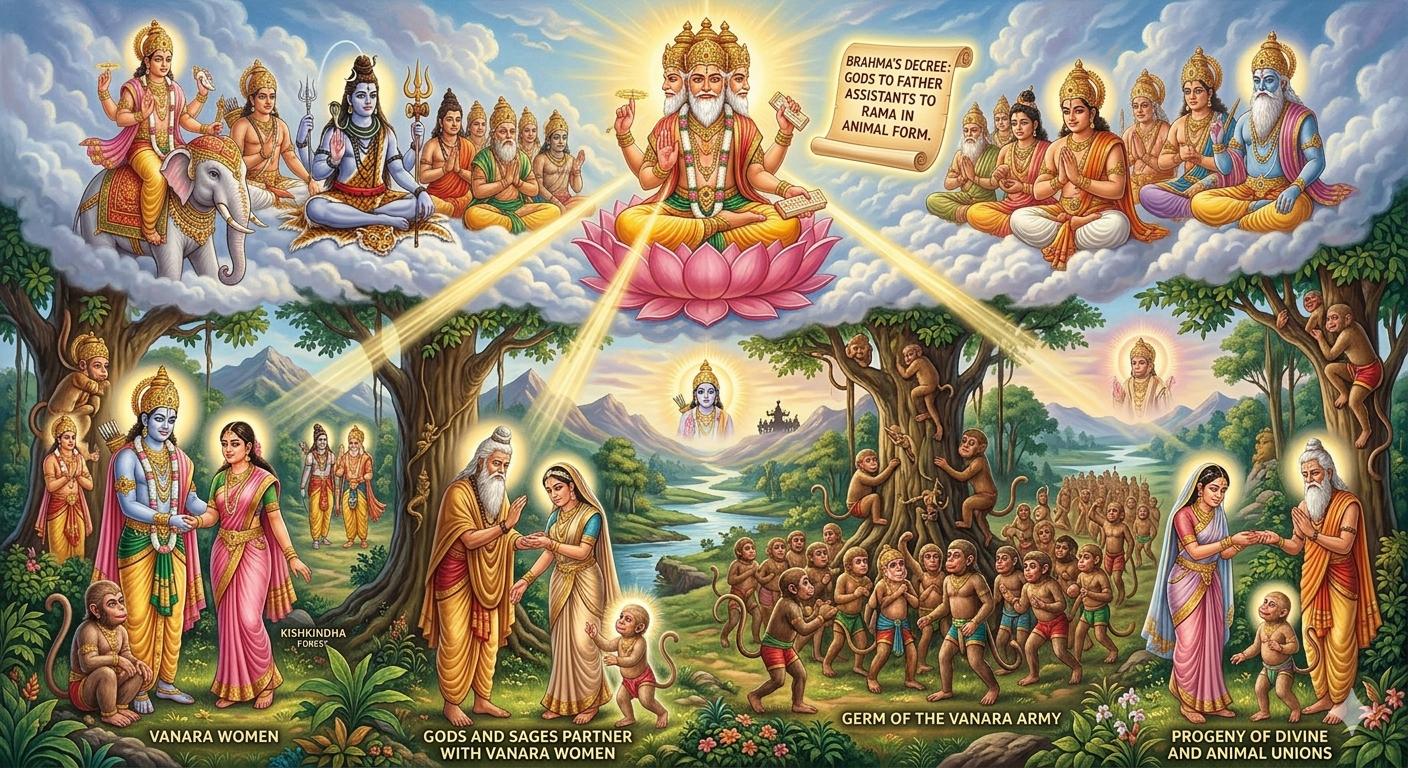
Core narrative: When Vishnu was about to incarnate as Rama to defeat Ravana, Brahma commanded the gods to father children on earth in animal form to assist Rama. The gods and sages mated with female monkeys (vanara women) to produce the vanara army.
Sources that share this core:
- Valmiki Ramayana, Bala Kanda 17 — Balakanda, Sarga 17
- Brahma Purana 2.1
- Padma Purana 4.72 — Patala Khanda
Differences:
- Valmiki Ramayana, Bala Kanda 17 (primary source): Brahma told the gods that Vishnu would need an army. He commanded them to produce sons in the form of bears and monkeys from female monkeys and bears. The gods, Gandharvas, Siddhas, and great sages all did so. Indra fathered Vali, Surya (the sun) fathered Sugriva, Brihaspati fathered Tara, Vayu (wind) fathered Hanuman, Agni (fire) fathered Nila. Each vanara inherited specific powers from his divine father. Vishwakarma (divine architect) created the vanara Nala who could build the bridge to Lanka.
- Brahma Purana 2.1: Adds that the female monkeys (riksha bears and vanara monkeys) chosen to bear these children were themselves divine beings who had been cursed to be born as animals.
- Padma Purana 4.72: Specifically details Hanuman's birth — Anjana was an apsara cursed to be born as a monkey woman. Vayu (wind god) carried Shiva's essence to her womb. Hanuman was thus born of Anjana by the power of Vayu, with Shiva's divine energy within him. Different Puranas vary on whether Hanuman is the son of Vayu alone, Shiva through Vayu, or Kesari (Anjana's husband) — this is an unresolved variation across texts.
Story 23: Origin of Lanka and the Rakshasas
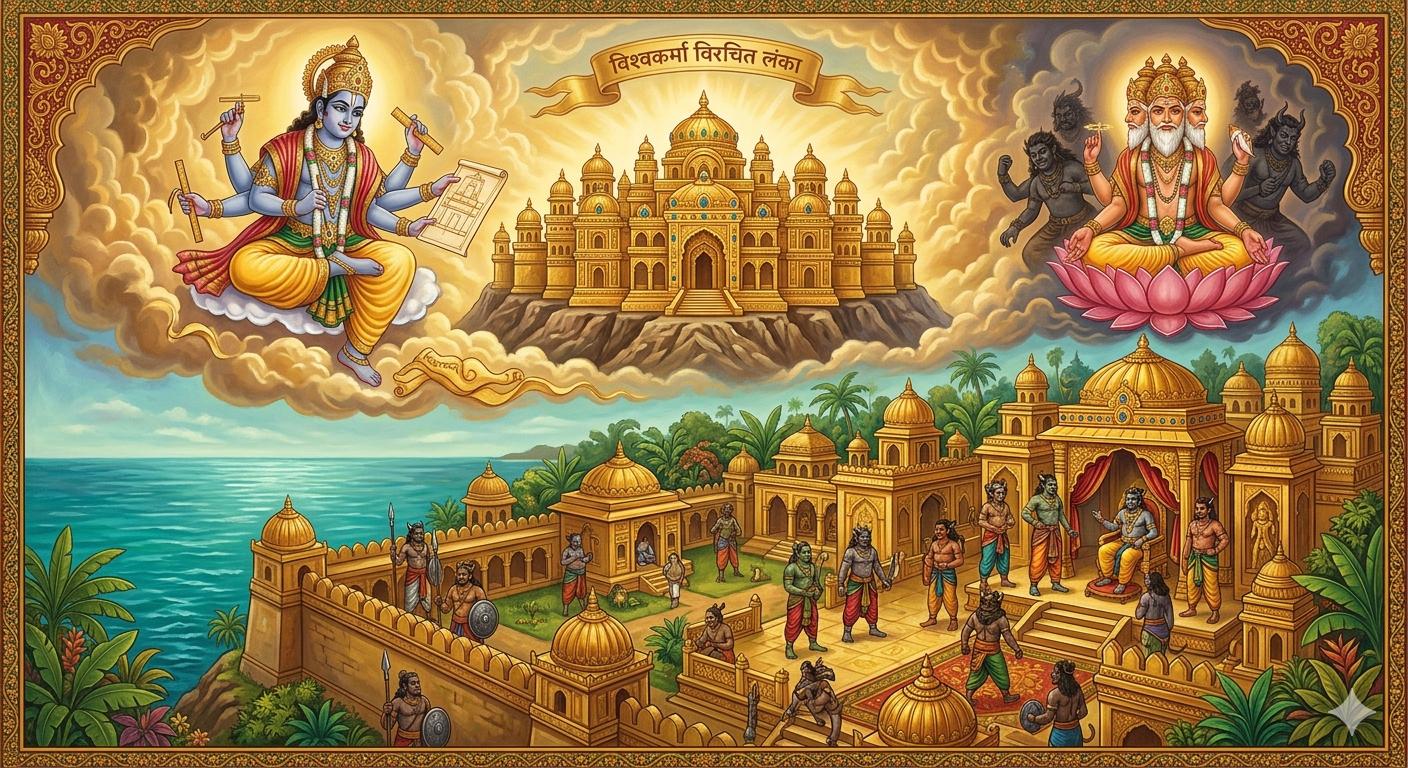
Core narrative: Lanka was originally a divine city built by Vishwakarma. The Rakshasas (demon beings) were born from Brahma's creation and inhabited Lanka before Ravana made it his kingdom.
Sources that share this core:
- Valmiki Ramayana, Uttara Kanda 2-10 — Uttarakanda, Sarga 2-10
- Vishnu Purana 1.9 — Amsha 1, Adhyaya 9
- Matsya Purana 6.20-30
- Bhagavata Purana 6.6.25
Differences:
- Valmiki Ramayana, Uttara Kanda 2-10 (most detailed): Vishwakarma built Lanka on top of a mountain in the ocean as a city for Shiva. Shiva gave it to Kubera (god of wealth) who was the first king of Lanka. Ravana (Kubera's half-brother, grandson of the sage Pulastya) defeated Kubera and seized Lanka. The Rakshasas themselves were born from Brahma's foot when Brahma was first creating beings — along with the Yakshas. Brahma told them their role was to guard (raksha) the primordial waters. Some said "we will protect" (rakshamah) — they became Rakshasas. Others said "we will eat" (yakshaamah) — they became Yakshas.
- Matsya Purana 6.20-30: The Rakshasas were born from Kashyapa's wife Khasa, along with the Yakshas and some lower supernatural beings. This places them firmly in the same genealogical framework as the Nagas and Garudas rather than as a separate spontaneous creation from Brahma.
- Vishnu Purana 1.9: Does not narrate Lanka's origin but traces the Rakshasa lineage through Pulastya's son Vishravas, whose four sons by two wives were Kubera (by the virtuous wife) and Ravana, Kumbhakarna, and Vibhishana (by the other wife).
Story 24: The Shaiva Agamas — Shiva-Shakti as the Original Pair
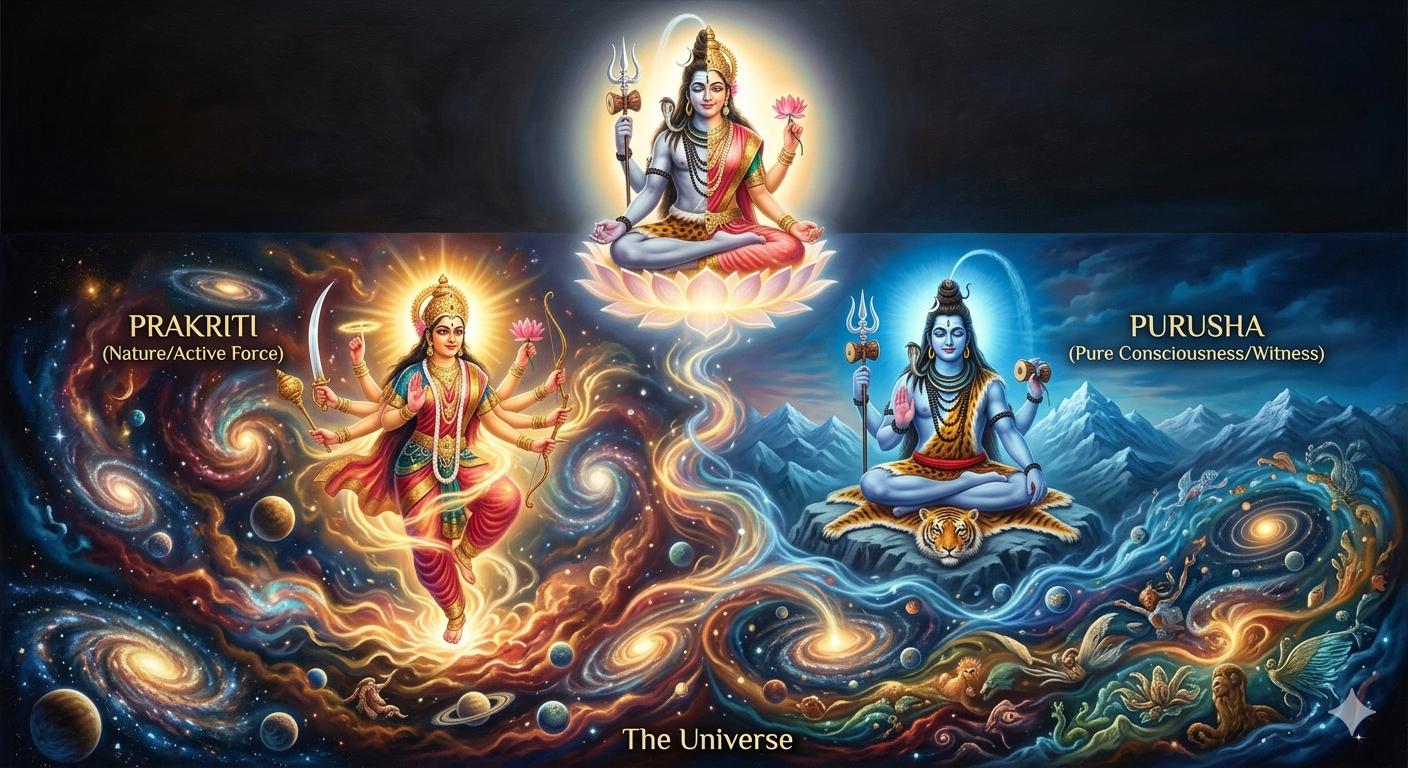
Core narrative: Before any creation, Shiva and Shakti existed as one undivided reality. Creation occurred when Shiva and Shakti separated — Shakti became the active creative force while Shiva remained the unchanging witness. The universe is the field of their interaction.
Sources that share this core:
- Shaiva Agamas (Kamikagama, Karanagama) — primary Shaiva canonical texts
- Shiva Purana, Rudra Samhita 1-5
- Linga Purana 1.3-5 — Purva Bhaga
- Mahanirvana Tantra — Adhyaya 4
- Kularnava Tantra — Ullasa 1
Differences:
- Kamikagama (Shaiva Agama): Shiva is described as having five functions — creation (srishti), sustenance (sthiti), dissolution (samhara), concealment (tirodhana), and grace (anugraha). The universe proceeds from these five acts perpetually. Brahma, Vishnu, and Rudra are Shiva's agents performing the first three functions on his behalf.
- Shiva Purana, Rudra Samhita 1-5: Shiva and Shakti are the original pair. Shiva is pure consciousness without motion; Shakti is motion without consciousness. When they unite, creation is possible. When they separate, Shakti creates, sustains, and dissolves the universe. The analogy given is a lamp and its light — you cannot separate them, yet they are distinct.
- Linga Purana 1.3-5: The Linga (Shiva's symbol) is the primordial form — it has no beginning and no end. The universe is contained within it. The Linga is described as the axis of the cosmos — the Brahmanda (cosmic egg) rotates around it.
- Mahanirvana Tantra, Adhyaya 4: The universe arose from the union of Shiva and Shakti — specifically from Shakti's womb. Everything that exists is either Shiva (pure consciousness) or Shakti (matter/energy). There is no third category. Brahma, Vishnu, and other gods are all modifications of this original pair.
- Kularnava Tantra, Ullasa 1: Shakti alone is responsible for all creation — Shiva merely provides the witnessing consciousness. The practical instruction for humans is to worship Shakti as the cause of the universe and Shiva as its eternal background.
Story 25: Devi as Sole Origin — Shakta Accounts
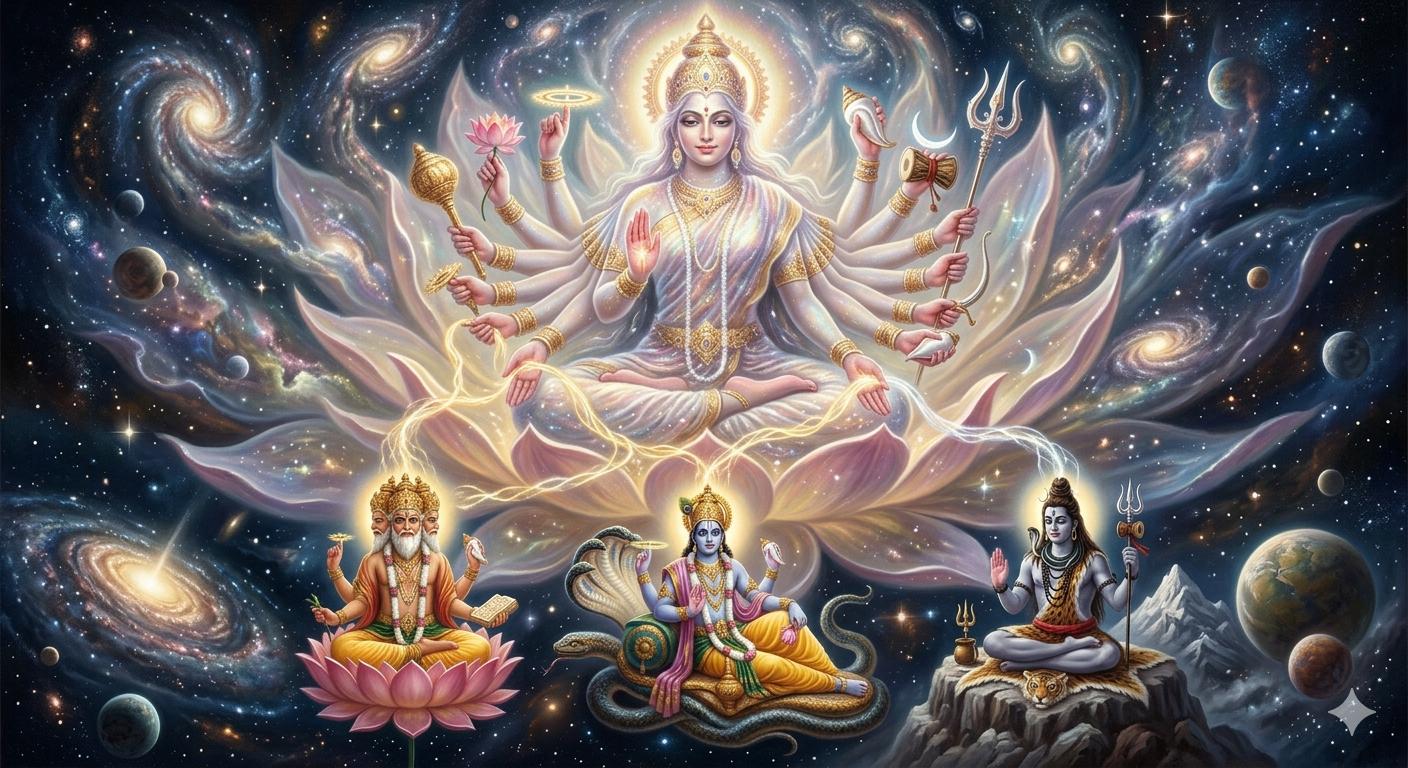
Core narrative: The Goddess (Adi Shakti) existed before everything — including Brahma, Vishnu, and Shiva. She is the material cause of the universe (what it is made of) and the efficient cause (the one who made it). All gods derive their power from her.
Sources that share this core:
- Devi Bhagavata Purana 1.5-9 and 3.3-5 — Skanda 1 and 3
- Devi Upanishad — Atharva Veda tradition, Verses 1-14
- Markandeya Purana 81-93 (Devi Mahatmya) — Adhyaya 81-93
- Lalita Sahasranama — Brahmanda Purana, Uttara Khanda
- Soundarya Lahari (Adi Shankaracharya) — Verses 1-3
Differences:
- Devi Bhagavata Purana 1.5-9: At the very beginning only Devi existed as pure consciousness. She willed creation. From her right side she produced Vishnu, from her left side Brahma, from her mind Shiva. She assigned Brahma the task of creating, Vishnu the task of sustaining, Shiva the task of dissolving. She herself remained as the power behind all three. When Vishnu and Brahma once argued over who was superior, Devi appeared as a blinding light and revealed that both derive entirely from her.
- Devi Mahatmya, Markandeya Purana 81 (Mahakali origin): When the universe was in dissolution (pralaya) and Vishnu was asleep on Shesha, two demons Madhu and Kaitabha emerged from his ear wax and threatened Brahma. Brahma prayed to Yoganidra (the sleep-goddess residing in Vishnu's eyes) to release Vishnu from sleep. She was a form of Devi. She withdrew from Vishnu, he awoke and killed the demons. This positions Devi as the power that controls even Vishnu's waking and sleeping — she is more fundamental than he is.
- Devi Upanishad, Verses 1-14: The Goddess speaks in first person — "I am the queen, the gatherer of treasures. I am knowledge. I am the unborn. I pervade all the worlds." She declares herself identical with Brahman — the ultimate reality of the Upanishads. She is both Brahman (the formless absolute) and the personal Goddess simultaneously. This is the only Upanishad where the Goddess directly identifies herself as the supreme principle.
- Lalita Sahasranama (Brahmanda Purana): Describes the Goddess Lalita Tripurasundari as self-created (svayambhu) — she arose from the fire of cosmic consciousness on her own without any cause. She then created Brahma, Vishnu, Shiva, and the entire universe as her play (lila).
Skanda Purana — Regional Creation Narratives
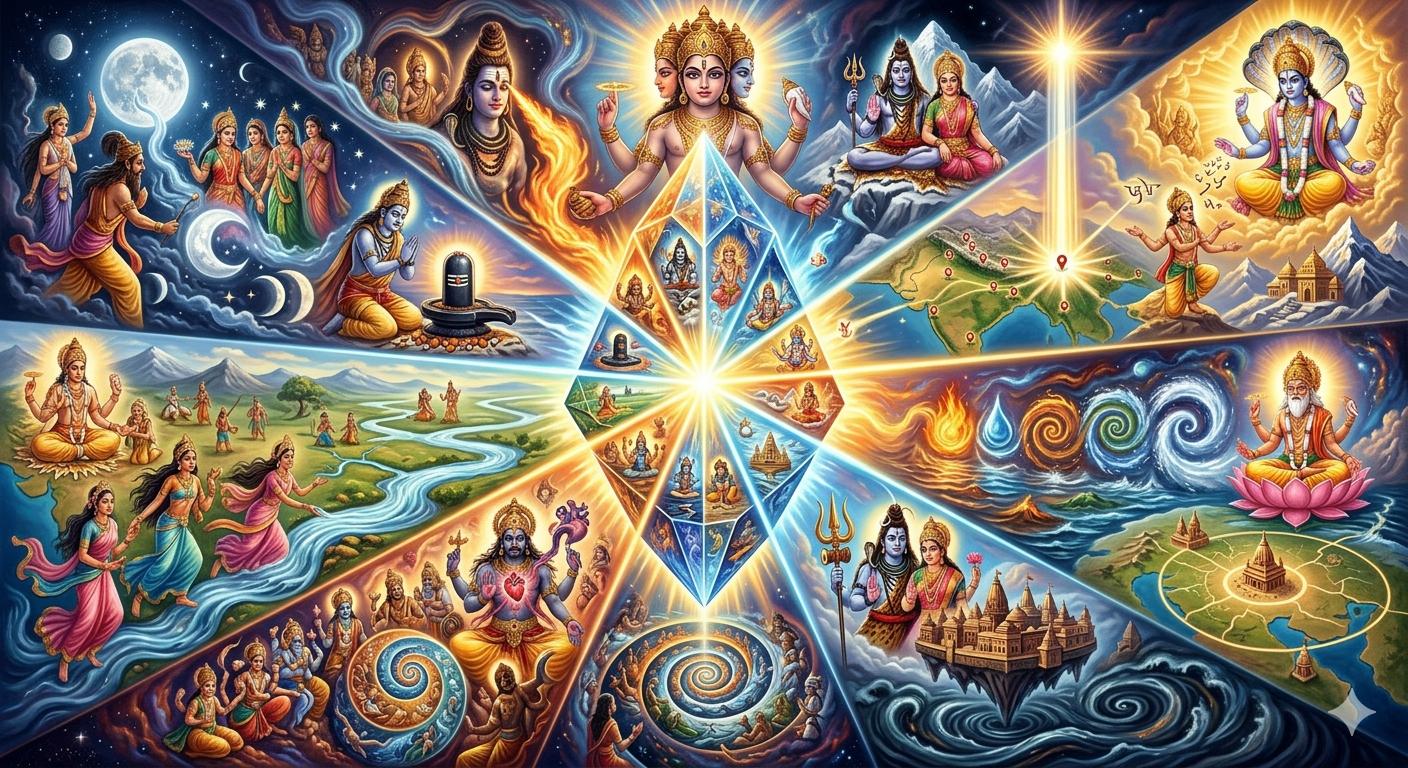
The Skanda Purana is the largest Purana — approximately 81,000 verses divided into seven major sections (Khandas). Each Khanda contains creation narratives tied to specific sacred geographies. Below are the distinct creation accounts from each Khanda.
Skanda Purana — Maheshvara Khanda
Source: Skanda Purana, Maheshvara Khanda, Adhyaya 1-5
Narrative: Shiva is the original creator in this Khanda. Before creation Shiva and Parvati existed alone on Mount Kailasha. Parvati asked Shiva to create the universe. Shiva opened his third eye and from it came fire that illuminated the void. He then created Brahma from his right side and Vishnu from his left. He gave them each half the divine energy and commanded Brahma to create beings and Vishnu to sustain them. This Khanda also contains the origin of the twelve Jyotirlingas — the twelve sacred sites where Shiva's pillar of light touched the earth — and connects each site to a specific act of creation or restoration in that region.
Skanda Purana — Vaishnava Khanda
Source: Skanda Purana, Vaishnava Khanda, Adhyaya 1-8
Narrative: This Khanda presents Vishnu as the supreme creator. It opens with Vishnu in Vaikuntha (his heavenly abode) before creation. Vishnu breathed out — from his breath emerged the Vedas. From the Vedas he created Brahma. Brahma then created the universe following Vedic instructions. The origin narratives here are connected specifically to the sacred site of Badrinath (in present Uttarakhand) — the Khanda states that Badrinath is the exact spot where Vishnu first instructed Brahma on how to create, and therefore it is the most sacred point of creation on earth.
Skanda Purana — Brahma Khanda
Source: Skanda Purana, Brahma Khanda, Adhyaya 1-6
Narrative: Brahma is the focus. This Khanda gives a creation account where Brahma alone is the original self-existent being — Vishnu and Shiva are described as his creations, not his sources. Brahma practiced austerity for 12,000 divine years. From that austerity he produced fire, water, earth, air, and space — the five elements in sequence. He then produced all beings from the five elements. This Khanda is associated with the sacred site of Pushkar (Rajasthan) — the only place on earth where Brahma has a major temple — and states that Pushkar was the first point of land that appeared when the earth emerged from the primordial waters, making it the geographic center of creation.
Skanda Purana — Kashi Khanda
Source: Skanda Purana, Kashi Khanda, Adhyaya 1-12
Narrative: Contains a distinct creation account centered on the sacred city of Kashi (Varanasi). Before the universe was created, Shiva and Parvati lived in the void. Shiva created Kashi first — before even the cosmic egg — as a foundation for creation to rest on. He placed Kashi on the tip of his trident to keep it above the primordial waters during every dissolution. This is why Kashi is said to transcend the cycle of creation and destruction — it is never destroyed even during mahapralaya. Brahma then created the universe around Kashi. This Khanda contains the account of the Jyotirlinga of Vishwanatha (Shiva's primary form) emerging at Kashi as the pillar of light that Brahma and Vishnu could not measure — connecting the Kashi creation account to the Linga Purana's Jyotirlinga story.
Skanda Purana — Avantya Khanda
Source: Skanda Purana, Avantya Khanda, Adhyaya 1-5
Narrative: Creation account centered on Ujjain (Avantika). After the primary creation was complete, a second wave of creation occurred in which Shiva assigned specific gods to specific geographic locations as their domains. Ujjain was assigned to Mahakaleshvara — the form of Shiva as the lord of death and time. This Khanda contains a distinct narrative on the origin of time (kala) — Shiva as Mahakala (the great time) is described as the being from whom time itself was born. Before Mahakala existed, there was no sequence of moments — past, present, and future were undifferentiated. Mahakala's first heartbeat created the first unit of time, and from that succession of heartbeats the entire framework of past and future unfolded.
Skanda Purana — Nagara Khanda
Source: Skanda Purana, Nagara Khanda, Adhyaya 1-10
Narrative: Centered on the sacred geography of Gujarat (Hatkeshvara region). Contains a regional creation account where after the primary creation Brahma realized the earth had regions that were still incomplete — uninhabited, without rivers, without mountains, without sacred energy. He sent specific gods and sages to populate and consecrate these regions. The Nagara Khanda describes the origin of the sacred rivers of western India — they were created by Brahma's daughters who were told to flow across the earth to make it fertile and inhabited. Each river's source is connected to a specific act of divine will.
Skanda Purana — Prabhasa Khanda
Source: Skanda Purana, Prabhasa Khanda, Adhyaya 1-8
Narrative: Centered on Somnath (the Somnatha Jyotirlinga in Gujarat). Contains the story of the moon god Chandra's origin. Chandra was born from the churning of the cosmic ocean (as in the Mahabharata account) or alternatively from Atri's mind (Bhagavata version) — the Prabhasa Khanda uses the Atri version. Chandra then married all 27 of Daksha's daughters (the 27 Nakshatras/lunar mansions) but favored only Rohini. Daksha cursed Chandra to wane and die. Chandra came to Prabhasa, worshipped Shiva, and was partially relieved — he would wane for 15 days and wax for 15 days eternally. This is the Skanda Purana's origin account for the phases of the moon. Chandra then installed the Somnatha Linga at Prabhasa in gratitude — this is the origin of the Somnath temple.
An Important Note on the Skanda Purana
The Skanda Purana exists in multiple regional recensions — the text was compiled differently in different parts of India, and some Khandas have their own sub-sections (upakhandas) with further local creation narratives. The most authoritative printed edition is the Nag Publishers Sanskrit edition (Delhi) in 20 volumes. The Gita Press edition covers major Khandas. For regional variants especially in the Nagara and Prabhasa Khandas, the Bhandarkar Oriental Research Institute (BORI) manuscripts are the most reliable verification source.