
- Aboriginal Australian — Dreamtime
- Siberian / Turkic Shamanic
- Ancient Mesopotamian
- Ancient Egyptian
- Zoroastrian (Persian)
- Ancient Greek
- Yoruba (West African)
- Dogon (West African)
- Chinese (Taoist & Folk)
- Norse / Germanic
- Japanese Shinto
- Māori / Polynesian
- Aztec / Mesoamerican
- Inca / Andean
- Native American
- Hawaiian — The Kumulipo
1. Aboriginal Australian — Dreamtime
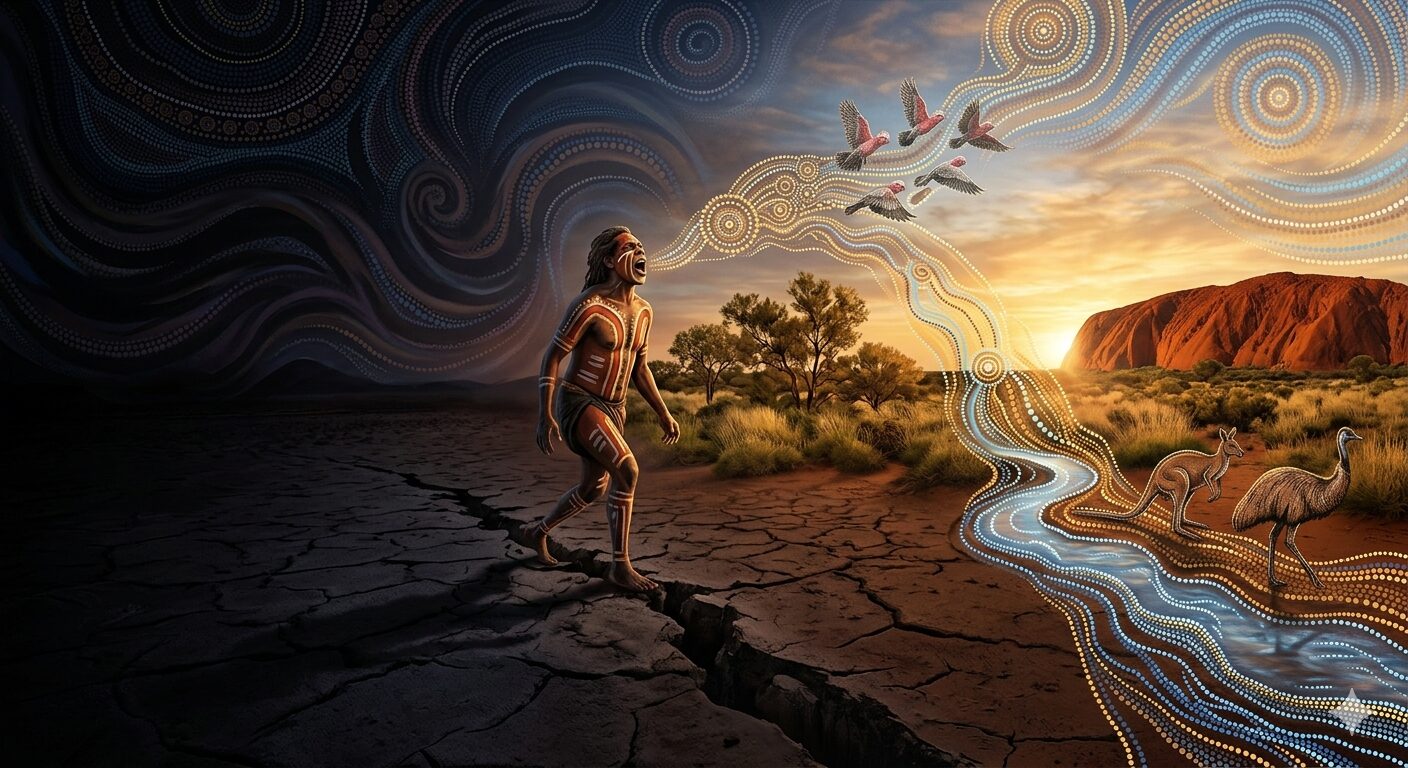
Estimated 65,000 BCE — oldest continuous religious tradition on earth
In the beginning there was only darkness and silence — a featureless, formless void. Beneath the surface of the earth slept the Ancestor beings, neither fully alive nor dead, waiting. Then the Ancestors woke and pushed through the surface of the earth. As they moved across the land they sang — and whatever they sang into existence came to be. A singing Ancestor would walk across the land calling out the name of everything they encountered — rocks, rivers, animals, plants — and in naming them, created them. The paths they walked became the landscape itself — mountains rose where they stamped, rivers flowed where they dragged their feet, waterholes formed where they stopped to rest. These paths are called Songlines — invisible pathways across the continent that connect every sacred site. The sun was sung into existence and placed in the sky. The stars were scattered across the sky by Ancestors flinging sparks or placing spirit beings in the heavens. Different groups of animals were created by different Ancestors — the kangaroo Ancestor sang kangaroos into being, the emu Ancestor sang emus. Humans were similarly sung into existence — in some accounts shaped from the earth itself by an Ancestor who breathed life into clay figures, in others they emerged directly from the earth as the Ancestors woke. After completing their creative journeys the Ancestors did not die — they transformed into the landscape features they had created. A great snake Ancestor became a mountain range. A bird Ancestor became a rock formation. They are still present in the land. The Dreamtime is not understood as a past event — it is an ever-present reality running beneath the surface of ordinary life. Sacred ceremonies re-enact the Ancestor journeys, keeping creation alive and maintaining the order of the world. If the ceremonies stop, creation itself could unravel.
- The idea of creation through sound/speech parallels the Hindu concept of creation through Om and sacred sound (Narada Purana 1.3, Mandukya Upanishad) and the Abrahamic "God said let there be light" (Genesis 1:3)
- Ancestors transforming into landscape features parallels the Hindu concept of sacred geography — rivers, mountains, and sacred sites as the embodied forms of divine beings
- The ongoing, cyclical nature of creation sustained by ritual parallels the Hindu concept of creation as continuous and sustained by cosmic sacrifice (Rigveda 10.90, Purusha Sukta)
2. Siberian / Turkic Shamanic — Earth Diver
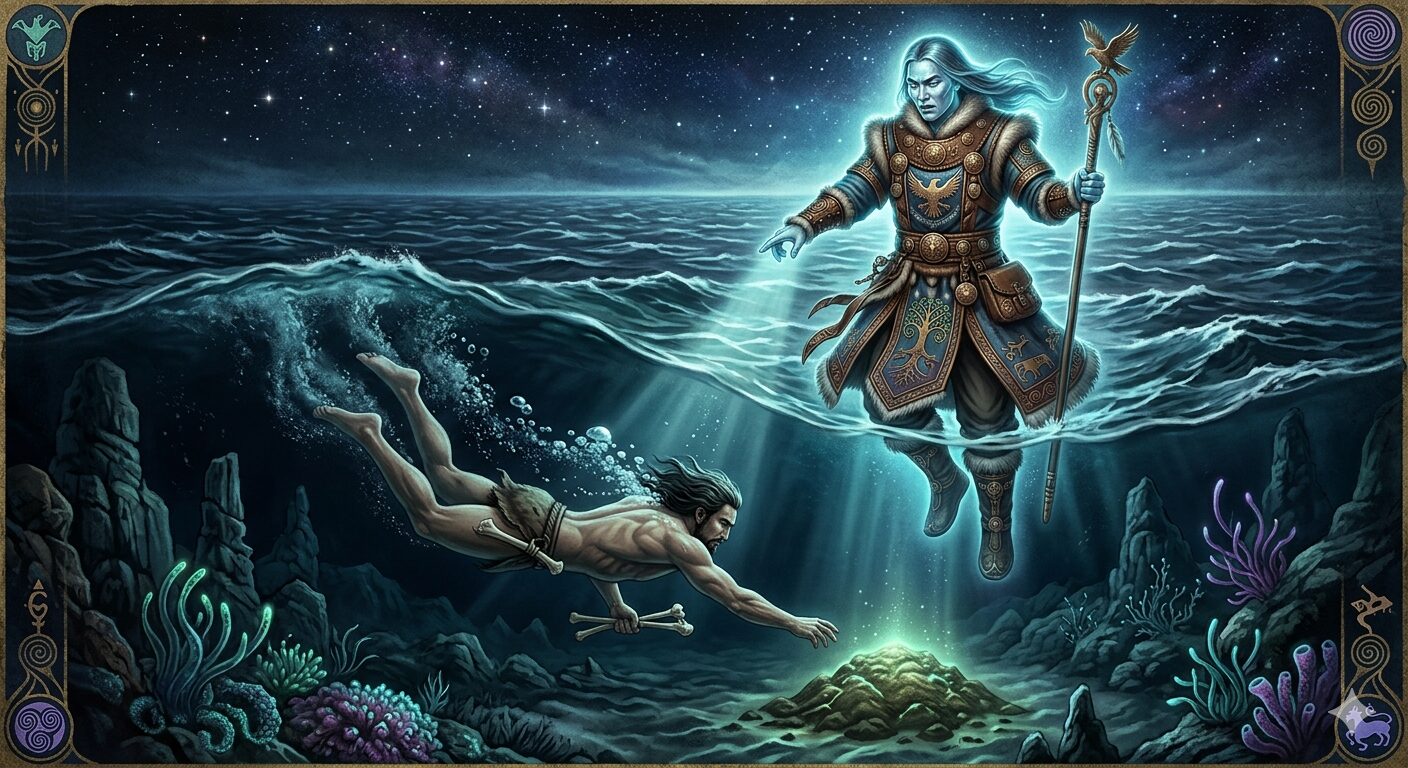
Estimated 20,000 BCE — among the most geographically widespread creation myth types on earth
In the beginning there was only a vast primordial ocean stretching in every direction with no land anywhere. A supreme being — variously named Ulgen, Tengri, or simply the Creator depending on the specific tradition — floated above or moved across the surface of the water. In some versions a great bird flew over the waters. The Creator sent a being — a bird, a divine helper, or in many versions a being named Erlik (who would later become associated with evil) — diving down into the depths of the primordial ocean to bring up earth from the bottom. The diver went down into the dark water and grabbed a handful of mud from the ocean floor. In some versions he secretly kept a mouthful of mud in his cheeks while handing the rest to the Creator. The Creator took the mud and placed it on the surface of the water — it expanded and spread in every direction becoming the earth. But the earth began to shake and tremble because the diver had hidden mud in his mouth — the Creator commanded him to spit it out, and where he spat the earth buckled and rose up into mountains and hills and uneven terrain. In a perfectly flat world the hidden mud created all the highlands and difficult terrain. The Creator then shaped the animals, birds, and plants and placed them on the earth. Humans were formed from earth and animated by the divine breath of the Creator. In Turkic variants Erlik, the diving being who deceived the Creator, was cast into the underworld as punishment — becoming the lord of the dead and the source of disease and misfortune for humans.
- The earth-diver motif — a being retrieving earth from primordial waters — closely parallels Vishnu's Varaha (boar) avatar diving into the cosmic ocean to retrieve the earth (Bhagavata Purana 3.13, Vishnu Purana 1.4)
- The primordial ocean before creation parallels Hindu primordial waters (Rigveda 10.129) and the Abrahamic "darkness over the face of the deep" (Genesis 1:2)
- The deceptive subordinate being who hides material and is cast below parallels the fall of Iblis/Satan in the Quran (Sad 38:75-85) and Erlik as a proto-Satan figure
3. Ancient Mesopotamian — Sumerian & Babylonian
Approximately 2,600 BCE written — among the oldest written narratives on earth
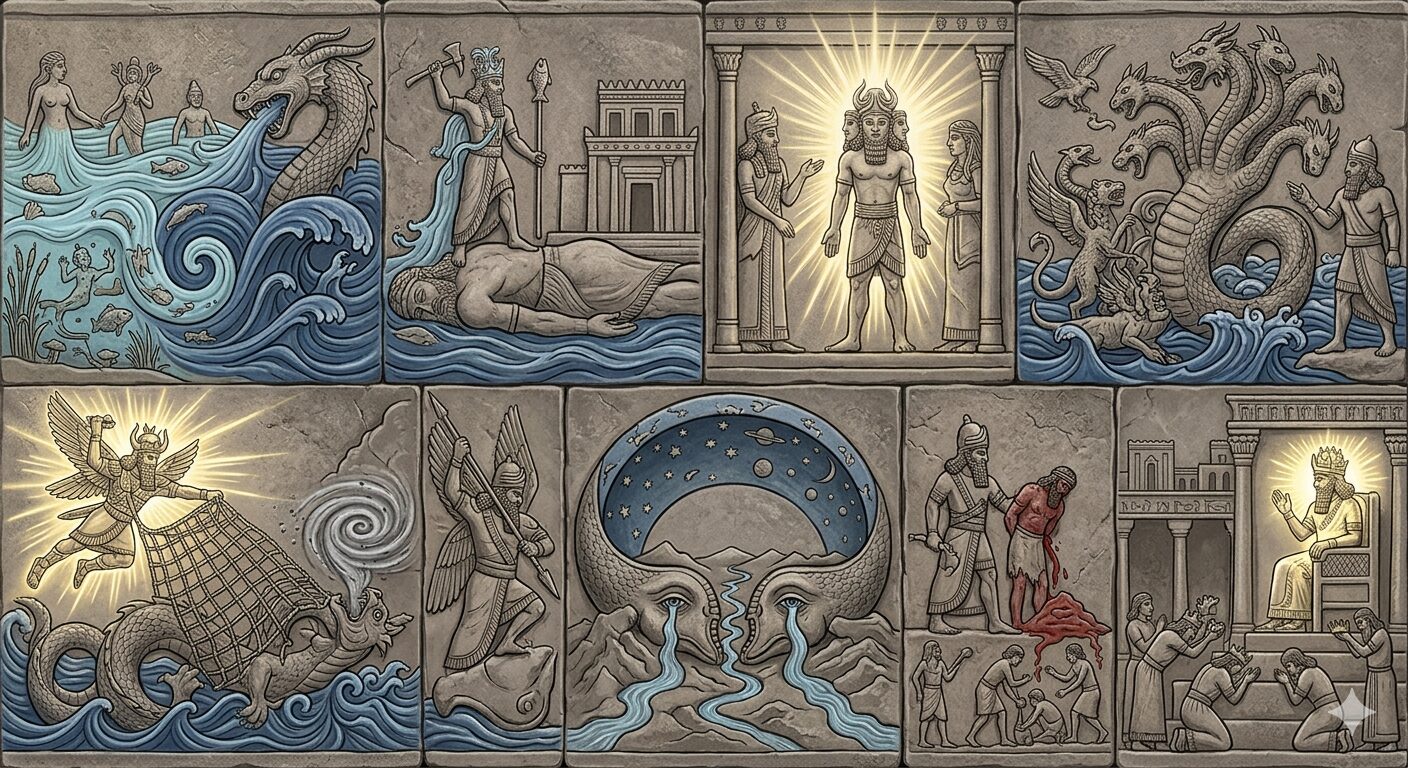
The Enuma Elish (Babylonian — approximately 1,200 BCE written, much older oral tradition)
In the beginning nothing existed except two primordial beings — Apsu, the freshwater ocean, and Tiamat, the saltwater ocean. They existed together, their waters mingling. From their mixing the first gods were born. The younger gods were noisy and restless and disturbed Apsu's sleep. Apsu decided to destroy them. The god Ea learned of the plan, killed Apsu first, and built his home on Apsu's body. From Ea and his consort was born Marduk — the greatest of the gods, born with four eyes and four ears, radiating light. Tiamat, enraged at Apsu's death, raised an army of monsters — serpents, dragons, and demon beings — led by her new consort Kingu, to whom she gave the Tablet of Destinies (which grants supreme power). The gods were terrified. Only Marduk agreed to fight Tiamat, on the condition that if he won he would be declared supreme god. He agreed. He caught Tiamat in a net, drove an evil wind into her open mouth so she could not close it, and split her body in two with his spear. From her upper body he made the sky. From her lower body he made the earth. From her eyes he made the Tigris and Euphrates rivers. From Kingu's blood, mixed with clay, Marduk created humans — specifically to serve the gods so the gods would not have to labor themselves. Marduk was then declared supreme among the gods.
The Atrahasis Epic (Sumerian/Babylonian — approximately 1,700 BCE written)
The lesser gods (Igigi) were forced to dig the rivers and canals and do all the heavy labor for the greater gods (Anunnaki). After 40 years they rebelled. The mother goddess Mami (also called Nintu) mixed clay with the flesh and blood of a slain god — a god who had intelligence (temu) — and from this mixture created humans to take over the labor. Seven males and seven females were created in the first batch. Humans were the workforce of the gods.
- Tiamat being split to form heaven and earth closely parallels the Hindu cosmic egg (Brahmanda) being split into heaven and earth (Manusmriti 1.9-13, Chandogya Upanishad 3.19)
- Humans created from a god's blood mixed with clay to serve the gods parallels the Hindu Purusha Sukta where the universe is created from a cosmic being's sacrificed body (Rigveda 10.90)
- The primordial waters (Apsu and Tiamat) mingling before creation parallels Hindu primordial waters (Rigveda 10.129) and Abrahamic "the deep" (Genesis 1:2) — Mesopotamian tradition is widely considered a direct influence on the Biblical account
- The rebellion of lesser divine beings parallels the war between Devas and Asuras in Hindu tradition (Vishnu Purana 1.15) and the rebellion of Iblis in the Quran (Al-Baqarah 2:34)
4. Ancient Egyptian
Approximately 2,400 BCE written (Pyramid Texts) — one of the most internally diverse creation traditions anywhere
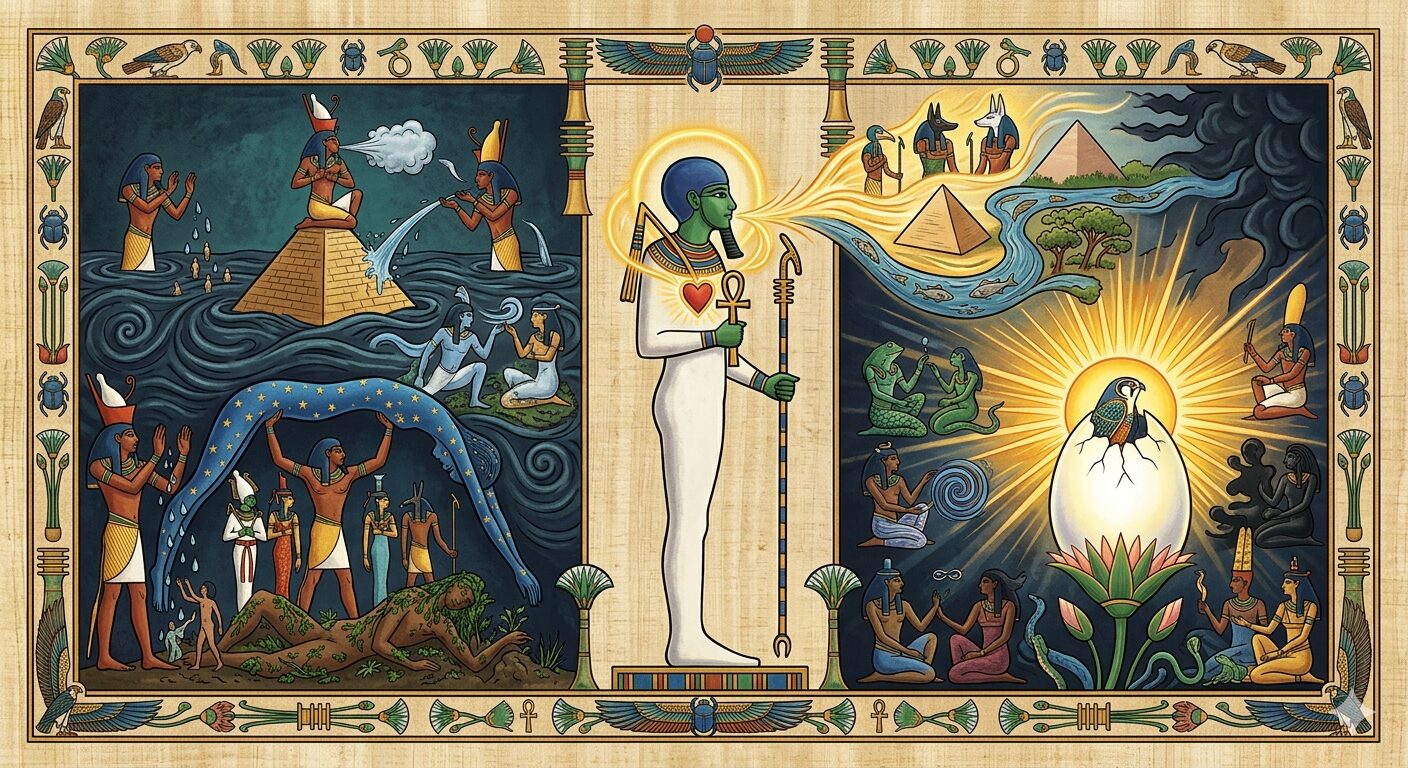
Egyptian creation was not one story but several distinct accounts from different city-states, each with a different primary creator. All share the concept of Nun — the infinite primordial ocean of dark, inert water that existed before everything.
The Heliopolitan Account (from Heliopolis — City of the Sun)
From the dark waters of Nun, a mound of earth (benben) rose spontaneously. On this mound appeared Atum — the self-created one, who existed through his own will. Atum was alone. He created the first divine pair through himself alone — he sneezed out Shu (air/wind) and spat out Tefnut (moisture). Shu and Tefnut produced Geb (earth) and Nut (sky). Originally Geb and Nut were locked in a permanent embrace — Shu separated them, lifting Nut above Geb, creating the space between earth and sky where life could exist. Geb and Nut produced Osiris, Isis, Set, and Nephthys — the gods of the human world. Humans were created from Atum's tears — when he wept tears of joy at finding his children (Shu and Tefnut had been lost in the dark waters), those tears fell to earth and became humans.
The Memphite Account (from Memphis)
The god Ptah was the original creator. He created everything through thought (heart) and speech (tongue) alone — he conceived of each thing in his heart and named it with his tongue, and it came into existence. Ptah created the other gods first, then the world. This is the most abstract and philosophical Egyptian creation account — creation through pure thought and word, with no physical mechanism.
The Hermopolitan Account (from Hermopolis)
Before creation eight primordial deities (Ogdoad) existed in pairs representing aspects of the primordial void — Nun and Naunet (water), Heh and Hauhet (infinity), Kek and Kauket (darkness), Amun and Amaunet (hiddenness). These eight together caused a primordial egg to appear on a lotus flower rising from the waters. From this egg the sun god Ra was born — his first sunrise was the first light and the first moment of creation. Everything else followed from Ra's rising.
- The primordial mound rising from dark waters parallels the Hindu lotus rising from Vishnu's navel in the cosmic ocean (Vishnu Purana 1.4) and the Mesopotamian earth rising from Apsu/Tiamat's waters
- Creation through thought and speech alone (Memphite account) closely parallels the Hindu Prajapati creating through speech (Shatapatha Brahmana 6.1.1) and the Abrahamic God creating through spoken command (Genesis 1:3)
- Humans created from a god's tears is unique to Egypt — though the general concept of humans emerging from a divine being's body parallels the Hindu Purusha Sukta (Rigveda 10.90)
- The primordial egg (Hermopolitan) from which the sun god is born parallels the Hindu Hiranyagarbha/Brahmanda (cosmic egg) accounts (Chandogya Upanishad 3.19, Brahmanda Purana 1.1.3)
- The separation of earth and sky (Geb and Nut separated by Shu) is one of the most widespread creation motifs in world mythology — paralleled in Maori (Rangi and Papa separated by their children) and in the Quran's joined heavens and earth being split apart (Al-Anbiya 21:30)
5. Zoroastrian (Persian)
Estimated 1,500 BCE oral, approximately 600 BCE written in the Avesta
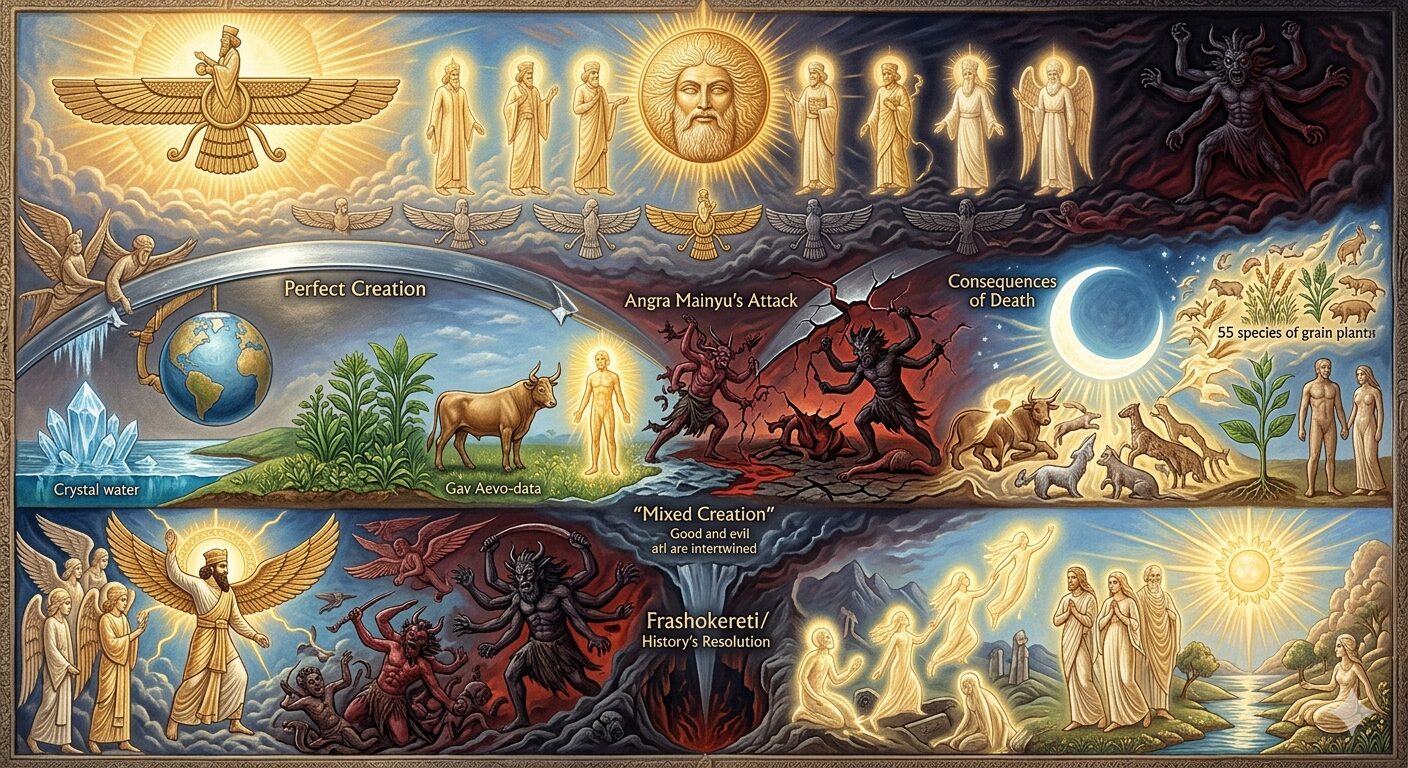
Ahura Mazda — the Wise Lord, the supreme being of light and truth — existed alone in infinite light. Opposite him existed Angra Mainyu (also called Ahriman) — the destructive spirit, the supreme being of darkness and lies. These two primal forces have existed eternally in opposition. Ahura Mazda knew that Angra Mainyu would attack, and he created the universe as the arena in which this cosmic conflict would be resolved. Ahura Mazda first created the Amesha Spentas — six divine emanations or holy immortals — each embodying a divine quality: Good Mind, Righteousness, Dominion, Devotion, Wholeness, and Immortality. He then created the spiritual forms (fravashi) of all things before creating their physical forms. The physical creation proceeded in six stages — first sky (of shining metal), then water, then earth, then plants, then the uniquely created bull (Gav Aevo-data — the first animal), then the first human (Gayomaretan — glowing like the sun). Angra Mainyu attacked this perfect creation. He broke through the sky, poisoned the water, scorched the earth, withered the plants, killed the first bull, and killed Gayomaretan. But from the death of the first bull came all the animals of the world — from its seed preserved in the purifying light of the moon, 55 species of grain and 55 species of healing plants grew. From the dying Gayomaretan's seed came a plant that grew into the first human couple — Mashya and Mashyana — who became the progenitors of the entire human race. The universe is now in a mixed state — Ahura Mazda's good creation interpenetrated by Angra Mainyu's corruption. History is the story of this conflict working itself toward a final resolution (Frashokereti) when Angra Mainyu will be defeated, the dead will be resurrected, and creation will be restored to its original perfect state.
- The cosmic dualism — a supreme good creator opposed by an equally ancient evil force — has no direct parallel in Hindu or Abrahamic traditions. Abrahamic traditions explicitly reject the idea of Satan as co-equal and co-eternal with God. Hinduism's closest parallel is the eternal conflict between Devas (gods) and Asuras (demons) though neither is identified as the ultimate source of creation
- Creation proceeding in six stages closely parallels Genesis's six days (Genesis 1:1-2:3) — Zoroastrian influence on Judaism during the Persian period (6th century BCE) is widely accepted by scholars
- The first bull's death producing all animal species parallels the Hindu Purusha Sukta where the sacrificed cosmic being's body produces all living things (Rigveda 10.90)
- The spiritual forms of all things existing before their physical creation parallels the Hindu concept of the unmanifest (avyakta) preceding manifest creation (Samkhya Karika) and the Abrahamic concept of the Torah/divine blueprint existing before creation (Midrash, Bereishit Rabbah 1:1)
- Zoroastrianism directly influenced the development of Satan as a figure in Judaism and Christianity — the concept of a cosmic adversary of God is believed by many scholars to have entered Jewish thought during the Babylonian exile when Jews lived under Persian Zoroastrian rule
6. Ancient Greek
The Theogony
Approximately 750 BCE written — Hesiod's Theogony and Works and Days
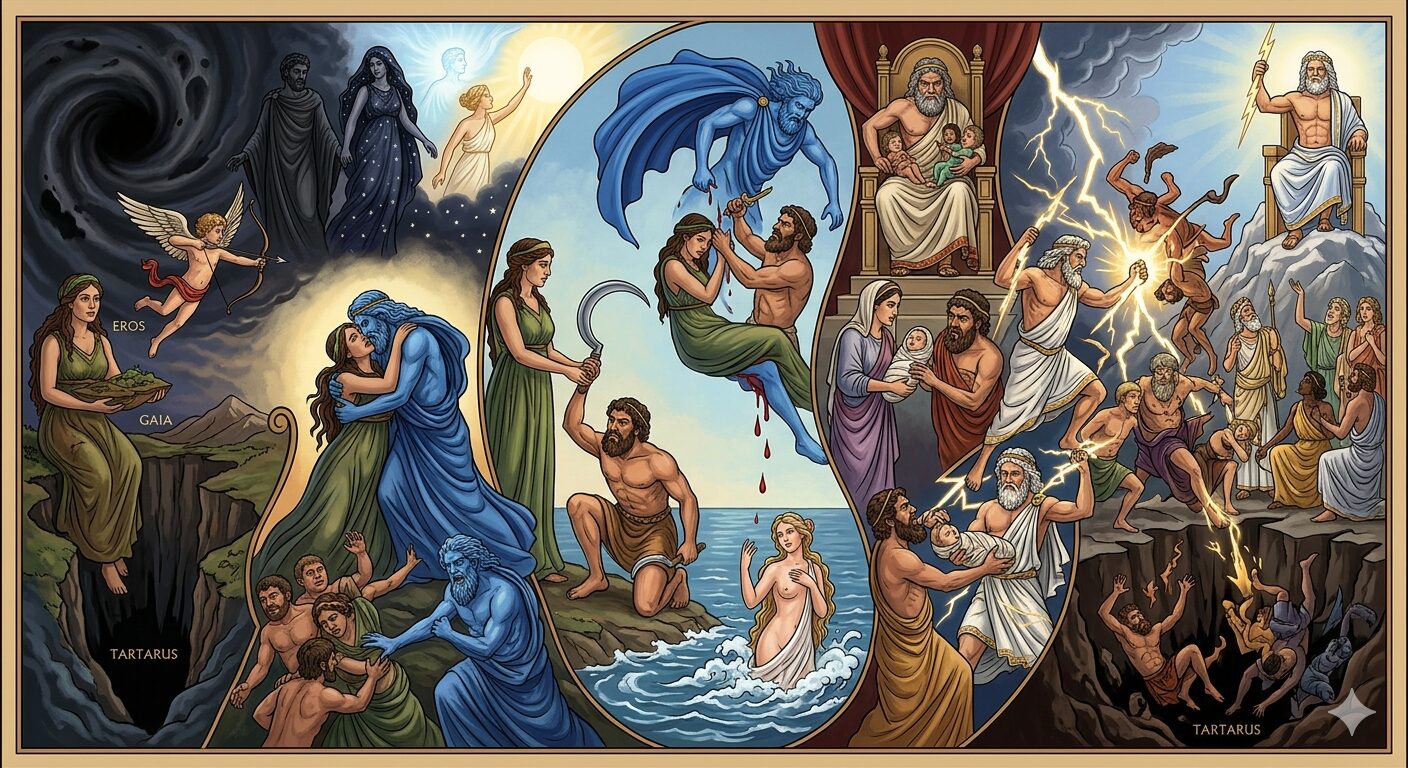
In the beginning was Chaos — not disorder but a vast yawning void or gap. From Chaos emerged Gaia (Earth), Tartarus (the deep abyss beneath the earth), Eros (desire/love — the force that drives creation), Erebus (darkness), and Nyx (night). From Erebus and Nyx came Aether (upper air/light) and Hemera (day). Gaia produced Ouranos (Sky) from herself without a partner. Ouranos covered Gaia completely — they were locked together. Their union produced the twelve Titans, three Cyclopes, and three Hecatoncheires (hundred-handed giants). Ouranos hated his children and pushed them back into Gaia's body as they were born, causing her enormous pain. Gaia gave her youngest Titan son Kronos a sickle. Kronos castrated Ouranos, separating sky from earth permanently. From Ouranos's blood falling into the sea Aphrodite was born. Kronos then ruled but swallowed each of his own children fearing a prophecy that he would be overthrown. His wife Rhea hid Zeus and gave Kronos a stone wrapped in cloth to swallow instead. Zeus grew up, returned, forced Kronos to disgorge his siblings, and led the Olympian gods in a ten-year war against the Titans. The Titans were defeated and cast into Tartarus. Zeus became supreme ruler of the cosmos.
Origin of Humans — Works and Days
The gods created five races of humans in succession. The first was the Golden Race — humans who lived like gods, without toil or sorrow, in abundance and peace. They died gently and became guardian spirits. The gods then made the Silver Race — lesser beings who lived long childhoods and brief adult lives, impious and ignorant. Zeus destroyed them. He then made the Bronze Race — violent, warlike men who destroyed each other. Then came the Race of Heroes — the great heroes of myth, the men of Troy and Thebes. Some went to the Isles of the Blessed after death. Finally Zeus made the Iron Race — the current humans, burdened with toil, suffering, and injustice, destined to decline further until the gods finally abandon them. The Titan Prometheus stole fire from the gods and gave it to humans. As punishment Zeus had Hephaestus fashion the first woman from clay — Pandora — and the gods each gave her a gift. She was sent to earth with a jar (pithos) containing all evils, miseries, and diseases. She opened it — releasing everything inside except Hope, which remained trapped. This is the Greek explanation for why the world contains suffering.
- Chaos as the primordial void before creation parallels the Hindu concept of the unmanifest void before creation (Rigveda 10.129) and the Abrahamic formless void (tohu vavohu, Genesis 1:2)
- The separation of sky (Ouranos) from earth (Gaia) by their own child parallels the Maori separation of Rangi (sky father) from Papa (earth mother) by their children, and the Egyptian separation of Nut from Geb by Shu — one of the most widespread creation motifs globally
- Five successive races of humans declining in quality closely parallels the Hindu four Yugas (Satya, Treta, Dvapara, Kali) with their progressive moral decline (Vishnu Purana 1.3, Manusmriti 1.67-86) — though Greek tradition has five ages and Hindu tradition four
- The first woman created from clay as a punishment parallels the creation of Eve in Genesis — in both cases the first woman's action results in suffering entering the human world, though the mechanisms and moral framings are very different
- Prometheus giving fire to humans against divine will parallels the serpent giving knowledge to humans against God's will in Genesis 3 — in both cases a being defies the divine order to give humans something the gods wanted to withhold
7. Yoruba (West African)
Estimated oral tradition 500 BCE and earlier — one of the world's largest indigenous religious traditions
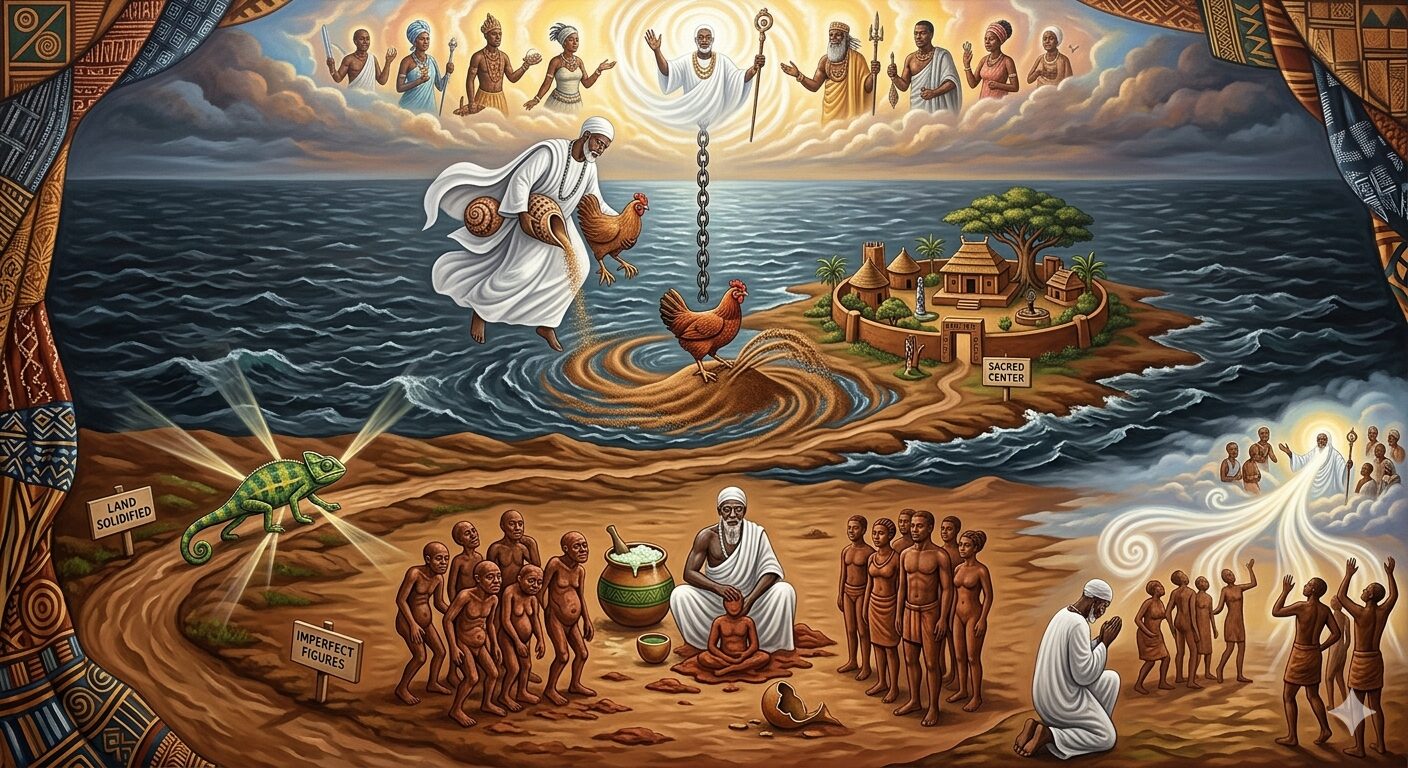
In the beginning there was only the sky above and a vast primordial ocean below. Olodumare — the supreme being, the source of all existence — dwelt in the sky. The sky was inhabited by the Orishas (divine beings), but there was no earth, no land, no solid ground anywhere. Olodumare called Obatala, the Orisha of creation and purity, and gave him the task of creating land. He gave Obatala a snail shell filled with sand, a five-toed hen, and a palm nut, and sent him down from the sky on a long iron chain. Obatala descended through the clouds and found only ocean below. He poured the sand from the snail shell onto the water. He placed the hen on the sand — the hen scratched and scattered the sand in all directions, and wherever the sand fell land appeared. This land became the earth. The first spot where the hen scratched became Ile-Ife — the sacred city at the center of the Yoruba world and the origin point of all existence. Olodumare then sent the chameleon to test whether the land was dry and solid enough. The chameleon walked carefully across it, testing each step — which is why chameleons still walk that way today. When the land was confirmed solid, Obatala began to form the bodies of humans from clay. He shaped them carefully — but he became tired and drank palm wine and grew drunk. The figures he shaped while drunk came out malformed — with bent limbs, hunched backs, or without proper features. When he sobered up Obatala was deeply remorseful. He swore never to drink again and took a sacred vow to be the protector and defender of all people born with physical differences, whom he considers his most beloved creations. Olodumare breathed life (emi) into all the figures Obatala had shaped, both the perfect and the imperfect, giving them all equally the divine breath of life.
- Land being created by scattering earth/sand onto primordial waters parallels the Siberian/Turkic earth-diver tradition and the Hindu Varaha avatar lifting earth from the cosmic ocean (Bhagavata Purana 3.13)
- Obatala forming humans from clay parallels God forming Adam from dust in Genesis 2:7 and Marduk creating humans from clay in the Babylonian Enuma Elish
- Olodumare breathing life (emi) into clay figures parallels God breathing the breath of life (nishmat chayyim) into Adam (Genesis 2:7) and Ahura Mazda animating Gayomaretan in Zoroastrian tradition
- The chameleon testing the land before full creation is a creative quality-assurance motif — paralleling God seeing that each day of creation was good (Genesis 1) before proceeding to the next
8. Dogon (West African)
Estimated oral tradition 500 BCE and earlier — one of the most complex cosmological systems of any indigenous tradition
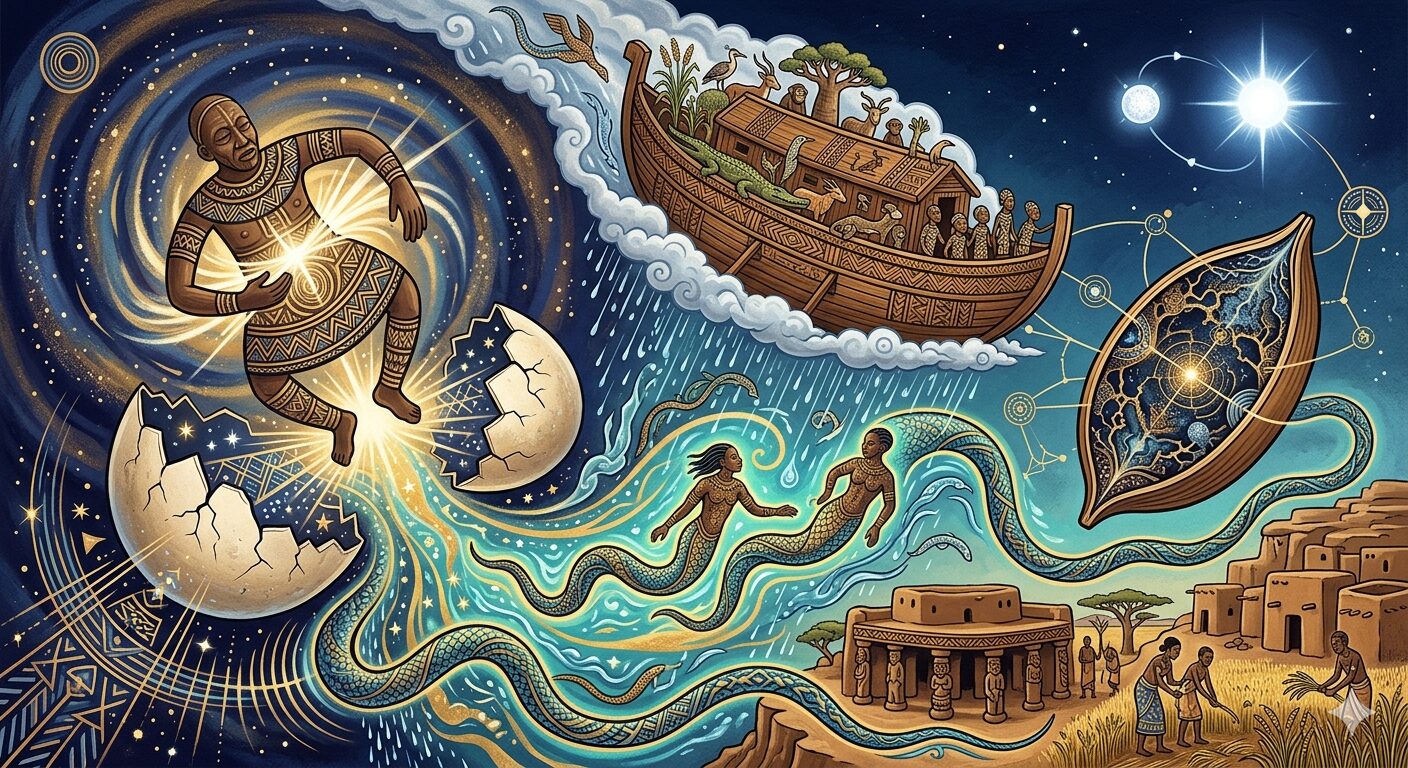
Amma — the supreme creator god — existed alone. He was a cosmic egg containing all the signs and patterns of what was to come — the entire blueprint of existence was contained within him in seed form. Amma began to spin. As he spun, the egg opened and the universe began to unfold from within him. The first act of creation was the Word — Amma spoke and the vibrations of his speech set the universe in motion. The entire cosmos was understood as the unfolding of Amma's original Word across time and space. From Amma emerged the Nommo — the first beings, born as twins. The Nommo were primordial water beings, associated with rivers, rain, and fertility. They were both human and serpentine in form and existed in the primordial waters. The Nommo became the ancestors and organizers of the universe. They stretched their bodies across the sky and became the firmament. They descended to earth on an ark with all the animals, plants, and the first human ancestors. The first humans were descended from these Nommo ancestors. The Dogon cosmology describes the universe as structured like a seed — specifically a seed of the Digitaria plant (known in the West as Fonio), which they called Po Tolo (the smallest thing). This seed contained everything — all matter, all patterns, all possibility. Creation was the germination and unfolding of this seed. The Dogon describe the star Sirius as having an invisible companion star with an extremely dense, heavy nature — a description of a white dwarf star that was not confirmed by Western astronomy until the 20th century, generating significant scholarly discussion about the origins of Dogon astronomical knowledge.
- Creation beginning as a cosmic egg containing all potential parallels the Hindu Brahmanda (cosmic egg) accounts (Chandogya Upanishad 3.19, Brahmanda Purana 1.1.3) and the Hermopolitan Egyptian egg from which Ra was born
- Creation through the primordial Word/vibration parallels the Hindu creation through Om and sacred sound (Mandukya Upanishad, Narada Purana 1.3) and the Memphite Egyptian creation through Ptah's speech
- The Nommo as primordial water beings who organize the cosmos parallels the Hindu Nagas (primordial serpent beings in the cosmic waters) and the Mesopotamian primordial beings Apsu and Tiamat
- Ancestors descending to earth on an ark with all species parallels Noah's ark (Genesis 6-9) and the Hindu Manu's boat carrying all species through the flood (Matsya Purana 1.1-35)
9. Chinese (Taoist & Folk Tradition)
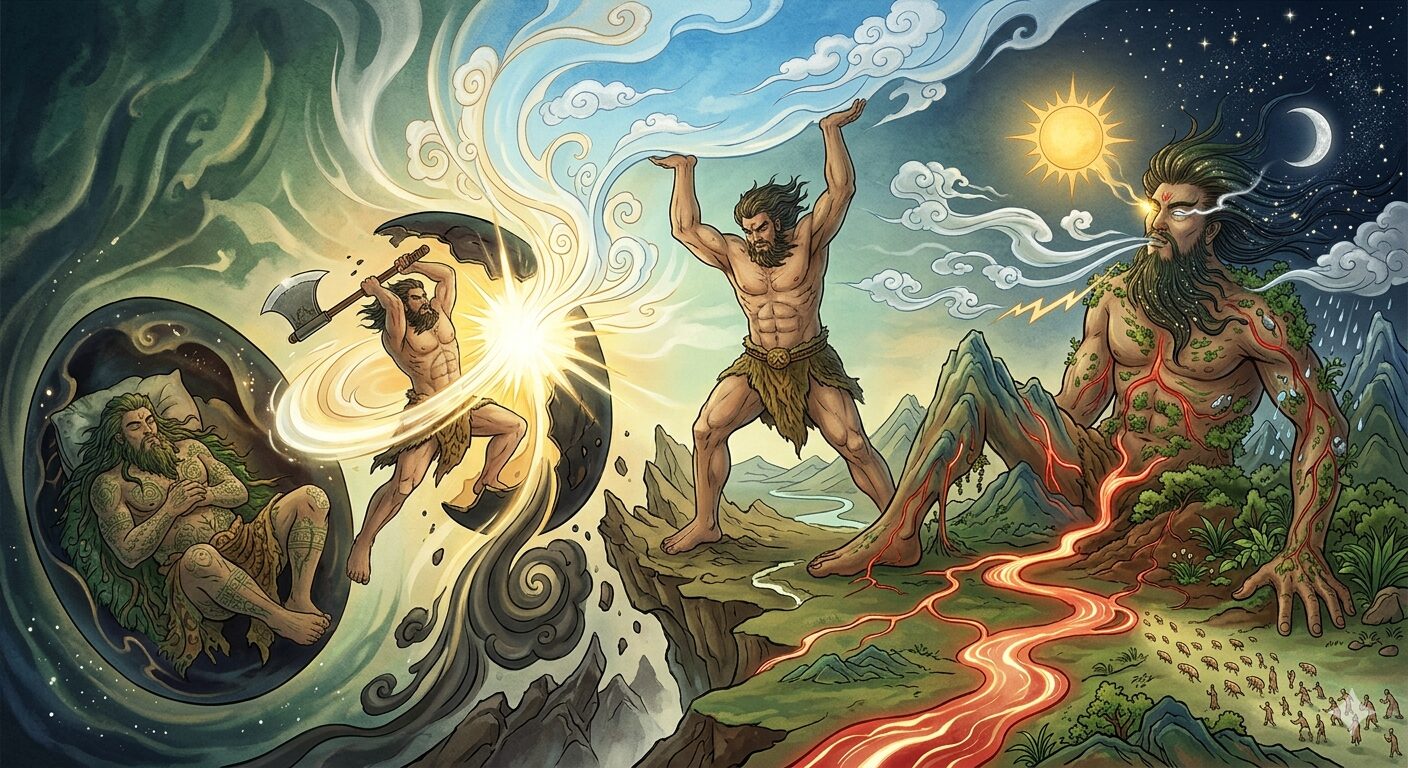
Pangu and the Cosmic Egg
Approximately 300 BCE written — though oral traditions considerably older
Before the universe existed everything was contained within a cosmic egg — a dark, swirling, undifferentiated mass of chaos. Inside this egg slept Pangu, the first being. He slept for 18,000 years. When he woke he found himself cramped in the darkness. He took a great axe and swung it — splitting the egg open. The light, clear elements (yang) rose and became the sky. The heavy, dark elements (yin) sank and became the earth. Pangu stood between them pushing sky and earth apart with his hands and feet, growing 3 meters taller each day to keep them from collapsing back together. He did this for another 18,000 years until sky and earth were permanently separated. When Pangu finally died his body became the world. His breath became the wind and clouds, his voice became thunder, his left eye became the sun, his right eye became the moon, his hair and beard became the stars, his limbs became the four mountains, his blood became the rivers, his veins became roads, his flesh became the soil, his skin and hair became plants and trees, his teeth and bones became minerals and rocks, his sweat became rain and dew. His last breath released fleas from his body — which became the human race in some versions of the story.
Nüwa Creates Humans
In a more widely told tradition, after the earth was formed the goddess Nüwa walked across it alone feeling lonely. She stopped by a river and looked at her reflection. She scooped up some yellow clay and shaped it into a small figure resembling herself. When she placed the figure down it came to life, dancing and singing. She continued making figures all day but it was slow work — there were too many to make individually. She dipped a rope into the mud and swung it around — wherever drops of mud fell, they became humans. The figures she made carefully by hand became the nobles and wealthy. The mud drops from the rope became the common people. Nüwa also repaired the sky when a great pillar supporting it broke — she melted stones of five colors to patch the hole, cut off a giant tortoise's legs to use as new sky pillars, and killed the black dragon causing floods on earth.
- Pangu's body becoming the world after death closely parallels the Hindu Purusha Sukta where the sacrificed cosmic being's body becomes every component of the universe (Rigveda 10.90) — one of the most striking cross-cultural parallels in world mythology
- The cosmic egg containing chaos before creation parallels the Hindu Brahmanda, the Egyptian Hermopolitan egg, and the Dogon cosmic egg tradition
- Nüwa creating humans from clay parallels Genesis 2:7 (Adam from dust), the Babylonian Enuma Elish, Obatala in Yoruba tradition, and the Inca Viracocha — clay as the material of human creation appears in virtually every world tradition
- The separation of yin (earth/dark/heavy) and yang (sky/light/clear) parallels the Hindu separation of Purusha (pure consciousness) and Prakriti (matter) in the Samkhya framework and the Zoroastrian separation of light (Ahura Mazda) and darkness (Angra Mainyu)
- Nüwa repairing a broken sky parallels the Hindu account of cosmic disruptions being repaired by divine avatars — specifically Vishnu's interventions to restore cosmic order
10. Norse / Germanic
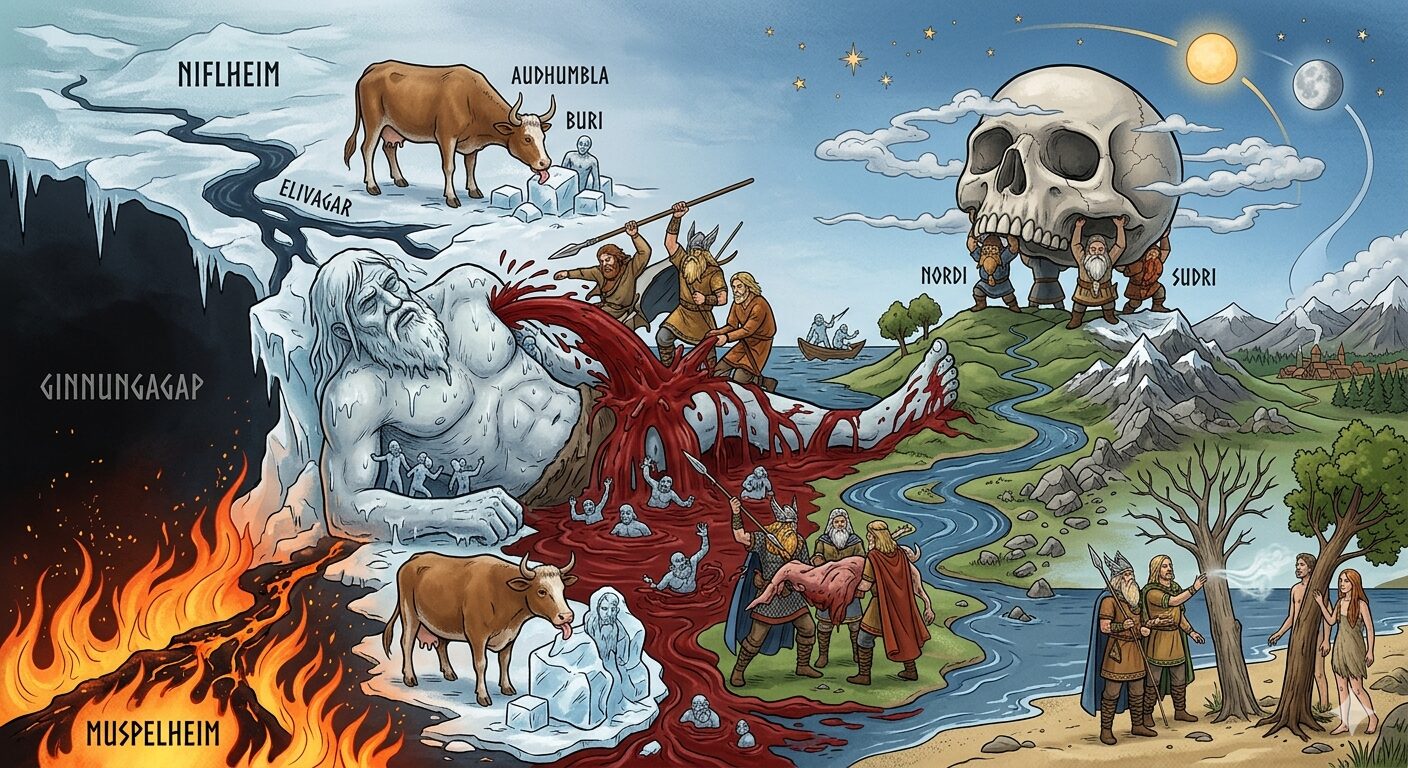
The Beginning — Ginnungagap
Oral tradition estimated 200 CE, written in the Prose Edda and Poetic Edda approximately 1,200 CE
Before anything existed there was Ginnungagap — a vast, silent void. To the north of this void was Niflheim, a region of primordial ice and cold, filled with rivers of frozen water. To the south was Muspelheim, a region of primordial fire. The rivers of Niflheim flowed into the void and froze. The heat from Muspelheim reached across the void and began to melt the ice. From the melting ice emerged the first being — Ymir, a giant of immense size. As Ymir slept he sweated — from his left armpit emerged a male and a female, and from his legs together emerged a son. These were the first frost giants. From the melting ice also emerged Audhumbla — a great cow. She nourished Ymir with her milk. She herself fed by licking the salty ice blocks. As she licked, a figure emerged from the ice over three days — first hair, then a head, then a full being named Buri. Buri's son Borr married a giantess named Bestla and had three sons — Odin, Vili, and Ve.
Creation of the World
Odin, Vili, and Ve killed Ymir. So much blood poured from his body that it drowned all the frost giants except two who survived to repopulate the giant race. Odin and his brothers carried Ymir's body to the center of Ginnungagap. From his flesh they made the earth. From his blood they made the seas and rivers. From his bones they made mountains. From his teeth and broken bones they made rocks and pebbles. From his skull they made the sky, held up at four corners by four dwarves — Nordi, Sudri, Austri, and Vestri (North, South, East, West). From his brain they made clouds. From his hair they made trees. They gathered sparks and embers from Muspelheim and scattered them across the sky — some fixed as stars, others given paths to move as the sun and moon.
Origin of Humans
Odin and his brothers were walking along the seashore and found two trees — an ash and an elm (some versions say an ash and a vine). They were lifeless. Odin gave them breath and life. Vili gave them intelligence and the power of movement. Ve gave them senses, speech, blood, and color. The ash became the first man — Ask. The elm became the first woman — Embla. The gods gave them Midgard (the middle world) as their home.
- Ymir's body becoming the world closely parallels the Hindu Purusha Sukta (Rigveda 10.90) and the Chinese Pangu tradition — in all three cases the cosmos is formed from the body of a primordial giant
- The primordial void (Ginnungagap) between opposing forces of fire and ice parallels the Zoroastrian opposition of Ahura Mazda's light and Angra Mainyu's darkness as the pre-creation condition
- Humans created from trees is unique to Norse tradition — though the idea of humans made from natural material and animated by divine breath parallels Genesis 2:7, Yoruba, and Chinese traditions
- Four dwarves holding up the sky at four corners parallels the Hindu concept of the four directions being assigned their guardian gods (Dikpalas) at creation
11. Japanese Shinto
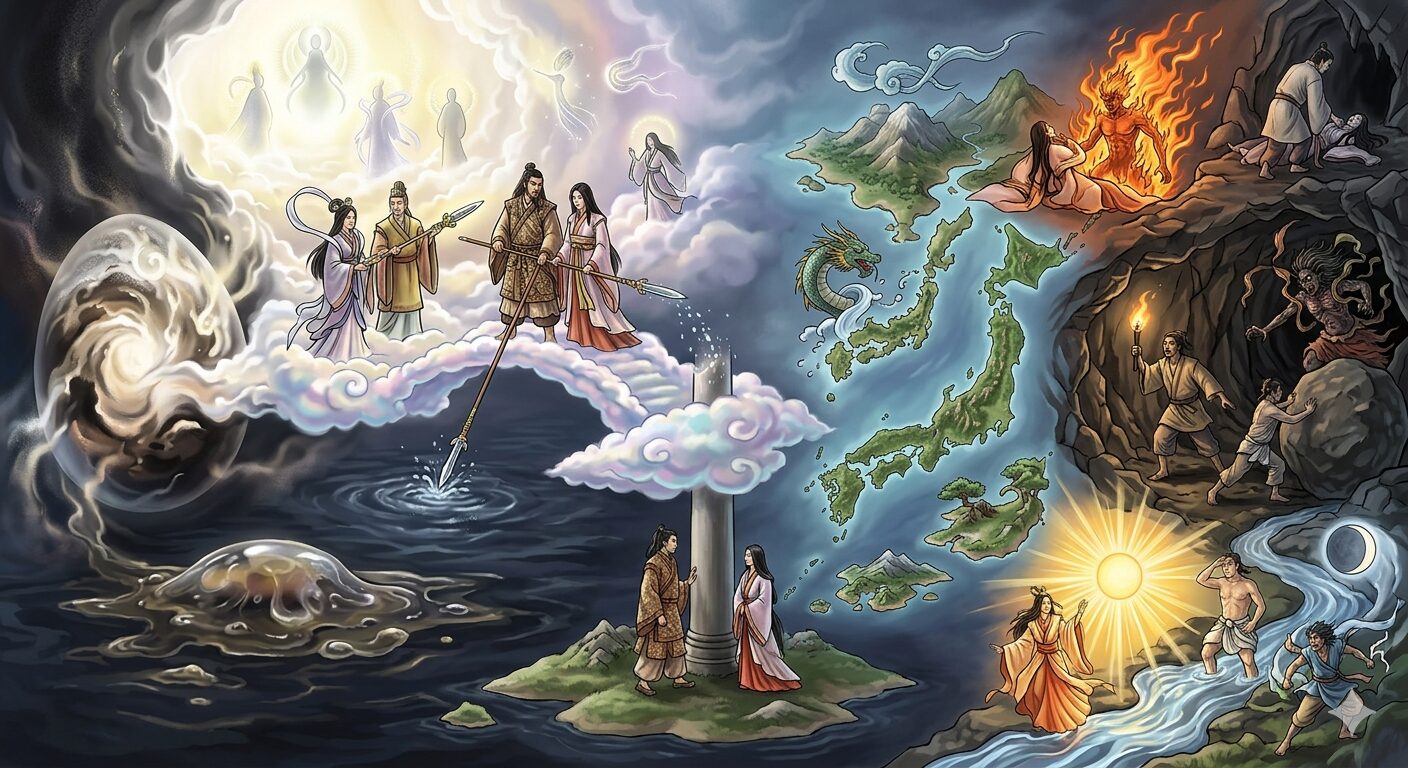
Written approximately 700 CE in the Kojiki and 720 CE in the Nihon Shoki — oral tradition considerably older
In the beginning was chaos — a formless, egg-like mass. The lighter, clearer elements rose and became the High Plain of Heaven (Takamagahara). The heavier elements sank and eventually solidified into earth, though at first the earth was young and drifted like oil on water, floating like a jellyfish. From the High Plain of Heaven three invisible, solitary deities came into being spontaneously — Amenominakanushi (Lord of the August Center of Heaven), Takamimusubi, and Kamimusubi. These were followed by two more solitary deities. All five were formless and genderless and had no creative role. Then came the first male-female pair — Izanagi (He Who Invites) and Izanami (She Who Invites). They were given a jeweled spear and commanded by the heavenly gods to create the land. They stood on the Floating Bridge of Heaven and dipped the spear into the ocean below, churning it. When they lifted the spear, drops of brine fell from its tip and solidified into the first island — Onogoro. They descended to this island and performed the marriage ritual — walking around a pillar in opposite directions and speaking to each other when they met. From their union Izanami gave birth to the islands of Japan — each island being literally born as a child of Izanagi and Izanami. Eight major islands were born first, then six more. After the islands they gave birth to the gods of wind, sea, rivers, mountains, trees, and plains. Finally Izanami gave birth to the fire god Kagutsuchi — whose heat burned her as he was born and she died from her injuries. This was the first death. Izanagi was grief-stricken and went to Yomi (the underworld) to retrieve Izanami. She told him not to look at her. He could not resist and lit a fire — seeing her body rotted and covered with maggots and thunder gods. He fled. Izanami, enraged and shamed, chased him. He escaped and blocked the entrance to Yomi with a great boulder — permanently separating the world of the living from the world of the dead. In his grief Izanagi washed himself in a river. As he washed, gods were born from each piece of clothing and each body part he washed — including Amaterasu (goddess of the sun) born from washing his left eye, Tsukuyomi (god of the moon) from his right eye, and Susanoo (god of storms) from his nose.
- The jeweled spear churning the ocean to create land parallels the Hindu Samudra Manthan (churning of the cosmic ocean) with Mount Mandara (Mahabharata, Adi Parva 17) and the Siberian earth-diver retrieving land from primordial waters
- The islands of Japan being literally born as children of divine parents parallels the Hindu account of all beings being born as children of Brahma
- Amaterasu born from washing the left eye and Tsukuyomi from the right parallels the Hindu Bhagavata Purana where the sun was born from Vishnu's right eye and the moon from his mind (Bhagavata Purana 2.5.35)
- The first death occurring during the act of creation itself (Izanami dying while giving birth) parallels the Zoroastrian account where Angra Mainyu kills the first beings during the creative process
12. Māori / Polynesian
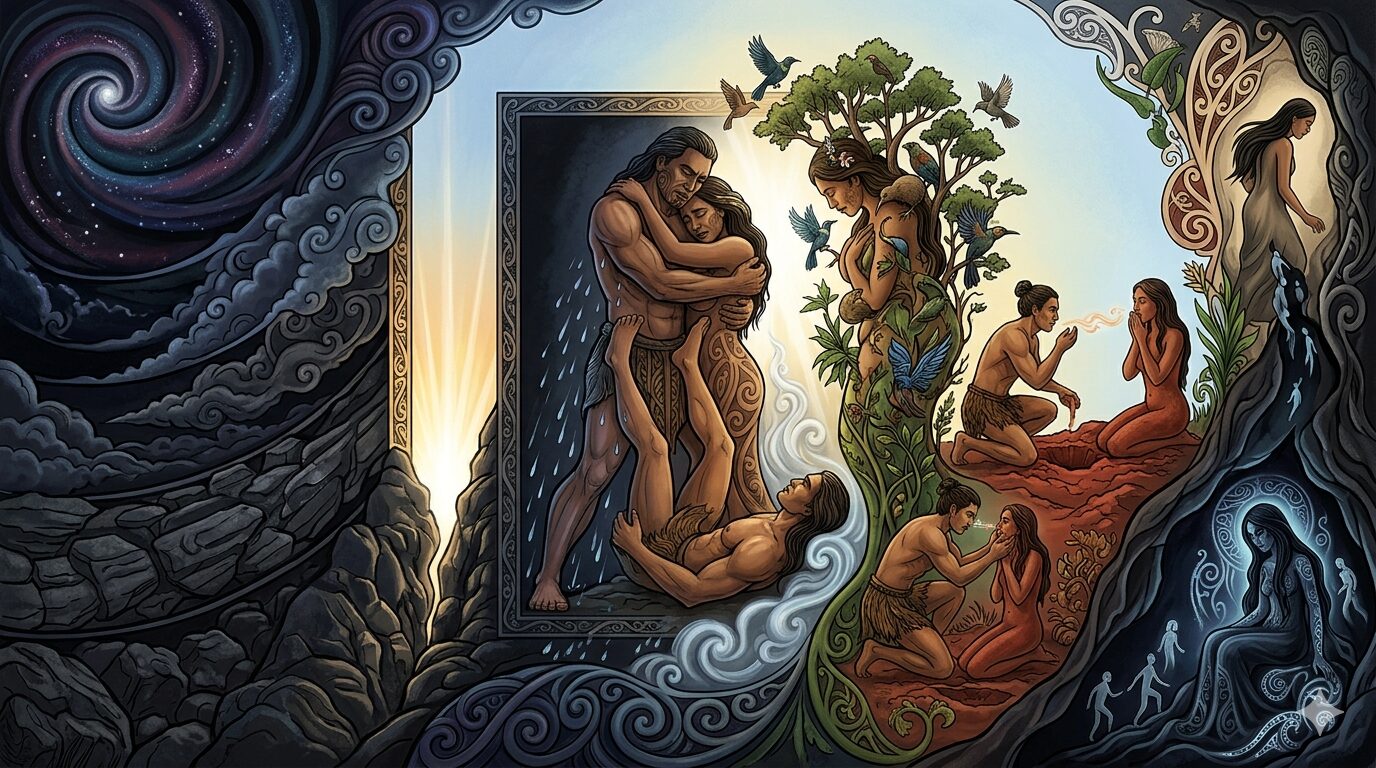
Te Kore and Te Pō — The Void and the Night
Oral tradition estimated 1,000 CE, written after European contact
In the beginning was Te Kore — the void, the nothingness, the state of pure potential. But Te Kore was not simple emptiness — the Māori tradition describes multiple stages of Te Kore, each with a name: Te Kore-tē-whiwhia (the void of not possessing), Te Kore-tē-rawea (the void of not feeling), Te Kore-i-ai (the void of not being). From Te Kore came Te Pō — the darkness, the night. Again multiple stages of Te Pō, each deeper and more developed than the last, representing the slow gathering of potential toward existence. From the deepest darkness came light — Te Ao (the world of light).
Ranginui and Papatūānuku — Sky Father and Earth Mother
From the primordial darkness emerged Ranginui (Sky Father) and Papatūānuku (Earth Mother) locked in a permanent embrace. They were pressed together so tightly that no light could enter and their children — the gods born between them — lived in total darkness cramped between their parents' bodies. The children debated what to do. Tāne (god of forests and birds) proposed separating their parents. He lay on his back, placed his shoulders against Papatūānuku (earth) and pushed his feet upward against Ranginui (sky), pushing with enormous effort until they were forced apart. Light flooded in for the first time. The tears of Ranginui falling for his lost wife became rain. The sighs of Papatūānuku became mist rising from the earth. With light now in the world Tāne clothed his mother Papatūānuku with trees and plants and birds. Tāne then wished to create a human being. He shaped a figure from red earth (uku) at Kurawaka (the sacred place). He breathed life into the figure's nostrils — she sneezed and became alive. This was Hineahuone — the earth-formed woman, the first human. Tāne then had a daughter with Hineahuone — Hinetītama. Tāne later married his own daughter Hinetītama. When she discovered this she fled to the underworld in shame and became Hine-nui-te-pō — the goddess of death. All humans die and descend to her.
- Te Kore (the void of pure potential before creation) parallels the Hindu concept of avyakta (the unmanifest) before creation (Samkhya Karika) and Rigveda 10.129's state where neither being nor non-being existed
- The separation of Sky Father and Earth Mother by their children is one of the most significant cross-cultural parallels — directly paralleling the Greek separation of Ouranos from Gaia, the Egyptian separation of Nut from Geb, and the Quran's joined heavens and earth being split apart (Al-Anbiya 21:30)
- Tāne shaping a human from earth and breathing life into her nostrils is among the closest parallels to Genesis 2:7 anywhere — and to the Yoruba Olodumare breathing emi into clay figures
- The origin of death coming from within the family of gods (Hinetītama becoming the goddess of death) parallels the Zoroastrian account where Angra Mainyu introduces death and the Shinto account where Izanami becomes the ruler of the underworld
13. Aztec / Mesoamerican
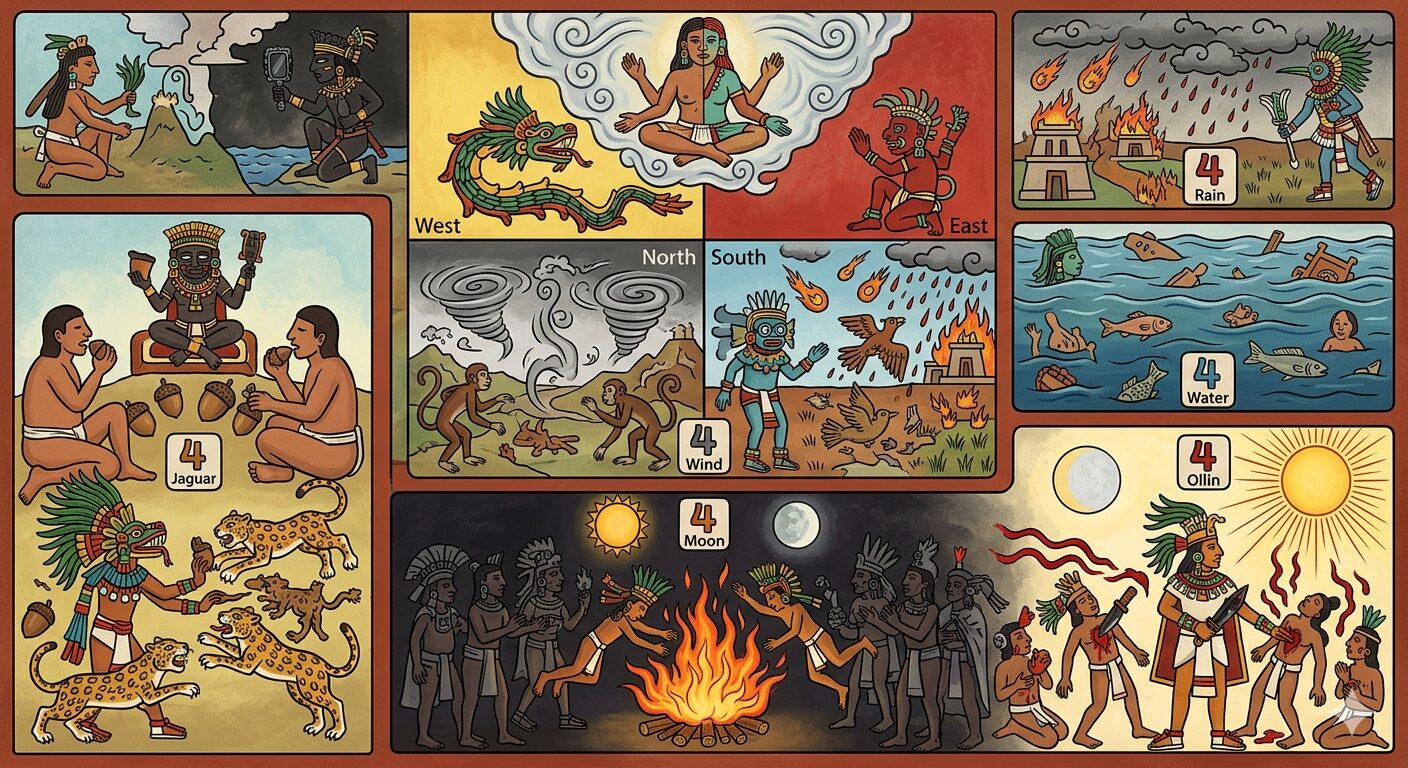
The Five Suns — Creation Cycles
Written approximately 1400 CE — oral tradition considerably older. Primary sources: Leyenda de los Soles, Historia de los Mexicanos por sus Pinturas, Popol Vuh (Mayan)
Before this universe existed there was only darkness and the primordial dual god Ometeotl — a supreme being who was simultaneously male and female, existing in Omeyocan (the thirteenth heaven). From Ometeotl were born four children — each associated with a direction and a color: Quetzalcoatl (the Feathered Serpent, associated with wind and the west), Tezcatlipoca (the Smoking Mirror, associated with darkness and the north), Xipe Totec (the Flayed One, east), and Huitzilopochtli (Hummingbird of the South). These four gods created the universe — sea, earth, time, and the lower heavens — but there was no sun and no humans yet. The universe has existed through five successive creations, each destroyed and replaced. The First Sun — Nahui Ocelotl (Four Jaguar) — was ruled by Tezcatlipoca. Humans in this age were giants who ate acorns. Quetzalcoatl destroyed it by causing jaguars to devour everything. The Second Sun — Nahui Ehecatl (Four Wind) — was ruled by Quetzalcoatl. Tezcatlipoca destroyed it by causing hurricanes. The humans turned into monkeys. The Third Sun — Nahui Quiahuitl (Four Rain) — was ruled by Tlaloc (rain god). It was destroyed by a rain of fire. Humans turned into birds. The Fourth Sun — Nahui Atl (Four Water) — was ruled by Chalchiuhtlicue (goddess of water). It was destroyed by a great flood lasting 52 years. Humans turned into fish. The Fifth Sun — Nahui Ollin (Four Movement) — is the current age. The gods gathered at Teotihuacan in total darkness. Two gods sacrificed themselves by leaping into a great fire — one became the sun, the other the moon. But the sun and moon did not move. The gods realized the sun required blood to move. All the gods sacrificed themselves — Quetzalcoatl cut out their hearts and offered their blood. The sun finally moved. This is why the Aztecs believed human sacrifice was necessary to keep the sun moving and prevent the destruction of the fifth and final universe.
The Mayan Account — Popol Vuh
The Mayan creators Heart of Sky and the Feathered Serpent existed in the primordial darkness with only the sky above and the sea below. They spoke — and the earth rose from the water at their word. They then tried to create humans who could speak their names and worship them. First they made humans from mud — they dissolved and fell apart. They destroyed them. Then they made humans from wood — these could speak but had no soul, no memory, and no recognition of their creators. They were destroyed in a flood. The survivors became monkeys. Finally the gods made humans from white and yellow maize — grinding it and mixing it with water. These humans could speak, think, see, and worship properly. They were the first true humans.
- Multiple successive failed creations before the current successful one parallels the Talmudic tradition of God creating and destroying multiple worlds before this one (Tractate Hagigah 12a, Midrash Bereishit Rabbah 3:7)
- The sun requiring blood/sacrifice to move parallels the Hindu concept of the cosmic sacrifice being necessary for creation to continue (Purusha Sukta, Rigveda 10.90) — creation sustained by sacrifice is shared across traditions
- Humans made from maize (Mayan) is unique — though the general concept of humans made from a natural substance specific to their environment is universal
- Failed attempts to create humans before the current version parallels the Hindu account in the Bhagavata Purana where Brahma creates beings multiple times before succeeding (Bhagavata Purana 3.12)
14. Inca / Andean
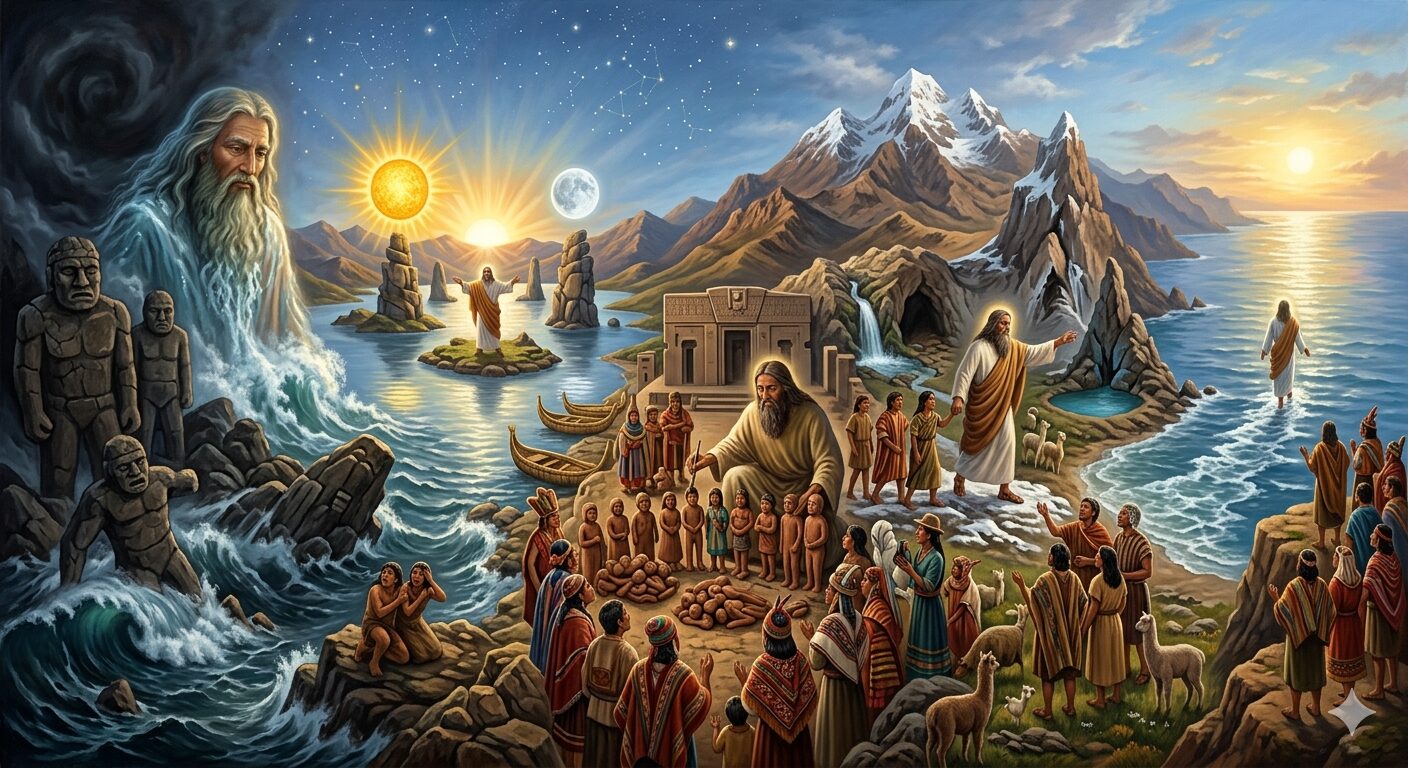
Written approximately 1550 CE by Spanish chroniclers from oral accounts — oral tradition considerably older
In the beginning there was only darkness. Viracocha — the supreme creator god, whose name means roughly "foam of the sea" or "lord of all creation" — existed before everything. He rose from the depths of Lake Titicaca (the great highland lake between present-day Peru and Bolivia, the highest navigable lake on earth) and began to create. First Viracocha created the earth and sky. He then created a race of beings — giants — in the darkness, sculpting them from stone. But these first beings had no light to live by and displeased him, so he flooded the world and destroyed them. Only two survived who would become his servants. Viracocha then created the sun, moon, and stars — calling them out of the islands in Lake Titicaca. He commanded the sun to rise, the moon to follow, and placed the stars in the sky as guides for humans. He then created the current race of humans — smaller than the giants. He fashioned them from clay at Tiwanaku (the great sacred city near Lake Titicaca), painting on their clothes, their languages, their songs, and their hair styles before giving them life. He created each nation of people differently — each with their own appearance, language, customs, and designated homeland. He then sent these peoples underground. He traveled across the land calling each people out from springs, caves, mountains, and lakes in the specific lands he had designated for them — which is why each Andean people has a specific pacarisca (place of origin) from which their ancestors first emerged into the world. Viracocha walked across the entire Andean world performing these acts, teaching his people how to live, then disappeared into the ocean at the coast of Ecuador, walking across the water.
- A first creation of giants that is destroyed before the current human creation parallels the Aztec Five Suns tradition, the Norse frost giants preceding humans, the Greek creation of Titans, and the Mesopotamian account of the first beings
- The creator walking across the land and calling each people out from specific sacred geographic locations parallels the Aboriginal Australian Songlines tradition where Ancestor beings walked across the land singing each place into existence
- Humans fashioned from clay and given life by the creator parallels Genesis 2:7, Yoruba, Chinese Nüwa, Babylonian, and Māori traditions — this is the single most cross-culturally universal origin of humans motif
- The creator disappearing into the ocean after completing creation parallels the Hindu concept of Brahma returning to rest inside Vishnu at the end of each cosmic cycle
15. Native American
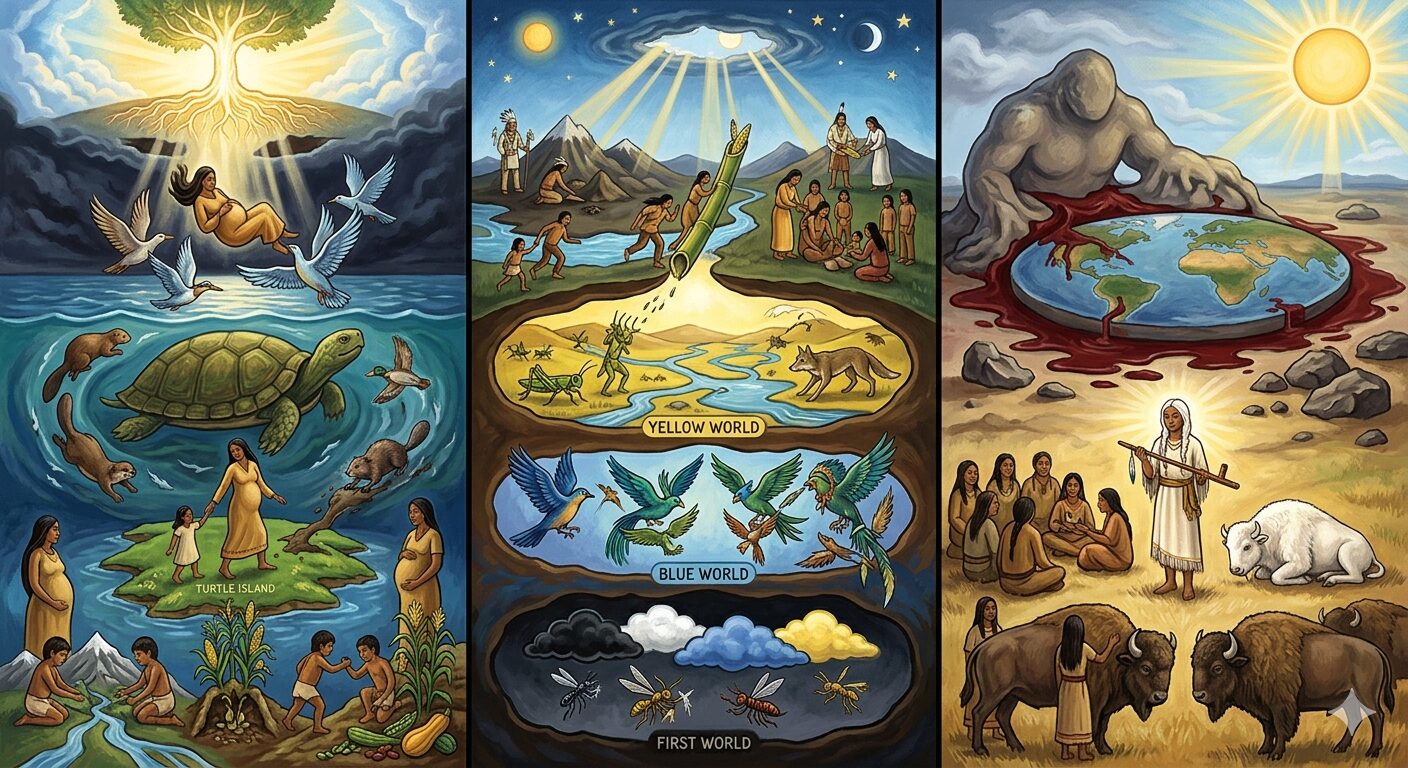
Oral traditions estimated 10,000+ BCE
15a. Haudenosaunee / Iroquois — Sky Woman
Before the earth existed there was only a great ocean below and a sky world above. In the sky world lived people much like humans. A great tree stood at the center of the sky world — the Tree of Light, whose roots glowed and illuminated everything. A chief of the sky world uprooted this tree, creating a hole. His pregnant wife leaned over to look through the hole and fell — or was pushed — through it into the darkness below toward the endless water. Water birds saw her falling. They flew up together and caught her on their spread wings, breaking her fall. The great turtle came up from the ocean depths and offered his back as a place for her to rest. The animals dove down into the ocean one by one trying to bring up earth from the bottom — the beaver, the otter, the duck — all failed. Finally the muskrat dove down and came back barely alive, but in his clenched paw was a small amount of mud from the ocean floor. This mud was placed on the turtle's back and expanded into the earth — which is why the earth is sometimes called Turtle Island in these traditions. Sky Woman walked the earth and it grew larger with each step. She gave birth to a daughter. Her daughter later became pregnant — by the West Wind in some versions — and gave birth to twin boys. The right-handed twin was born normally. The left-handed twin forced his way out through his mother's armpit, killing her. From the right-handed twin's nature came all good and useful things. From the left-handed twin came all difficult and dangerous things. The right-handed twin shaped mountains and rivers gently. The left-handed twin made them jagged and difficult. Together their conflict shaped the world into its current form. Sky Woman died and was buried — from her body grew the plants that sustain humans: corn, beans, and squash (the Three Sisters).
15b. Navajo — The Emergence
The Navajo origin tradition describes a series of underworlds through which the Holy People (divine beings) and the first humans traveled upward before reaching the current world. In the First World (Black World) there was only darkness and four clouds — black, white, blue, and yellow — and small insect-like beings. The beings fought among themselves and were forced to travel upward to escape. In the Second World (Blue World) they found blue and green birds and feathered beings. Again conflict arose and they were forced upward. In the Third World (Yellow World) they found more beings including Grasshopper People, and for the first time they found water — four rivers and a great lake. Here Coyote secretly stole a water monster's baby, causing a great flood. The people fled upward through a hollow reed to escape the rising waters. They emerged into the Fourth World — the current world — through a hole in the sky. The earth was soft and dark. The Holy People shaped the mountains and placed them at the four sacred directions. They set the sun, moon, and stars in the sky. They stretched the sky above the earth and pinned it down with sunbeams. They created the first man (*Nihookáá' Dinéé*) from two ears of corn — a white ear and a yellow ear — breathing wind into them. Changing Woman (*Asdzáá Nádleehé*) — the most important of the Holy People, who represents the cycles of the natural world — created the four original Navajo clans from her own body, rubbing skin from different parts of herself to create the first people of each clan.
15c. Lakota — The Buffalo People & Inyan
In the beginning there was only Inyan — the Rock, the first being, who contained all power (wakan) within himself. He had no shape and no form that could be seen. He desired to use his power — but power can only be exercised over something. There was nothing. So Inyan spread himself out, giving of his own substance to create the disk of the earth — Maka. As he spread himself out his blood flowed from him and became the waters surrounding the earth. In giving so much of himself his power diminished and he shrank into hard stone — which is why rocks are the oldest things on earth. From the combination of Inyan's power and Maka's earth emerged the sky (Skan) and the sun (Wi). These four — Inyan, Maka, Skan, and Wi — are the original beings, the superior gods (Taku Wakan Kin). White Buffalo Calf Woman brought the sacred pipe to the Lakota people — she appeared first as a young woman and taught the people their sacred ceremonies, their way of life, and their relationship to all living things. As she left she rolled on the ground and transformed into a white buffalo calf. The buffalo nation itself is considered the older sibling of humans — the buffalo came first and agreed to give their lives to sustain humans. Humans and buffalo are bound in a sacred reciprocal relationship that structures the entire Lakota understanding of the origin of their way of life.
- The earth-diver motif (animals diving to bring earth from the ocean bottom) is one of the most widespread creation motifs on earth — directly paralleling the Siberian/Turkic shamanic tradition and Vishnu's Varaha avatar (Bhagavata Purana 3.13)
- Sky Woman falling from an upper world through a hole parallels the Hindu concept of beings descending from higher realms into the physical world, and the Abrahamic fall from Eden/heaven to earth
- The world growing on a turtle's back is a Native American specific cosmological image — though the concept of the earth resting on a divine being parallels the Hindu earth resting on the cosmic serpent Shesha
- Good and difficult aspects of the world coming from opposing twin creators parallels Zoroastrian dualism (Ahura Mazda and Angra Mainyu) and the Norse account of Odin and his brothers creating both the useful and difficult aspects of the world
- Emergence from a series of underworlds upward into the current world parallels the layered cosmic worlds in Hindu cosmology (fourteen worlds from Patala to Brahmaloka) and the Aztec concept of multiple previous worlds preceding the current one
- Humans created from corn (ears of corn becoming the first man and woman) parallels the Mayan Popol Vuh where humans are made from maize — both Mesoamerican and North American traditions connect human origin to this specific plant
- The great flood caused by theft/transgression compelling movement upward parallels the Hindu Matsya Purana flood (Manu's boat) and the Abrahamic Noah's flood — though the Navajo flood is caused by Coyote's theft rather than human wickedness
- Changing Woman creating clans from her own body parallels Brahma creating beings from different parts of his own body (Bhagavata Purana 3.12) and Purusha's body generating different categories of beings (Rigveda 10.90)
- Inyan diminishing himself by giving of his own substance to create the world parallels the Hindu concept of Brahma or Prajapati giving of their own self to create (Shatapatha Brahmana 11.5.8) and the Zoroastrian concept of Ahura Mazda's emanations being aspects of himself
- The blood of the original being becoming the waters of the world parallels the Babylonian Enuma Elish where Tiamat's body becomes the world and her blood flows as rivers, and the Norse account where Ymir's blood becomes the seas
- White Buffalo Calf Woman appearing as a human before transforming into an animal parallels the Hindu avatar tradition — divine beings taking human or animal form to interact with and teach humans
- The reciprocal sacred relationship between humans and a specific animal species (buffalo) as the foundational structure of human existence has no direct parallel in Hindu or Abrahamic traditions — it is a distinctly indigenous framework that places humans within nature rather than above it
16. Hawaiian — The Kumulipo
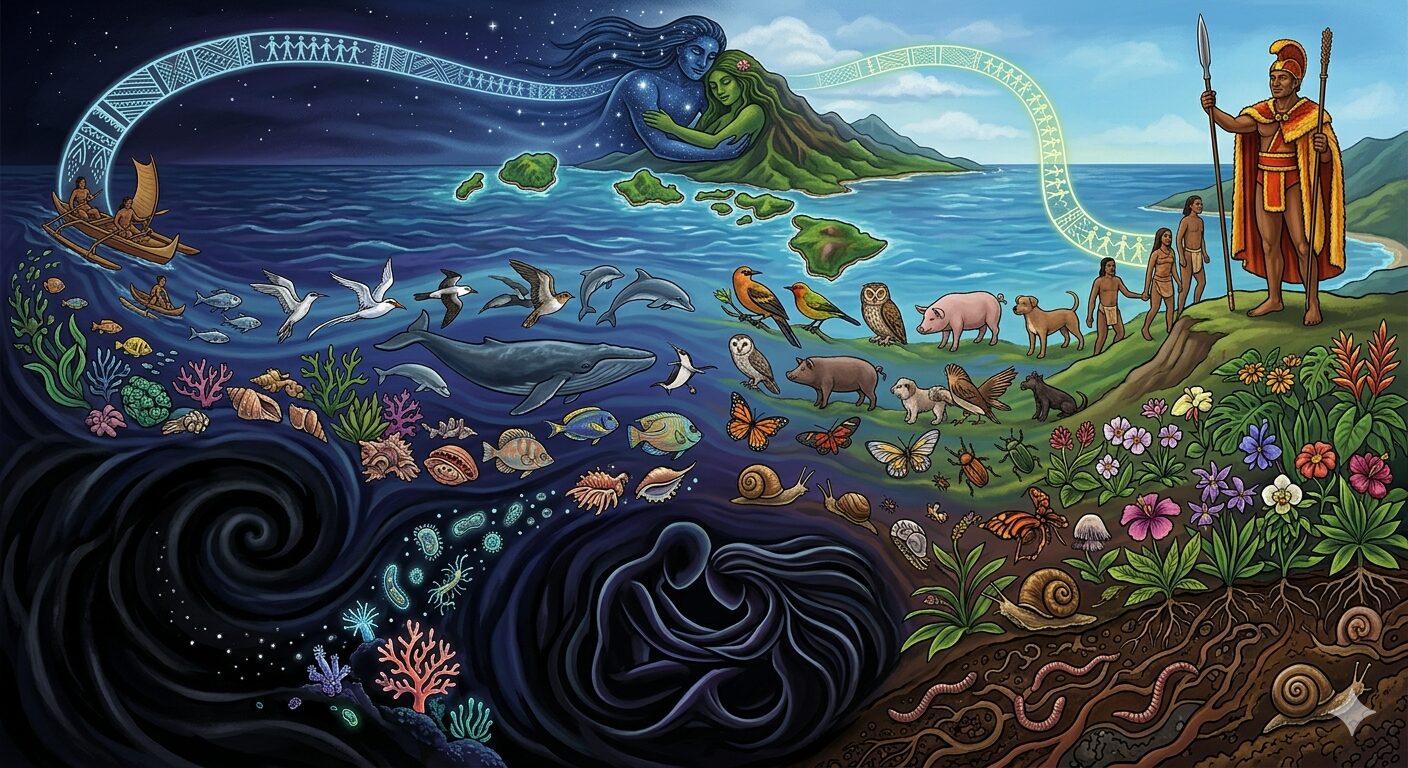
Written approximately 1700 CE — oral tradition considerably older. One of the most elaborate creation chants anywhere.
The Kumulipo is an 1,800-line creation chant composed in the Hawaiian oral tradition. Its name means "the source of deepest darkness" or "origin from the depths." It was both a cosmological account and a genealogical chant — tracing the origin of the universe all the way forward to the Hawaiian royal family, connecting a chief's bloodline directly to the first moment of creation. In the beginning was Po — the deep primordial darkness, formless and without boundary. From within Po stirred the first movement. The Kumulipo describes creation not as a single act but as a long slow process of emergence — like germination. The chant describes the universe as beginning in the deep sea and working upward through increasing complexity — coral polyps first, then shellfish, then fish, then plants, then insects, then birds, then animals, then finally humans. Each category of sea creature has a corresponding land creature born alongside it — the sea urchin and the pipipi (land snail), the coral and the earthworm — creation proceeding in paired opposites between sea and land throughout. The first parents of all things were Kumulipo (male, associated with darkness) and Pō'ele (female, associated with darkness). Their union produced the first living things in the sea. As creation progressed through its sixteen sections (wa) each era produced new categories of beings of increasing complexity — the progression moving from simple oceanic organisms through all forms of life to humans in a sequence that modern readers have noted resembles an evolutionary progression from sea to land to complex life. The gods Wākea (Sky Father) and Papa (Earth Mother) are the divine parents of the Hawaiian islands — each island was born as their literal child, as in the Māori tradition. Humans descended from these divine parents through an unbroken genealogical line. The chant ends with the birth of a specific historical chief — the entire universe exists as the ancestral backstory of the Hawaiian royal lineage.
- Creation beginning in total primordial darkness (Po) and slowly emerging into light parallels the Māori Te Kore and Te Pō, the Norse Ginnungagap, and the Abrahamic darkness before God's first act (Genesis 1:2)
- Creation proceeding from simpler to more complex life forms (sea creatures first, then land creatures, then humans) is the most striking parallel to modern evolutionary biology of any ancient creation narrative — also paralleling Genesis's sequence of creation from simple to complex on successive days
- Sky Father and Earth Mother as divine parents of the land parallels the Māori Ranginui and Papatūānuku exactly — both are Polynesian traditions sharing a common ancestral origin
- The universe as the genealogical backstory of a royal family connects cosmology to human kingship — paralleling the Hindu Solar and Lunar dynasty genealogies that trace royal bloodlines back to Brahma, and the Mesopotamian tradition of kingship descending from the gods