
The Trimurti
Brahma, Vishnu & Shiva
their sons, avatars, and Forms
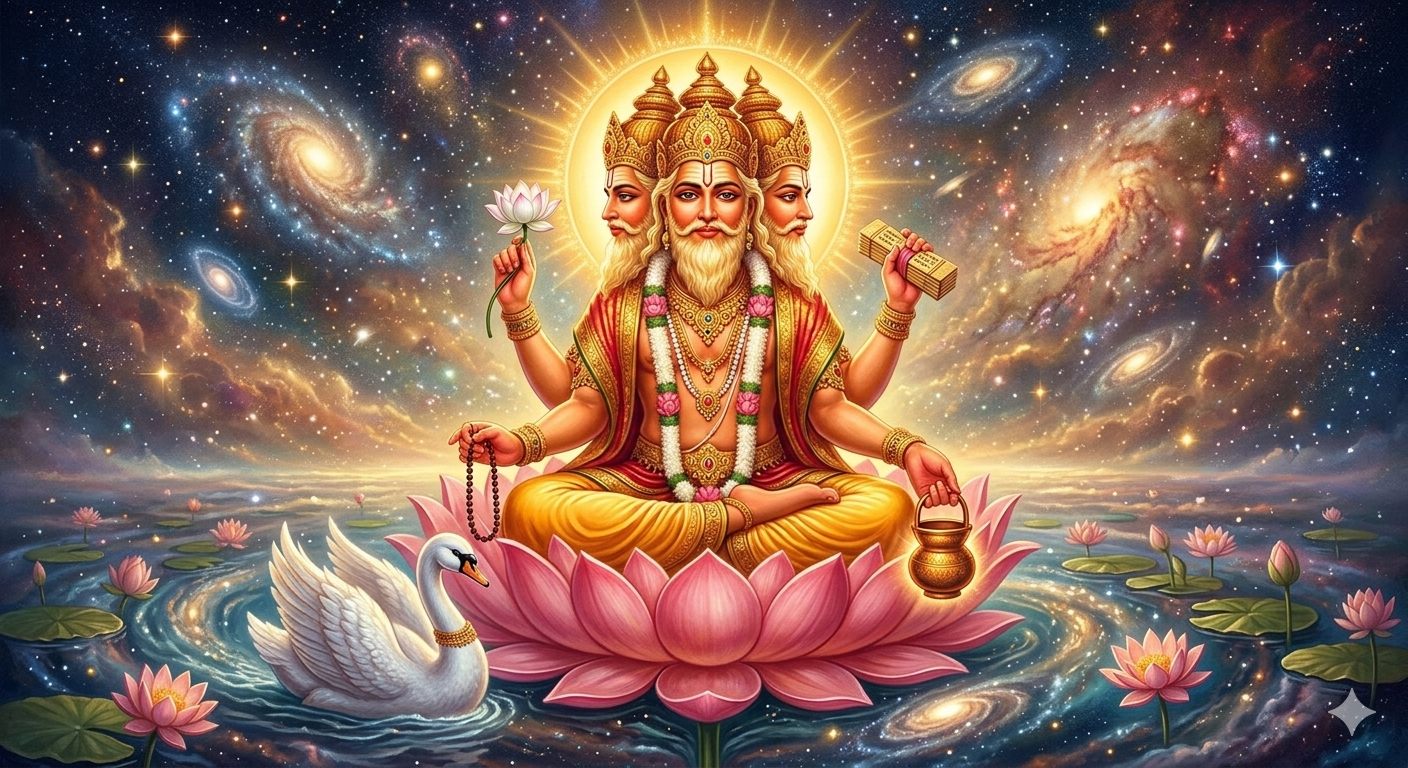
Brahma is the first member of the Trimurti — the Hindu grouping of three gods associated with creation, preservation, and dissolution. His function is creation: he is the god credited with giving form to the cosmos at the beginning of each universal cycle. He presides over wisdom, speech, and the Vedas, and is regarded as the father of all living beings. Also known as Svayambhu, Prajapati, Vedanatha, Virinchi, and Pitamaha.
Symbols & Iconography
Birth & Origin
In the Vaishnava tradition, Brahma was born from a lotus that emerged from the navel of Vishnu as he lay in cosmic sleep between creation cycles.
In older Vedic accounts he is Svayambhu — self-born from the Hiranyagarbha, the cosmic golden egg that floated in the primordial waters before time began.
In the Shaiva tradition, both Brahma and Vishnu were created by Shiva — emerging from his body or will, subordinate to him.
In the Shakta tradition, the Devi Bhagavata Purana holds that the Goddess is the source of all three members of the Trimurti.
Family
Consort: Saraswati — also described in some texts as his daughter. Sons: the four Kumaras. Father of the Saptarishi and the Prajapatis. First creation: Shatarupa, the first woman.
Scriptures
Brahma appears in the Rigveda as Brahmanaspati — a functional title rather than the fully formed creator deity of later texts. He is elaborated in the Upanishads, the Mahabharata, the Ramayana, the Brahma Purana, and the Brahma Vaivarta Purana — both among the 18 Mahapuranas.
Worship & Legacy
There is only one major temple dedicated to Brahma in India: the Brahma Temple at Pushkar in Rajasthan, believed to be over 2,000 years old. Pushkar is one of the five sacred pilgrimage sites in the Vaishnava tradition and the Pushkar Lake is held to have been created when a lotus fell from Brahma's hand. The annual Pushkar fair coincides with Kartik Purnima and draws pilgrims who bathe in the sacred lake. A secondary Brahma temple exists at Kumbakonam in Tamil Nadu. Despite his theological rank as the creator, Brahma is among the least worshipped deities in active Hindu practice.
Key Stories
1. The Fifth Head and Shiva's Curse
Brahma originally had five heads. In the Shiva Purana, one of his heads made a claim of supremacy over Shiva. Shiva, in the form of Bhairava, cut off the fifth head with his fingernail. Brahma was left with four. Shiva then cursed him: he would not be worshipped by humans. This is the primary mythological explanation for why Brahma, despite being the creator, has almost no active worship or temples in India.
2. The Lie at the Pillar of Light
Brahma and Vishnu disputed which of them was supreme. Shiva appeared as an infinite column of fire — the Jyotirlinga — and challenged both to find its end. Vishnu took the form of a boar and dug downward for thousands of years without finding the base. Brahma flew upward as a swan, equally unable to find the top. Vishnu admitted defeat honestly. Brahma lied, claiming he had reached the summit, and produced a ketaki flower as false evidence. Shiva exposed the deception and cursed Brahma further — the ketaki flower was permanently barred from divine ritual. This story appears in the Shiva Purana and the Skanda Purana.
3. The Creation of Shatarupa
When Brahma created Shatarupa — the first woman, born from his own body — he became so fixated on her that a head grew on each side to keep watching her as she moved around him. She rose above him and a fifth head looked up at her. Shiva's destruction of that fifth head became entangled with the curse above. Shatarupa and Manu are regarded in some Puranas as the parents of humanity.
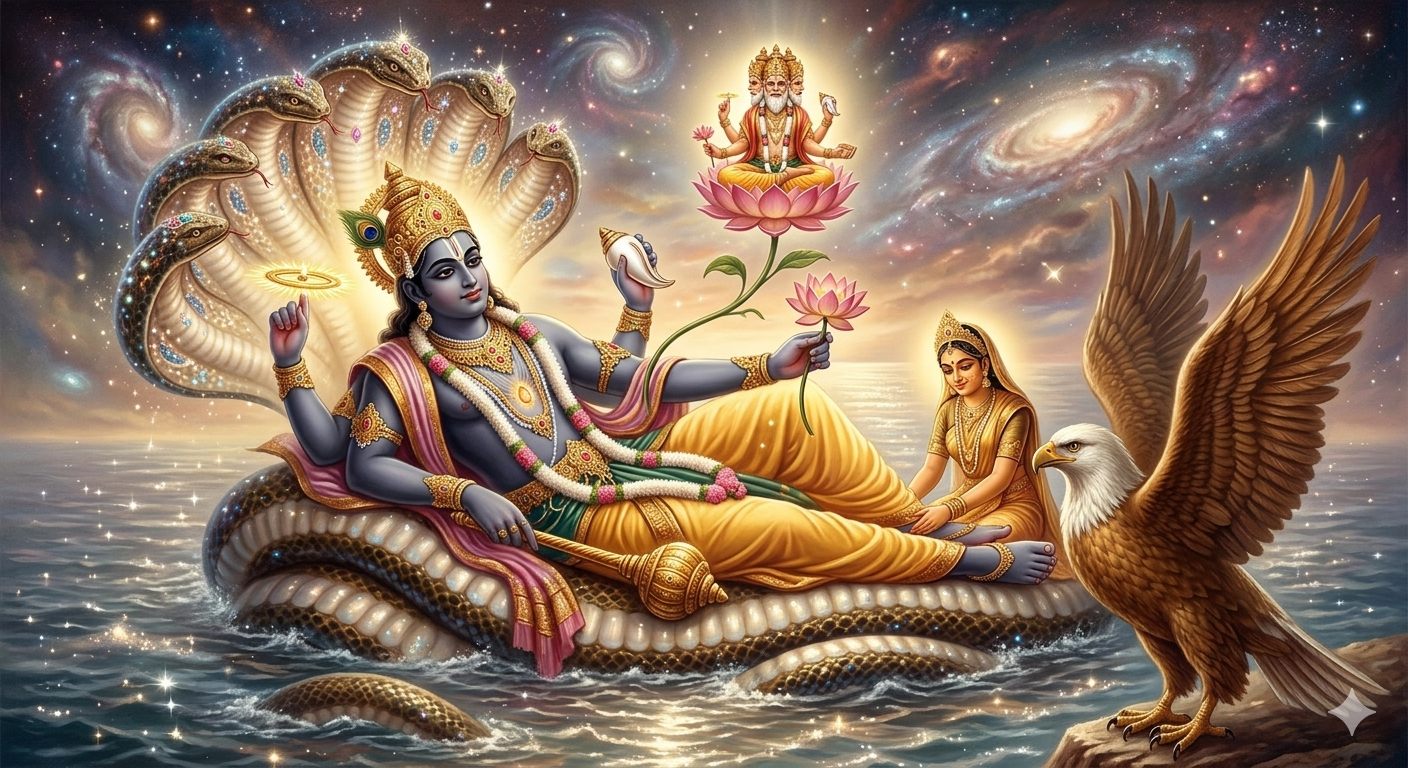
Vishnu is the second member of the Trimurti, associated with preservation and the maintenance of cosmic order. His defining theological doctrine is the Avatara — the descent of the divine into the world whenever dharma is threatened, taking whatever form is necessary to restore it. In the Vaishnava tradition he is the supreme reality, the source from which Brahma and Shiva themselves emerge. In the Shaiva tradition he is a great god but subordinate to Shiva. In the Shakta tradition both are subordinate to the Goddess. Also known as Narayana, Hari, Madhava, Govinda, Jagannath, and Venkateswara. His thousand names are catalogued in the Vishnu Sahasranama.
Symbols & Iconography
Birth & Origin
In the Vaishnava tradition, Vishnu is self-existent — without origin, beginning, or end. Brahma emerges from him and the cosmos cycles through his will.
In the Shaiva tradition, the Shiva Purana describes both Brahma and Vishnu as emerging from Shiva's body — Brahma from his right side, Vishnu from his left.
In the Shakta tradition, the Devi Bhagavata Purana describes the Goddess as the ultimate source, with Vishnu among those who emerge from her.
In the Rigveda, Vishnu is a minor deity known primarily for his three cosmic strides, not yet the supreme god of later tradition. His theological dominance developed in the Puranic period.
Family
Consort: Lakshmi, goddess of wealth and fortune. In avatar forms: Sita as Rama, Rukmini as Krishna. Resides in Vaikuntha, attended by gatekeepers Jaya and Vijaya. Mount: Garuda, himself a deity with his own mythology.
Scriptures
Vishnu appears in the Rigveda as a minor deity known for his three cosmic strides — far fewer hymns than Indra or Agni. His mythology expands significantly in the Puranic period. Primary texts: the Vishnu Purana, Bhagavata Purana, Mahabharata, Ramayana, Padma Purana, and Garuda Purana. The Vishnu Sahasranama from the Mahabharata is among the most recited texts in daily Hindu practice.
Worship & Legacy
The Tirumala Venkateswara Temple at Tirupati in Andhra Pradesh is the most visited Hindu pilgrimage site, receiving between 50,000 and 100,000 pilgrims daily. The Ranganathaswamy Temple at Srirangam in Tamil Nadu is the largest functioning Hindu temple, where Vishnu is worshipped as Ranganatha reclining on Shesha. The Jagannath Temple at Puri in Odisha is the site of the annual Rath Yatra — one of the largest religious gatherings on earth. Badrinath in the Himalayas is one of the four sacred dhams of Hindu pilgrimage. Festivals include Vaikuntha Ekadashi, Janmashtami, and Ram Navami. The Bhagavad Gita, spoken by his avatar Krishna, is among the most widely translated religious texts in the world.
Key Stories
1. Samudra Manthan — The Churning of the Ocean
When the gods lost their power after a curse from the sage Durvasa, Vishnu advised them to churn the cosmic ocean of milk with the asuras, using the serpent Vasuki as a rope and Mount Mandara as a churning rod. He took the form of the tortoise Kurma to support the mountain on his back. From the churning came the Halahala poison — swallowed by Shiva — the goddess Lakshmi, the physician Dhanvantari bearing the nectar of immortality, and other treasures. When the asuras seized the nectar, Vishnu took the form of Mohini — an enchantress — and recovered it for the gods.
2. The Three Strides of Vamana
The demon-king Bali had taken control of all three worlds through austerity and conquest. Vishnu took the form of Vamana — a dwarf brahmin — and approached Bali during a great sacrifice, asking for three paces of land. Bali agreed despite warnings from his guru Shukracharya. Vamana then grew to cosmic proportions: one step covered the earth, the second covered the heavens, and for the third there was nowhere left. Bali offered his own head. Vishnu pressed him into the underworld but honored his virtue by granting him lordship there.
3. Rama and the War Against Ravana
As Rama, Vishnu was born a prince of Ayodhya. His wife Sita was abducted by Ravana, the ten-headed demon-king of Lanka. Exiled from his kingdom, Rama assembled an army of forest beings led by Hanuman, crossed the ocean to Lanka, and fought a war that ended with Ravana's death. The Ramayana of Valmiki is the complete account.
4. Krishna, the Bhagavad Gita & the Cosmic Vision
As Krishna, Vishnu was born in a prison cell to save the world from the tyrant Kamsa. His life spanned a miraculous childhood, the slaying of Kamsa, and his role as charioteer to the warrior Arjuna in the great civil war of the Mahabharata. On the eve of battle, with Arjuna paralyzed by the prospect of fighting his own kin, Krishna delivered the Bhagavad Gita — 18 chapters covering duty, selfless action, devotion, and the nature of the self. Within this teaching, at Arjuna's request, Krishna revealed his cosmic form — Vishvarupa — in which Arjuna saw all gods, all worlds, all time, and all destruction simultaneously within Krishna's body. The vision overwhelmed him and he begged Krishna to return to his familiar human form.
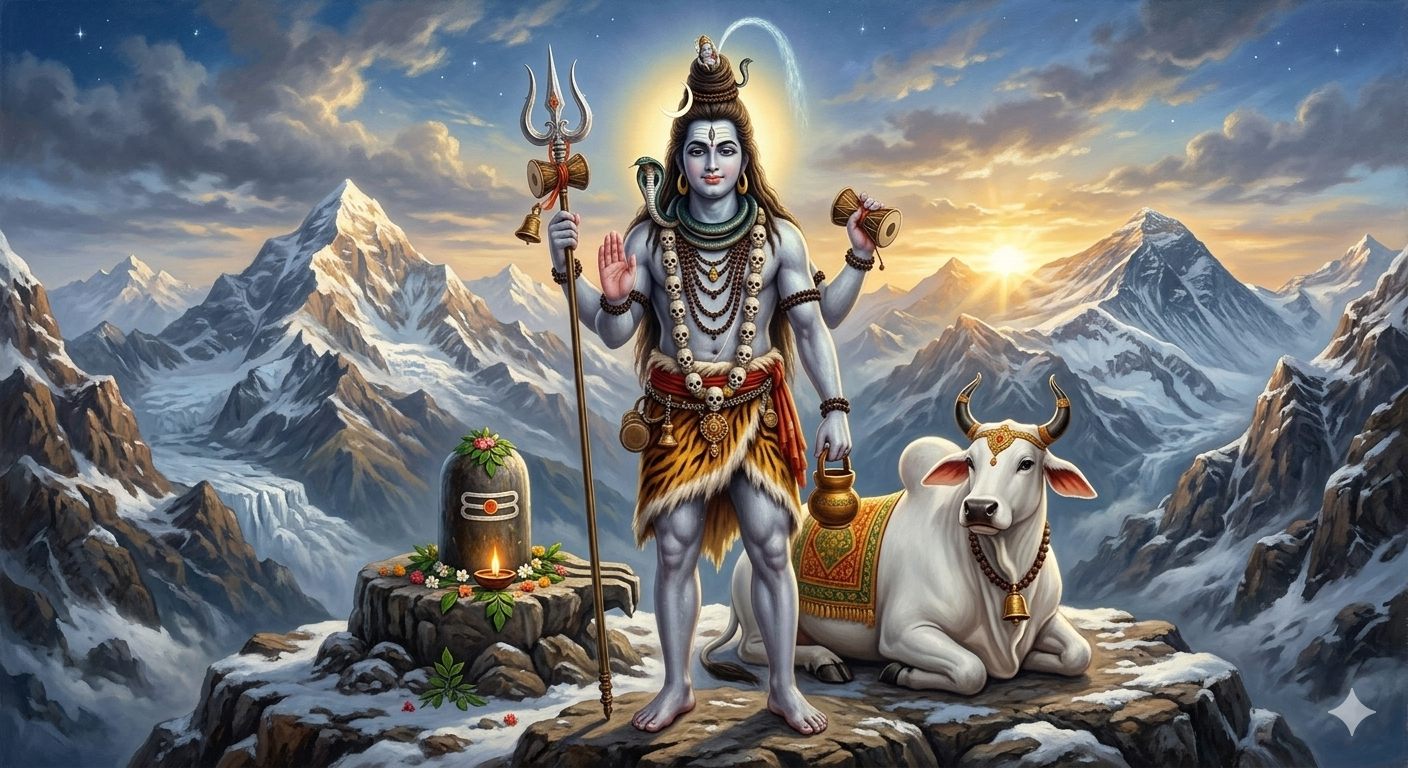
Shiva is the third member of the Trimurti, associated with dissolution and transformation. In the Shaiva tradition he is the supreme reality — the source from which Brahma and Vishnu both emerge and into whom all creation is eventually dissolved. In the Vaishnava tradition he is a great god subordinate to Vishnu. In the Shakta tradition he is subordinate to the Goddess. His domain covers dissolution, time, death, yoga, asceticism, wild nature, outcasts, and liberation (moksha) from the cycle of rebirth. Also known as Mahadeva, Maheshvara, Rudra, Shankar, Nataraja, Pashupati, Bhairava, Neelakantha, and Tryambaka.
Symbols & Iconography
Birth & Origin
In the Shaiva tradition, Shiva is self-existent — the supreme source of all things including Brahma and Vishnu.
In the Vaishnava tradition, the Bhagavata Purana describes Shiva as having emerged from Brahma's forehead when Brahma was overcome with anger.
In the Vedic tradition, Shiva's precursor is Rudra — a wild, storm-associated deity of the Rigveda who haunts forests and mountains, associated with both destruction and healing. The transition from Vedic Rudra to Puranic Shiva is visible across several centuries of texts.
The Linga Purana's account of his manifestation as an infinite column of fire — in which neither Brahma nor Vishnu could find his beginning or end — is the theological basis for the twelve Jyotirlingas.
Family
First consort: Sati, daughter of Daksha. Second consort (Sati reborn): Parvati, daughter of the mountain king Himavat. Sons: Ganesha and Kartikeya (Murugan/Skanda). Attendants: Nandi, Virabhadra, and the Ganas.
Scriptures
Shiva's earliest form as Rudra appears in the Rigveda and is extensively addressed in the Sri Rudram of the Yajurveda — still chanted daily in Shiva temples across India. Primary Puranic texts: Shiva Purana, Linga Purana, Skanda Purana (the largest of all 18 Mahapuranas). Also prominent throughout the Mahabharata. The Shaiva Agamas form the ritual foundation of temple worship across South India.
Worship & Legacy
Shiva is worshipped in more temples than any other deity in India. The twelve Jyotirlingas are his most sacred pilgrimage sites, spanning the subcontinent: Somnath in Gujarat, Mallikarjuna in Andhra Pradesh, Mahakaleshwar in Ujjain, Omkareshwar in Madhya Pradesh, Kedarnath in the Himalayas, Bhimashankar in Maharashtra, Kashi Vishwanath in Varanasi, Trimbakeshwar in Maharashtra, Vaidyanath in Jharkhand, Nageshvara in Gujarat, Rameshwaram in Tamil Nadu, and Grishneshwar in Maharashtra. The Nataraja Temple at Chidambaram in Tamil Nadu is a sacred site in the Shaiva tradition. The Brihadeeswarar Temple at Thanjavur — built by the Chola king Raja Raja I in 1010 CE — is a UNESCO World Heritage Site. Maha Shivaratri is observed with all-night vigil and fasting. The month of Shravan (July–August) is dedicated to his worship.
Key Stories
1. Swallowing the Halahala
During the churning of the cosmic ocean, the first thing to emerge was the Halahala — a poison that threatened to destroy all existence. Neither gods nor demons could contain it. Shiva swallowed the entire poison and held it in his throat through yoga, allowing neither its destruction of the world nor its harm to himself. His throat turned permanently blue, giving him the name Neelakantha.
2. The Destruction of Daksha's Sacrifice
Daksha held a great yagna to which all gods were invited except Shiva. His daughter Sati arrived uninvited and was publicly humiliated by Daksha. She immolated herself in the sacrificial fire. Shiva tore a lock from his matted hair and created Virabhadra — a warrior of immense power — along with an army of Ganas. They stormed the sacrifice. Virabhadra beheaded Daksha, blinded Bhaga, knocked out Pushan's teeth, and scattered the assembled gods. Brahma pleaded for mercy and Shiva restored the dead — giving Daksha a goat's head in place of his own.
3. The Burning of Kama
After Sati's death, Shiva retreated into the Himalayas in deep meditation. The gods sent Kama — the god of desire — to disturb him. Shiva's third eye opened and reduced Kama to ash. Kama's wife Rati pleaded and Kama was eventually restored to a bodiless existence — Ananga.
4. The Dance of Nataraja
A group of sages in the Taragam forest relied on ritual mechanics alone and rejected devotion. When their magical attacks against Shiva failed — a tiger, a serpent, a club — he skinned the tiger with his fingernail, wore the serpent as an ornament, and began to dance. The dance — the Tandava — contained within it the full cycle of creation and dissolution. He is depicted in this form as Nataraja: dancing within a ring of fire, one foot raised, one pressing down the demon Apasmara beneath him.
5. Shiva and Arjuna at the Forest of Indrakila
During the Mahabharata, Arjuna undertook austerities to obtain Shiva's weapon the Pashupatastra. Shiva appeared disguised as a Kirata (mountain hunter) and contested Arjuna's claim to a boar both had shot simultaneously. They fought. Arjuna's arrows had no effect. When all his weapons failed he made a clay image of Shiva and offered flowers — but the garland kept falling on the hunter instead. Arjuna recognized the god, surrendered, and was granted the Pashupatastra.
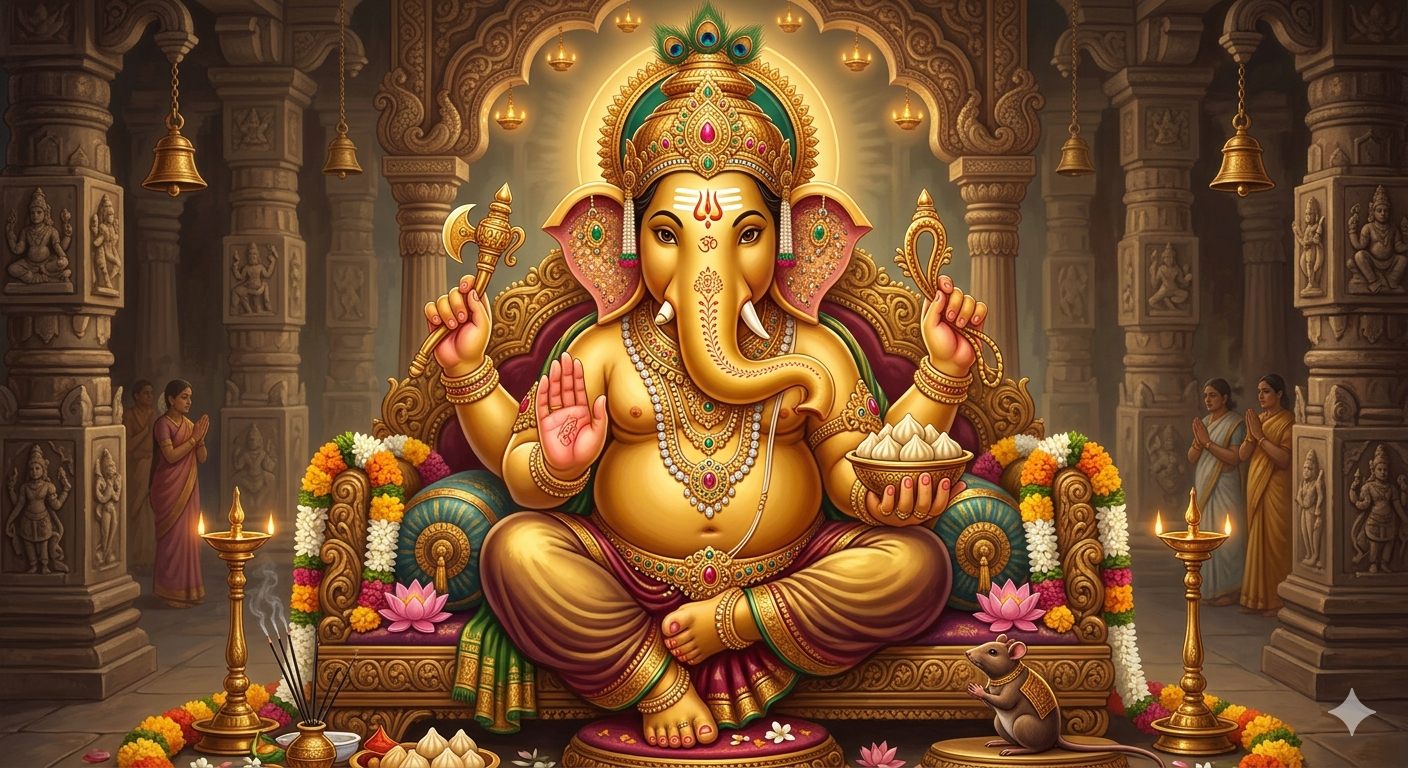
Ganesha is the elephant-headed son of Shiva and Parvati — the lord of beginnings, invoked before any new undertaking, journey, ritual, or venture. He governs intellect, wisdom, writing, and the removal of obstacles, as well as the placing of obstacles before those who proceed without proper intention. He is the lord of the Ganas and the first deity worshipped in most Hindu rituals regardless of which god the ritual is ultimately for. Also known as Ganapati, Vighneshvara, Ekadanta, Lambodara, and Vinayaka.
Symbols & Iconography
Birth & Origin
The most widely told story, from the Shiva Purana: Parvati created Ganesha from turmeric paste while bathing, fashioning him as a guard in Shiva's absence. When Shiva returned and the child blocked his entry, Shiva — not recognising him — cut off the child's head in anger. Parvati was devastated. To make amends, Shiva sent attendants to bring the head of the first living creature they found — an elephant. Shiva placed the elephant head on the child, restored his life, and declared him his son, granting him the position of first among the gods to be worshipped.
A second origin: the gods asked Shiva and Parvati to create a being of such power and beauty that he could distract demon forces. Ganesha was born from Parvati's laughter or from Shiva's desire, fully formed.
Family
Father: Shiva. Mother: Parvati. Brother: Kartikeya. Consorts: Riddhi (prosperity) and Siddhi (spiritual attainment) in some traditions; celibate in others. Sons: Shubha and Labha. Vahana: Mushika.
Scriptures
Ganesha appears in the Mahabharata and the Puranas — particularly the Ganesha Purana and the Mudgala Purana, both dedicated to his mythology. He is mentioned in the Rigveda in the context of Brahmanaspati, though this identification is contested.
Worship & Legacy
Ganesha is worshipped across virtually all traditions of Hinduism and by Hindus worldwide. He is invoked first in every Hindu ritual regardless of the primary deity. Ganesha Chaturthi is among the most widely celebrated Hindu festivals, observed with particular fervour in Maharashtra. The Ashtavinayaka — eight sacred Ganesha temples in Maharashtra — are a major pilgrimage circuit. Major temples include Siddhivinayak in Mumbai and Dagdusheth Halwai Ganpati in Pune.
Key Stories
1. The Broken Tusk
Ganesha broke his own tusk to use as a pen while transcribing the Mahabharata as Vyasa dictated it — in one version his pen broke mid-session and rather than stop, he broke off his own tusk and continued. In another version, the tusk was broken in a fight with Parashurama, who hurled his axe at Ganesha; Ganesha, recognising it as Shiva's own axe, allowed it to strike him out of respect rather than deflect it.
2. The Race Around the Universe
Shiva and Parvati announced that whichever of their sons — Ganesha or Kartikeya — circled the universe first would receive a special fruit of wisdom. Kartikeya leapt onto his peacock and set off around the actual universe. Ganesha simply walked around his parents once and declared that his parents were his entire universe. Shiva and Parvati, moved by his wisdom, gave him the fruit.
3. Ganesha and the Moon
One night, after eating enormous quantities of modakas at a feast, Ganesha was riding home on his mouse when his belly split open. He gathered the sweets and held his belly together with a serpent. The moon laughed at the spectacle. Ganesha, furious, broke off his tusk and hurled it at the moon, cursing it so that anyone who looked at the moon on Ganesha Chaturthi would be falsely accused of theft. This explains why the moon is not to be seen on his festival day.
4. Ganesha and Kubera
Kubera once invited Ganesha to a feast intending to display his wealth. Ganesha arrived and ate everything — every dish, the vessels, the furniture — and began consuming the palace itself. Only when Parvati gave him a handful of roasted rice was he satisfied. The story illustrates that no material wealth can satisfy the divine; only the simplest offering given with genuine devotion can.
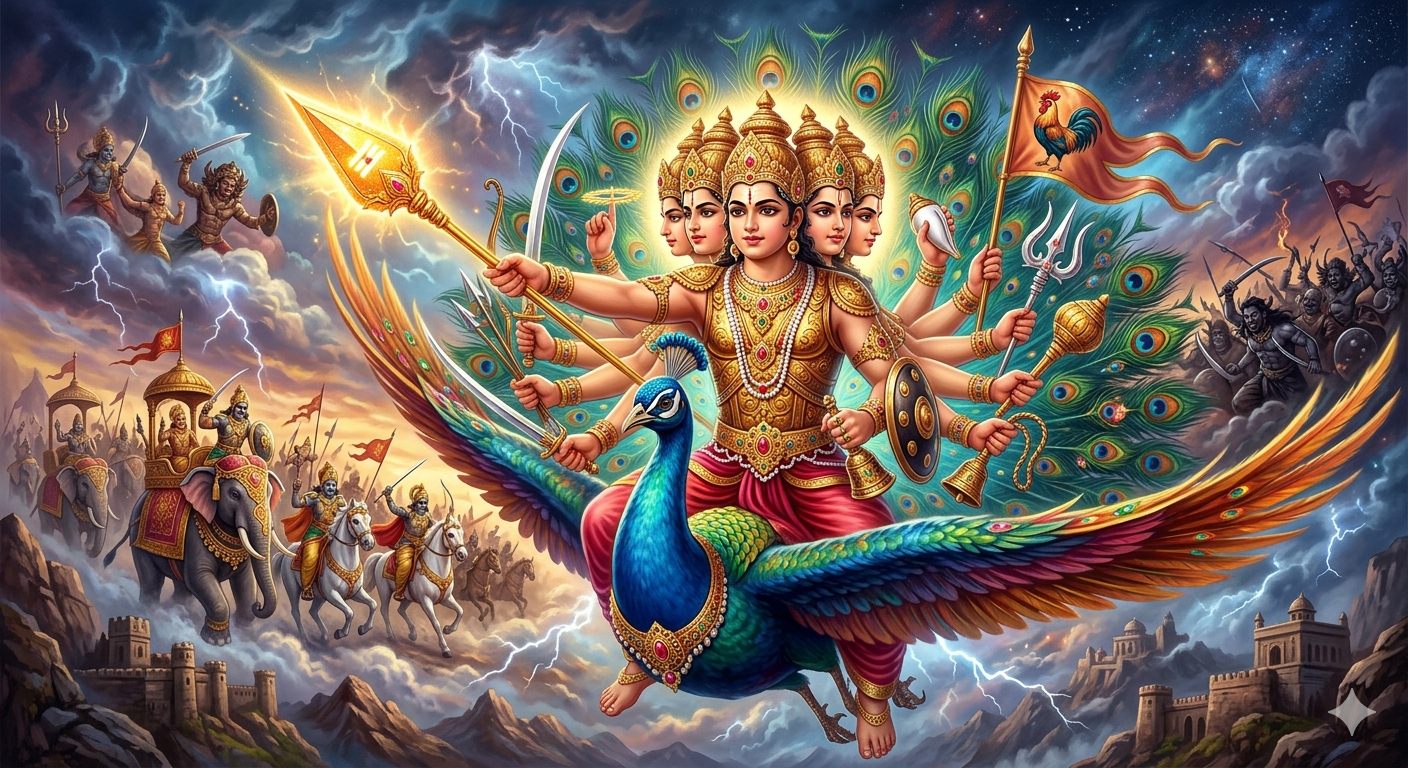
Kartikeya is the god of war and commander of the armies of the gods, born specifically to defeat the demon Tarakasura who could only be killed by Shiva's son. He is worshipped across India as Kartikeya or Skanda in the north, and as Murugan in Tamil Nadu and Sri Lanka — where he is among the most beloved and actively worshipped deities in the tradition. He is the patron of the Tamil language, the god of mountains, and the exemplar of divine youth and valour. Also known as Shanmukha, Subrahmanya, Kumara, and Senthil.
Symbols & Iconography
Birth & Origin
The gods needed Shiva's son to defeat Tarakasura. But Shiva, in meditation after Sati's death, was not to be disturbed. Kama was sent to awaken desire in Shiva and was destroyed for it. Eventually Parvati won Shiva through austerity and their union occurred. Shiva's seed — of such immense power that no vessel could contain it — was eventually carried by the river Ganga and deposited in the reeds of the Saravana forest.
The Krittikas — the six Pleiades stars — found the child and nursed him. He was born with six heads, one for each Krittika. Parvati gathered all six into one child. He immediately grew to warrior age and led the gods to victory against Tarakasura.
Family
Father: Shiva. Mother: Parvati. Brother: Ganesha. Foster mothers: the Krittikas (the Pleiades). Consorts: Devasena in the Sanskrit tradition; Valli in the Tamil tradition. Valli — a tribal girl whose love Murugan pursues — is among the most beloved narratives in Tamil devotional literature.
Scriptures
Kartikeya appears in the Mahabharata (Shalya Parva) and the Ramayana, and is the central subject of the Skanda Purana — the largest of all 18 Mahapuranas. In Tamil literature he is the subject of the Tirumurugattrupadai and the entire Shaiva Siddhanta devotional tradition.
Worship & Legacy
Murugan is one of the most actively worshipped deities in India, especially in Tamil Nadu. The six Arupadai Veedu — his six primary battle abodes — are the most sacred pilgrimage sites in Tamil Shaivism: Palani, Tiruchendur, Swamimalai, Thiruttani, Pazhamudircholai, and Thiruparankundram. Thaipusam — observed by Tamil Hindus worldwide — is among the most dramatic Hindu festivals, with devotees carrying Kavadi as acts of devotion.
Key Stories
1. The Defeat of Tarakasura
Tarakasura — a demon who had gained near-invincible power through austerity — could only be killed by Shiva's son. When Kartikeya took command of the gods' army, he led them against Tarakasura's forces and killed him with his Vel. The purpose of his birth was fulfilled immediately. This story is the mythological foundation of his identity as the divine warrior born for a single, necessary act of cosmic rescue.
2. The Race Around the Universe
When Shiva and Parvati announced that whichever of their sons circled the universe first would receive the fruit of wisdom, Kartikeya leapt onto his peacock and circled the actual universe. He returned to find Ganesha had already won by simply walking around their parents. Kartikeya, angry, left home and went to live on a hill in Tamil Nadu — Palani — where he remains, worshipped as an ascetic who renounced the world's rewards.
3. Murugan and Valli
In the Tamil tradition, Murugan disguised himself as a hunter and pursued the tribal girl Valli, who was guarding her family's millet field. She rebuffed him. He enlisted Ganesha, who took the form of a wild elephant and charged toward Valli. She ran to the hunter for protection — and Murugan revealed himself. Their union represents the divine pursuit of the human soul. The story is told in the Kanda Puranam and in the devotional poetry of Tamil Shaivism.
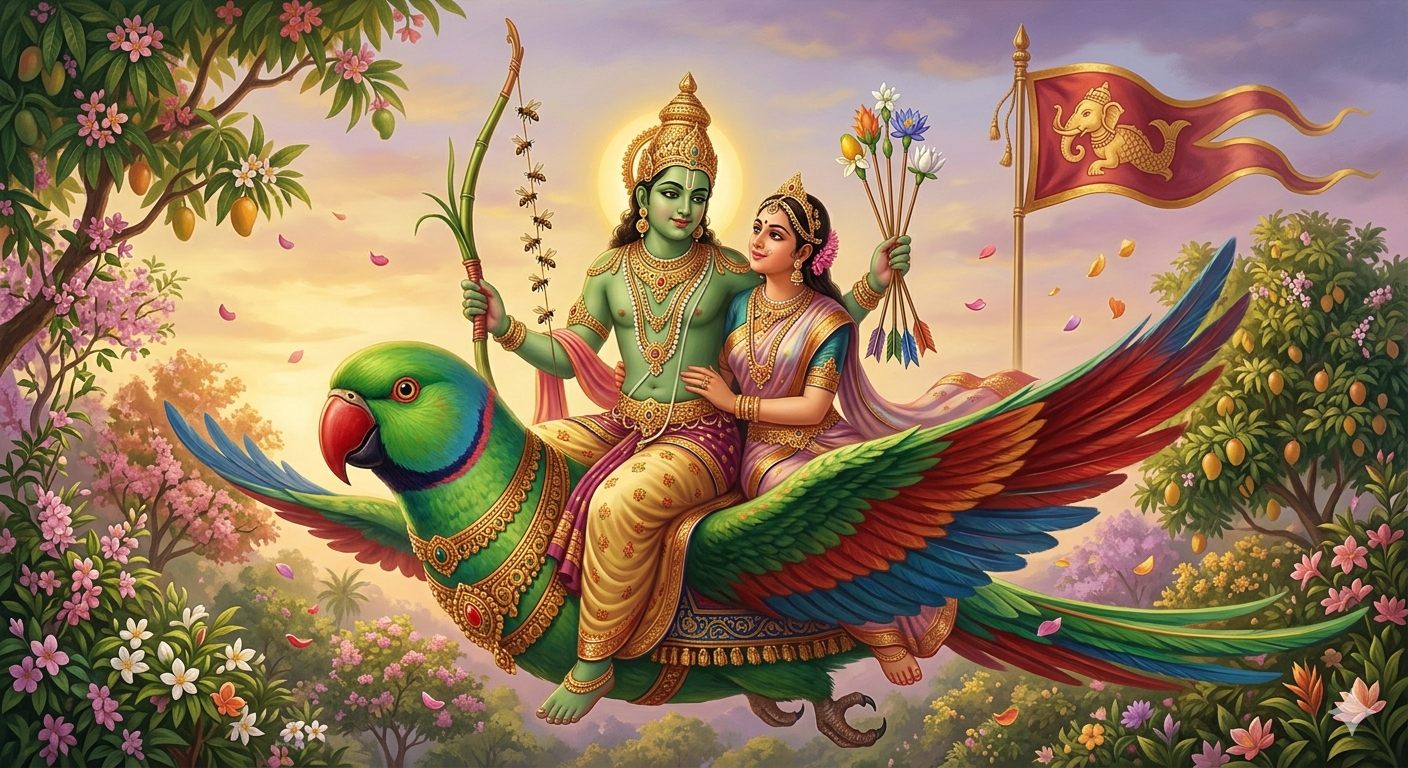
Kama is the god of love, desire, and erotic attraction — the divine force who shoots flower-tipped arrows into the hearts of gods and mortals alike, causing them to fall in love. In the Rigveda, Kama is the first impulse — the desire that caused creation to begin. In the Puranas he is a fully personified deity with a consort, attendants, and a dramatic mythology centred on his destruction by Shiva. Also known as Manmatha (churner of minds), Madana, Ananga (the bodiless one), Kandarpa, and Kamadeva.
Symbols & Iconography
Birth & Origin
In the Atharvaveda, Kama is described as the first-born of all — the cosmic desire that preceded creation itself. In the Puranas, he is the son of Brahma — born from Brahma's mind or heart as the first creative impulse. In some accounts he is the son of Vishnu and Lakshmi. In yet another tradition, he is identified with Krishna himself as the supreme lord of love.
Family
Father: Brahma (or Vishnu and Lakshmi in some texts). Consort: Rati, goddess of desire and passion. Their union represents love and longing as cosmic principles inseparable from creation.
Scriptures
Kama appears in the Rigveda's Nasadiya Sukta (10.129), the Atharvaveda, the Mahabharata, the Bhagavata Purana, and the Shiva Purana. The Kamasutra — attributed to Vatsyayana — is dedicated to his domain though not directly to him as a deity.
Worship & Legacy
Kama has no major independent temples in modern India. He is invoked in love-related rituals. His destruction and restoration are celebrated in the Holi festival — the bonfire on Holika Dahan eve represents the burning of Kama, and the festival of colours the following day represents the joy of his restoration. In parts of South India, Kama Dahanam is observed as an independent ritual.
Key Stories
1. Kama in the Rigveda — The First Impulse
The Rigveda's Nasadiya Sukta (10.129) — the hymn of creation — describes Kama as the first seed of mind, the primal impulse that moved the one undifferentiated reality toward creation: "Desire (kama) arose in it first — that was the primal seed of mind." This makes Kama not merely a god of romance but the cosmic force of becoming itself. Before gods, before the world, before time — desire existed first.
2. The Destruction by Shiva
After Sati's death, Shiva retreated into the Himalayas in deep meditation. The gods needed him to father a son to defeat the demon Tarakasura. They sent Kama to shoot an arrow into Shiva's heart. Kama, knowing the danger, shot his flower arrow anyway. Shiva's third eye opened and reduced Kama to ash in an instant. His wife Rati wept inconsolably. Eventually, at Rati's plea and the gods' request, Shiva restored Kama — but without a body. Kama became Ananga, the bodiless one, who henceforth acts on minds and hearts invisibly. This explains why love and desire are felt internally, without a visible presence.
3. Kama and Pradyumna
In the Bhagavata Purana, Kama is reborn as Pradyumna — the son of Krishna and Rukmini. The demon Shambhara, knowing the prophecy that Pradyumna would kill him, kidnapped the infant and threw him into the ocean. A fish swallowed the child. The fish was caught in Shambhara's kitchen; when it was cut open, Pradyumna emerged. The kitchen maid Mayavati — actually Rati, Kama's wife, reborn — recognised him, raised him, fell in love with him, and helped him kill Shambhara. Kama's destruction and rebirth through Krishna's lineage connects the god of desire directly to the divine love story at the heart of Vaishnavism.
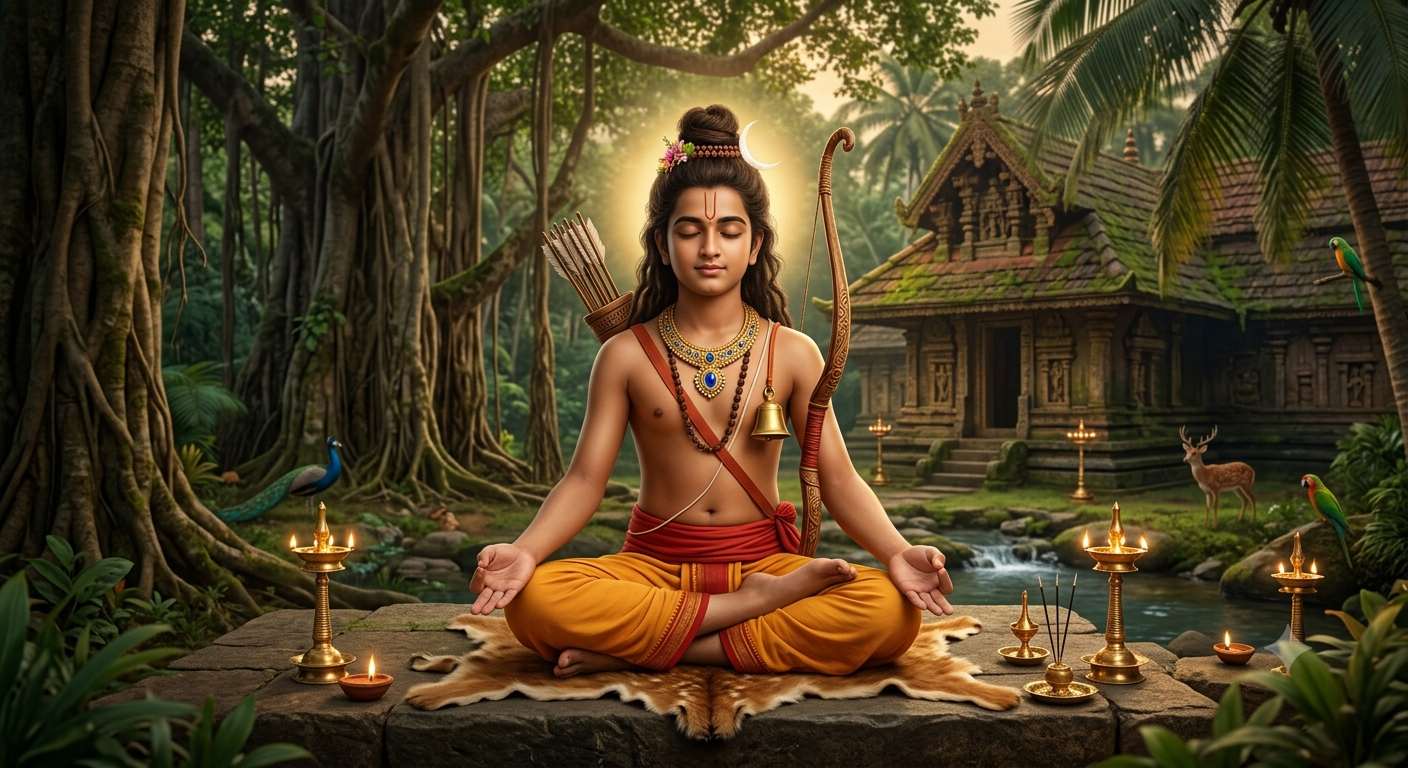
Ayyappa is the deity of the Sabarimala temple in Kerala — a major pilgrimage site. He is considered the son of Shiva and Mohini (Vishnu's female form), making him the offspring of the two supreme deities of the Hindu tradition. He is the god of dharma, celibacy, and equality — his temple is traditionally open to all devotees regardless of caste, a feature that has been part of the tradition from its early history. Also known as Shasta, Manikanta, and Harihara Putra (son of Hari and Hara — Vishnu and Shiva).
Birth & Origin
Shiva, upon seeing Vishnu's Mohini form, was enchanted, and their union produced Ayyappa. The child was abandoned on the banks of the Pampa river and was found and adopted by the king of Pandalam, who raised him as his own son. The king's own biological son was born later and jealousy developed at court. A series of tests, dangers, and ultimately the divine revelation of Ayyappa's nature led to his installation on the hill of Sabarimala.
Family
Father: Shiva. Mother: Mohini (the female form of Vishnu). Foster father: the King of Pandalam.
Symbols & Iconography
Depicted as a young man seated in yoga posture with a jewel (Mani) around his neck and a bell (Kanta) — hence Manikanta. He wears simple attire, carries a bow and arrow, and is shown in a meditative posture.
Scriptures
Ayyappa's story is told in the Bhuta Natha Gita, the Skanda Purana (in some versions), and regional devotional texts of Kerala.
Worship & Legacy
The Sabarimala Ayyappa Temple in Kerala receives an estimated 40 to 50 million pilgrims annually during the Mandala-Makaravilakku season (November–January) — making it one of the largest annual pilgrimages in the world. The pilgrimage requires 41 days of celibacy, vegetarianism, and austerities before undertaking the climb barefoot through the forest to the hilltop temple. Devotees wear black clothing and carry an Irumudi (a two-compartment cloth bundle) on their heads. The Sabarimala temple has been at the centre of significant legal and social controversy regarding women's entry — the Supreme Court of India ruled in 2018 that women of all ages could enter, though implementation has been contested.
Key Stories
1. The Defeat of Mahishi
The buffalo demoness Mahishi — sister of Mahishasura — had received a boon that she could only be killed by the son of Shiva and Vishnu. Since such a being had never existed, she considered herself invincible. Ayyappa defeated her. After the battle, Mahishi was transformed back into her true form — an Apsara who had been cursed — and she attained liberation. The killing of Mahishi is the central mythological event of Ayyappa's biography.
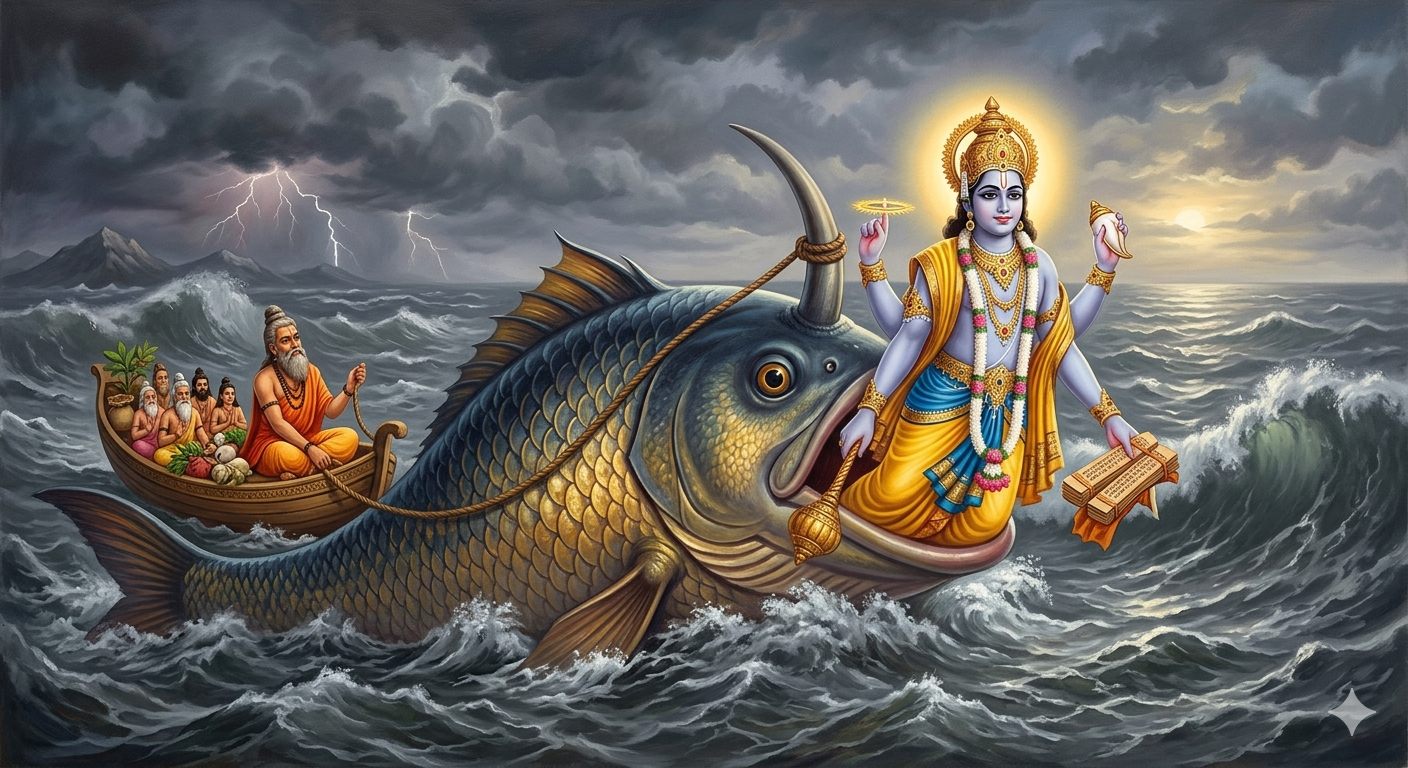
Matsya — the fish — is the first avatar of Vishnu, descending to rescue the Vedas from a demon who stole them and to save Manu (the progenitor of humanity) from a cosmic flood. The Matsya story is the Hindu tradition's primary flood narrative and one of the oldest avatar stories in the tradition.
Descent & Purpose
Vishnu took the form of a great fish — first tiny, then growing to fill the cosmic ocean — to accomplish two missions: to rescue the sacred knowledge of the Vedas stolen at the end of a cosmic cycle, and to save the progenitor of humanity from the flood that would wipe the earth clean before the next creation.
Scriptures
The Matsya story appears in the Shatapatha Brahmana — its oldest form — the Mahabharata, and the Bhagavata Purana. The Matsya Purana is among the 18 Mahapuranas.
Worship & Legacy
The Matsya avatar is not widely worshipped independently. His significance is cosmological and narrative — the flood story connects the Hindu tradition to a widespread ancient flood narrative found across Mesopotamian, Biblical, and other world traditions. He is worshipped as part of the Dashavatar in Vaishnava temples.
Key Stories
1. The Flood and the Rescue of Manu
In the Shatapatha Brahmana (one of the oldest versions), a small fish appeared in the palm of the sage Manu's hands while he washed them in a river. It asked to be protected, promising in return to save him from a coming flood. Manu kept the fish in progressively larger vessels as it grew — first a jar, then a tank, then a river, then the ocean. The fish revealed itself as the divine and told Manu to build a boat. When the flood came, Manu tied his boat to the fish's horn and was guided through the deluge until the waters receded and the boat rested on a northern mountain. Puranic versions identify the fish as Vishnu.
2. The Rescue of the Vedas
In the Bhagavata Purana version, the demon Shankhasura stole the Vedas from Brahma while he slept at the end of a cosmic cycle. Vishnu took the form of Matsya, slew the demon, and recovered the Vedas — restoring the knowledge that makes the next cycle of creation possible. Without the Vedas, creation cannot recommence; Matsya's descent ensures the continuity of sacred knowledge across the dissolution of worlds.
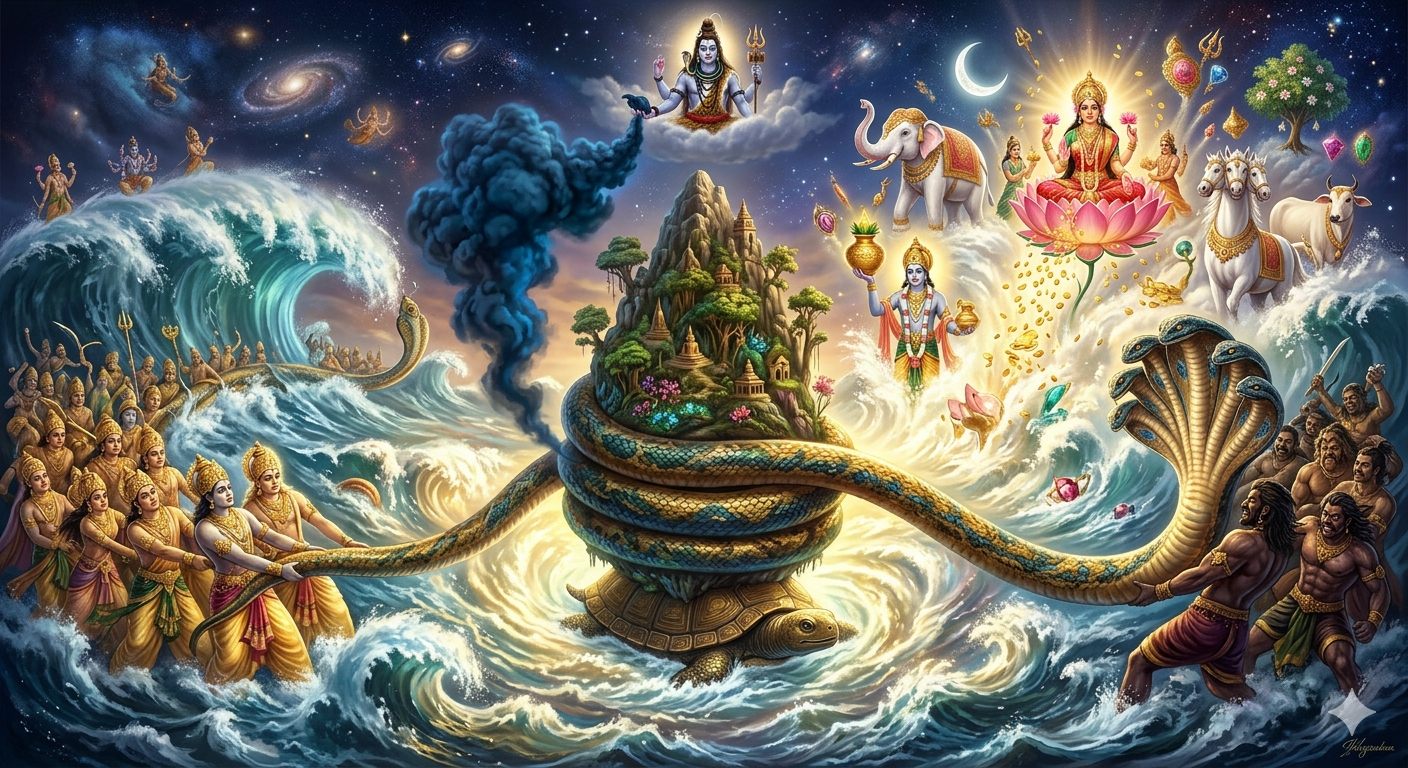
Kurma — the tortoise — is the second avatar of Vishnu, descending to support Mount Mandara on his back during the churning of the cosmic ocean (Samudra Manthan). Without Kurma's support, the mountain would have sunk into the ocean floor and the churning would have been impossible. He is the literal foundation of the great act that produced the nectar of immortality.
Descent & Purpose
When the gods lost their power after a curse from the sage Durvasa, Vishnu advised them to churn the cosmic ocean of milk with the asuras, using Mount Mandara as a churning rod and the serpent Vasuki as the rope. As they churned, the mountain began to sink. Vishnu became Kurma — a tortoise of vast size — and submerged himself beneath the mountain, providing a stable base on his shell.
Scriptures
The Kurma story appears in the Bhagavata Purana, Vishnu Purana, and Mahabharata. The Kurma Purana is among the 18 Mahapuranas.
Worship & Legacy
The Srikurmam Temple in Andhra Pradesh — one of the few temples dedicated primarily to Kurma — is a significant pilgrimage site. Kurma is also worshipped as part of the Dashavatar in Vaishnava temples across India.
Key Stories
1. The Support of Mount Mandara — Samudra Manthan
During the Samudra Manthan, the gods and demons used Mount Mandara as a churning rod and the serpent Vasuki as the rope. As they churned, the mountain began to sink into the soft ocean floor. Vishnu took the form of a giant tortoise and submerged beneath the mountain, providing a stable base on his shell. The churning then produced the Halahala poison (swallowed by Shiva), the goddess Lakshmi, the divine physician Dhanvantari bearing the Amrita, and other divine treasures. Kurma's role is passive but essential — he is the stable ground beneath the greatest act of cosmic production in Hindu mythology.
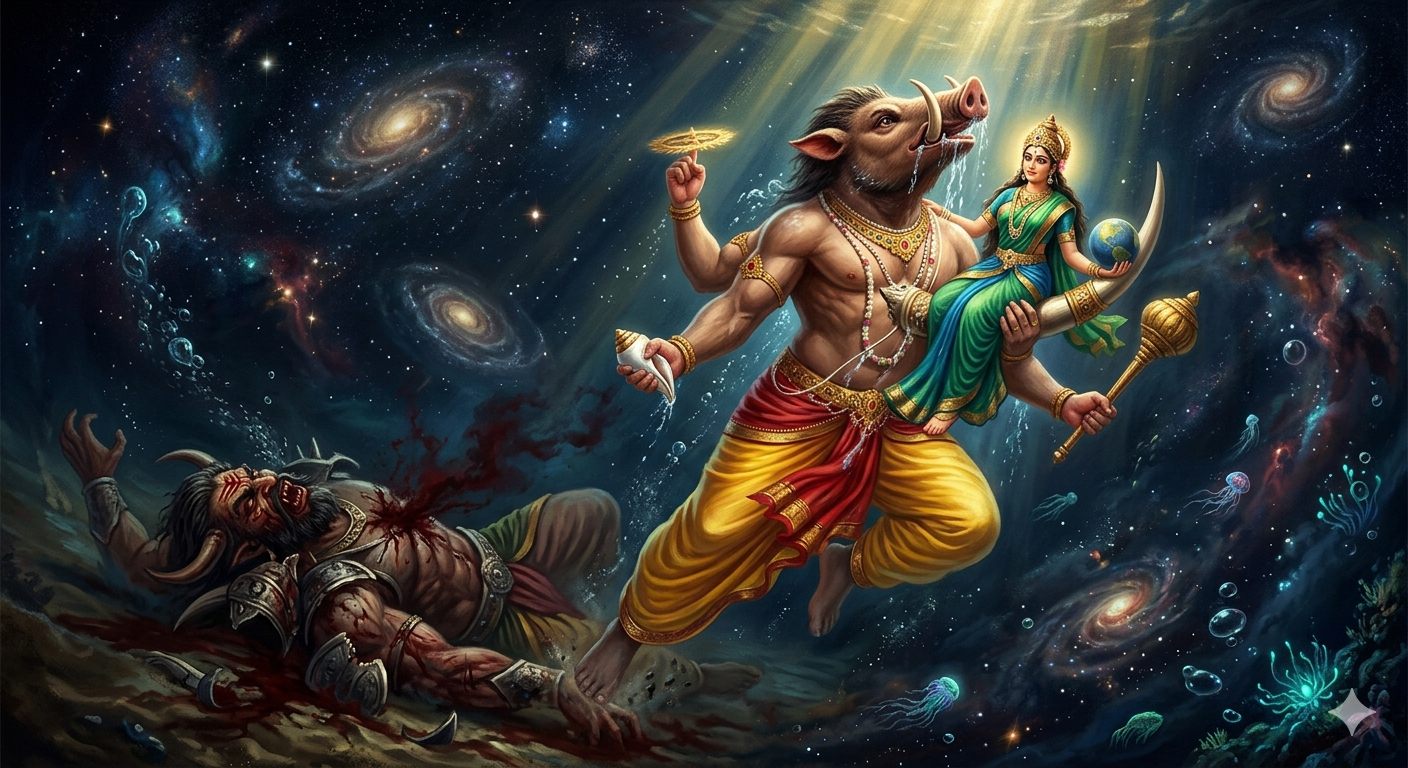
Varaha — the boar — is the third avatar of Vishnu, descending to rescue the earth goddess Prithvi (Bhumi) from the demon Hiranyaksha who had dragged her to the bottom of the cosmic ocean. The image of Varaha lifting the earth on his tusk from the primordial waters is one of the most powerful and ancient iconographic statements in Hindu art.
Descent & Purpose
The demon Hiranyaksha — brother of Hiranyakashipu — dragged the earth to the bottom of the cosmic ocean, plunging all of creation into chaos. Without the earth in its place, life cannot exist. Vishnu took the form of Varaha — a great boar of vast cosmic size — and dove into the ocean to restore her.
Scriptures
Appears in the Vishnu Purana, Bhagavata Purana, Valmiki Ramayana, and Mahabharata.
Worship & Legacy
The Varaha Temple at Pushkar in Rajasthan and the Varaha shrines at Tirupati are significant worship sites. The image of Varaha lifting Prithvi is a dramatically sculpted form in Hindu temple art — particularly the massive 5th-century rock-cut Varaha carving at Udayagiri, Madhya Pradesh, one of the finest examples of Gupta-period sculpture.
Key Stories
1. The Rescue of Prithvi
Hiranyaksha dragged the earth to the bottom of the cosmic ocean, plunging creation into chaos. Vishnu took the form of Varaha — so vast that his body filled the sky — dove into the ocean, killed Hiranyaksha in a fierce battle lasting a thousand divine years, and lifted the earth on his tusks, restoring her to her place in the cosmos. The earth goddess Prithvi is depicted clinging to Varaha's tusk as he rises from the waters — a tender and powerful image of divine rescue. This story appears in the Bhagavata Purana and is one of the defining narratives of Vishnu's role as preserver of the created world.
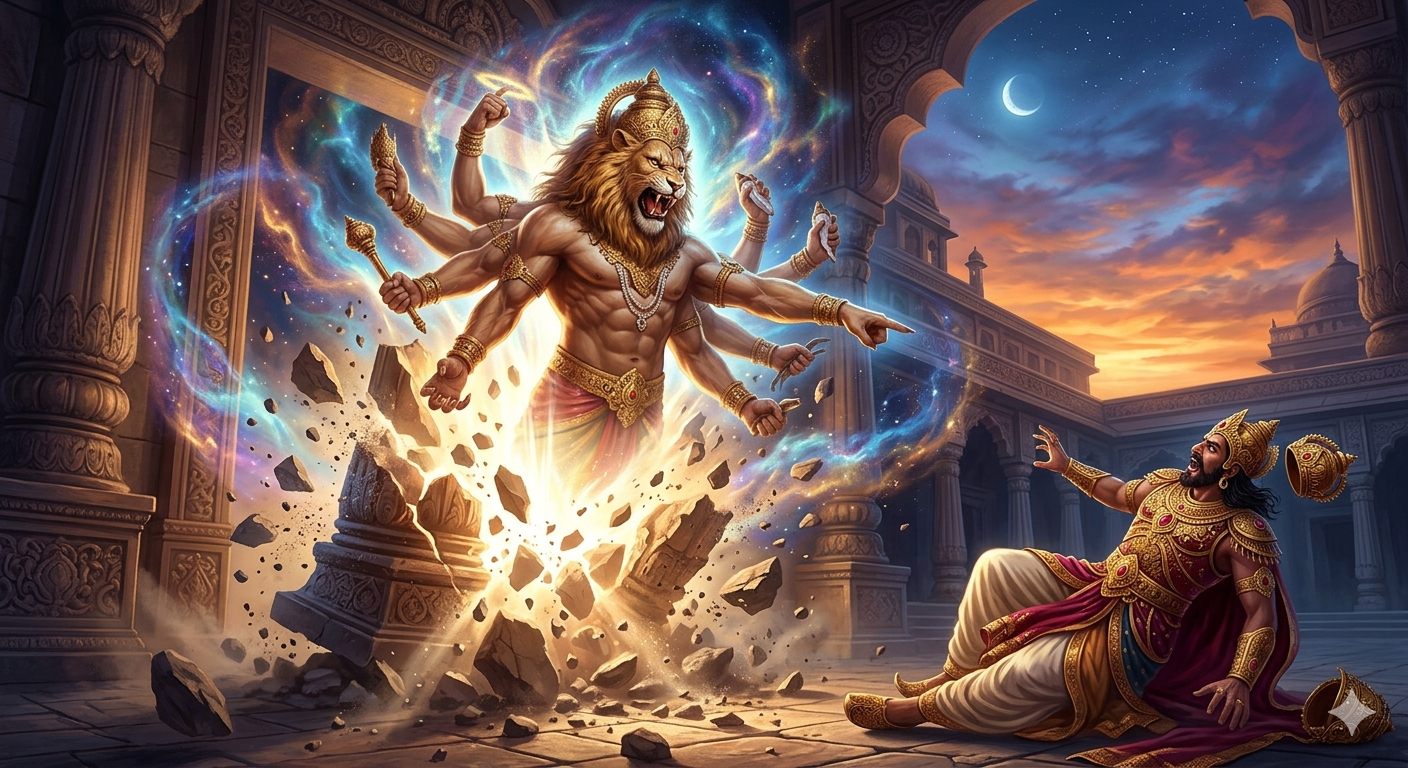
Narasimha — half man, half lion — is the fourth avatar of Vishnu, descending specifically to kill the demon Hiranyakashipu. He is the avatar of divine ingenuity: when a near-invulnerable demon cannot be destroyed by any conventional means, Vishnu takes a form that satisfies every clause of the protective boon while circumventing all of them simultaneously.
Descent & Purpose
Hiranyakashipu — brother of Hiranyaksha — received from Brahma a boon of near-invulnerability: he could not be killed by man or animal, by day or night, indoors or outdoors, on the ground or in the air, by any weapon. His son Prahlada's intense devotion to Vishnu enraged him and he repeatedly tried to kill his own child. Vishnu took the form of Narasimha to circumvent every condition of the boon.
Scriptures
The Narasimha story is told primarily in the Bhagavata Purana and the Vishnu Purana.
Worship & Legacy
Narasimha is widely worshipped across India. Major temples include the Yadagirigutta Narasimha Temple in Telangana, the Ahobilam Narasimha Temple in Andhra Pradesh (considered the site of the actual killing), and the Simhachalam Temple in Andhra Pradesh. Narasimha Jayanti celebrates his manifestation. Eight forms of Narasimha — from the gentle Prahlada-natha to the terrifying Ugra Narasimha — are worshipped in Vaishnava traditions.
Key Stories
1. The Death of Hiranyakashipu
Hiranyakashipu challenged his devotee-son Prahlada — asking where Vishnu was, since Prahlada claimed Vishnu was everywhere. When Hiranyakashipu struck a pillar in contempt, Narasimha burst from it. He killed Hiranyakashipu at twilight (neither day nor night), on the threshold of the palace (neither inside nor outside), holding him on his lap (neither on the ground nor in the air), using his own claws (not a weapon), as a being that was neither man nor animal. Every single condition of the boon was satisfied. Prahlada was saved. This story is a celebrated demonstration of divine ingenuity — and of the principle that devotion to Vishnu cannot be suppressed by any power in the universe.
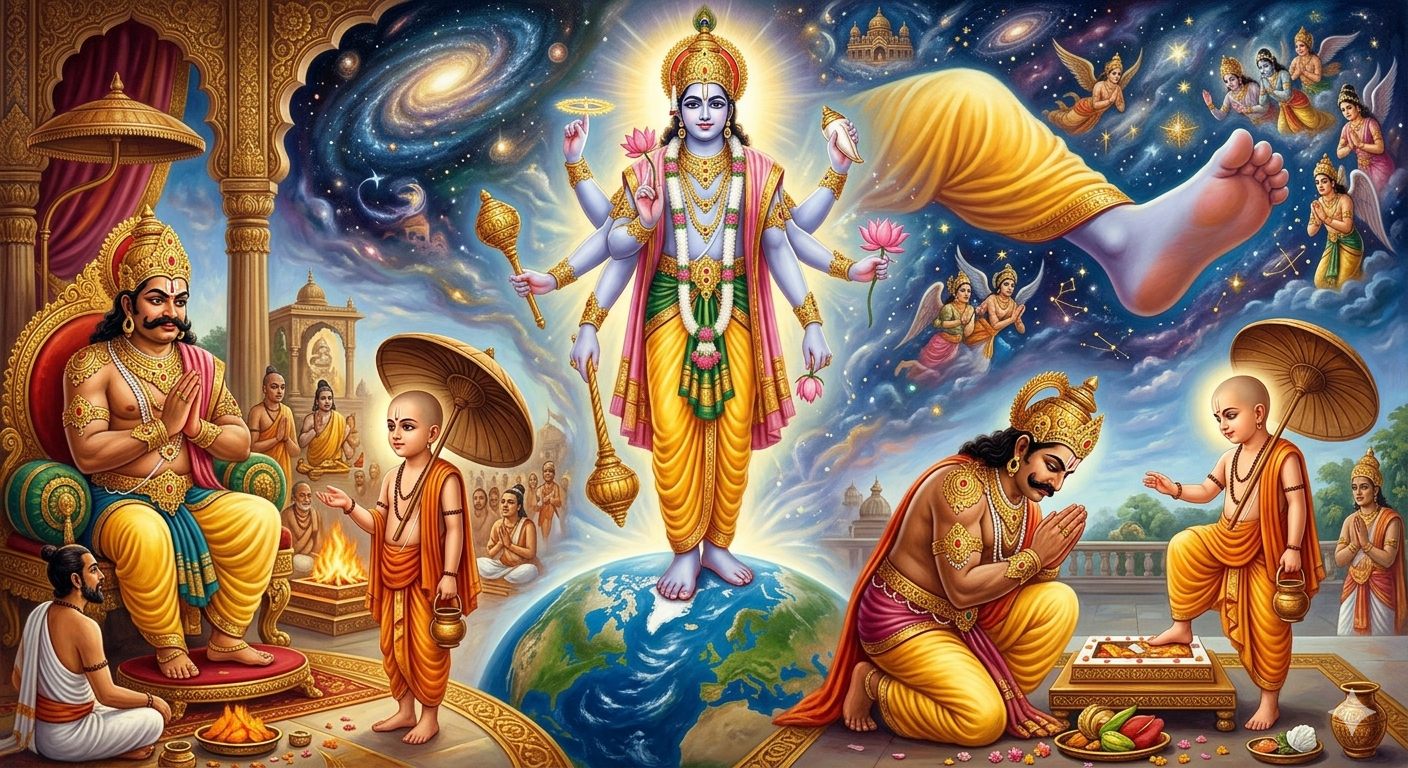
Vamana — the dwarf — is the fifth avatar of Vishnu and the first to appear in fully human form. He descended to reclaim the three worlds from the demon-king Bali, who had conquered them through virtue and austerity rather than violence. The story is notable because Bali himself is treated as an admirable figure — his generosity and commitment to his word are presented sympathetically even as Vishnu defeats him.
Descent & Purpose
The demon-king Bali had conquered all three worlds through righteous conduct and austerity. The gods, dispossessed, appealed to Vishnu. Vishnu chose not force but wit — taking the form of a tiny brahmin boy who would approach Bali during a great sacrifice when any request must be honoured.
Scriptures
Vamana appears in the Rigveda as the deity of the three cosmic strides — the Trivikrama. He is elaborated in the Bhagavata Purana and the Vishnu Purana. The Vamana Purana is among the 18 Mahapuranas.
Worship & Legacy
The Thrikkakara Temple in Kerala is the most significant Vamana temple in India and is the centre of Onam celebrations — the harvest festival of Kerala, which commemorates Bali's annual return to visit his beloved people. Onam is one of the major festivals of Kerala. The Vamana Temple at Kurukshetra in Haryana is another significant site.
Key Stories
1. The Three Strides
Bali's guru Shukracharya recognised the dwarf brahmin as Vishnu in disguise and warned Bali not to grant the boon. Bali overruled his teacher — a gift promised to a brahmin cannot be withdrawn. Shukracharya, furious, sat in the spout of Bali's ritual water vessel to physically prevent the water of promise from pouring; Vishnu poked a grass stalk into the spout, blinding Shukracharya in one eye. Vamana grew to cosmic size: one step covered the earth, the second covered the heavens. For the third, there was nowhere left. Bali offered his own head. Vishnu pressed him into the underworld but honoured his virtue — declaring himself Bali's eternal doorkeeper and promising that Bali will reign as Indra in the next cosmic cycle. The story is in the Bhagavata Purana.
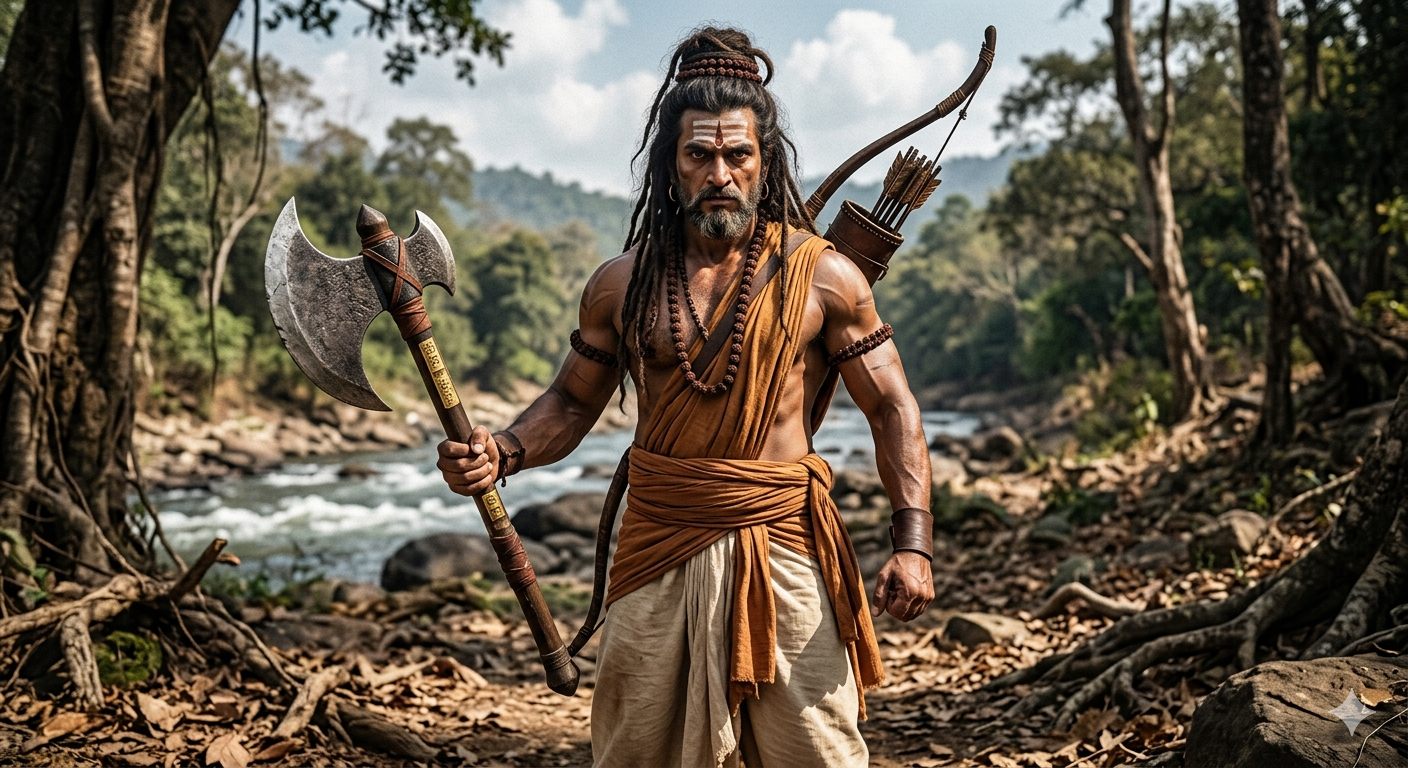
Parashurama is the sixth avatar of Vishnu — a brahmin warrior who descended to rid the earth of the kshatriya class that had become corrupt and tyrannical. He is unique among the avatars: not a king or a god-hero but a brahmin sage who carries an axe, and one of the Chiranjivi — immortals still alive, who will appear at the end of the current age to become Kalki's teacher. Also known as Rama Jamadagnya and Bhargava Rama.
Symbols & Iconography
Birth & Origin
Son of the sage Jamadagni (one of the Saptarishi) and Renuka. Born a brahmin but trained as a warrior by Shiva, who gave him the divine axe (Parashu) after Parashurama performed intense austerities at Shiva's abode.
Family
Father: Jamadagni. Mother: Renuka. He taught Bhishma, Drona, and Karna — making him the guru of the greatest warriors in the Mahabharata. His students span both sides of the Kurukshetra war.
Scriptures
Parashurama appears in the Mahabharata (where he teaches Bhishma, Drona, and Karna), the Ramayana, the Bhagavata Purana, and the Brahma Purana.
Worship & Legacy
Parashurama is believed to have created the coastal strip of Kerala, Karnataka, and Goa — called the Parashurama Kshetra — by throwing his axe into the sea and commanding the ocean to recede. This origin story is deeply embedded in the cultural identity of these coastal regions. He is considered the adi-guru of the martial arts tradition of Kerala (Kalaripayattu). Major temples include the Thiruvallam Parashurama Temple in Kerala.
Key Stories
1. The Murder of His Own Mother
Jamadagni, a sage of extreme temper, saw that his wife Renuka had momentarily experienced desire when she saw a king bathing in a river. He ordered his sons to kill her. One by one they refused. When Parashurama was ordered, he obeyed — killing his mother with his axe. Jamadagni, satisfied with his absolute obedience, offered him a boon. Parashurama asked for his mother to be restored to life with no memory of her death. The boon was granted. This story illustrates the extreme obedience demanded of Parashurama — and the immediate compassion that follows his compliance.
2. The Extermination of the Kshatriyas
After king Kartavirya Arjuna stole Jamadagni's sacred cow Kamadhenu, Parashurama tracked him down and killed him. Kartavirya's sons retaliated by killing Jamadagni. Parashurama, consumed with grief and fury, vowed to exterminate the kshatriya class twenty-one times over. He went around the earth twenty-one times, killing every kshatriya warrior he could find, filling five lakes with their blood. He then performed a great sacrifice and gave the earth away to the sage Kashyapa. This purge is the central act of his avatarhood — a cosmic correction of a class that had exceeded its dharmic authority.
3. Parashurama and Rama
When Rama broke the divine bow of Shiva at Sita's swayamvara, the sound reached Parashurama's hermitage. He arrived furious — the bow had belonged to his lineage. He challenged Rama to string his own bow (Vishnu's bow). When Rama strung it effortlessly, Parashurama recognised him as Vishnu's higher avatar and acknowledged his supremacy — then departed to his mountain hermitage. The encounter between the sixth and seventh avatars marks the transfer of divine purpose from the warrior-brahmin age to the age of the ideal king.
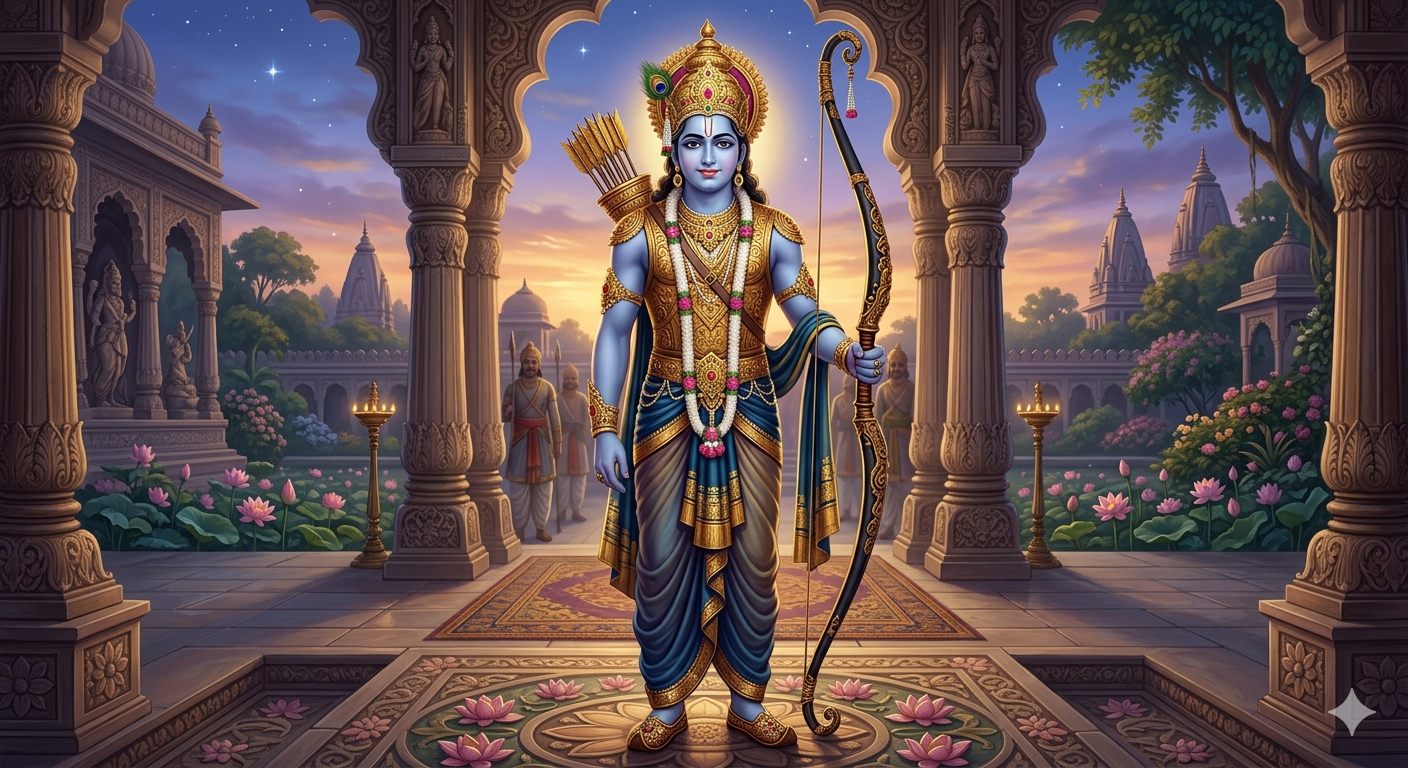
Rama is the seventh avatar of Vishnu and the hero of the Ramayana — one of the two great epics of India. He is the ideal of dharmic kingship, the devoted husband, the obedient son, and the righteous warrior. His story is the moral foundation of much of the Hindu cultural world. His name — Ram — is among the most commonly spoken words in the daily lives of hundreds of millions of Hindus. Also known as Ramachandra, Raghava, Dasharathi, and Maryada Purushottam.
Symbols & Iconography
Birth & Origin
Born to King Dasharatha of Ayodhya and his first wife Kaushalya as the eldest of four princes — Rama, Bharata, Lakshmana, and Shatrughna. His birth was the result of a divine pudding given to Dasharatha after a ritual performed to obtain sons. Vishnu divided himself: Rama received half, Bharata a quarter, and the twins each an eighth.
Family
Father: King Dasharatha. Mother: Kaushalya. Brothers: Bharata, Lakshmana, Shatrughna. Consort: Sita, daughter of King Janaka — found in a field, considered a daughter of the earth. Sons: Lava and Kusha. Devotee: Hanuman.
Scriptures
Rama is the hero of the Valmiki Ramayana — the original and most authoritative version. He appears in the Mahabharata, the Adhyatma Ramayana, and the Ramcharitmanas of Tulsidas — the most beloved Hindi version. He is discussed in the Bhagavata Purana and the Vishnu Purana.
Worship & Legacy
Ram Navami — his birthday — is a major national festival. The Ram Mandir at Ayodhya, consecrated in January 2024, is among the most significant religious sites in modern India. The Ram Charit Manas is recited every evening across India. The greeting "Jai Shri Ram" is among the most common religious salutations in North India.
Key Stories
1. The Exile
King Dasharatha, bound by a boon given to his second wife Kaikeyi, was compelled to send Rama into fourteen years of forest exile on the eve of his coronation and to crown Kaikeyi's son Bharata instead. Rama accepted the exile without protest. Sita and Lakshmana accompanied him voluntarily. Dasharatha died of grief shortly after. Bharata refused the throne and ruled only as Rama's regent, placing Rama's sandals on the throne as a symbol of the absent king.
2. The Abduction of Sita and the War for Lanka
In the forest, the demon-king Ravana abducted Sita while Rama and Lakshmana were distracted. Searching for her, Rama allied with the monkey-king Sugriva and his general Hanuman. Hanuman leapt across the ocean to Lanka, found Sita, and brought back news. Rama built a bridge of rocks across the ocean, crossed to Lanka with his army, fought Ravana, and killed him. Sita was rescued.
3. Sita's Fire Ordeal and Exile
After Ravana's defeat, Rama asked Sita to prove her purity through the Agnipariksha — the fire ordeal. She stepped into the fire and emerged unharmed, the fire god Agni bearing witness to her chastity. They returned to Ayodhya. Later, hearing reports that citizens questioned Sita's purity, Rama exiled her to the forest — pregnant with his children — despite his personal certainty of her innocence. Valmiki took her in and she gave birth to twins Lava and Kusha. When eventually reunited with Rama, and asked to undergo a second public test, Sita called on her mother the earth to receive her — and the earth opened. This ending is among the most debated passages in Hindu epic literature.
4. The Return to Ayodhya — Diwali
After the defeat of Ravana and the completion of fourteen years of exile, Rama, Sita, and Lakshmana returned to Ayodhya. The citizens lit lamps to welcome them back. This return is celebrated annually as Diwali — the festival of lights — one of the most widely observed festivals in the world.
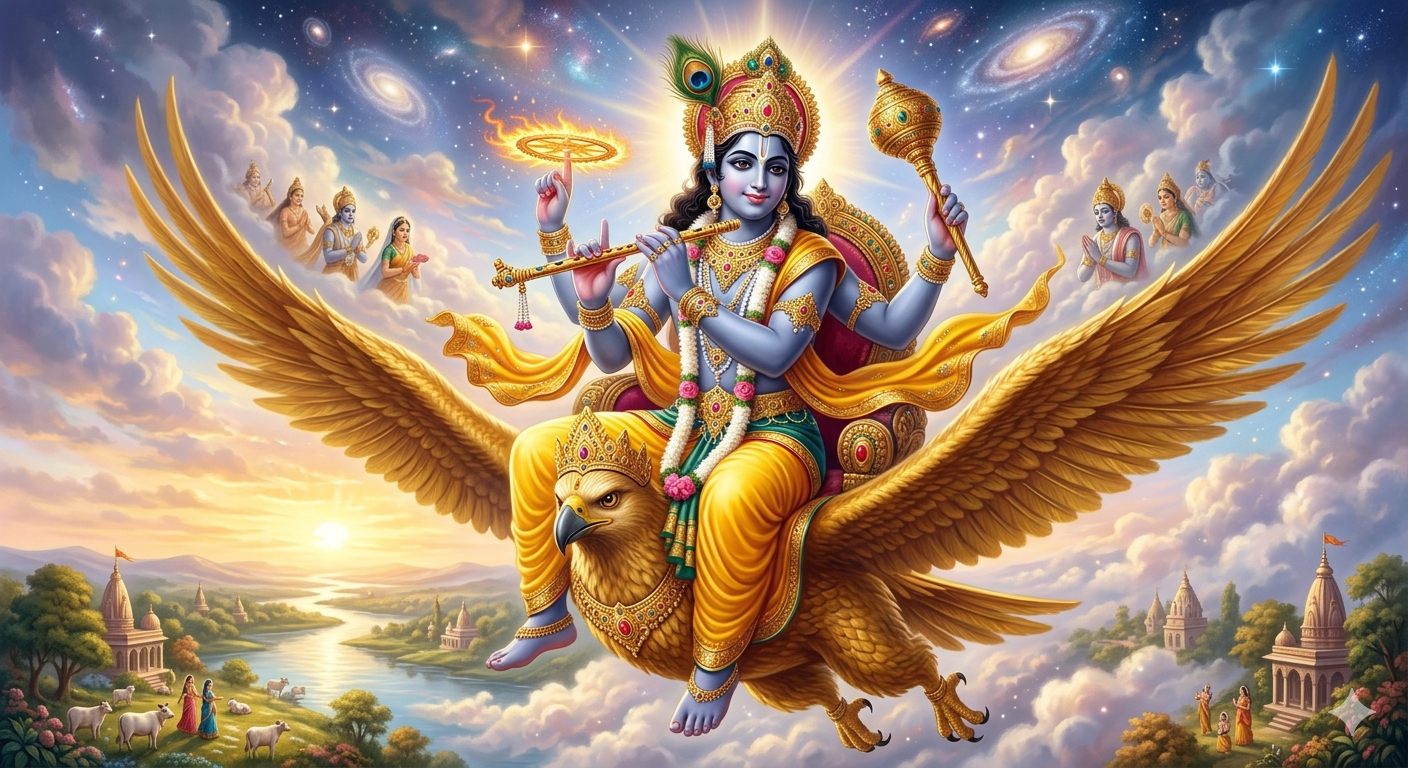
Krishna is the eighth avatar of Vishnu and the most beloved and theologically complex figure in the entire Hindu tradition. Unlike other avatars who descend for a specific purpose and depart, Krishna's life encompasses the full range of divine experience — miraculous birth, playful childhood, romantic youth, political war, and the deepest philosophical teaching. In the Vaishnava tradition he is the Svayam Bhagavan — the supreme being himself. He is the speaker of the Bhagavad Gita. Also known as Govinda, Gopala, Madhava, Murali, Keshava, and Dwarkadheesh.
Symbols & Iconography
Birth & Origin
Born in a prison in Mathura to Devaki and Vasudeva. The tyrant Kamsa — Devaki's brother — had been told by a divine voice that Devaki's eighth child would kill him. He imprisoned the couple and killed each child as it was born. When Krishna was born, the prison doors opened, the guards slept, and Vasudeva carried the infant across the flooding Yamuna river to safety in Gokul, placing him with the cowherd couple Yashoda and Nanda.
Family
Birth parents: Devaki and Vasudeva. Foster parents: Yashoda and Nanda. Elder brother: Balarama. Primary consort: Rukmini. Beloved: Radha — whose relationship with Krishna is devotional rather than marital in the theological literature, representing the soul's longing for the divine. Sons: Pradyumna (with Rukmini).
Scriptures
Krishna is the subject of the tenth canto of the Bhagavata Purana — the longest, most elaborated, and most beloved section of any Purana. He is central to the Mahabharata. The Bhagavad Gita, the Gita Govinda (12th-century poem by Jayadeva), and the entire Vaishnava bhakti poetic tradition across all Indian languages are devoted to him.
Worship & Legacy
Janmashtami — his birthday — is among the most widely celebrated Hindu festivals. The Dwarkadhish Temple in Dwarka is one of the four sacred dhams. The Vrindavan-Mathura region contains hundreds of temples and is one of the most sacred pilgrimage zones in India. ISKCON — founded by Srila Prabhupada in 1966 — has made Krishna one of the most recognised Hindu deities in the world.
Key Stories
1. The Childhood Miracles at Gokul
Krishna's childhood in Gokul is told in the Bhagavata Purana's tenth canto. The infant was attacked by a series of demons sent by Kamsa — Putana the demoness who offered him poisoned milk (he nursed her dry, taking her life force), Trinavarta the whirlwind demon, the cart demon Shakata. As he grew he stole butter from the gopis, was tied to a mortar by Yashoda and dragged it between two Arjuna trees releasing two cursed celestials, lifted the Govardhana hill on his finger to shelter the village from Indra's storms, and danced the Rasa Lila with the gopis in the moonlit forest.
2. The Killing of Kamsa
When Kamsa invited the young Krishna and Balarama to Mathura for a wrestling tournament, intending to have them killed, Krishna instead killed every champion Kamsa sent against him, then leapt to the king's platform and killed Kamsa himself. He freed his birth parents Devaki and Vasudeva from prison and restored his grandfather Ugrasena to the throne of Mathura.
3. The Bhagavad Gita & the Cosmic Vision
On the battlefield of Kurukshetra, Arjuna saw his teachers, uncles, cousins, and friends on the opposing side and collapsed in grief, refusing to fight. Krishna, his charioteer, delivered the Bhagavad Gita — 18 chapters covering duty (dharma), selfless action (karma yoga), devotion (bhakti yoga), and the nature of the self. At Arjuna's request, Krishna revealed his Vishvarupa — a vision of infinite simultaneous forms containing all worlds, all gods, all time, and all destruction within a single cosmic body. Arjuna was overwhelmed and begged him to return to his human form. The Gita and the Vishvarupa together are the philosophical climax of the Mahabharata.
4. The End of Dwaraka and Krishna's Death
After the Mahabharata war, the Yadava clan — Krishna's own people — destroyed themselves in a drunken brawl that Krishna allowed to happen, knowing it was their time. Dwaraka sank into the ocean. Krishna retired to the forest and was struck in the heel by an arrow from a hunter named Jara — who mistook his foot for a deer. He died from the wound. His heel was the one vulnerable point remaining from an earlier curse. Before dying, he told Jara he had nothing to forgive — the hunter had unknowingly fulfilled the plan.
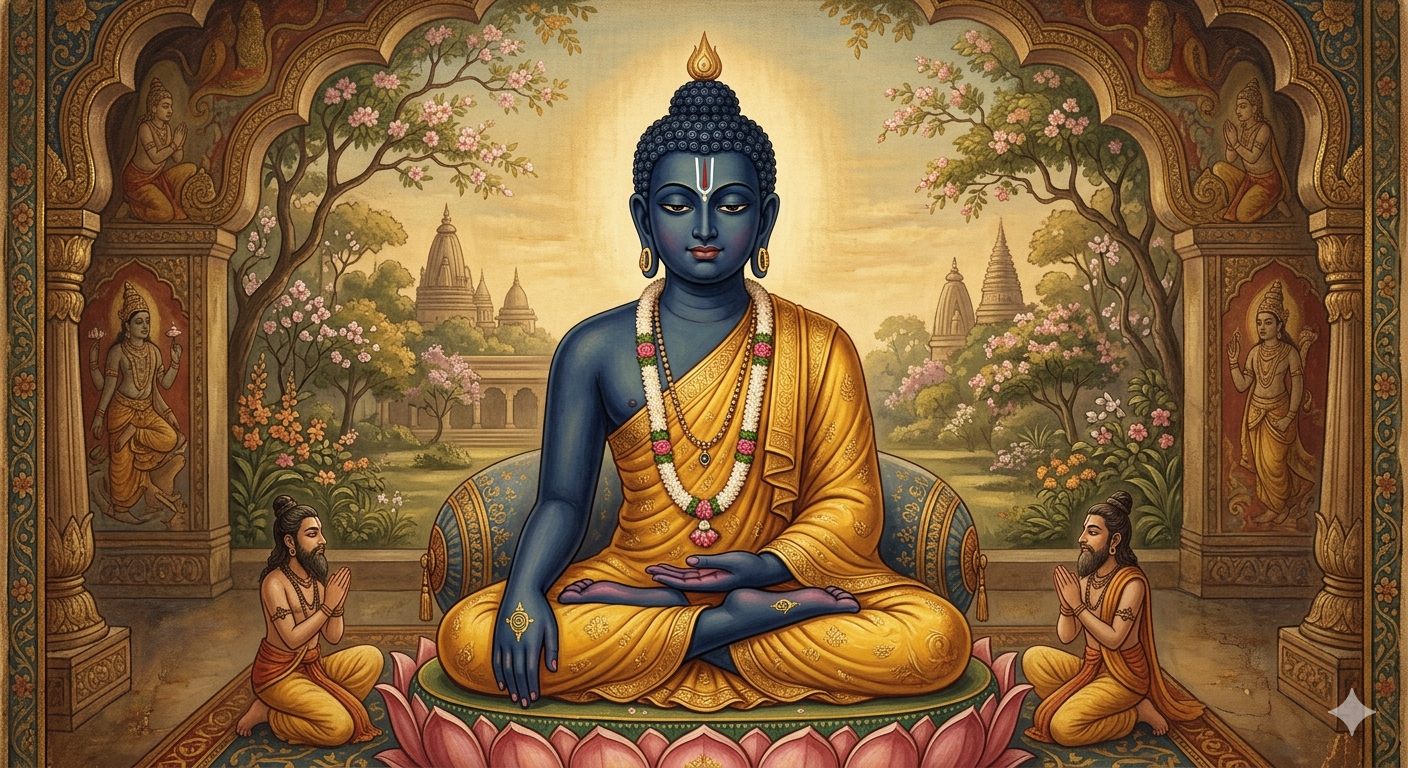
In the Dashavatar tradition, the ninth avatar of Vishnu is identified as the historical Siddhartha Gautama (c. 5th century BCE), founder of Buddhism. This identification appears in the Bhagavata Purana and other Puranic texts. The theological purpose assigned varies: in some texts Vishnu took the form of Buddha to mislead demons away from the Vedas; in others, he appeared to teach ahimsa and compassion to a world grown cruel. The identification is contested — Buddhists do not accept it, and it has been critiqued as a way of absorbing Buddhism into Hinduism while subordinating it.
Symbols & Iconography
Descent & Purpose
The Puranic accounts offer two divergent explanations: that Vishnu took the form of Buddha to mislead the demons away from sacrifice and thereby weaken them — removing their access to the power granted by Vedic ritual — or that he appeared to reduce animal sacrifice and promote compassion at a time when the world had become violent. Both accounts acknowledge the historical Buddha while interpreting him through a Vaishnava theological lens.
Scriptures
The Buddha avatar appears in the Bhagavata Purana, Vishnu Purana, Agni Purana, and Garuda Purana.
Worship & Legacy
The Buddha avatar is rarely worshipped independently in Hindu temples. His significance is primarily theological and historical — the inclusion of the historical Buddha in the Dashavatar list is one of the most debated intersections between Hinduism and Buddhism. In some South Indian temples, a Dashavatar panel includes a figure representing this avatar.
Key Stories
1. The Dharmic Teaching — Puranic Account
In the Bhagavata Purana's account, Vishnu took the form of Buddha and taught a path that led demons away from sacrifice and toward ahimsa and meditation — thereby weakening them by removing their access to the power granted by Vedic ritual. In other Puranic readings, he appeared to reduce animal sacrifice and promote compassion at a time when the world had become violent. Both accounts acknowledge the historical Buddha while reading his teaching through a specifically Vaishnava framework — making him an instrument of cosmic management rather than an independent religious founder.
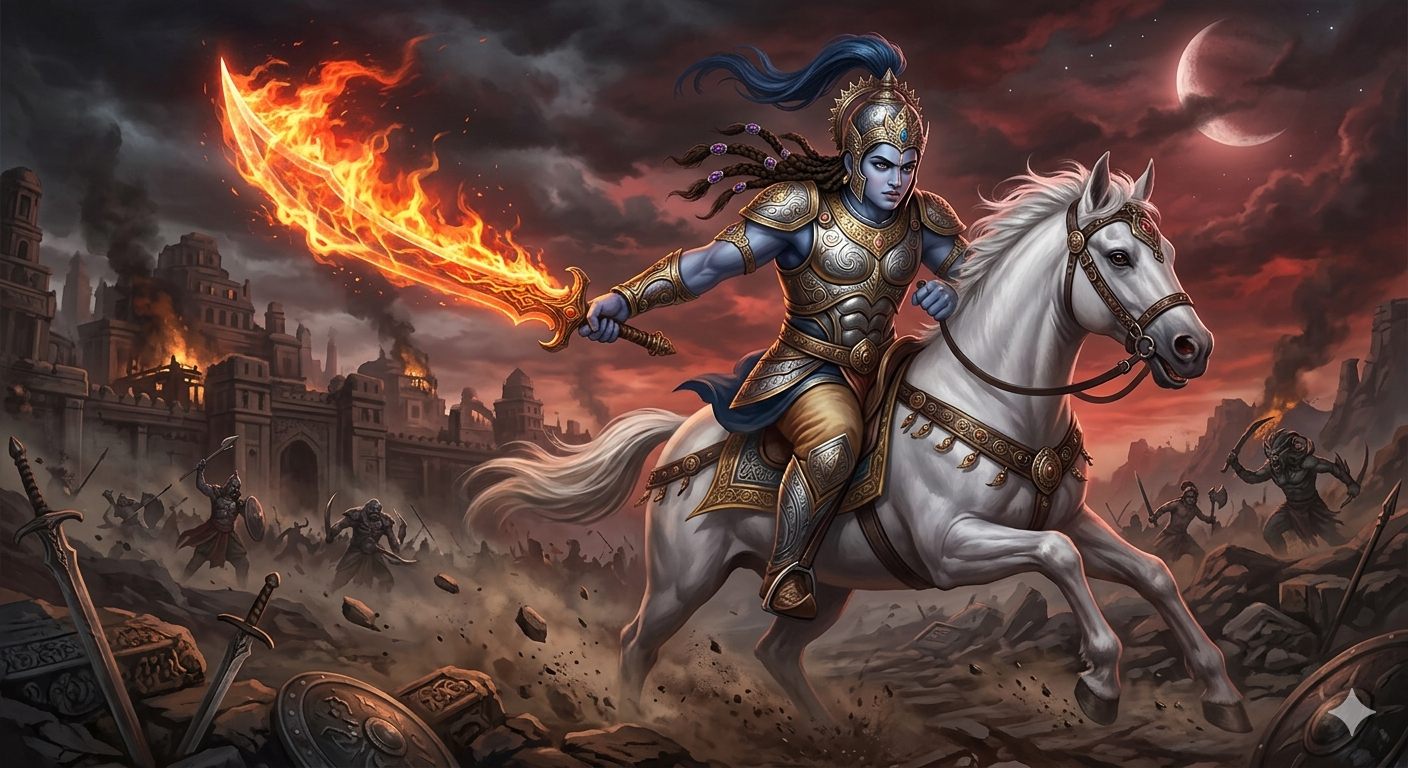
Kalki is the tenth and final avatar of Vishnu — the one who has not yet come. He will appear at the end of the Kali Yuga (the current age of darkness and moral decline) to destroy the corrupt world and restore dharmic order, marking the beginning of a new Satya Yuga (age of truth). He is the only avatar who is entirely prophetic — his mythology is a prediction, not a historical narrative.
Symbols & Iconography
Descent & Purpose
He will be born in the village of Shambhala to a brahmin named Vishnuyasha, at the point in the Kali Yuga when truth, virtue, and righteous conduct have entirely disappeared from the earth. His descent will mark not a rescue mission — as earlier avatars were — but a final termination and reset of the cosmic cycle.
Scriptures
Kalki is prophesied in the Bhagavata Purana and Vishnu Purana, and is the sole subject of the Kalki Purana — a text dedicated entirely to describing his coming and the world he will enter.
Worship & Legacy
Kalki has a small but dedicated devotional tradition. The Kalki Temple in Jaipur is among the few temples dedicated to a deity who has not yet arrived. His prophecy continues to generate interpretation — various teachers and traditions across history have applied the Kali Yuga description to their own times and the hope of Kalki to their own visions of renewal.
Key Stories
1. The Prophecy of Kalki
The Kalki Purana describes his coming in detail: he will be born when the world has descended into complete moral chaos — when dharma, truth, and righteousness have entirely disappeared. He will ride a white horse, carry a blazing sword, and destroy the forces of adharma in a final battle. After his victory, the cycle of cosmic time will reset and the golden age will begin again. The description of the Kali Yuga preceding his arrival — with its corruption, dishonesty, shortened lives, loss of memory, and destruction of natural order — is one of the most detailed apocalyptic visions in the Hindu tradition, and one that each generation has found uncomfortably recognisable.
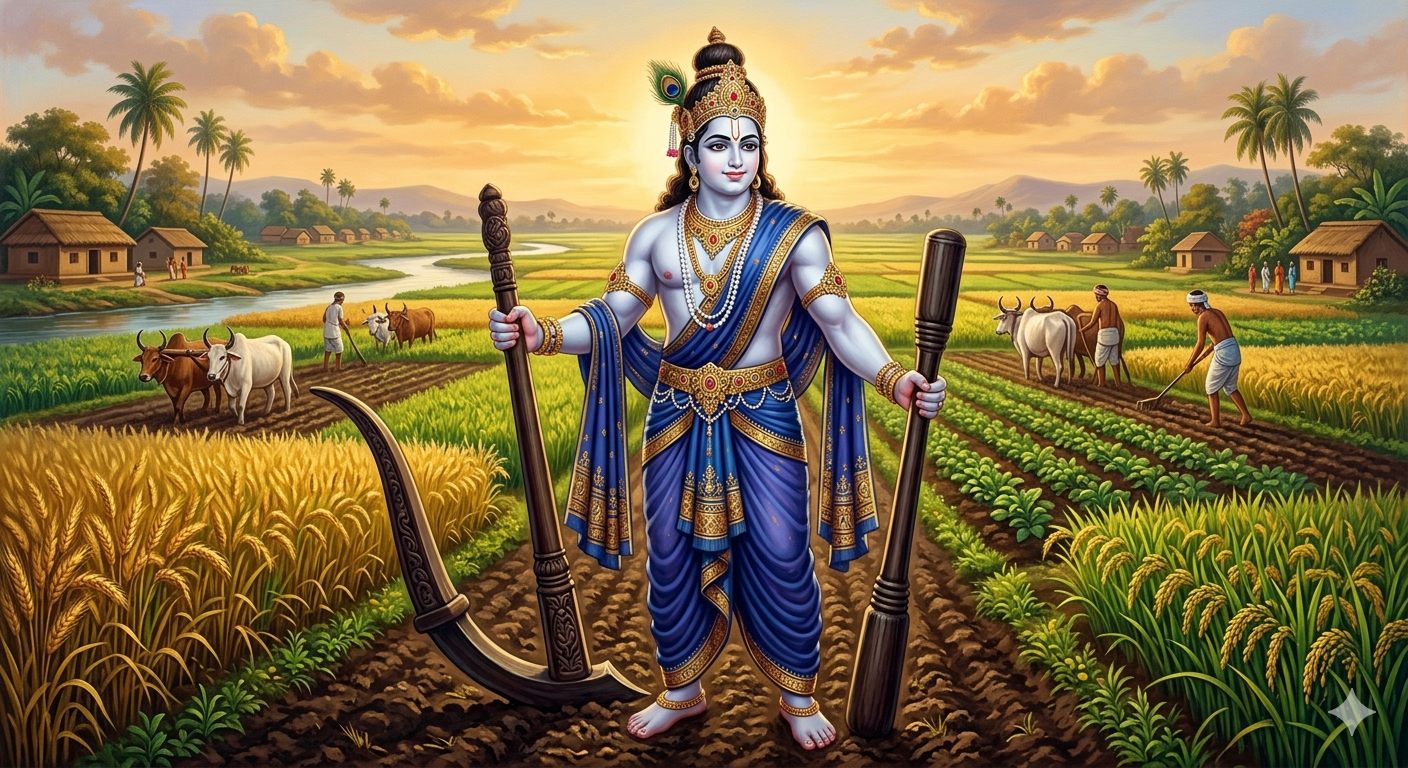
Balarama is the elder brother of Krishna and is considered either the eighth avatar of Vishnu (in lists that exclude Buddha) or an independent avatar of Shesha — the cosmic serpent on whom Vishnu rests. He is the god of agriculture, ploughing, and physical strength, and the teacher of both Bhima and Duryodhana in mace combat. Also known as Halayudha, Sankarshana, and Rohini-nandana.
Birth & Origin
The seventh embryo of Devaki was miraculously transferred from Devaki's womb to the womb of Rohini — Vasudeva's other wife — to protect it from Kamsa. Balarama was thus born to Rohini and raised alongside Krishna in Gokul.
Family
Birth mother: Rohini. Raised with Yashoda and Nanda. Brother: Krishna. Wife: Revati. Sons: Nishatha and Ulmuka.
Scriptures
Balarama appears extensively in the Bhagavata Purana (tenth canto), the Mahabharata, and the Harivamsha.
Worship & Legacy
Balarama is widely worshipped in Odisha, where he is one of the three deities of the Jagannath Temple — alongside Jagannath (Krishna) and Subhadra. He is also worshipped as Daupji in Mathura-Vrindavan. The plough as an agricultural symbol connects him to farming communities across the subcontinent.
Key Stories
1. The Youth in Gokul
Balarama and Krishna grew up together in Gokul. He participated in many of Krishna's childhood adventures and killed several demons — including Dhenuka (a donkey demon) and Pralambasura (a demon who attempted to carry him off). His great strength was apparent from childhood.
2. Balarama and the Yamuna
In the Bhagavata Purana, Balarama once demanded that the river Yamuna come to him. When she refused, he dragged her with his plough, redirecting her course. This story explains certain meanders of the Yamuna river and establishes Balarama's power over rivers.
3. Balarama During the Mahabharata
Unlike Krishna, who chose to be Arjuna's charioteer, Balarama refused to take sides in the Kurukshetra war — he had taught mace combat to both Bhima and Duryodhana and could not fight against either student. He went on a pilgrimage along the Saraswati river for the duration of the war. When Bhima finally killed Duryodhana by striking his thigh — which Balarama had taught was forbidden in fair combat — Balarama raised his plough in fury. Krishna persuaded him that Duryodhana's earlier unrighteous acts had justified the killing.
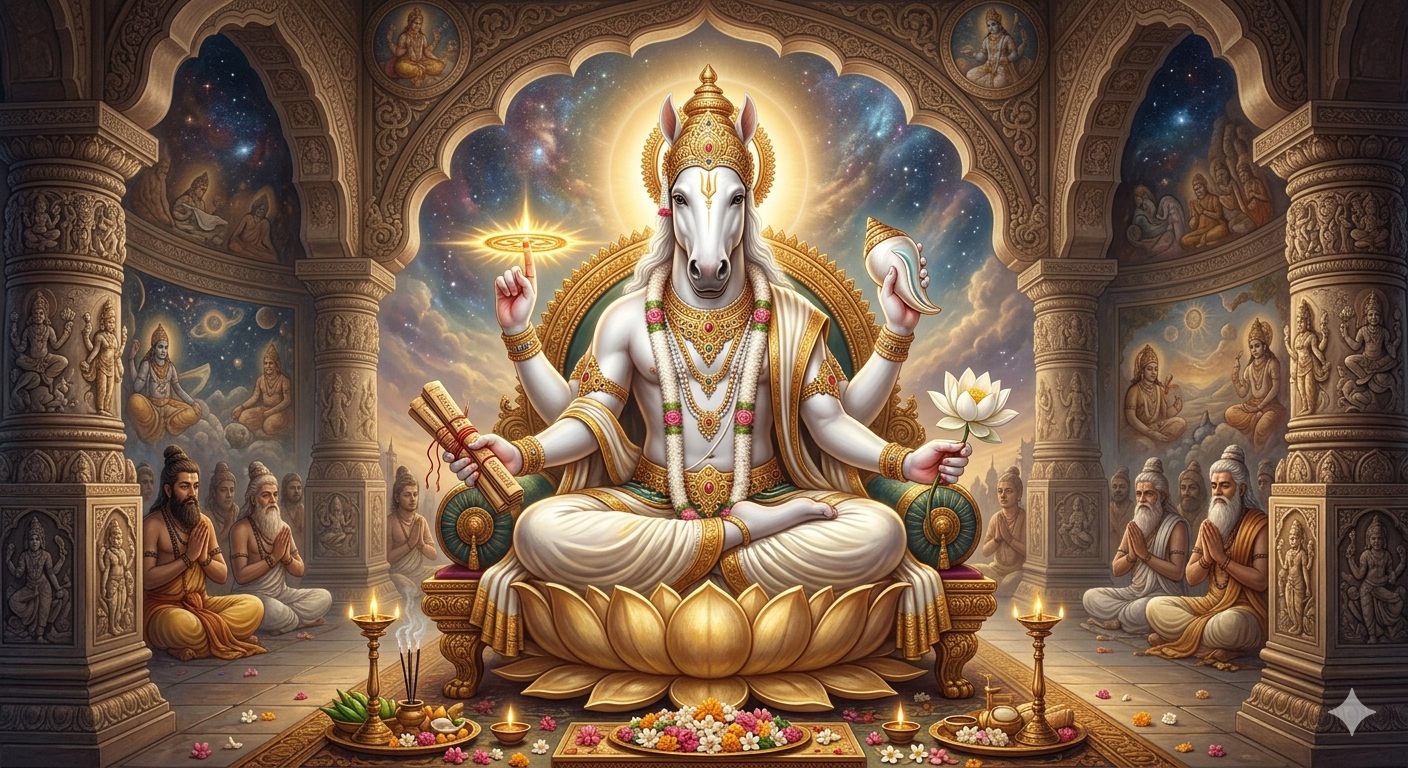
Hayagriva is an avatar of Vishnu with a human body and a horse's head — the god of knowledge, wisdom, and the Vedas. His primary mythological role is the recovery of the Vedas after they are stolen at the end of a cosmic cycle, making him the guardian of sacred knowledge across cosmic dissolution.
Symbols & Iconography
Human body with a white horse's head, white complexion. Carries the Vedas, a conch, a discus, and a lotus. Often depicted seated in the lotus posture, radiating the calm of supreme knowledge.
Scriptures
Hayagriva appears in the Bhagavata Purana, Devi Bhagavata Purana, and the Pancharatra Agama texts.
Worship & Legacy
Hayagriva is worshipped by students and scholars across South India, particularly before examinations. The Hayagriva Madhava Temple in Hajo, Assam — built on a hill and considered one of the sacred Vaishnava temples of northeastern India — is the most significant pilgrimage site. Hayagriva Jayanti is observed on the full moon of the month of Shravana.
Key Stories
1. The Recovery of the Vedas
At the end of a cosmic cycle, the demons Madhu and Kaitabha stole the Vedas from Brahma while he slept. Vishnu took the form of Hayagriva, killed the demons, and recovered the Vedas — restoring the knowledge that makes the next creation cycle possible. Without the Vedas, creation cannot recommence; Hayagriva's descent ensures the continuity of sacred knowledge across the dissolution of worlds.
2. The Origin of Hayagriva's Form
In the Devi Bhagavata Purana, a demon named Hayagriva performed austerities and received a boon that he could only be killed by another Hayagriva. Vishnu, whose own head had been accidentally severed while he rested his bow on his chin and slept — a bee cut the bowstring — had his head replaced with a horse's head. He then used this form to kill the demon Hayagriva, defeating the enemy with the very form the enemy had invoked as his protection.
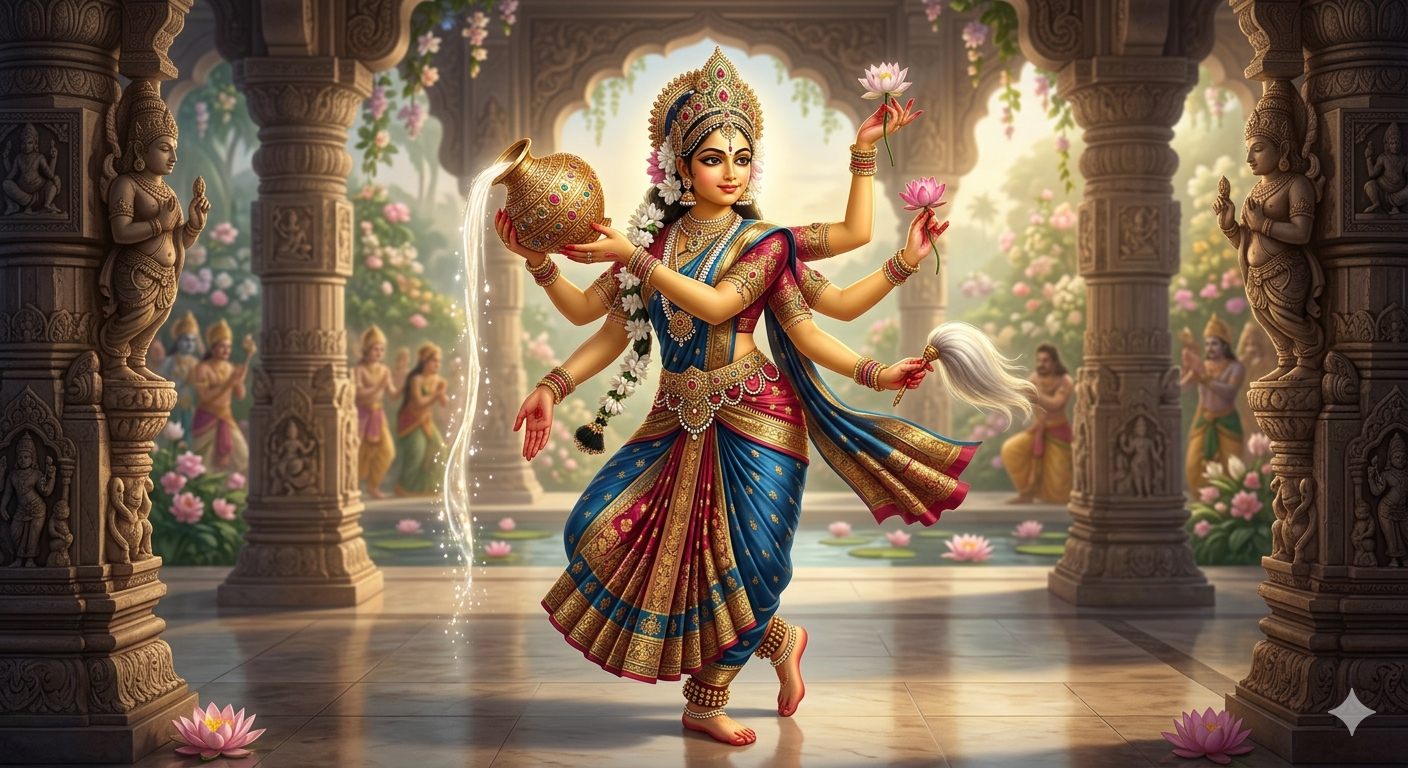
Mohini is the only female avatar of Vishnu — a form of supreme beauty and enchantment taken to recover the nectar of immortality from the demons after the Samudra Manthan, and to assist Shiva in defeating the demon Bhasmasura. She is the divine embodiment of illusion (Maya) in its most irresistible form.
Symbols & Iconography
Depicted as an extraordinarily beautiful woman, richly adorned, with four hands or two. Carries the vessel of Amrita. Shown dancing or in the act of distributing nectar — at once graceful and lethal in her divine purpose.
Scriptures
Mohini appears in the Bhagavata Purana, Vishnu Purana, and Mahabharata.
Worship & Legacy
The Mohiniattam — a classical dance form of Kerala — is named for Mohini and her dance. She is also worshipped in the context of the Ayyappa tradition in Kerala, where the story of Shiva and Mohini explains Ayyappa's divine origin. The dance tradition traces its theatrical and spiritual inspiration directly to her form.
Key Stories
1. The Recovery of the Amrita
After the Samudra Manthan produced the nectar of immortality, the demons seized it. Vishnu took the form of Mohini — an enchantress of such beauty that the demons were helpless before her. She offered to distribute the nectar equally and the demons agreed. She served the gods all the Amrita while the demons were distracted. The demon Svarbhanu disguised himself as a god and received a sip — but Surya and Chandra identified him and Vishnu severed his head. The head had already swallowed the nectar and became immortal — becoming Rahu.
2. Mohini and Shiva
In the Bhagavata Purana, Shiva asked Vishnu to display the Mohini form again after hearing about it. Vishnu obliged and appeared as Mohini. Shiva, despite his supreme austerity and his role as destroyer of desire, became enchanted and pursued Mohini across the forest. His seed fell on the earth as he chased her, and from it emerged beings of great power — including Shasta (Ayyappa) in some traditions.
3. Mohini and Bhasmasura
The demon Bhasmasura received from Shiva the power to reduce to ash anyone whose head he touched. He immediately tried to touch Shiva's head. Shiva fled. Vishnu took the form of Mohini and appeared to Bhasmasura. Enchanted, Bhasmasura asked to dance with her. She began a dance and he imitated her movements. When she placed her hand on her own head, he did the same — and was instantly reduced to ash by his own boon.
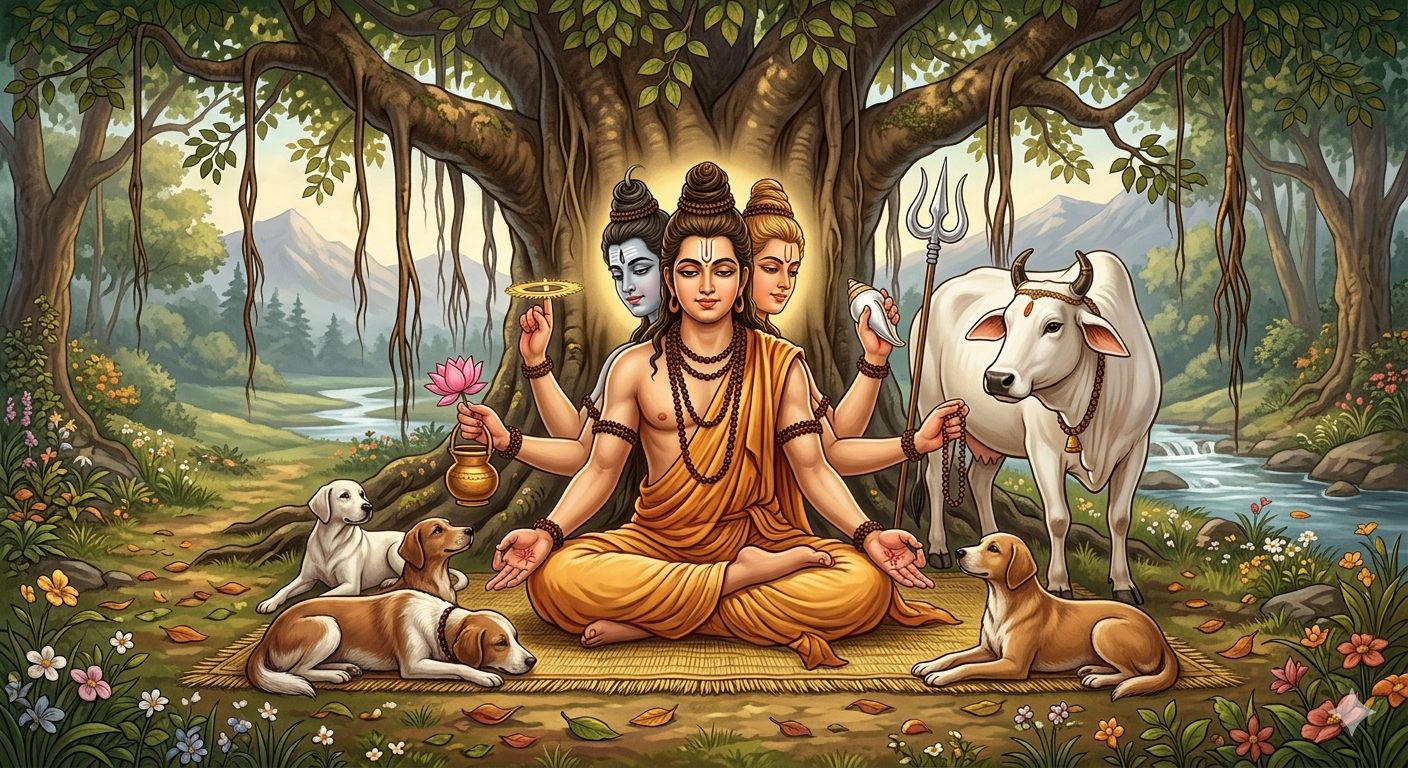
Dattatreya is a unique deity who embodies all three members of the Trimurti simultaneously — Brahma, Vishnu, and Shiva — in a single form. He is the supreme Avadhuta: one who has shaken off all worldly concerns, a wandering ascetic beyond social and religious convention. He is the patron deity of the Nath tradition and one of the Chiranjivi — immortals still living on earth. Also known as Datta and Avadhuta.
Birth & Origin
Born to the sage Atri and his wife Anasuya. The Trimurti, wishing to test Anasuya's legendary chastity, appeared at her door disguised as mendicants and demanded she serve them food while naked. Anasuya, unperturbed, used her powers of tapas to transform all three into infants. She nursed them. When their wives came searching and the truth emerged, the three gods were so moved by Anasuya's devotion that they merged into a single being — Dattatreya — and were born as her son.
Family
Father: Atri (one of the Saptarishi). Mother: Anasuya. Brothers in some accounts: Durvasa (Shiva's portion) and Chandra (Brahma's portion).
Scriptures
Dattatreya appears in the Mahabharata, Markandeya Purana, Devi Bhagavata Purana, and Bhagavata Purana. He is the central figure of the Dattatreya Purana and the Avadhuta Gita — a text of non-dual philosophy attributed to him — and teaches Parashurama in the Tripura Rahasya.
Worship & Legacy
Dattatreya is particularly revered in Maharashtra, Karnataka, Andhra Pradesh, and Gujarat. Datta Jayanti on the full moon of Margashirsha is widely celebrated. The Ganagapura temple in Karnataka and the Narsobawadi temples in Maharashtra are the most significant pilgrimage sites. The Nath tradition — including Gorakhnath and Matsyendranath — traces its origin to Dattatreya. He is worshipped simultaneously across Shaiva, Vaishnava, and Shakta traditions.
Key Stories
1. The Twenty-Four Gurus
In the Bhagavata Purana, Dattatreya tells King Yadu that he has learned from twenty-four teachers — not human teachers but elements of the natural world: the earth (patience), water (purity), fire (consuming without attachment), wind (moving without clinging), sky (remaining unaffected), the moon (being unchanged despite appearing to change), the sun (drawing out and returning essence), a pigeon (the danger of excessive attachment), a python (accepting what comes), the ocean (being unmoved by anything), a moth (the danger of attraction to flame), an elephant (the danger of touch), a honey bee (collecting without hoarding), a deer (the danger of attraction to sound), a fish (the danger of attraction to taste), a prostitute (the teaching of patience), a child (freedom from honor and dishonor), a young woman (the teaching of solitude), an arrow maker (the power of single-pointed focus), a serpent (living without attachment), a spider (creating and withdrawing the web of the world), a caterpillar (becoming what one contemplates), and water in a vessel (reflecting whatever is before it). The teaching: wisdom is everywhere, for one who knows how to look.
2. Dattatreya and Parashurama
In the Tripura Rahasya, Dattatreya teaches Parashurama the nature of consciousness and the supreme reality — a dialogue considered one of the most important works of the Shakta-Dattatreya tradition. The student who wielded the axe that felled kings sat at the feet of the wandering sage who had transcended all kingdoms.
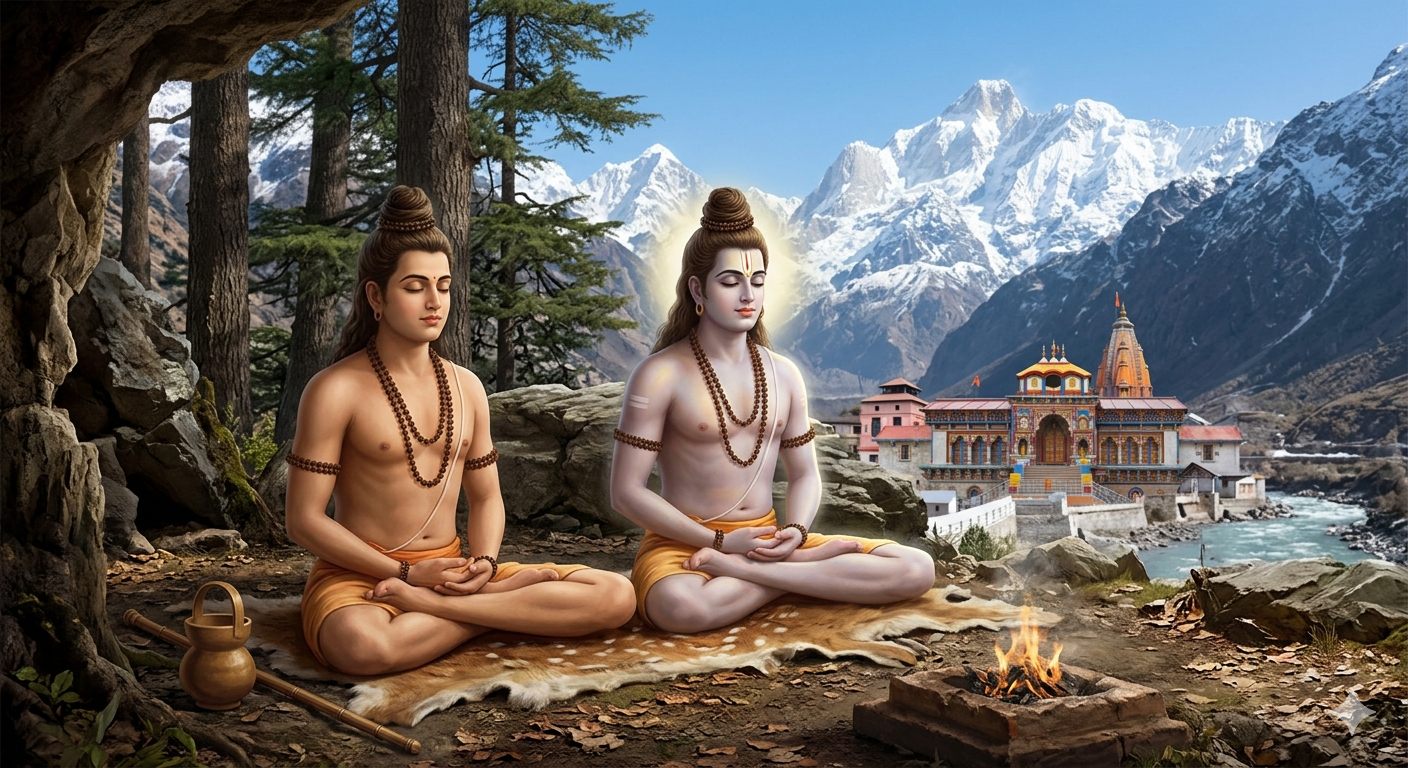
Nara-Narayana are a pair of twin avatars of Vishnu — eternal sages performing austerities at Badrinath in the Himalayas. Narayana is Vishnu himself in ascetic form; Nara is his eternal companion, considered a previous birth of Arjuna (as Narayana is a previous birth of Krishna). Together they represent the divine engaged in eternal yogic discipline — the two that are inseparably one.
Scriptures
Nara-Narayana appear in the Mahabharata and the Bhagavata Purana. Their eternal companionship is the theological basis for the relationship of Arjuna and Krishna in the Mahabharata — two souls whose bond spans across cosmic cycles.
Worship & Legacy
The Badrinath Temple in Uttarakhand — one of the four sacred Char Dhams — is dedicated to Vishnu as Badrinatha, the lord of Badri, identified with Narayana. Situated in the Himalayas at 3,300 metres altitude, it is among the holiest Vaishnava pilgrimage sites in India, drawing hundreds of thousands of pilgrims during the brief summer opening.
Key Stories
1. The Creation of Urvashi
When the gods of Indra's heaven were disturbed by the austerities of Nara-Narayana — fearing that such intense tapas would destabilise the divine order — Indra sent Apsaras to distract them. Narayana, completely unmoved, created an Apsara of incomparable beauty from his own thigh (uru) — Urvashi — and sent her to Indra's court, making all the other Apsaras seem ordinary by comparison. Urvashi became the most celebrated Apsara in the heavens. The story establishes that yogic power, when truly established, cannot be broken by anything the world of desire can send against it.
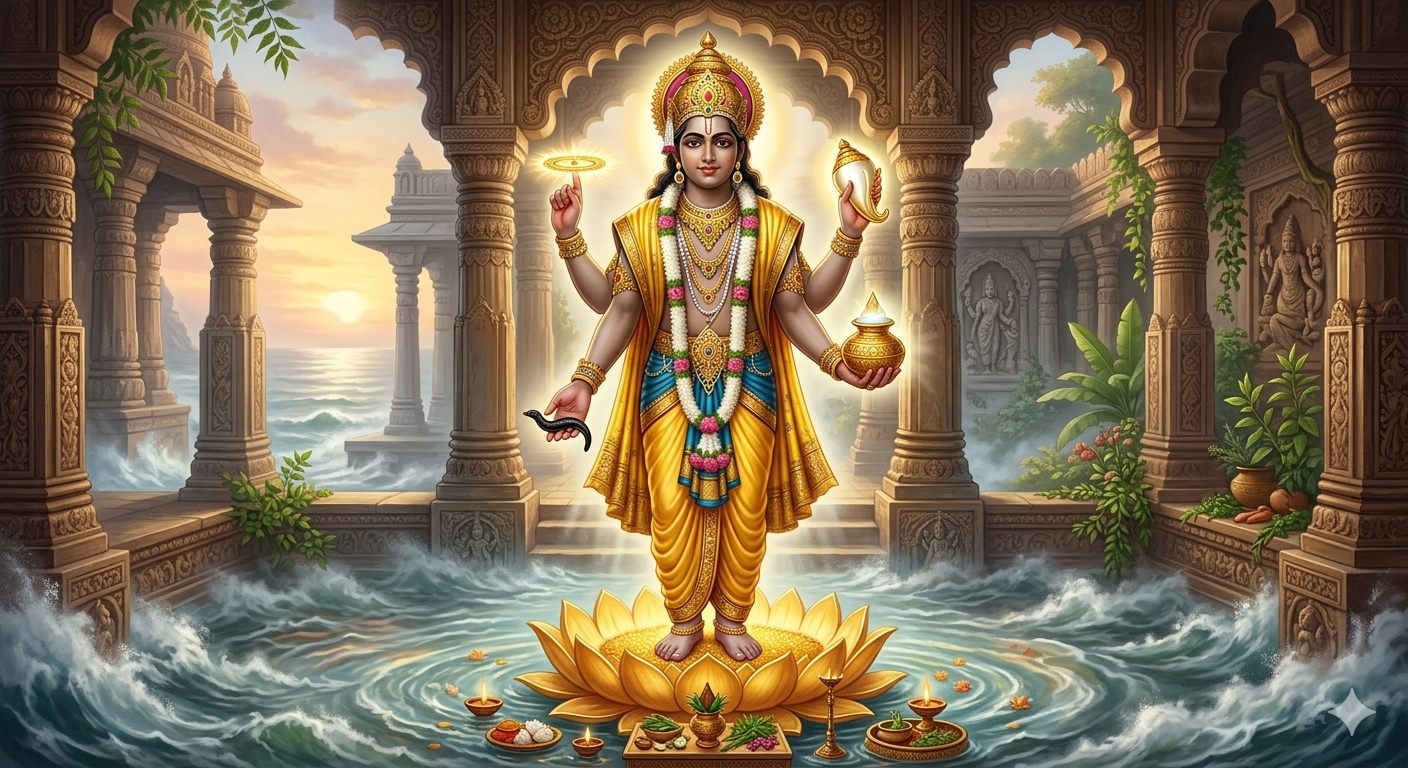
Dhanvantari is the divine physician of the gods and the father of Ayurveda — the traditional Indian system of medicine. He emerged from the Samudra Manthan carrying a white vessel of Amrita, the nectar of immortality. He is worshipped as the god of health and medicine, the source of the knowledge that heals. Also known as Sudha Pani — holder of nectar.
Symbols & Iconography
Depicted with four arms, dark complexion, wearing yellow robes. He carries a conch, a discus, a leech, and a vessel of Amrita. Sometimes depicted with medicinal plants — the divine physician fully equipped.
Scriptures
Dhanvantari appears in the Bhagavata Purana, Vishnu Purana, and Mahabharata in the context of the Samudra Manthan. The Charaka Samhita and Sushruta Samhita — foundational texts of Ayurvedic medicine — are attributed to disciples of his lineage.
Worship & Legacy
Dhanteras — the first day of Diwali — is dedicated to Dhanvantari. On this day, people buy gold, silver, and new utensils, and Dhanvantari is worshipped for health and prosperity. The Dhanvantari Temple at Thrissur in Kerala is one of the few temples dedicated primarily to him. Ayurveda practitioners across India invoke him before treating patients. The Indian government has declared National Ayurveda Day to coincide with Dhanteras.
Key Stories
1. The Emergence from the Ocean
During the Samudra Manthan — the churning of the cosmic ocean — after many other treasures had emerged, Dhanvantari appeared from the depths carrying the vessel of Amrita. His emergence was the culmination of the churning: the nectar that grants immortality. The demons immediately seized the vessel, leading to the episode of Mohini's recovery of it. Dhanvantari's appearance marks the moment when the highest fruit of the churning is revealed — and immediately contested.
2. Dhanvantari and Ayurveda
The Charaka Samhita and the Sushruta Samhita — the foundational texts of Ayurvedic medicine — are attributed to disciples of Dhanvantari. He is considered the source of the medical knowledge that was transmitted to humanity through these lineages. In the tradition, Dhanvantari taught Sushruta the art of surgery — making him the patron of surgery as well as medicine, of the art of healing the body as well as sustaining it.
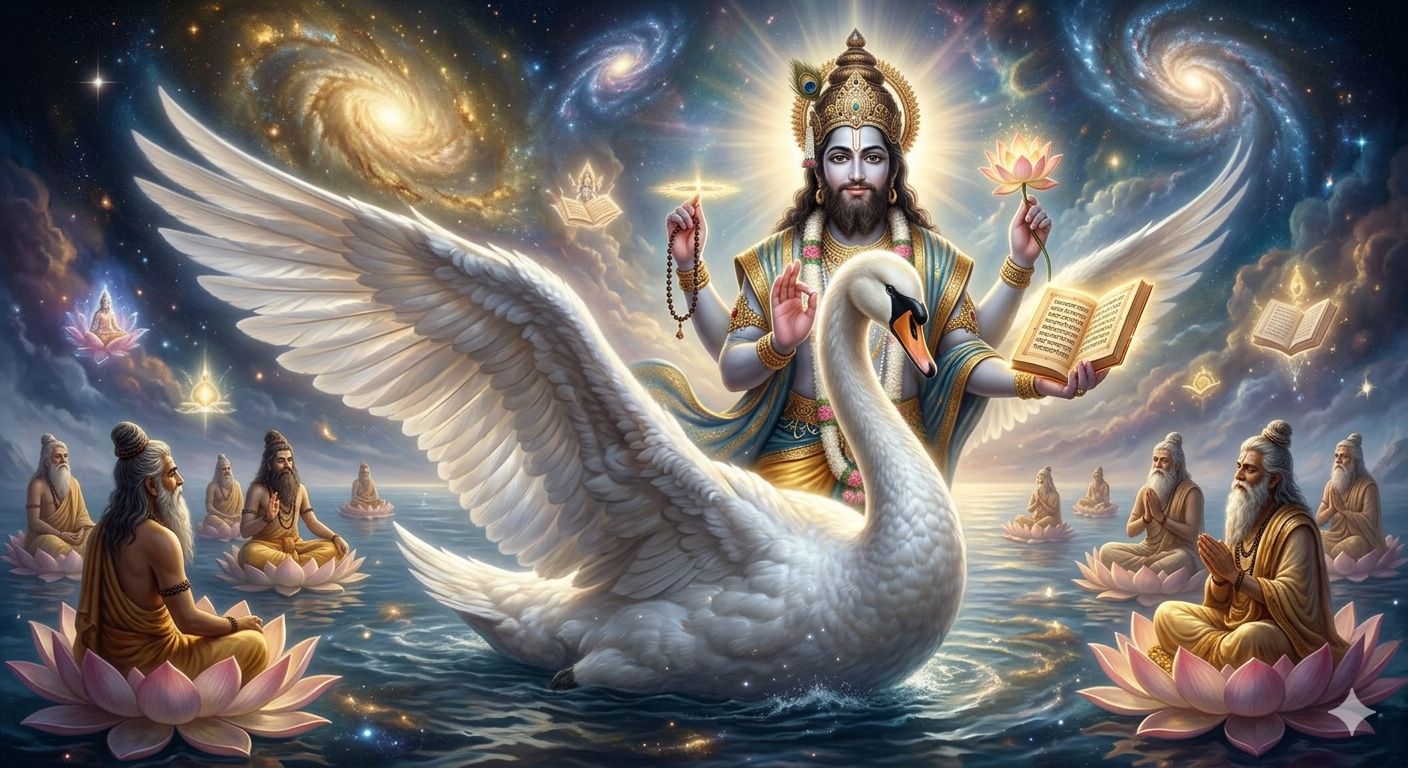
Hamsa is the avatar of Vishnu in the form of a swan — the divine teacher who appeared at the beginning of creation to transmit the knowledge of the Vedas and the ultimate nature of reality. He is distinct from Brahma's vahana — this is Vishnu himself taking that form for a specific purpose of cosmic teaching. He is associated with pure knowledge, discrimination between truth and falsehood, and the primordial transmission of wisdom. Also known as Hamsavatara.
Birth & Origin
Vishnu took this form voluntarily at the beginning of a cosmic cycle to transmit knowledge that Brahma himself could not provide. The circumstances vary slightly by text but the purpose is consistent — direct divine teaching at the cosmic level.
Symbols & Iconography
Depicted as a white swan, sometimes with a human face or in a composite form — swan below, wise teacher above. The swan in Hindu tradition symbolizes the ability to separate milk from water — the discrimination of truth from illusion — which is Hamsa's defining quality as an avatar.
Scriptures
The Hamsa avatar appears in the Bhagavata Purana (eleventh canto), the Mahabharata (Shanti Parva — the Hamsa Gita), and is listed among the avatars in the Vishnu Purana. He is sometimes counted as one of the Dashavatara in traditions that do not include Buddha or Balarama in that list.
Worship & Legacy
Hamsa is not widely worshipped independently in temple tradition. His significance is primarily philosophical — the Hamsa Gita is studied in Vedanta traditions as a dialogue on the nature of consciousness and liberation. The Hamsa mantra (So'ham — "I am that") is one of the most fundamental mantras of the Advaita tradition, directly connected to the symbolic meaning of the swan. Every breath is said to naturally produce this sound — So on the inhale, Ham on the exhale — making the Hamsa avatar present in the breath of every living being.
Key Stories
1. The Teaching to Brahma
In the Bhagavata Purana (eleventh canto), a group of sages came to Brahma seeking knowledge of the highest truth. Brahma himself was uncertain and meditated on Vishnu. Vishnu appeared in the form of Hamsa and taught Brahma the knowledge of the supreme self — the understanding that all apparent multiplicity resolves into a single undivided reality. Brahma then transmitted this knowledge to the sages. The Hamsa avatar is therefore the origin of the guru-shishya (teacher-student) transmission at the cosmic level — the divine source from which all subsequent teaching lineages descend.
2. Hamsa and the Four Kumaras
In a related account, the four Kumaras — Brahma's celibate sage-sons Sanaka, Sanandana, Sanatana, and Sanatkumara — asked Brahma about the highest reality. Brahma, unable to answer fully, directed them to Vishnu who appeared as Hamsa. The questions and answers of this dialogue are preserved in the Hamsa Gita section of the Mahabharata's Shanti Parva — a philosophical discourse on the nature of the self, liberation, and the relationship between the individual soul and the supreme.
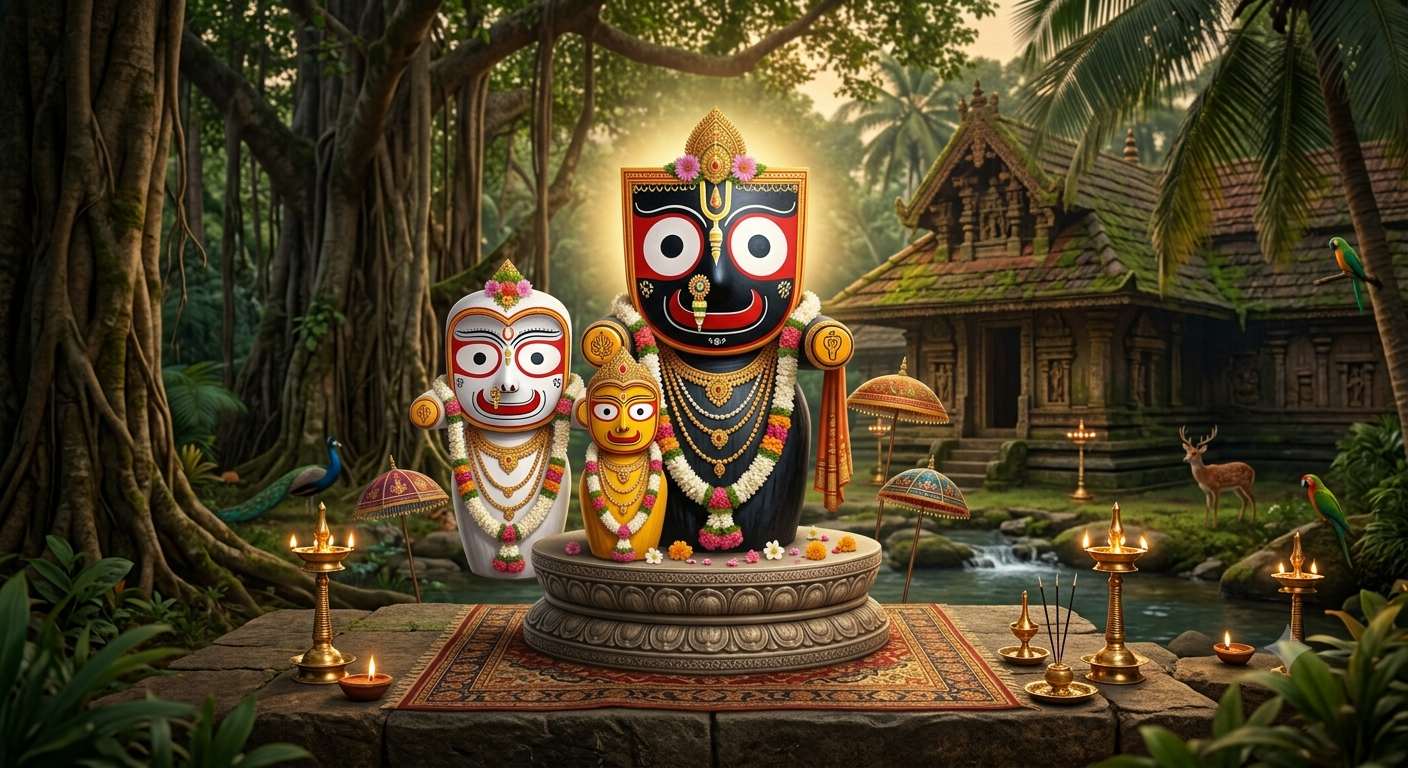
Jagannath is the form of Krishna (or Vishnu) worshipped at the Jagannath Temple in Puri, Odisha — one of the four sacred Dhams of Hindu pilgrimage. His form is distinctive and ancient: a large, roughly hewn, dark-coloured wooden image with enormous circular eyes, no arms, and an unfinished lower body. He is worshipped alongside his brother Balabhadra (Balarama) and sister Subhadra. His name means "Lord of the Universe." Also known as Mahaprabhu and Patitapavana (purifier of the fallen).
Birth & Origin
The theological origin of the Jagannath image is explained in the Skanda Purana's Utkala Khanda. King Indradyumna of Avanti wished to build a temple for Vishnu and received instructions to seek the divine image on the ocean shore. The divine craftsman Vishwakarma, disguised as a carpenter, agreed to carve the image on the condition that he not be disturbed until it was finished. The door was opened early, the image was left unfinished — without arms — and this unfinished form became sacred. A more mystical account holds that the image contains the original physical substance of Krishna — his essence deposited in the Brahmapadartha (the divine element) placed inside the wooden form and transferred to each new image at Nabakalebara.
Family
Brother: Balabhadra (Balarama). Sister: Subhadra. All three are worshipped together as the Jagannath trinity.
Symbols & Iconography
The wooden image of Jagannath is unlike any other deity in the Hindu tradition — abstract, unfinished in appearance, with a massive circular head, huge eyes, a wide smile, and no arms or legs. He is painted black; Balabhadra beside him is white, and Subhadra between them is yellow. The images are made of sacred wood (Daru Brahma) and are remade every 12 to 19 years in a ritual called Nabakalebara.
Scriptures
Jagannath is described in the Skanda Purana (Utkala Khanda), the Brahma Purana, and in the devotional literature of Odisha — particularly the Odia Mahabharata and the poetry of the Panchasakha saints.
Worship & Legacy
The Jagannath Temple at Puri is one of the four Hindu Dhams — the sacred pilgrimage destinations marking the four corners of the Indian subcontinent (Badrinath in the north, Dwarka in the west, Rameswaram in the south, Puri in the east). The temple is historically known for inclusive practices around Mahaprasad, the temple's sacred food, traditionally distributed without regard to caste.
The Rath Yatra — the annual Chariot Festival — is the most prominent living expression of Jagannath worship. The three deities are placed on freshly built wooden chariots each year and pulled through the streets of Puri by thousands of devotees to the Gundicha temple. The English word "juggernaut" derives from "Jagannath" and the historical sight of pilgrims before the enormous chariot.
The Nabakalebara — the periodic renewal of the deities' bodies — occurs every 12 to 19 years, when priests select sacred trees, carve new wooden images, and transfer the Brahmapadartha from the old images to the new in a ritual performed in darkness by blindfolded priests. This cycle of death and replacement gives Jagannath worship a distinctive theology of divine embodiment.
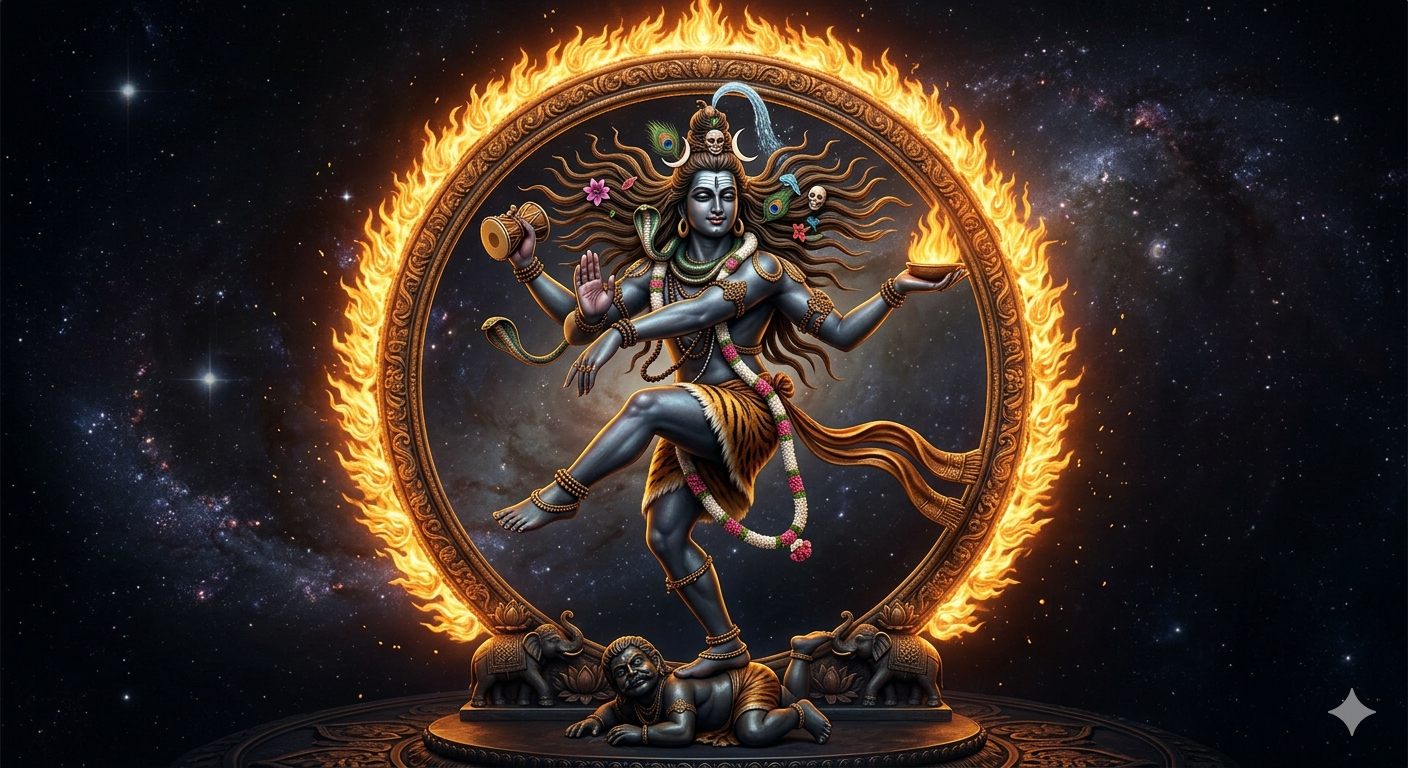
Nataraja — the Lord of Dance — is a theologically and artistically supreme form of Shiva. He performs the Ananda Tandava — the dance of cosmic bliss — within a ring of fire, simultaneously creating, sustaining, and dissolving the universe through his movement. The Nataraja image is considered one of the highest achievements of Hindu iconographic thought. Also known as Sadashiva Nataraja and Koothan in Tamil.
Symbols & Iconography
Depicted dancing within a ring of fire (the Prabhamandala). Right foot raised; left foot pressing down the dwarf demon Apasmara (ignorance). Upper right hand holds the Damaru (drum — creation). Upper left hand holds fire (dissolution). Lower right hand gestures Abhaya mudra (protection). Lower left hand points toward the raised foot (liberation). His matted hair fans out in the dance, containing Ganga, a crescent moon, and a skull. The entire composition holds perfect balance between movement and stillness.
Scriptures
The Nataraja form is described in the Shaiva Agamas, the Thevaram (Tamil devotional hymns), and the Chidambara Mahatmya.
Worship & Legacy
The Nataraja Temple at Chidambaram in Tamil Nadu is the primary shrine of this form — considered in the Shaiva tradition to be the centre of the universe, the place where Shiva performed his cosmic dance. It is one of the five Pancha Bhuta Stalas (Shiva temples representing the five elements) — here representing Akasha (sky/space). The Nataraja bronze sculptures of the Chola period (9th–13th century CE) are among the finest works of metal sculpture in art history and are held in major museums worldwide.
Key Stories
1. The Dance in the Taragam Forest
When arrogant sages in the Taragam forest relied entirely on ritual mechanics and rejected devotion and divine grace, Shiva appeared as a wandering mendicant. The sages sent magical attacks against him — a fire, a tiger, a serpent. Each failed. He adorned himself with the tiger's skin and the serpent and began the Tandava. The dance overwhelmed them utterly; their pride dissolved and they surrendered. The story establishes that no ritual power, however great, can withstand the direct encounter with the divine in motion.
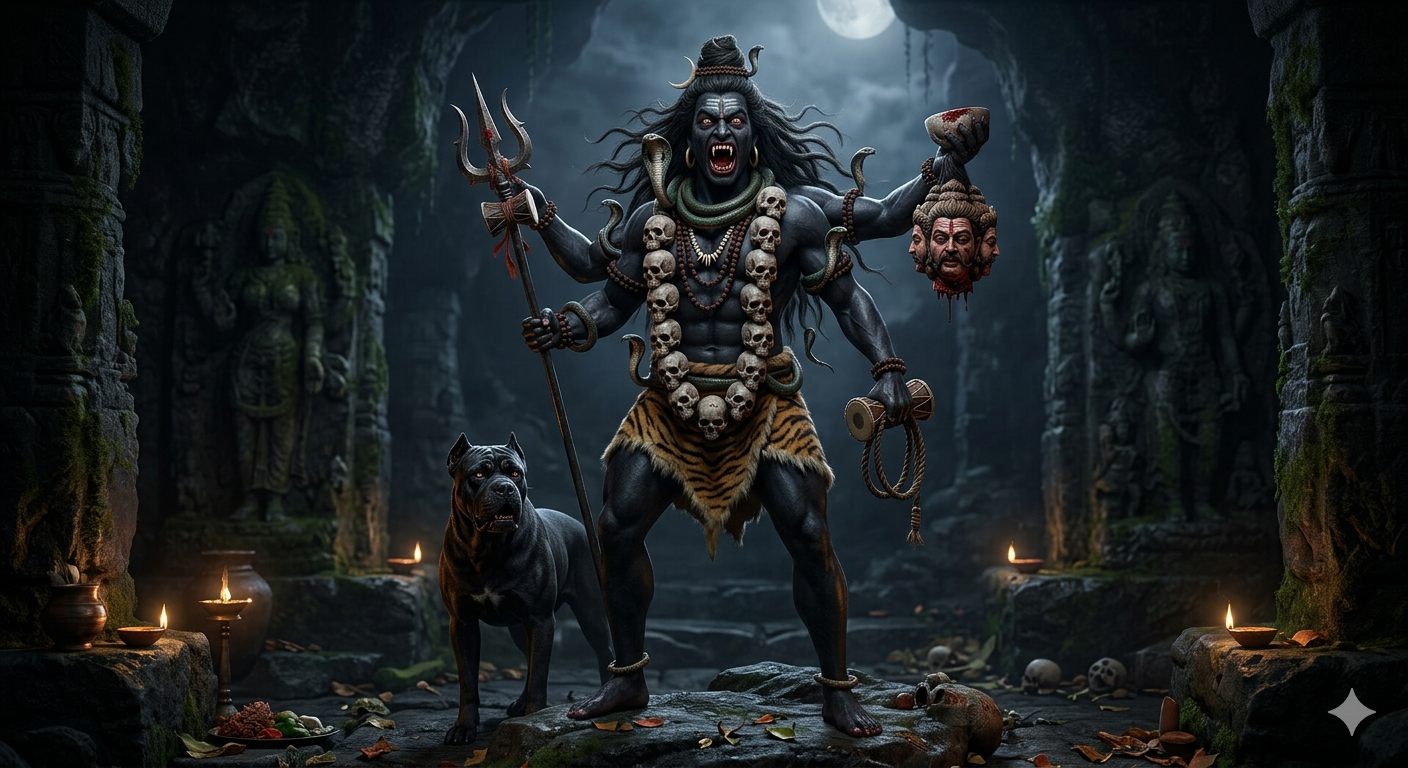
Bhairava is the most terrifying form of Shiva — fierce, skull-bearing, associated with cremation grounds and the extreme margins of existence. He is the form Shiva took when he cut off Brahma's fifth head. He represents the aspect of the divine that confronts and destroys ego, fear, and the attachment to life itself. Widely worshipped in Shaiva and Tantric traditions. Also known as Kala Bhairava and Batuka Bhairava.
Symbols & Iconography
Depicted as dark or black, naked or minimally clothed, with wild eyes and a gaping mouth with fangs. He carries a skull-cup, a trident, a drum, and a noose. He wears a garland of skulls. He is accompanied by a dog — his vahana. His severed-head posture — sometimes shown holding Brahma's fifth head — is among his most recognised forms.
Scriptures
Bhairava appears in the Shiva Purana, Skanda Purana, and extensively in the Shaiva and Shakta Agama and Tantra texts.
Worship & Legacy
The Kala Bhairava Temple in Varanasi is among the most visited temples in the city. Every Varanasi pilgrimage traditionally includes worship at this temple. Bhairava is worshipped across Shaiva temples in South India — his form is present at the entrance to many major temples as a protector and gatekeeper. Bhairav Ashtami (the eighth day of the dark half of Margashirsha) is his primary festival. He is widely worshipped in Tantric and Nath traditions.
Key Stories
1. The Cutting of Brahma's Head and the Wandering
When Shiva cut off Brahma's fifth head — the head that had lied about seeing the top of the cosmic Shivalinga — the skull became stuck to his hand and could not be removed. The sin of brahminicide was so severe that it bound itself physically to him. Shiva wandered for years as Bhairava, carrying the skull-cup, begging for food, performing penance. He eventually reached Varanasi, where the skull fell from his hand — the city's divine power capable of releasing even this sin. This story establishes Varanasi as the city that grants liberation and establishes Bhairava as its eternal guardian.
2. Kala Bhairava of Varanasi
Bhairava is the Kotwal — guardian-chief — of Varanasi: the divine authority who oversees the holy city. In the Kashi Khanda of the Skanda Purana, Shiva declares that no soul can attain liberation in Varanasi without Bhairava's permission. He guards the Kashi Vishwanath temple precinct. The most terrible form of the divine is also, in this tradition, the most merciful — because he stands at the gate between the world and liberation.
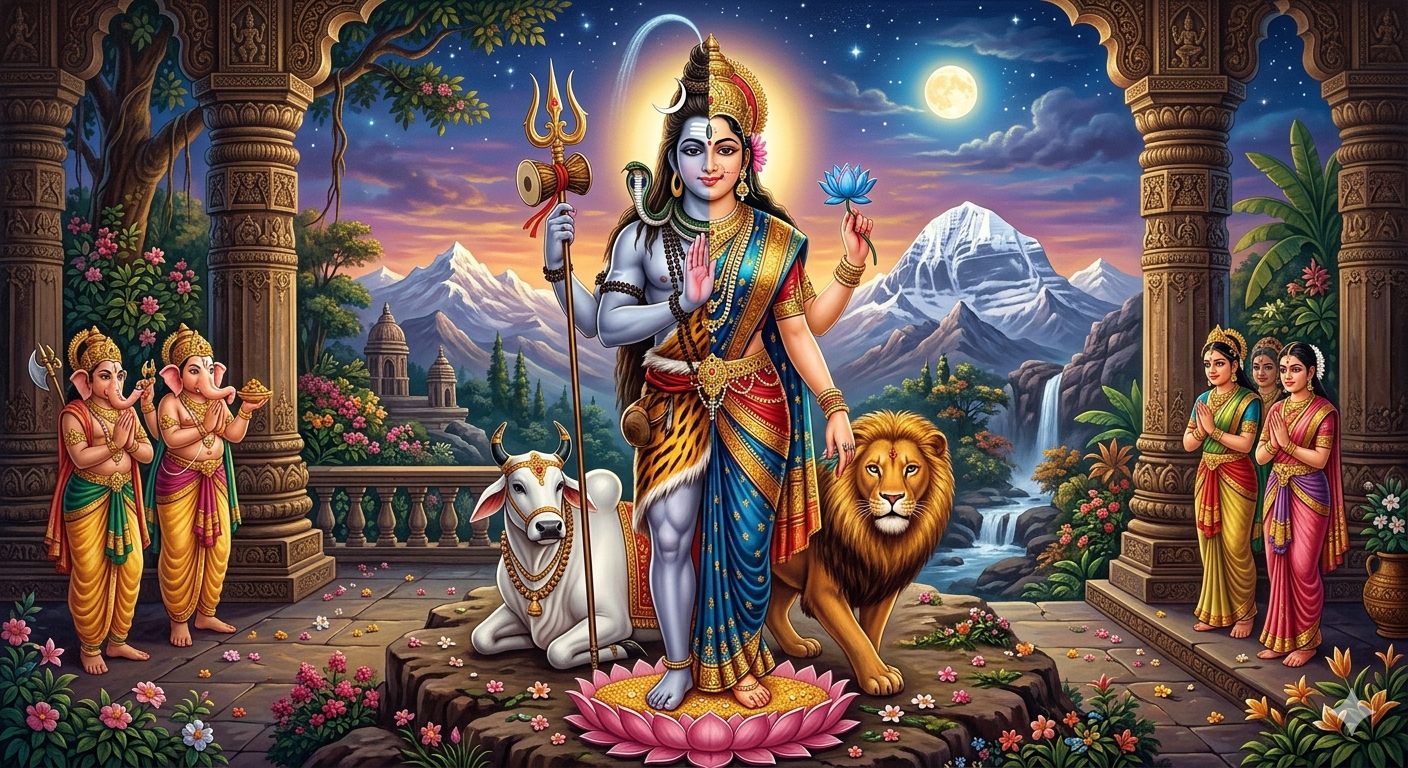
Ardhanarishvara is the composite form of Shiva and Parvati — the right half is Shiva, the left half is Parvati. This form represents the inseparability of the masculine and feminine principles of the universe, and the understanding that the divine is neither exclusively male nor female but both simultaneously. It is one of the most philosophically significant forms in Hindu iconography.
Symbols & Iconography
The right half of the body shows Shiva's attributes — matted hair, third eye, tiger skin, trident. The left half shows Parvati's attributes — dressed in silk, adorned with jewellery, smooth hair, feminine form. The two halves are integrated without seam into a single figure: the union held visually in perfect balance.
Scriptures
Ardhanarishvara is described in the Shiva Purana, Linga Purana, Skanda Purana, and in Tamil Shaiva literature. The form is widely represented in sculpture from the Gupta period onward.
Worship & Legacy
Ardhanarishvara shrines are found in many major Shiva temples, particularly across Tamil Nadu. The form is frequently discussed in academic literature on Hindu theology, gender, and iconography — it presents a non-dualistic view of the divine that refuses the separation of male and female as ultimate categories.
Key Stories
1. The Origin — Why the Universe Can Create
In the Shiva Purana, Brahma was unable to populate the creation because all the beings he created were male — born of his mind, they could not reproduce. He appealed to Shiva. Shiva appeared as Ardhanarishvara — half himself, half Parvati — demonstrating that creation requires the union of both principles: the masculine and the feminine, consciousness and energy, Shiva and Shakti. Brahma understood and creation proceeded through the complementary forces. The form is the universe's answer to the question of why anything exists at all.
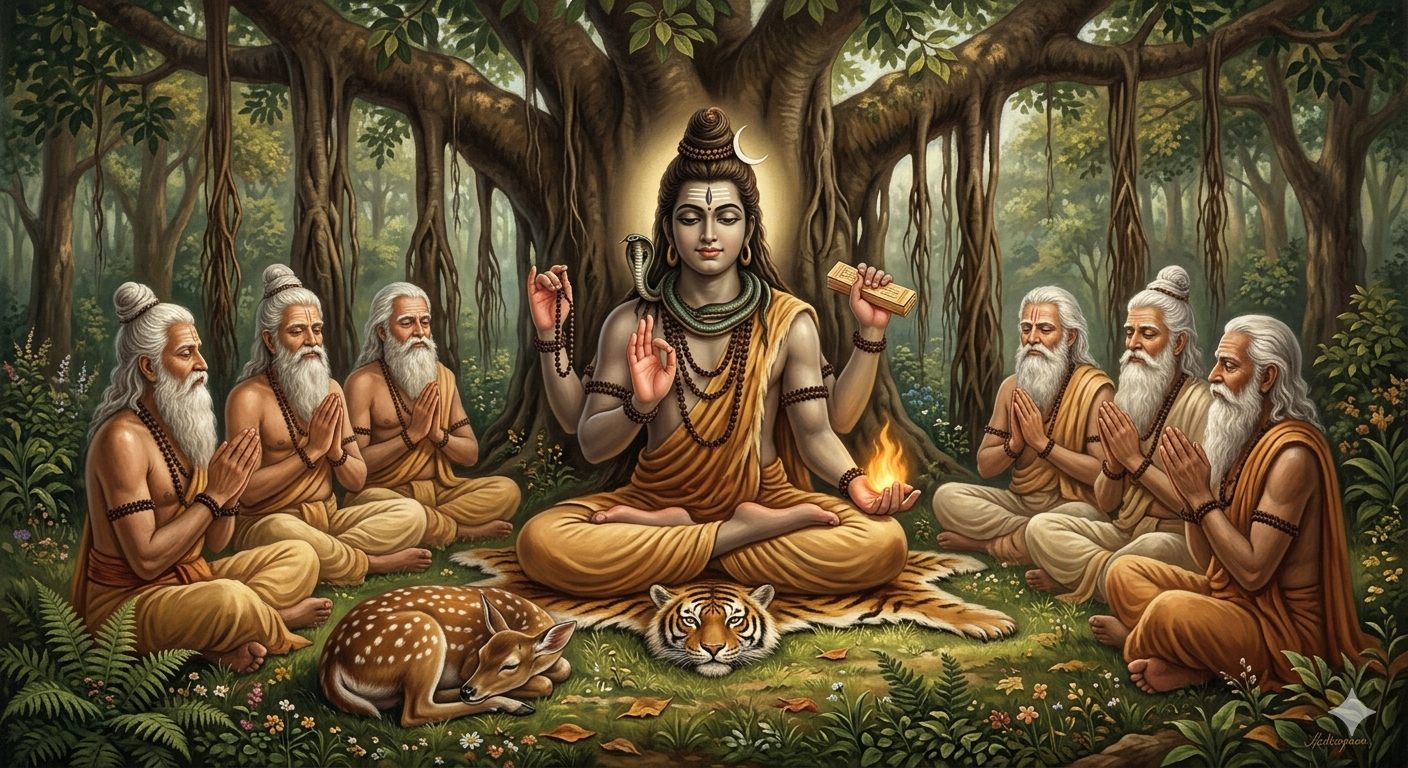
Dakshinamurthy is the form of Shiva as the supreme guru — teaching through silence so profound it contains all knowledge. He is the god of knowledge, wisdom, yoga, music, and the source of all learning. His students are ancient sages far older than himself; he is the eternally young teacher of the eternally old. His teaching is not in words but in the wordless transmission that happens between a prepared student and a living silence.
Symbols & Iconography
Depicted as a young man seated in yoga posture under a banyan tree, facing south. He holds a book, a rosary, fire, or a serpent depending on the school. His right hand gestures the Jnana mudra — the gesture of knowledge. He is surrounded by ancient sages as students. A deer sometimes sits at his feet. He faces south: the direction of death and of liberation, the direction that transcends.
Scriptures
Dakshinamurthy is described in the Shiva Purana and Skanda Purana, and is the subject of the Dakshinamurthy Stotra — attributed to Adi Shankaracharya and widely studied in the Advaita Vedanta tradition. The Stotra describes the nature of the guru's silent teaching and its relationship to the non-dual understanding of reality.
Worship & Legacy
Dakshinamurthy shrines face south in virtually every major Shiva temple in South India — he is always present in the southern niche of the temple's outer wall. The Dakshinamurthy Stotra of Shankaracharya is recited daily in many Shaiva and Advaita institutions. He is the patron of teachers and students and is worshipped on Guru Purnima — the festival celebrating the teacher-student relationship at the heart of the tradition.
Key Stories
1. The Teaching of Silence
The four Kumaras — Brahma's celibate sage-sons who had accumulated enormous spiritual knowledge across countless cycles — sought the supreme teacher. They came to Dakshinamurthy, who sat beneath the banyan tree in silence. In his silence, they received all answers. Every question dissolved before it could be fully formed. The teaching of Dakshinamurthy is the theological basis of the idea that the highest truth cannot be conveyed in words — it is transmitted in silence between the guru and the prepared student. The banyan tree behind him drops roots that become new trunks: the image of a wisdom that endlessly renews itself without ever departing from its root.
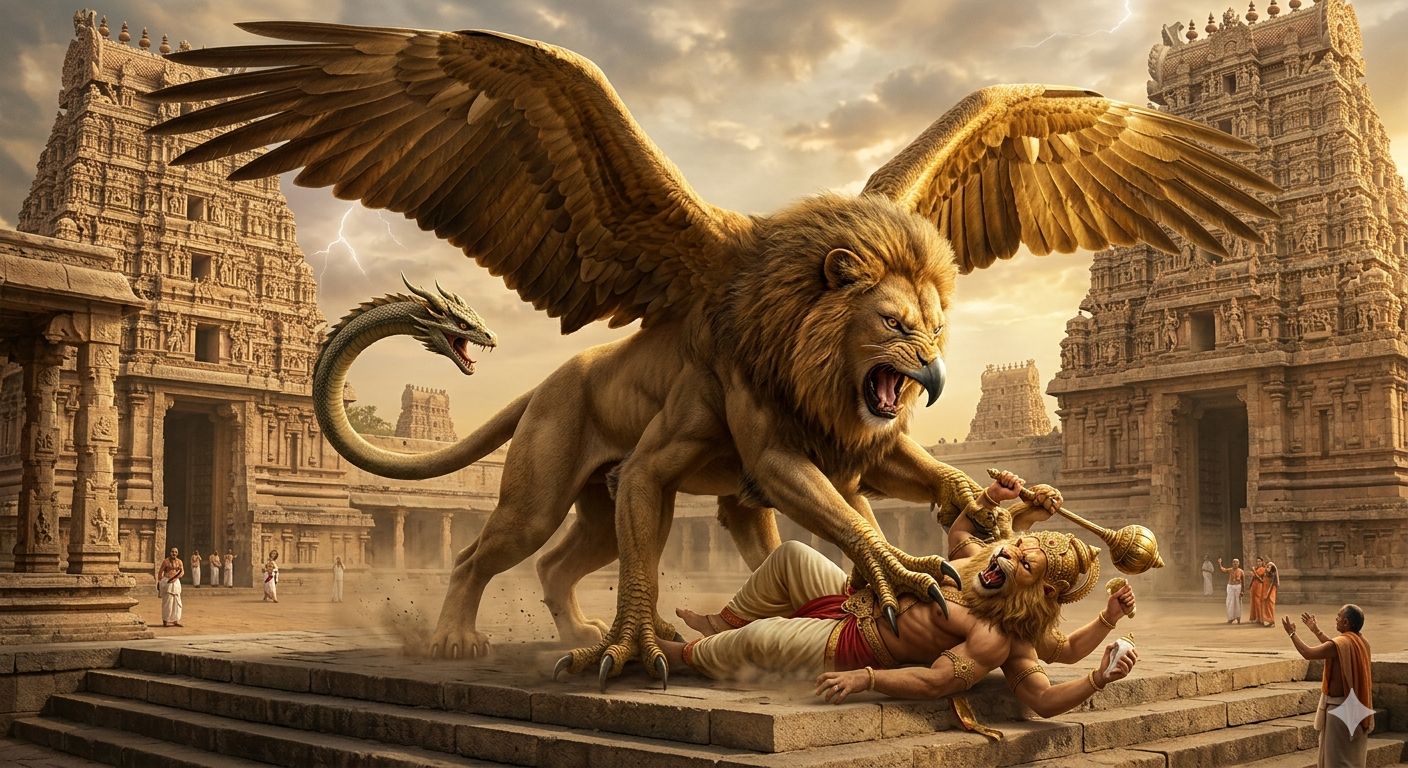
Sharabha is one of the most theologically charged forms of Shiva — a being of such immense power that it could subdue even Narasimha, Vishnu's most fierce avatar. The Sharabha myth is distinctly Shaiva in origin and represents the claim that Shiva's power is supreme even over Vishnu's most extreme manifestations. Also known as Sharabheshvara and Sharabheshwaramurti.
Birth & Origin
In the Shiva Purana, after Narasimha killed the demon Hiranyakashipu, the man-lion's ferocity did not subside. He continued to rampage, threatening to destroy the world with his uncontrolled wrath. The gods appealed to Shiva to pacify him. Shiva took the form of Sharabha — a being of even greater power — to subdue and calm Narasimha. In some versions Sharabha simply overpowered Narasimha; in others he embraced him and absorbed his rage.
Symbols & Iconography
Described as an eight-legged creature of enormous size — part eagle or bird (with wings and talons) and part lion, with a long tail like a serpent. In South Indian temple sculpture, Sharabha is depicted subduing Narasimha — holding the man-lion in its talons or limbs. He is sometimes depicted with two wings spread wide, a lion's face, and eight powerful legs — four gripping the earth and four extending upward. The form is rare but appears in specific Shaiva temples in Tamil Nadu and Karnataka.
Scriptures
Sharabha appears in the Shiva Purana, Skanda Purana, Linga Purana, and Kalika Purana. He is not mentioned in Vaishnava texts. The Sharabha Upanishad — a minor Upanishad — addresses this form directly.
Worship & Legacy
Sharabha is worshipped primarily in Shaiva temples in Tamil Nadu and Karnataka. The Sharabeshwaraswamy Temple at Thiruvirkudi in Tamil Nadu is among the few temples dedicated specifically to this form. He is depicted in sculpture at several major South Indian temples — most dramatically at the Darasuram Airavatesvara Temple (a UNESCO World Heritage Site) near Kumbakonam in Tamil Nadu, built by the Chola king Rajaraja II in the 12th century CE. His worship is not widespread but is theologically significant as one of the clearest expressions of Shaiva supremacy claims in sculptural and textual form.
Key Stories
1. The Subduing of Narasimha
In the Shiva Purana's account, after Hiranyakashipu's death, Narasimha's fury continued unchecked. The gods, frightened by the man-lion's rampage, prayed to Shiva. Shiva manifested as Sharabha — described as mightier than any being in the cosmos — and attacked Narasimha. Narasimha, recognizing a superior force, eventually surrendered. Shiva then calmed him and restored cosmic order. The theological point is explicit: however powerful Vishnu's avatar, Shiva remains the supreme reality who can subdue even that power when the cosmos requires it.
2. The Vaishnava Counter-Narrative
The Vaishnava tradition does not accept the Sharabha story — the Bhagavata Purana and other Vaishnava texts make no mention of it. Several Vaishnava texts composed counter-narratives in which Vishnu takes the form of Gandabherunda (a two-headed bird of equal or greater power) to defeat Sharabha. This theological dispute — expressed through competing mythologies of divine power — reflects the historical tension between Shaiva and Vaishnava traditions in medieval South India.
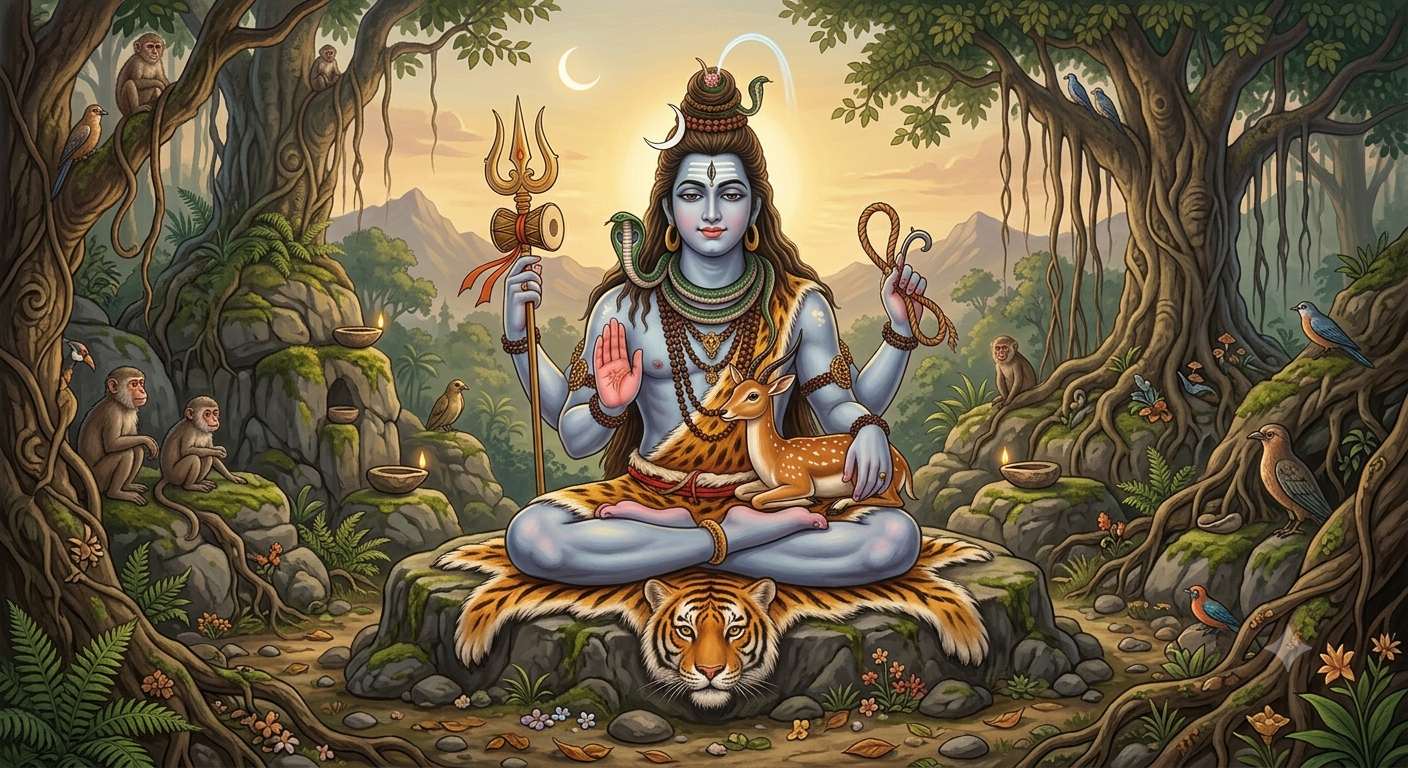
Pashupati — Lord of Beings (Pashu = any bound creature, Pati = lord) — is one of the most philosophically significant forms of Shiva. In the Shaiva tradition, all souls are Pashu — bound beings caught in the cycle of existence — and Shiva as Pashupati is the master who holds the Pasha (noose of bondage) and can release souls from it. He governs all living beings, presides over liberation, and is the supreme ascetic whose stillness contains the entire cosmos. The name appears in the Rigveda and is among Shiva's oldest attested epithets. Also known as Pashupatinath.
Birth & Origin
Pashupati is not a birth-form but an eternal aspect of Shiva — one of his most ancient identities, addressed in the Rigveda and the Sri Rudram of the Yajurveda. In the Puranas, the other gods named Shiva as Pashupati at the time of the destruction of Tripura — the three cities of illusion — acknowledging his sovereignty over all bound beings.
Family
An aspect of Shiva — no independent family distinct from Shiva's.
Symbols & Iconography
His defining attribute is the Pashu — an antelope held in one hand, representing the bound, animal nature of all unliberated souls — alongside the Pasha (noose) by which he holds and releases them. He carries a trident and a goad (ankusha), and gestures Abhaya (fearlessness) with an empty hand. Puranic and Agamic texts also describe him with five faces facing the cardinal directions and the zenith, though his identity is centred on the antelope and noose. Early multi-faced lingas from the Kushan period (1st–3rd century CE) are sometimes associated with this aspect of Shiva.
Scriptures
The name Pashupati appears in the Rigveda and is extensively addressed in the Sri Rudram of the Yajurveda. The Pashupata Sutras — attributed to Lakulisha, a revivalist Shaiva teacher — are the foundational text of the Pashupata sect, one of the oldest organised Shaiva traditions.
Worship & Legacy
The Pashupatinath Temple in Kathmandu, Nepal — established in the 5th century CE on the banks of the Bagmati River — is a UNESCO World Heritage Site and the holiest Shiva temple in Nepal, considered its national deity. The Nageshvara Jyotirlinga in Gujarat is also associated with this form. The Pashupata sect — wandering ascetics who smeared themselves with ash and performed unconventional ritual practices — was one of the earliest organised Shaiva monastic traditions, predating the Shaiva Siddhanta and Nath traditions.
Key Stories
1. The Pashupatastra
In the Mahabharata, Arjuna performed intense austerities to obtain the Pashupatastra from Shiva — the supreme weapon capable of destroying entire armies. Shiva first appeared as a Kirata (mountain hunter) and fought Arjuna to test his valour. When Arjuna's weapons failed and he made a clay image of Shiva and offered flowers — only to find the garland falling on the hunter — he recognised the god and surrendered. Shiva revealed himself and granted the Pashupatastra, warning Arjuna never to use it without absolute necessity.
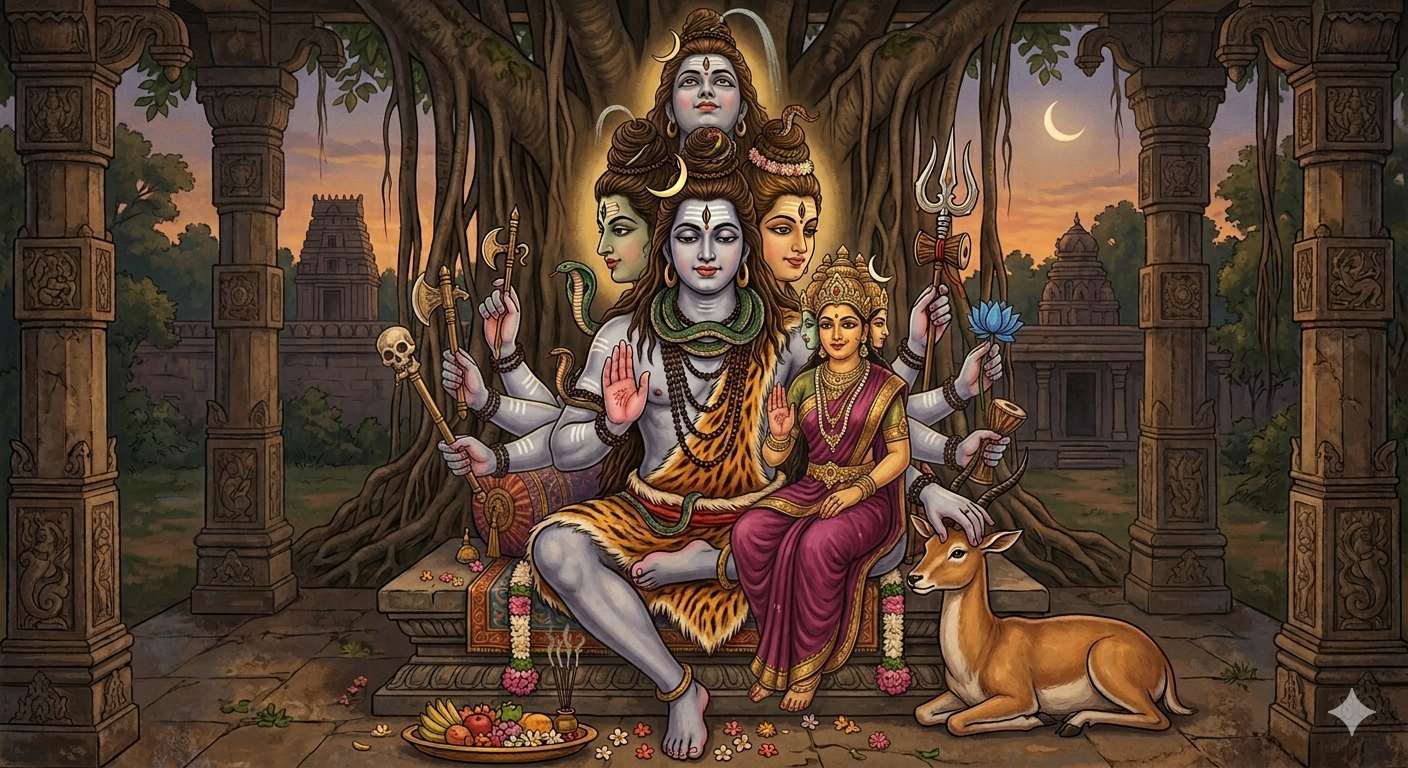
Sadashiva is the supreme, transcendent form of Shiva in the Shaiva Siddhanta tradition — the highest manifested form of the divine, beyond ordinary attributes, through whom the Panchakritya (five cosmic acts) are continuously performed. These five acts are Srishti (creation, let loose from within Shiva rather than from external material), Sthiti (preservation), Samhara (dissolution), Tirobhava (concealment), and Anugraha (grace, the bestowal of liberation). Sadashiva has no independent narrative mythology — he is not a character who appears in events but a theological category describing the ceaseless cosmic functioning of the divine.
Birth & Origin
Sadashiva has no origin in the ordinary sense — he is the eternal, self-existent highest aspect of Shiva, prior to and underlying his other forms. The Shaiva Agamas describe him as the source from which the other manifestations of Shiva emanate.
Family
Consort: Mahagayatri (Manonmani), a form of Parvati, seated in his lap.
Symbols & Iconography
Five-faced and ten-armed, each face governing one of the five cosmic acts: Sadyojata (west), Vamadeva (north), Aghora (south), Tatpurusha (east), and Ishana (zenith). The Kamika Agama specifies his ten attributes precisely: his right hands hold a trident, an axe, a skull-staff (khatvanga), a thunderbolt, and gesture fearlessness; his left hands hold a serpent, a citron fruit, a blue lotus, a drum (damaru), and gesture the granting of boons. This exact set of ten objects is unique to Sadashiva and distinguishes him from other five-faced forms of Shiva.
Scriptures
Sadashiva is described in the Kamika Agama (the first of the 28 Shaiva Agamas), the Panchabrahma Upanishad, and across Shaiva Siddhanta philosophical literature.
Worship & Legacy
The five-faced Sadashiva form governs the design and ritual orientation of every major Shiva temple — each face corresponds to a direction, and shrines within larger temple complexes are oriented accordingly. The Panchamukha Lingam — a Shivalinga with five faces — is among the most sacred objects in Shaiva worship. The cult of Sadashiva is believed to have originated in South India and spread to Bengal under the Sena dynasty, and sculptures of this form have been found as far as Cambodia and Laos, reflecting the reach of Shaiva Siddhanta theology across Southeast Asia.
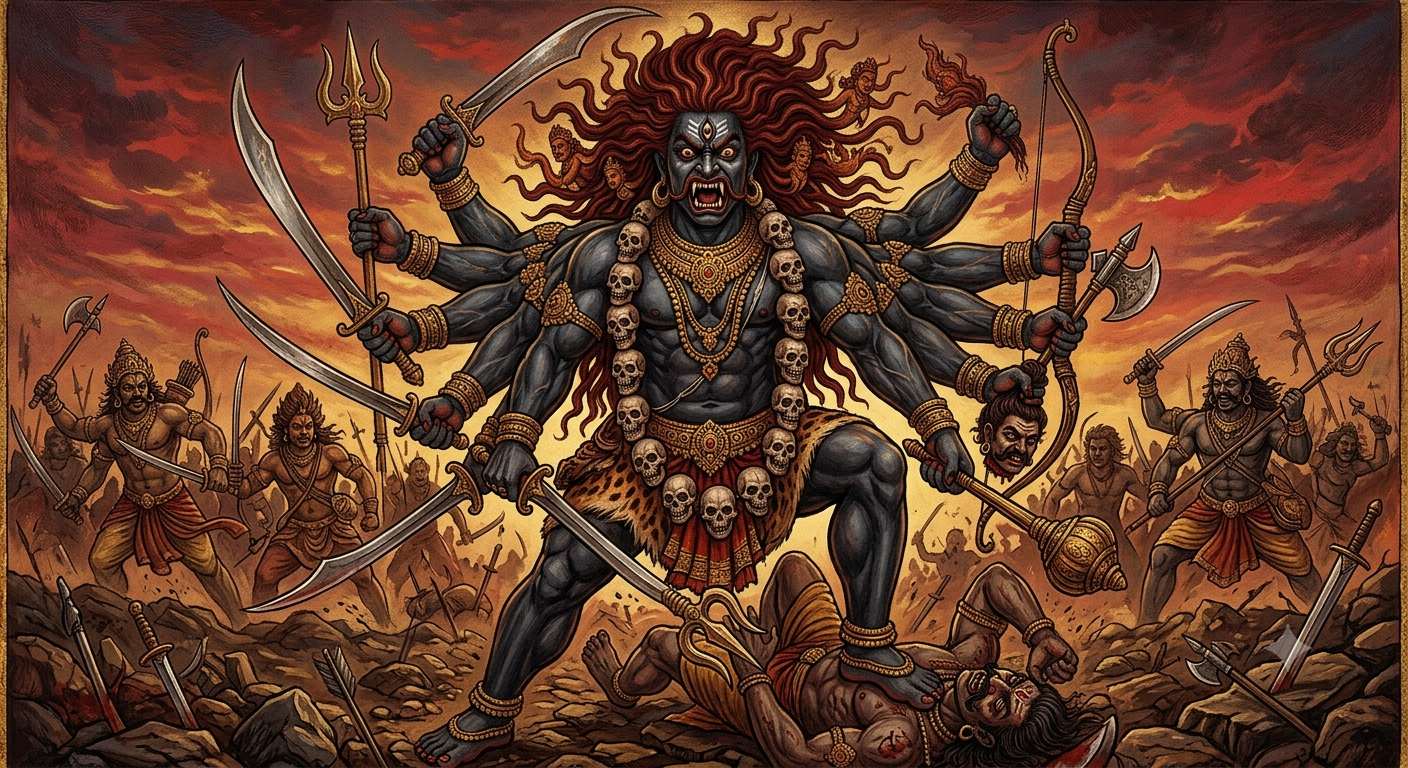
Virabhadra is the terrifying warrior deity created by Shiva from a lock of his matted hair — brought into being specifically to destroy Daksha's sacrifice in vengeance for Sati's death. He is a form of Shiva's absolute wrath made manifest, a being of such power that he scattered the assembled gods. He is worshipped as a fierce, protective deity, particularly in South India.
Birth & Origin
When Sati immolated herself at Daksha's sacrifice, Shiva — in grief and fury — tore a lock from his matted hair and dashed it to the ground, and from it Virabhadra arose, accompanied by an army of a thousand Ganas, created for the single purpose of destroying the sacrifice.
Symbols & Iconography
Depicted as a tall, dark, terrifying figure with multiple arms carrying swords, a trident, a bow, and other weapons. He has three eyes, fangs, and a ferocious expression, and wears a garland of skulls. His vahana is a horse or a chariot.
Scriptures
Virabhadra appears in the Shiva Purana, Bhagavata Purana, Linga Purana, and the Mahabharata.
Worship & Legacy
Virabhadra is the presiding deity of many temples in Karnataka, Andhra Pradesh, and Telangana — particularly in the Veerashaiva (Lingayat) tradition. The Lepakshi Temple in Andhra Pradesh — famous for its magnificent Vijayanagara-era murals and sculpture — is dedicated to him. He is also associated with the Veerabhadra form worshipped during warrior festivals.
Key Stories
1. The Destruction of Daksha's Sacrifice
Shiva tore a lock from his matted hair and brought Virabhadra into being along with an army of a thousand Ganas. Virabhadra stormed Daksha's sacrifice, beheaded Daksha, blinded Bhaga, knocked out Pushan's teeth, and routed all the assembled gods. Brahma pleaded for mercy. Shiva then restored the dead — giving Daksha a goat's head in place of the one that had been destroyed.
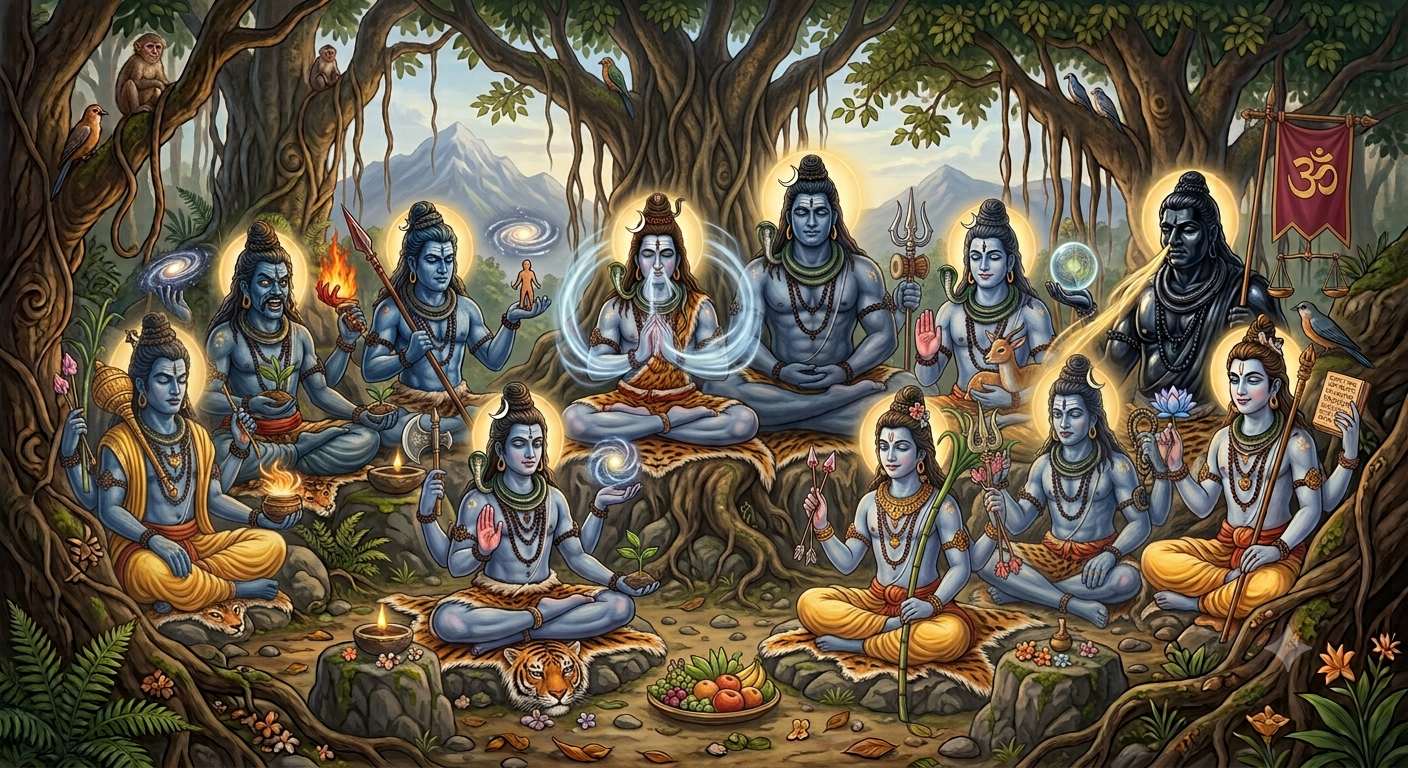
The Ekadasha Rudras are eleven manifestations of Rudra/Shiva, named in the Vedic tradition and elaborated in the Puranas. Their names vary across texts. They are worshipped collectively in Vedic ritual and invoked in the Sri Rudram, representing the full spectrum of Rudra's power — from his fierce, destroying aspect to his protective and healing aspects.
Birth & Origin
In the Shatapatha Brahmana, Rudra weeps at birth and his tears scatter — each tear becoming one of the Rudras. Brahma names them Rudras because they wept (from the root rud — to weep or howl). In the Vishnu Purana, they are born from Brahma's forehead in anger.
The Eleven
A widely cited list from the Vishnu Purana and Bhagavata Purana:
- Manyu — Wrath and fury
- Manu — Mind and the human
- Mahinasa — The Great-Nosed, associated with breath and vital force
- Mahan — The Great One
- Shiva — The Auspicious — the placatory epithet of Rudra
- Ritadhvaja — One whose banner is truth
- Ugrareta — The fierce-seeded
- Bhava — Existence or becoming
- Kama — Desire — Rudra as the principle of longing
- Vamadeva — The beautiful god
- Dhritavrata — One who upholds vows
Scriptures
The Ekadasha Rudras are named in the Rigveda and elaborated in the Shatapatha Brahmana, Vishnu Purana, Bhagavata Purana, Shiva Purana, and Linga Purana. The Sri Rudram of the Yajurveda is their primary liturgical text.
Worship & Legacy
The eleven Rudras are invoked collectively in Vedic fire ceremonies (Homa) and in the Sri Rudram chanting that accompanies daily worship in Shiva temples. The Ekadasha Rudra Abhisheka — a ritual involving eleven rounds of the Sri Rudram — is performed on auspicious occasions and is considered among the most powerful Shaiva rituals.
Key Stories
1. The Sri Rudram Invocation
The Sri Rudram of the Yajurveda (Taittiriya Samhita) addresses Rudra in all eleven forms and in all the environments he inhabits — forests, rivers, armies, villages, crossroads, craftsmen's shops. The Namakam section names Rudra across every aspect of existence. This text is the primary ritual vehicle through which the eleven Rudras are collectively addressed, and it is chanted daily in Shiva temples and in Vedic rituals across India.
2. Vamadeva — A Major Shiva Form
Among the eleven Rudras, Vamadeva is the most theologically developed. He is one of the five faces of Sadashiva in the Shaiva Agama tradition, associated with the west direction, water, and the gentle, gracious aspect of the divine. The Panchakshara mantra (Om Namah Shivaya) is associated with Vamadeva in some traditions.